Agenticos
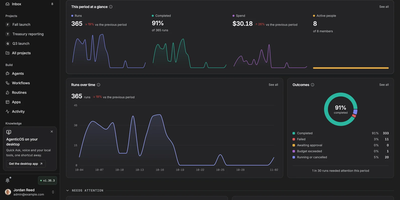
Give each team an AI teammate that works where the team already works: AgenticOS lets colleagues and agents share one live chat and the same project files, so an agent can answer in the thread, apply a correction from a reply, and show its work as it writes. You build an agent in the browser by writing its instructions, picking a model, and switching on tools, then publish it to web chat, Slack, Teams, Discord, Mattermost, Telegram, a website widget, or an API. Agents analyze spreadsheets, run code in a sandbox, browse the web in a browser you can watch and take over, and hand programming work to Claude Code or Codex. Company knowledge comes from uploaded documents and synced drives, searched with cited answers, while reusable skills teach agents how your team writes reports, reviews code, or researches a market. Agents can draw charts and diagrams in chat and publish dashboards as apps with stable links your team opens anywhere. Administrators set roles and department groups, cap each agent's monthly budget, require approval for sensitive tools, and read a recorded run history with costs. Running on a dedicated VPS on RepoCloud with guaranteed CPU, RAM, and SSD, full root SSH access, and a browser serial console. Apache-2.0 licensed.
Cuttlely
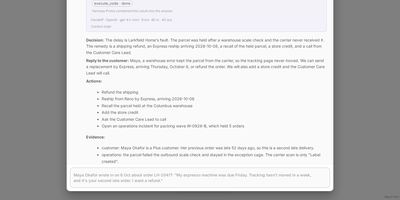
Anyone shipping AI agents inside an app can build the team visually in Cuttlely and replay real questions on Live and a draft, side by side, before anything changes. A lead agent called Harness Prime splits each question among specialists with their own models, tools, and data; the built-in customer care demo sends a late-order complaint to customer, operations, and policy specialists. The Analyst specialist owns a database and returns one page of rows at a time, so earlier pages never re-enter the prompt. Every run card lists input and output tokens, cached tokens when reported, and each step's time. Edits save to a draft while Live keeps serving. Compare in the Publish dialog replays 4 to 100 recent questions on both versions and marks each answer Same, Changed, or Error. On a chatflow, switching on the passing test set keeps Publish disabled until the draft passes, scored by text, JSON, numeric, or model evaluators. Apps call a published team through a prediction API with per-flow keys; people use a share link or a website embed. Switch on MCP Server for a flow and other agents can call it over Streamable HTTP with a bearer token. Build with AI turns a description into a first version on the canvas. Owner, Admin, Builder, and Viewer roles keep a shared server orderly. Running on a dedicated VPS on RepoCloud with guaranteed CPU, RAM, and SSD, full root SSH access, and a browser serial console. Apache-2.0 licensed.
MiroFish
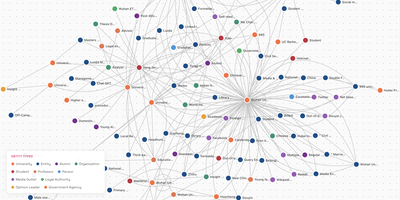
Upload a report, ask a "what if" question in plain language, and MiroFish builds a small simulated society that plays out the answer before you commit to a decision. It reads your seed documents, whether news, policy drafts, financial signals, or a novel, and extracts entities and relationships into a GraphRAG knowledge graph. Entities from the graph become agents with a profession, a biography, and interest tags, and the app estimates simulation rounds from the simulated time span, with a custom mode for shorter runs. Agents post and react on two simulated platforms at once, a feed-style plaza and a topic community, while a live monitor tracks rounds, elapsed simulated time, and actions. A ReportAgent then plans an outline and writes the prediction report section by section with the InsightForge, PanoramaSearch, QuickSearch, and InterviewSubAgent tools. Afterward you can keep questioning the ReportAgent, chat with any individual agent, or send a survey question to a selected group and read their answers. Typical uses include rehearsing public relations responses, testing policy drafts against likely reactions, and exploring alternate endings for a story. The interface switches between English and Chinese, and you bring your own model: any OpenAI SDK compatible LLM endpoint works, Zep Cloud stores agent memory, and the project suggests starting under 40 rounds because runs consume many tokens. Running on a dedicated VPS on RepoCloud with guaranteed CPU, RAM, and SSD, full root SSH access, and a browser serial console. AGPL-3.0 licensed.
Hoprig
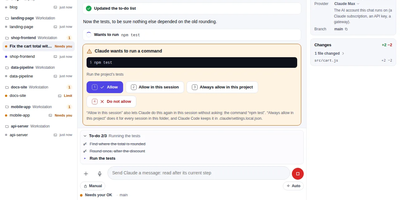
One install line later, Hoprig has turned a spare Linux PC or small server into an always-on AI coding machine, with every Claude Code and OpenCode session on one page, phone included. Each project opens as a chat that streams replies, shows every change as a diff, offers Allow or Deny when the tool asks permission, and keeps the real terminal one tap away. At a usage limit, one tap moves the same conversation to another provider (a subscription of yours, an API key, or a gateway), or Auto mode does it for you. One git repository holds the rules, skills, and memory both coding tools share, and a new computer gets your projects back after an install and a git sign-in. The page also holds a code editor with Explorer, Search, and Source Control, and a browser desktop for terminal, files, processes, services, and logs. Computers behind a router connect out by themselves into one list, and one switch makes the dashboard reachable from anywhere through a Cloudflare tunnel behind a sign-in. Schedules start AI work by itself at set times, on a branch of its own, and an Operator page lists whatever stopped or waits on you. Tia, an experimental assistant that stays off until switched on, asks by card before she changes your computer. Running on a dedicated VPS on RepoCloud with guaranteed CPU, RAM, and SSD, full root SSH access, and a browser serial console. Apache-2.0 licensed.
Hob
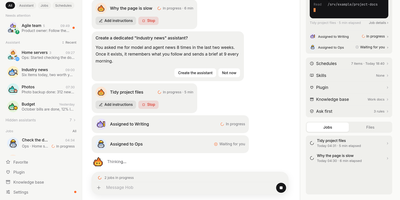
Tell Hob what you need and it handles small requests on the spot, hands longer work to background jobs, and asks first whenever your rules say the decision is yours. Each assistant carries its own duties, rules, skills, and schedules, so a Writing assistant can send weekly reports while an Ops assistant watches your servers. Every job appears as a card with a live transcript, takes extra instructions mid-run, and stops with one click. Global and per-assistant rules decide which actions wait for confirmation, and approving one can save it as a rule so the question never returns. Requests that belong elsewhere go to the right assistant through a delegation card, and Hob offers a dedicated assistant once similar requests keep arriving. Schedules can run a check script first and wake the assistant only when something changed. Interactive cards in the chat render tables, toggles, and forms, so one question can collect a choice and several typed answers. A plugin marketplace adds GitHub, Cloudflare, Gmail, IMAP mail, and Bitwarden, with per-tool switches and per-assistant access. Knowledge bases with citations, web search through SearXNG, Exa, Tavily, or Brave, and per-model cost tracking keep answers grounded. The web app installs to a phone's home screen and pushes a notification when an assistant needs your answer. Running on a dedicated VPS on RepoCloud with guaranteed CPU, RAM, and SSD, full root SSH access, and a browser serial console. MIT licensed.
Open Agent API
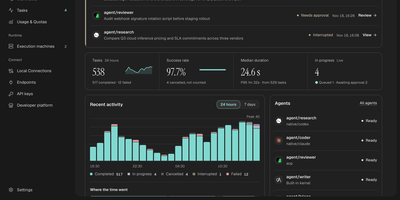
Open Agent API is a self-hosted gateway that turns agents into an API, so any OpenAI, Claude, or Gemini SDK client can call a complete agent with its own tools and permissions instead of a bare model. Change the base URL, put an agent name such as agent/research in the model field, and each request becomes a task that loops through tools, remembers earlier turns, and stops when a sensitive action needs sign-off. Behind a name you can run a built-in agent on Ollama, DeepSeek, OpenAI, Anthropic, Gemini, or OpenRouter, or wrap Codex, Claude Code, an ACP agent, or a remote A2A agent. The web console opens on the tasks waiting for you, lists every run with status filters, and expands one into a timeline showing the command it wants to run beside Approve and Reject buttons. Runs can be cancelled and resumed, repeated calls with an Idempotency-Key execute once, and signed webhooks, cron schedules, and inbound triggers start or report work. Agents keep searchable memory across sessions and stream artifacts back to the caller. Callers can force a tool choice, request schema-validated JSON, and attach images for agents that accept them. Turn on the developer platform and outside developers register, create their own keys in a portal, and call the agents you list, billed in credits per task. Running on a dedicated VPS on RepoCloud with guaranteed CPU, RAM, and SSD, full root SSH access, and a browser serial console. Apache-2.0 licensed.
Octosift
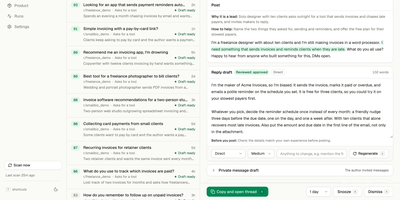
Somewhere on Reddit, a stranger just asked what everyone uses for the problem you solved, and Octosift spots that post, explains why it is a lead, and drafts an honest reply for you to send. It watches only the subreddits you pick, reading new posts hourly and slowly. Free filters drop spam and old threads, a small model screens the rest, and a stronger one checks each survivor. Every verdict comes with a score and a plain reason. Open any scan to see why each post was kept or dropped. Mark a lead good or bad, and later scans follow it as a rule. A second model reviews each draft like a moderator, checking that it answers the question, invents nothing, and says you built the product. Choose an angle and length, ask for a rewrite in plain words, or take the private message draft when the author invites one. Subreddits that ban promotion get replies without a mention. Pacing warnings ask for helpful replies between product mentions. Paste your website URL and Octosift drafts a product profile, including what the tool does not do, that every judgment follows. Bring an OpenAI, Anthropic, or OpenAI-compatible key, local models included, and presets show a monthly cost estimate before you spend anything. You send every reply yourself. Running on a dedicated VPS on RepoCloud with guaranteed CPU, RAM, and SSD, full root SSH access, and a browser serial console. AGPL-3.0 licensed.
Paddock
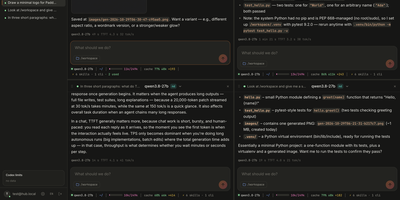
Paddock puts up to four AI coding agents side by side in one browser tab, each user's agent running in a sealed container, so no laptop has to stay awake. Each chat streams markdown with highlighting, cards for shell commands, file edits, and web searches, approvals, and edit-and-rerun on any message. A statusline tracks model, effort, branch, context fill, and subscription limits, while every answer carries its duration, time to first token, and tokens per second. It runs OpenAI's Codex agent today, signing in with a ChatGPT subscription by device code or with any OpenAI-compatible provider that supports the Responses API. Agents can talk: one lists the other open chats, reads them, and hands off work or asks for a review. Slash commands such as /compact, /review, and /diff work as in the Codex CLI. Whatever the approval policy says, rm, git push, and other destructive commands stop at an approval card. A side panel lists changed files, a live action feed with diffs, network health per proxy, and layout snapshots you can restore on any device. Every user gets a container with all capabilities dropped and no direct internet; traffic leaves through a proxy chain with failover, and the LAN and host stay closed. Login adds TOTP two-factor and backup codes. Running on a dedicated VPS on RepoCloud with guaranteed CPU, RAM, and SSD, full root SSH access, and a browser serial console. MIT licensed.
Kvitok
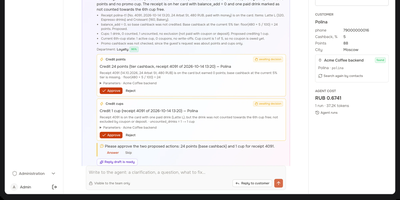
Kvitok is a helpdesk where an AI agent reads your backend, drafts the reply, and lines up the fix, so by the time an operator opens a ticket only the decision is left. Take a guest whose loyalty points never arrived: the agent finds her in your system, reads her receipts, and queues the missing credit for one click of approval. Requests arrive by mailbox or API channel, and your backend matches customers by phone, email, card number, or any identity it exposes. Rules you write run first and can set a department, priority, or tags, or skip the agent for senders such as partners. The agent calls tools your backend publishes, follows your playbooks, and picks a department with a confidence score, while your backend validates every action it proposes. Operators talk to the agent inside the ticket: say the receipt was really 540 and it revises only what that changes. Approved actions run exactly once, and the reply goes out by email or back through the channel the request came from. Each workspace picks its own model from any OpenAI-compatible endpoint, hosted or local, and every ticket shows what the agent spent. Test scenarios run against a real model, so policy or model changes get checked before reaching customers. Claude Code can tune rules and playbooks over MCP. Running on a dedicated VPS on RepoCloud with guaranteed CPU, RAM, and SSD, full root SSH access, and a browser serial console. AGPL-3.0 licensed.
Euron AgentStudio
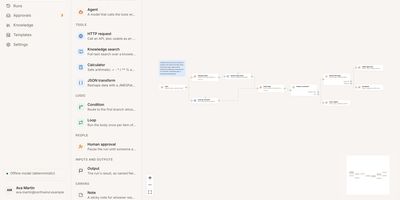
Euron AgentStudio lets you draw an AI agent workflow on a canvas, run it, and watch every step report its inputs, outputs, tokens, and cost live. Twelve node types cover prompts, tool-calling agents, HTTP requests, knowledge search, a calculator, JSON transforms, conditions, loops, human approvals, and sticky notes. Typed connections, inline validation, undo and redo, and autosave keep the editor honest. Branches run in parallel with timeouts, retries, and cancellation, and the run inspector shows the graph as it ran beside a timeline of loop iterations. A human approval step pauses a run for days without tying up a worker. Reviewers decide from an inbox, comment for the record, and let deadlines expire into the rejected branch. Start flows from the editor, a workspace API key that waits for the result, or a signed webhook. Every template runs on a built-in offline model with no API key, and any OpenAI-compatible endpoint or Ollama can take over step by step. Knowledge bases of Markdown and text feed the search steps. Any flow exports as JSON or as a standalone script you own, and published versions can be restored. Owners, editors, and viewers share a workspace with write-only secrets, expiring keys, an activity log, and a dashboard of runs, success rate, and spend. Running on a dedicated VPS on RepoCloud with guaranteed CPU, RAM, and SSD, full root SSH access, and a browser serial console. MIT licensed.