Leon
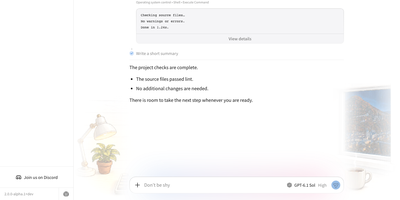
Leon is a personal AI assistant that lives on your own server, remembers what matters to you, and finishes real tasks with tools instead of just chatting. Ask for something in the browser web app and Leon plans the work, runs tools in isolated workers, checks the results, recovers from failures, and writes a short summary. Agent mode handles open-ended requests, controlled mode follows predictable native skills, and smart mode picks the better route for each task. Layered memory keeps durable facts and preferences, daily summaries, and recent discussion context, and Leon can search earlier conversations when exact details matter. Answers can arrive as interactive charts with region toggles, forms, and calculators instead of walls of text, and generated files become downloadable artifacts. Setup cards guide you through connecting services such as Spotify, owner-installed MCP servers add more tools, and a browser tool and computer use handle web pages and desktop applications. Pick models per profile, from a local llama.cpp model to OpenAI, Anthropic, DeepSeek, Groq, or OpenRouter. Profiles keep config, secrets, sessions, and memory separate, so one server can serve several people, with optional token authentication for remote clients. Workspaces group conversations under a shared brief, and Leon Satellite lets a remote Leon use enabled tools on your own device. Running on a dedicated VPS on RepoCloud with guaranteed CPU, RAM, and SSD, full root SSH access, and a browser serial console. MIT licensed.
OmniRoute
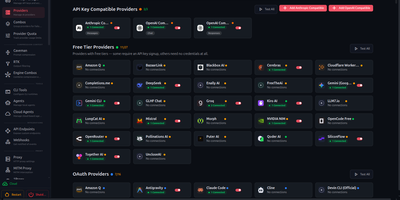
OmniRoute is an AI gateway, aggregating 338 LLM providers including OpenAI, Anthropic Claude, Google Gemini, DeepSeek, Kimi, MiniMax, and GLM into a single OpenAI-compatible endpoint at localhost:20128. The gateway catalogs over 1,200 models across 90 free-tier providers and 40 free-forever providers, automatically rotating through tier-1, tier-2, and tier-3 fallback chains when any provider exhausts its quota or returns errors. RTK plus Caveman stacked token compression reduces eligible context by 15 to 95 percent before forwarding requests, cutting API costs dramatically without degrading output quality. OmniRoute exposes its full routing engine through a built-in MCP server with 104 tools across 31 scopes over stdio, HTTP, and SSE transports, plus an A2A protocol server with six autonomous agent skills and JSON-RPC 2.0 streaming. The gateway integrates directly with Claude Code, Cursor, GitHub Copilot, Codex CLI, OpenCode, and Cline through standard base-URL configuration. Seventeen routing strategies include latency-optimized, cost-minimized, and auto-scoring modes that evaluate candidates on success rate, context fit, model fitness, quota state, and circuit-breaker health. The Next.js dashboard provides real-time provider status, usage analytics, combo chain configuration, and model catalog browsing via a responsive PWA. Running on a dedicated VPS on RepoCloud with guaranteed CPU, RAM, and SSD, full root SSH access, and a browser serial console. MIT licensed.
Open WebUI
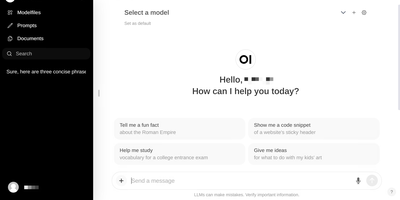
Large language models get a polished front end that can run fully offline: Open WebUI is the self-hosted front end of choice. It talks to local model runners, primarily Ollama, and to any OpenAI-compatible API, so LM Studio, vLLM, Groq, Mistral, OpenRouter, and cloud providers all plug into the same chat interface and can be mixed per conversation. RAG is built in: upload files to knowledge bases or reference them in chat with the # command, backed by a choice of nine vector databases (ChromaDB and PGVector officially maintained) and multiple extraction engines including Tika and Docling, with hybrid BM25-plus-vector search and cross-encoder reranking. Web search results from providers like SearXNG, Brave, and Tavily inject directly into conversations. Extensibility comes from Python tools and functions that run inside the chat, a Pipelines plugin framework, and native MCP support. Multi-user features include RBAC, SSO, and group permissions, and the instance itself exposes an OpenAI-compatible API your own apps can call.
EvoScientist
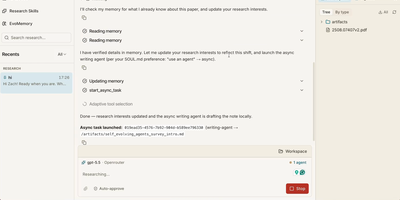
EvoScientist gives a research project a team of cooperating AI agents that plan experiments, read papers, write and debug code, and draft reports, then remember what they learned so the next project starts further ahead. A researcher can schedule a weekday arXiv digest as a cron-style task, optionally graded against a rubric checklist, while a lab lead reviews the reusable skills that AutoSkills proposes from recurring patterns. The EvoSkills catalog adds ready-made skills such as academic slides, paper figures, and experiment pipelines. Six sub-agents cover planning, research, coding, debugging, data analysis, and writing, following a workflow of intake, plan, execute, evaluate, write, and verify. Each turn is distilled into a memory that links itself into a knowledge graph you can browse in the EvoMemory view, next to profile pages for you, your research taste, and the agent's SOUL. Work from a terminal UI, a browser workspace with a file tree and agent panel, or messaging channels including Telegram, Slack, and Feishu that share one session. Rubric and goal commands grade each turn against acceptance criteria you approve. MCP servers plug in extra tools with one command, shell commands ask for approval by default, and the Docker image confines file edits to the folders you mount. Choose Anthropic, OpenAI, Google, MiniMax, NVIDIA, or any OpenAI-compatible endpoint such as vLLM. Running on a dedicated VPS on RepoCloud with guaranteed CPU, RAM, and SSD, full root SSH access, and a browser serial console. Apache-2.0 licensed.
ClawMetry
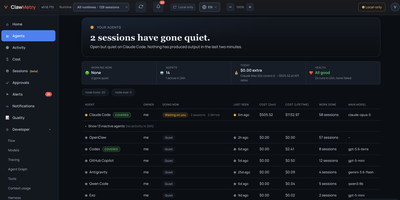
Without an SDK, a proxy, or a single line of agent code changed, ClawMetry reads the session files your AI agents already write and puts every session, tool call, token, and dollar on one live dashboard. The sessions view replays a run turn by turn, with a timeline that gives each tool call its own duration and cost, so a four-minute shell command stands apart from a call that took milliseconds. Usage charts split tokens and spend by runtime, model, session, and day. A live flow diagram follows messages from chat channels through the gateway to models and tools, and a context view tracks window use per turn along with compaction events. The Brain tab streams reasoning, tool calls, and errors as they happen, while memory, skills, health, logs, and cron jobs each get a tab of their own. OTLP receivers accept traces, metrics, and logs from runtimes that keep no local files. The MIT-licensed app reads OpenClaw, NVIDIA NemoClaw, Goose, and Qwen Code for free. Paid plans add the other 28 runtimes, including Claude Code, Codex, and Cursor, plus approval queues for risky tool calls, budget limits, anomaly detection, and a cost optimizer. Session data stays on your server unless you choose to run cloud sync. Running on a dedicated VPS on RepoCloud with guaranteed CPU, RAM, and SSD, full root SSH access, and a browser serial console. MIT licensed.
Obsidian Arc
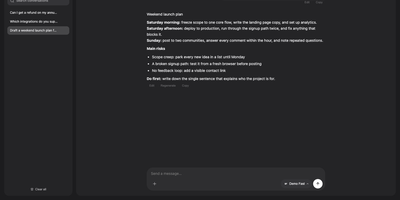
Teams and communities sign in to a private AI chat site, and one admin console routes and meters every request. Users pick a model from the menu and chat with streamed answers, visible reasoning, projects that share a system prompt, searchable history, archives, and an Image Lab for generated pictures. Administrators connect providers that speak the OpenAI or Anthropic protocols, map several models onto each, and place users in groups with their own allowances counted in requests, tokens, or credits per five hours, week, or month. A developer endpoint accepts API keys and serves chat completions, Anthropic messages, responses, images, and a model list, so coding assistants and scripts can share the same pool. The dashboard charts requests, tokens, and spend by model and by person, and Availability probes idle models and trips a circuit breaker after repeated failures. Registration can be open, invite-only, or closed, with invite codes, email rules, authenticator-app two-step sign-in, and GitHub, Google, or OpenID Connect login. Announcements, a feedback inbox, an optional leaderboard, a guest trial chat, and scheduled backups to S3-compatible storage round out the operator toolkit. A company AI portal, a classroom, a research group, or a paid community with trial codes can all run on it. Running on a dedicated VPS on RepoCloud with guaranteed CPU, RAM, and SSD, full root SSH access, and a browser serial console. MIT licensed.
LLMVault
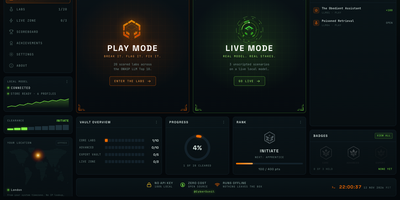
A hacking gym for AI apps: every lab is a chatbot or agent with a planted weakness, and your job is to exploit it and capture the flag. The dashboard tracks score, rank, badges, and a live activity feed across three tiers. Ten core labs map to the OWASP Top 10 for LLM Applications, ten advanced labs need multi-turn tactics like persona escalation, stored injection, and tool chaining, and an encrypted expert tier unlocks last. Each lab opens with a short reference panel on the weakness, offers hints, and ends with the defense that would have stopped you. Play mode uses scripted assistants so flags reproduce every time and the whole range runs offline without API keys. Live mode points attacks at a real local model through Ollama, mints a fresh secret per session, streams replies token by token, and checks the output instead of a flag box. Scenarios cover direct prompt injection, a hidden payload in an uploaded image, and unsafe rendering of model output. A RAG lab accepts text and markdown uploads, so poisoning a knowledge base is hands-on. Two themes, Neon and Phosphor green-CRT, change the look. Security teams run workshops with it, red teamers sharpen prompt injection skills, and developers see why their guardrails fail. Running on a dedicated VPS on RepoCloud with guaranteed CPU, RAM, and SSD, full root SSH access, and a browser serial console. MIT licensed.
Promptfoo
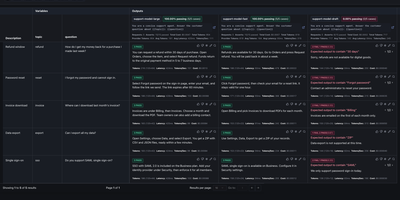
Promptfoo replaces vibes-based prompt tweaking with measurable tests, then attacks your AI app the way a hostile user would. An evaluation matrix lines up every prompt and model side by side, with pass or fail badges, assertion messages, latency, token counts, and cost in each cell. A red team wizard walks through the target, application details, plugins, and strategies, then probes for prompt injection, data exposure, broken access control, and harmful content. Preset bundles map plugins to the OWASP LLM Top 10, NIST AI RMF, MITRE ATLAS, GDPR, ISO 42001, and the EU AI Act. Meta Agent and Hydra Multi-Turn strategies adapt attacks across a whole conversation instead of firing one-shot prompts. Providers span OpenAI, Anthropic, Gemini, Bedrock, Azure, and local Ollama models, and any HTTP endpoint, Python script, or JavaScript function can be tested as a target. The history page lists every run with pass rates and raw scores, and prompt and dataset pages show which templates and test sets each run used. A provider allowlist file narrows the models offered in the web editor for cost control. Running on a dedicated VPS on RepoCloud with guaranteed CPU, RAM, and SSD, full root SSH access, and a browser serial console. MIT licensed.
Narrative Engine
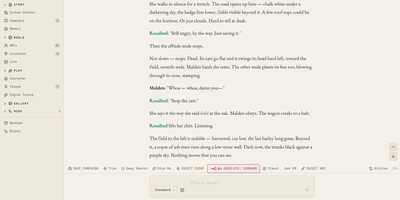
Narrative Engine is an AI dungeon master that remembers every scene of a tabletop campaign, so session 200 can still quote the betrayal from chapter 3. Every turn is archived verbatim into sealed chapters, a two-step search recalls the exact scene, and auto-condensation keeps the context window under its limit. A world-state register tracks who is where, who holds what, and which secrets each NPC may know. NPCs get generated profiles, a six-axis personality, goals that advance on background dice rolls, and portraits in five art styles. World Arcs escalate storylines on their own, event engines add surprises and encounters, and a timeskip simulates the gap. Steering tools include swipe, continue, one-shot event injection, an out-of-character Ask GM chat, a Lore Check, and scene rollback that rewinds the whole world state. A character wizard, staged inventory changes, a captioned image gallery, and a location ledger with an unfinished pixel-art map round out the table. Extensions add features such as an enemy compendium, and example worlds ship ready to play. An encrypted vault protects your API keys, and the web interface opens from a tablet or phone on your network. Running on a dedicated VPS on RepoCloud with guaranteed CPU, RAM, and SSD, full root SSH access, and a browser serial console. MIT licensed.
Chatpad
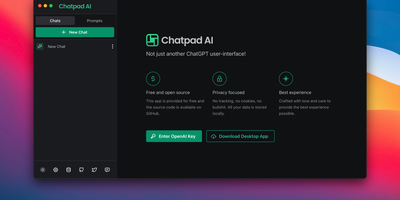
Why should your chat history live on someone else's servers? Chatpad AI - a React/TypeScript front end for the OpenAI API, built on the Mantine component library - is designed around that question. Enter your own OpenAI API key and start chatting with GPT models; every conversation, prompt, and setting is stored locally in your browser via DexieJS over IndexedDB, with no tracking, no cookies, and no backend database at all. That architecture is the point - the Docker image is just Nginx serving static files, making it one of the lightest AI deployments in the catalog, and pay-per-token API pricing typically undercuts a ChatGPT Plus subscription for moderate use. The interface earns its "premium quality" tagline with the details: a persona selector that switches communication styles per conversation, a saved-prompts library for messages you reuse constantly, organized chat history, and full data export/import so conversations move between browsers or into backups as files you control. A JSON config file customizes defaults - models, API endpoints, UI options - without rebuilding the image. AGPL-licensed, with desktop builds available upstream. For teams that want ChatGPT's utility with a self-hosted, zero-telemetry footprint, Chatpad is the minimal, sane answer.
9Router Pro
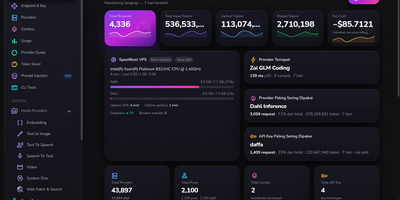
One endpoint for every model account you own: 9Router Pro sits between your applications and a fleet of LLM providers, decides which account answers each request, and keeps the whole operation visible on a live dashboard. Its signature trick is prompt injection scoped three ways, globally, per API key, or per model, delivered either as a system prompt or as a scripted chat history that primes the model far harder than instructions alone. Keys are products here: each carries a rolling token budget over 24 hours, 7 days, or 30 days plus rate limits per minute, hour, and day, so a resold plan enforces itself with polite 429 responses. Routing stays healthy on its own, with accounts tiered as clean, suspect, or cooldown, least-recently-used spreading across the fleet, flaky upstream responses retried against the next account, and proxy pools health-checked with one-click cleanup of the dead. The monitoring dashboard leads with VPS specs, fastest and most-used providers, top API key, and usage spectrum charts, while backup and restore cover providers, combos, keys, and settings section by section. Everything runs as a single application with one SQLite file and a dashboard localized into 34 languages. Running on a dedicated VPS on RepoCloud with guaranteed CPU, RAM, and SSD, full root SSH access, and a browser serial console. MIT licensed.
Sage Wiki
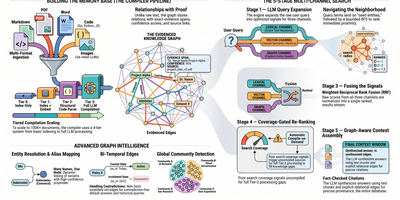
Sage Wiki turns a pile of unstructured documents into a fully interlinked, searchable wiki by running them through a five-pass LLM compiler pipeline. Inspired by Andrej Karpathy's vision of LLM-compiled knowledge bases, the pipeline processes source files through diff detection, summarization, concept extraction, image captioning, and cross-reference discovery, with parallel LLM calls and checkpoint/resume for vaults scaling to 100,000+ documents. The typed ontology graph stores entities and relations with BFS traversal, configurable relation types, multilingual synonyms, and a promotion/demotion lifecycle backed by grounding verification and consensus scoring. Multi-format ingestion handles Markdown, PDF, Word, Excel, PowerPoint, EPUB, email, CSV, images, and code files without manual tagging. LLM provider support spans Anthropic, OpenAI, Gemini, Ollama, and any OpenAI-compatible API, with per-pass model routing enabling cost optimization by assigning cheaper models to simpler tasks. The built-in MCP server exposes 17 tools over SSE transport for integration with Claude, Cursor, and any MCP-compatible agent, while native Obsidian vault overlay ensures existing note workflows remain undisrupted. Team deployment supports Git-synced shared wikis, centralized server access, and hub federation across multiple projects. Ships as a single Go binary with Docker Compose multi-arch images serving the web UI on port 3333. Running on a dedicated VPS on RepoCloud with guaranteed CPU, RAM, and SSD, full root SSH access, and a browser serial console. MIT licensed.
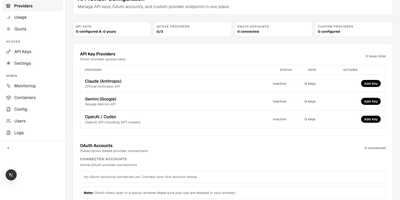
CLIProxyAPI Dashboard
CLIProxyAPI Dashboard puts a web console in front of CLIProxyAPI so you manage AI providers, keys, quotas, and containers through forms instead of YAML files. Connect Claude Code, Codex, xAI, Antigravity, Kimi, and Devin accounts with OAuth, then add Gemini CLI, GitHub Copilot, Kiro, and Cursor through plugins you install and configure from the settings store. Any OpenAI-compatible endpoint can join as a custom provider with model mappings, and admins can mark a provider as shared so the whole team uses it. You create, revoke, and track API keys with per-user ownership, manage dashboard users and admin rights, and stream live logs beside container health. Quota views track rate limits per provider and per model, and Telegram alerts fire when remaining quota drops below your threshold. Usage analytics break down request counts, provider share, model statistics, error rates, and estimated cost. Configuration syncs to OpenCode automatically, model configurations travel as share codes, and backups can be created, scheduled, previewed, and restored from settings. One-click updates refresh the dashboard and proxy images, containers start and stop from the panel, and automatic TLS keeps the console reachable under your domain. Running on a dedicated VPS on RepoCloud with guaranteed CPU, RAM, and SSD, full root SSH access, and a browser serial console. MIT licensed.
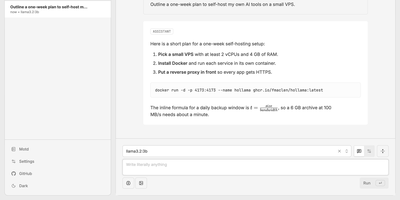
Hollama
A tidy, account-free chat client for every language model server you run. Ollama, the OpenAI API, and OpenAI-compatible servers like llama.cpp plug in side by side, and each of their models appears in one picker. Prompts accept images for vision models, and answers render Markdown, highlighted code, and KaTeX formulas. Reasoning models keep their thinking in a separate panel from the final answer. Messages can be edited, retried, or copied, and the session panel holds a system prompt plus Ollama options for temperature, Top K, Top P, and seed. Knowledge notes, written in a built-in code editor, attach to a session as reusable context. The Settings page pulls new Ollama models by tag, labels each connection, and filters model names by prefix. Tabs stay in sync, themes switch between light and dark, and the interface is translated into many languages. Servers, preferences, sessions, and knowledge export and import as files. Nothing sits in a cloud database, because history lives in the browser of whoever opens it. A single Docker container on port 4173 serves a whole team. Running on a dedicated VPS on RepoCloud with guaranteed CPU, RAM, and SSD, full root SSH access, and a browser serial console. MIT licensed.
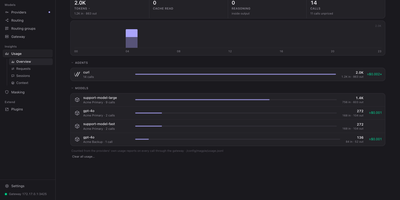
magpie
Point every coding agent and chat client at one self-hosted gateway, then choose which model answers from a single browser console. Add providers by preset or custom OpenAI-compatible URL, or sign in with the subscriptions you already pay for. Routing groups bundle several models into one name and move to the next member when a quota runs out, so the calling agent never sees the error. Create a gateway key per client, cap each with daily token or cost budgets, restrict its models, and watch usage counted separately. The Usage pages chart tokens, cost, request counts, cache hit rate, and a yearly heatmap, split by model, provider, or agent, with CSV export. A Routing view replays how each request was routed, with timing for masking, connecting, and the vendor. Masking swaps passwords, API keys, and tokens for placeholders before a prompt leaves your server and restores them in the answer. The browser page is protected by a key you set at launch. Running on a dedicated VPS on RepoCloud with guaranteed CPU, RAM, and SSD, full root SSH access, and a browser serial console. MIT licensed.
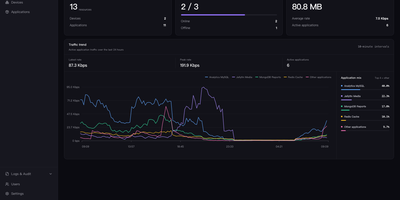
Liaison
Liaison puts every private service you run behind one browser console, so a laptop, a homelab box, or a customer server becomes reachable without opening a single inbound port. Install a lightweight connector on each device and it dials out to the control plane, where administrators register applications over TCP, HTTP, HTTPS, WebSocket, and SSH and grant access per user. Browser workspaces cover audited Web SSH terminals, RDP and VNC desktops, SFTP file management, read-only S3 browsing, and database clients for MySQL, PostgreSQL, MariaDB, SQL Server, Oracle, MongoDB, and Redis, each with a session Agent that drafts commands and explains query results once you approve them. Local models are shared through authenticated APIs with a browser Playground, scoped keys, token quotas, and usage tracking, while Codex and Claude Code run on your own devices with resumable sessions and permission prompts. A built-in code-server IDE edits projects remotely, and on-demand TCP ports open for 5 to 300 seconds. Casbin-backed identity management, firewall policies by source IP or CIDR, and logs of management actions and supported sessions keep access accountable. Application discovery scans connector devices for existing services and registers them from the console. Running on a dedicated VPS on RepoCloud with guaranteed CPU, RAM, and SSD, full root SSH access, and a browser serial console. AGPL-3.0 licensed.
Observal
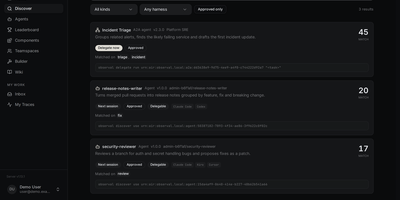
To pull a team's skills, MCP servers, hooks, prompts, and agent files out of scattered Git repositories, Observal keeps them in one reviewed registry and traces real sessions to show which ones help. Build an agent visually, with a live config preview for every harness. Submissions wait in an admin review queue, where reviewers inspect side-by-side version diffs before approving a release. Teamspaces give each team its own namespace, and approved releases can be forked into independent drafts. One pull command then writes the right config for Claude Code, Cursor, Kiro, Codex, Copilot, Pi, OpenCode, Antigravity, or Goose. Every approved resource is discoverable through the open Agentic Resource Discovery standard, and a running agent can hand part of its task to another approved agent or a remote Agent2Agent service. Hooks record each session as a trace of prompts, tool calls, MCP round trips, tokens, and errors, with turn-by-turn replay for debugging and audits. Insight reports, generated through providers such as Anthropic, OpenAI, or Ollama, list what is working, what is hindering, and quick wins. A dashboard follows adoption, cost, and department usage, a leaderboard ranks agents by downloads, and audit logs, SAML single sign-on, and SCIM provisioning are included. Running on a dedicated VPS on RepoCloud with guaranteed CPU, RAM, and SSD, full root SSH access, and a browser serial console. Apache-2.0 licensed.
PandaProbe
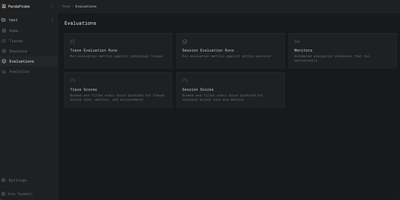
A looping agent burns money quietly until someone can see where it drifted, and PandaProbe is an observability and evaluation platform for AI agents that makes that drift visible step by step. Capture complete executions as sessions, traces, and spans spanning model calls, tool calls, multi-agent handoffs, and custom logic, then follow a looping or failing run back to the decision where it drifted. Score traces and sessions with agent-specific metrics, run asynchronous and sampled evaluations so judge models do not cost more than inference, and use lightweight trajectory signals to catch stalls, bad tool use, and regressions over time. Bring agents built with LangGraph, CrewAI, the Claude Agent SDK, the OpenAI Agents SDK, and other integrations, with MCP tool calls captured automatically where supported. Organize work by user, organization, and project, send data through an SDK or HTTP API with project keys, and query filtered, paginated traces when you need the raw record. Keep sensitive workflows local when that matters: prompts, traces, and evaluation results stay inside the deployment you run, instead of leaving for a hosted console. Running on a dedicated VPS on RepoCloud with guaranteed CPU, RAM, and SSD, full root SSH access, and a browser serial console. Apache-2.0 licensed.