Apache OFBiz
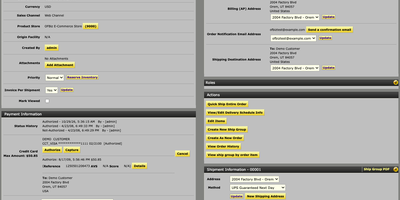
Apache OFBiz is the enterprise resource planning system a company installs when accounting, inventory, orders, and the factory floor must all agree with each other in real time. One shared data model connects the modules, so a sales order entered by the CRM team immediately reserves stock in the warehouse, schedules a pick list, and posts the receivable to the general ledger when it ships. The catalog manager handles unlimited stores, categories, and product variants with price rules and a promotion engine, and the built-in e-commerce storefront and point of sale sell from the same inventory your warehouse counts. Manufacturing plans production with bills of materials, routings, and MRP runs that propose purchase orders for missing raw materials, then costs every job as it moves through the shop. Accounting is proper double-entry: accounts receivable and payable, invoicing, payments, fixed assets with depreciation, budgets, and financial reports across multiple organizations. Facility tools manage several warehouses with lot and serial tracking, receiving, returns, and physical inventory counts, while the HR module keeps positions, contracts, expenses, and performance reviews. Party management unifies customers, suppliers, and employees into one record, REST and service APIs expose every function to integrations, and project and work effort tools track tasks against orders. Running on a dedicated VPS on RepoCloud with guaranteed CPU, RAM, and SSD, full root SSH access, and a browser serial console. Apache-2.0 licensed.
Akaunting
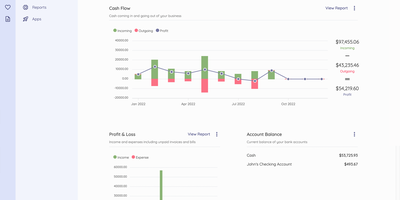
Akaunting is an online accounting software for small businesses and freelancers. The double-entry accounting engine provides a full Chart of Accounts, journal entries, and balance sheet reporting, eliminating the manual errors inherent in single-entry systems. Unlimited invoice creation with customizable templates, automatic payment reminders, and client portal access lets businesses present professional documents and accept payments through PayPal, Stripe, and other gateway integrations. Expense tracking captures operational costs with category-based organization, receipt scanning, and vendor bill management with overdue payment alerts. Bank Feeds auto-syncs transactions from connected bank accounts and matches them against invoices and bills for streamlined reconciliation. The dashboard displays receivables, payables, cash flow summaries, profit and loss charts, expenses by category, and account balances at a glance with configurable date ranges. Quotes and estimates convert directly into invoices upon client approval, while recurring invoices and bills automate periodic billing without manual intervention. The modular architecture built on Laravel with the Akaunting Module package enables an App Store where developers publish extensions for payroll, inventory, projects, and CRM functionality. Multi-company support manages separate books from a single installation with per-company user roles. Running on a dedicated VPS on RepoCloud with guaranteed CPU, RAM, and SSD, full root SSH access, and a browser serial console. BSL licensed.
Google Browser Scraper
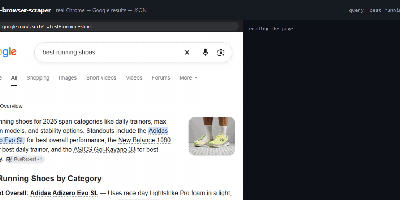
Google Browser Scraper is a self-hosted SERP API that gets Google results from a real Chrome browser and your own residential proxy, because plain HTTP scraping is refused and a fresh browser on a fresh IP is refused almost as fast. It warms a sticky proxy session with ordinary browsing first, lets the browser pass Google's checks, and then switches to a hybrid mode that fetches results pages directly over HTTPS with the browser's own cookies, at about 0.4 MB and 1.4 seconds per search on a warm IP. Every page comes back as SERP-style JSON with organic results, ads, related questions, related searches, pagination, the AI Overview, and local results. If a proxy IP starts serving poisoned pages for some other query, the scraper catches it within a few pages, drops that IP, and asks the query again on a fresh one. Captchas and blocks are reported as captchas and blocks, never disguised as an empty result set, so your pipeline knows when to retry or rotate. Run it as a CLI for keyword files, import it as a Python library, serve it as a local HTTP API, or expose the MCP server so AI agents get live Google search. Every run ends with a traffic and cost summary per thousand pages, and any sticky residential proxy works, with NodeMaven sessions handled for you. Running on a dedicated VPS on RepoCloud with guaranteed CPU, RAM, and SSD, full root SSH access, and a browser serial console. MIT licensed.
Aureus ERP
With over 11,500 GitHub stars, 20 contributors, and nine releases through version 1.4.0 in May 2026, Aureus ERP has established itself as the modern Laravel-powered alternative to legacy ERP systems like Odoo and ERPNext by packaging accounting, inventory, manufacturing, HR, sales, procurement, and project management into a modular MIT-licensed platform where you install only the plugins your business actually needs. Built on Laravel 13 with FilamentPHP 5 admin panels and TailwindCSS, each module installs via a single Artisan command that automatically resolves dependencies, runs migrations, seeds default data, and generates role-based permissions through Filament Shield integration. The Accounts module defines chart of accounts, journals, ledgers, currencies, and fiscal structures while the Accounting module handles journal entries, financial reports, period closing, and reconciliation workflows. Inventory management provides warehouse operations with stock tracking, transfers, and adjustments while Manufacturing handles bills of materials, manufacturing orders, work orders, and work center scheduling. The Sales module manages pipeline stages and opportunity tracking while Purchases handles procurement workflows and vendor management. HR capabilities span employee management, recruitment with applicant tracking, leave management through Timeoffs, and employee hour tracking via Timesheets. The Projects module provides planning and task management with the Maintenance module covering preventive and corrective equipment maintenance with calendar views. Docker deployment pulls a single image bundling PHP, MySQL, Apache, and Node.js for immediate browser access. Running on a dedicated VPS on RepoCloud with guaranteed CPU, RAM, and SSD, full root SSH access, and a browser serial console. MIT licensed.
Bigcapital
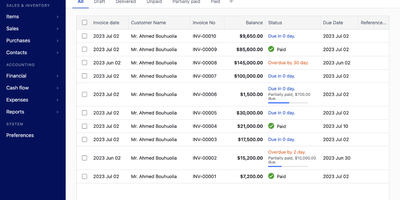
Bigcapital gives small and medium businesses a complete double-entry accounting, invoicing, and inventory management platform they can self-host for free, replacing the per-seat subscriptions of QuickBooks, Xero, and Wave. Every transaction records debits and credits across your chart of accounts, automatically generating balance sheets, profit and loss statements, trial balances, general ledger reports, journal entries, accounts receivable and payable summaries, cash flow analysis, inventory valuation, and inventory summary reports. Sales invoicing supports recurring schedules, customer payment tracking, estimate-to-invoice conversion, and configurable GST/VAT tax rates. Purchase invoicing handles vendor bills with expense categorization for payroll, rent, and operational costs. The inventory module tracks stock levels using FIFO and average cost methods, automatically adjusting quantities on every sale or purchase and providing reorder alerts. Multi-currency accounting converts transactions at real-time exchange rates and consolidates them under customer or vendor profiles with detailed currency reports. The platform deploys via Docker Compose with multi-tenant isolation giving each organization its own separate database, requiring as little as 2GB RAM for the complete production stack. A headless REST API with Postman collections lets developers embed the accounting engine into external applications for programmatic transaction management. Role-based permissions control access for team members and invited accountants across organizations. Running on a dedicated VPS on RepoCloud with guaranteed CPU, RAM, and SSD, full root SSH access, and a browser serial console. AGPL-3.0 licensed.
Dolibarr
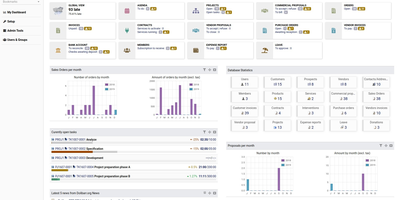
With 7,400+ GitHub stars, 280+ contributors, and 99 releases spanning 15 years of active development since 2011, Dolibarr is the modular ERP and CRM platform that scales from freelancers tracking invoices to manufacturing companies managing full production workflows — all within a single PHP application requiring only a web server and database. Enable exactly the modules your business needs: CRM with leads, proposals, and online contract signing; invoicing with customer and supplier management, credit notes, and SEPA direct debit; double-entry accounting with bank reconciliation and margin analysis; stock and warehouse management with barcode scanning, batch and lot tracking, and product variants; bill of materials and manufacturing orders with workstation scheduling; HR with employee records, leave management, expense reports, recruitment pipelines, and timesheets; project and task management with shared iCal calendars; and a ticket system with integrated knowledge base for customer support. TakePOS provides a touch-optimized point-of-sale interface for retail shops, bars, and restaurants with floor and table management, QR code self-ordering, automatic stock decrements, and Stripe terminal integration. Payment processors connect via PayPal, Stripe, and Paybox. The marketplace offers over 1,000 third-party add-ons, and the low-code Module Builder enables custom extensions without programming. Deploy via the official Docker image with MariaDB, DEB and RPM packages for Linux, or manual installation on any PHP-capable server. Running on a dedicated VPS on RepoCloud with guaranteed CPU, RAM, and SSD, full root SSH access, and a browser serial console. GPL-3.0 licensed.
Tryton
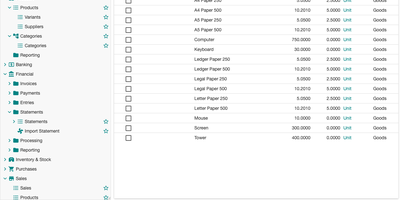
In Tryton, an invoice knows its shipment and a production order knows its stock, since accounting, inventory, purchasing, and sales are modules of one ERP rather than separate programs exchanging exports. Financial accounting posts customer and supplier invoices, reconciles bank statements imported from SEPA or configured CSV formats, manages dunning and direct debits, and produces Factur-X electronic invoices, while analytic accounting splits results across cost centers. Stock tracks goods through warehouses and locations with lots, shipments, inventories that warn when counts drift beyond tolerance, and automatic period closing, and production consumes bill-of-material inputs into finished goods with quantity checks. Sales quotations become orders, shipments, and invoices without retyping; purchases calculate real supplier lead times; point of sale records lot numbers at the till; subscriptions bill recurring services on schedule. Multi-company installations share the same database with per-company wizards, tax rules can be defined per organization for European trade, and parties, products, carriers, currencies, and customs duties are managed as shared reference data. Access happens through the browser web client, a desktop client, or scripting and REST libraries, so integrations read and write the same business objects your staff see. Running on a dedicated VPS on RepoCloud with guaranteed CPU, RAM, and SSD, full root SSH access, and a browser serial console. GPL-3.0-or-later licensed.
LedgerSMB
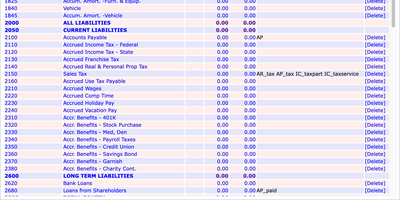
Every invoice a growing business sends has to land in the books correctly twice, in the right currency, under the right tax rules: LedgerSMB is a full double-entry accounting and ERP system that keeps that discipline without locking the company into a proprietary vendor. Sales staff raise quotations, convert them to orders, and issue invoices that post straight into receivables and the general ledger, and purchasing mirrors the flow through payables. The warehouse side tracks inventory across products and assemblies, and fixed assets carry their own depreciation schedules, so the balance sheet reflects what the business actually owns. Multi-currency accounting is built into the core rather than bolted on: foreign-currency invoices show both amounts, gains and losses post automatically, and balance sheets can split balances by currency. Owners slice results by profit center, department, or project to see which parts of the business earn their keep. Documents leave the system as PDF, HTML, CSV, or office formats, and invoices can be mailed to customers from inside the application. Each user can work in a different language, with forty-five translations included, and documents can be produced in a language other than the operator's. Concurrent logins into several companies from one browser suit accountants and bookkeepers who keep books for more than one business. Running on a dedicated VPS on RepoCloud with guaranteed CPU, RAM, and SSD, full root SSH access, and a browser serial console. GPL-2.0 licensed.
Metasfresh
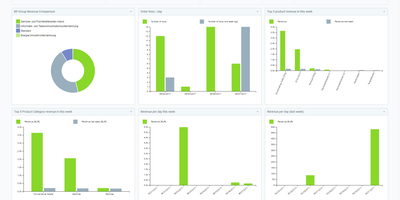
Metasfresh is a free, open-source ERP system that runs the whole commercial life of an industry or trade company, from the first lead and quotation through sales orders, warehouse shipments, manufacturing orders, and the invoices that close the books. The CRM module keeps business partner master data for customers and vendors, tracks prospects, leads, tasks, and opportunities, and shows the sales pipeline. Sales staff create quotations, convert them into sales orders with credit limit checks and Incoterms, and follow each order through shipment planning to the customer invoice. Purchasing mirrors the flow on the vendor side: procurement planning and purchase dispositions generate purchase orders, goods receipts book deliveries into stock, and vendor invoices match what actually arrived. Manufacturers work with bills of materials, MRP II planning, and manufacturing orders that consume components and finish products, and production planning ties resources to schedules. The warehouse module manages storage locations and handling units, books inventory movements between warehouses, and counts physical stock, so promised quantities match what the floor can actually ship. Accounting posts invoices, credit notes, and reversals for debtors and creditors with automatic FACT accounting entries, keeping the ledger current. Every screen is a responsive web interface that adapts from office monitors to tablets on the warehouse floor, and a REST API connects shop systems and third-party tools to the same data. Running on a dedicated VPS on RepoCloud with guaranteed CPU, RAM, and SSD, full root SSH access, and a browser serial console. GPLv2 and GPLv3 dual licensed.
Huf
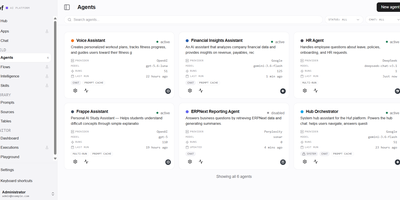
Give your team one console to build agents, ground them in real data, and reach them through email, Telegram, Slack, and WhatsApp: Huf is a self-hosted multi-agent AI platform running on servers you operate. Create agents visually, assign each one a provider and model, and watch runs, last activity, and status from a grid that shows every agent at a glance; the same console manages prompts, skills, flows, data tables, and knowledge sources. Connect agents to Gmail and email, Telegram, Slack, WhatsApp, and custom HTTP webhooks, and inbound messages trigger runs whose replies route back to the original channel automatically. Agents read, create, update, and delete any Frappe document, work ERPNext data, and call external systems through Model Context Protocol servers with managed OAuth credentials. Code-heavy tasks run in hardened execution profiles: a local Python environment, an isolated venv, direct SSH, a Frappe SSH connection, or a Docker container, each gated by role-based permissions for agents, tools, data tables, and MCP servers. Teams package prompt templates, tools, and MCP configurations into shareable skills and Huf Apps, run models from cloud providers, or keep everything local with Ollama, LM Studio, or any OpenAI-compatible endpoint. Running on a dedicated VPS on RepoCloud with guaranteed CPU, RAM, and SSD, full root SSH access, and a browser serial console. AGPL-3.0 licensed.
Manager.io
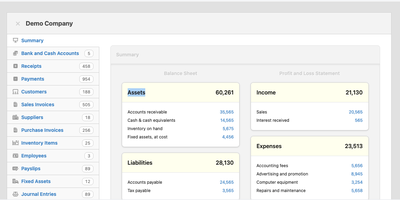
Full double-entry accounting on your own server: Manager.io Server Edition runs the same engine as the free desktop edition as a web server, so unlimited users work in unlimited businesses concurrently, with all books on infrastructure you control. The module coverage is genuinely comprehensive - general ledger with a customizable chart of accounts, sales and purchase invoices, quotes and orders, bank and cash account reconciliation, inventory with stock tracking, fixed assets with depreciation, payroll, multi-currency with exchange gains and losses, tax codes for VAT and GST regimes, and the complete reporting stack: balance sheet, profit and loss, trial balance, aged receivables and payables, and cash flow statements. The interface is translated into more than seventy languages, reflecting a genuinely global user base. The licensing model is the refreshing part: a server license is a one-time perpetual purchase, not a subscription - twelve months of updates included, optional renewals after, no per-user tiers, no data limits, and you can downgrade to the free desktop edition anytime, so your books are never hostage. Businesses wanting collaborative accounting behind their own firewall, with data sovereignty and no monthly fees, get exactly that.