OpenQuok
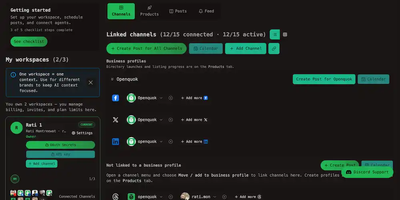
Monday starts with a blank composer and eleven open tabs. OpenQuok replaces those tabs with one open-source Content OS where social scheduling and directory launch share a workspace, a media library, and a review queue. You connect the accounts once: Facebook Page, Threads, Instagram, LinkedIn, X, YouTube, TikTok, Dev.to, Bluesky, Reddit, Skool. Then the week takes shape on a calendar you can drag around. A post begins in Global mode, one caption for everywhere. Unlock a channel and that network gets its own words, its own media, its own settings, with a preview that shows exactly what its audience will see. Drafts wait on the kanban board until a person signs off. Clients comment through preview links, and nothing reaches a live channel before that approval, no matter which tool drafted it. Agents queue drafts through MCP, the CLI, or the public API, and playbooks repeat the campaigns that worked last month. When launch day comes, the other half of the workspace opens. Your product profile already holds the copy, the readiness check names the missing fields, and each directory submission and live URL is tracked beside the posts announcing it. Separate workspaces keep separate brands honest, each with its own teammates, timezone, templates, and tags. Running on a dedicated VPS on RepoCloud with guaranteed CPU, RAM, and SSD, full root SSH access, and a browser serial console. AGPL-3.0 licensed.
LLDAP
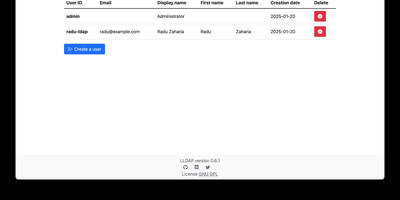
LLDAP is a lightweight user directory that lets all your self-hosted apps share one set of accounts and passwords. It speaks just enough LDAP for Nextcloud, Jellyfin, Gitea, GitLab, Grafana, Home Assistant, Proxmox VE, Vaultwarden, and many more to authenticate users against a single source of truth, with ready-made example configurations for more than 80 services. Day-to-day administration happens in a web interface where you create users, set passwords, upload avatars, build groups, and add members from a dropdown. Regular users can sign in to edit their own profile, and once SMTP is configured they can request a password-reset link by email instead of pinging the admin. Custom attributes (text, numbers, dates, or JPEG photos) are defined on the user and group schema pages, which unlocks integrations that expect fields such as uidNumber or homeDirectory, including Linux logins through PAM. Three built-in groups keep privileges tidy: lldap_admin for full control, lldap_password_manager for password resets, and lldap_strict_readonly for read-only service accounts. Group membership is exposed through memberOf filters, LDAPS secures connections when you expose the port, and a GraphQL API plus a bootstrap script let you manage users, groups, and attributes declaratively from JSON files. Pair it with Authelia, Authentik, or Keycloak when you also want single sign-on and multi-factor prompts. Running on a dedicated VPS on RepoCloud with guaranteed CPU, RAM, and SSD, full root SSH access, and a browser serial console. GPL-3.0 licensed.
Admidio
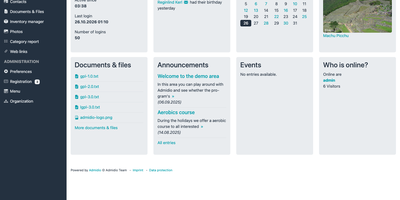
Admidio is membership management software for clubs, associations, and groups, built so that every permission follows from the roles a person holds. Organizers define roles such as board, youth team, or trainers, decide who may email or see each one, and grant module rights like managing events, editing contacts, or uploading photos with simple switches. Contact records use customizable profile fields, record relationships such as parent and child, and can be imported in bulk or exported as vCards. New members register online and administrators review each request. Events carry dates, venues, calendars, and participant lists with sign-up, and the schedule downloads as iCal. Messages go as HTML email to individuals, roles, or groups, and members also find announcements, a categorized forum, document folders with role-based access, and photo albums with e-cards. The inventory manager tracks equipment, who holds it, and its borrowing history. Optional two-factor login protects accounts, a change history can be switched on for every module, and single sign-on lets other applications authenticate against the member database. Twenty-five languages are included, the interface installs as a progressive web app, and sub-organizations can be managed from the same installation. Running on a dedicated VPS on RepoCloud with guaranteed CPU, RAM, and SSD, full root SSH access, and a browser serial console. GPL-2.0 licensed.
Cairn
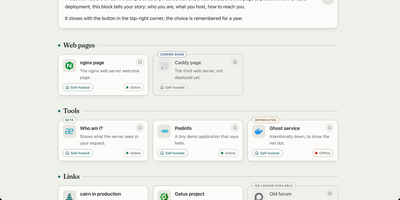
Cairn gives the people you host services for one calm directory page that explains each service in plain language and shows whether it works right now. Your family does not want another dashboard; they want to know what this thing is and what to click. Group tools by need, write a welcome note in your own words, and give each service a Learn more page that explains whom to ask for an account. Status comes from the monitor you already run, Gatus, Uptime Kuma, Cachet, or a hosted status page, polled by your server so a visitor's browser never has to call anything. Labels say honestly where a service stands: coming soon, beta, new, deprecated, or retired, with dead links removed for the last two. Search finds the one service by name from anywhere on the page, eight shipped languages plus your own inline translations cover the relatives abroad, and legal notice and privacy pages are served by Cairn itself, because self-hosters never have anywhere to put those. The whole directory is one YAML file and a five-megabyte image. Running on a dedicated VPS on RepoCloud with guaranteed CPU, RAM, and SSD, full root SSH access, and a browser serial console. GPL-3.0 licensed.
Compass
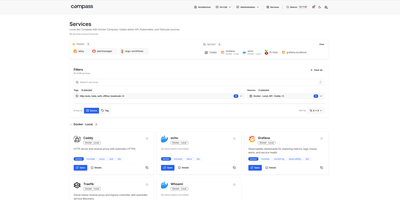
Every homelab outgrows the browser bookmark folder, and Compass answers by building the front page for you, discovering your services automatically instead of asking you to maintain cards by hand. Point it at Docker, Kubernetes, Tailscale, Headscale, NetBird, DNS records, a JSON API, or a plain static list, and it renders everything it finds as a searchable directory with icons, descriptions, and tags filled in from a catalog when a source leaves them blank. Each card shows whether the service is actually up, using the Prometheus or Gatus monitor you already run, and pinned and recent services keep daily tools one click away. Opening a service reveals its connection details, source metadata, extra links such as runbooks and health endpoints, and panels you embed from Grafana. Markdown pages live beside the directory, so architecture notes and on-call runbooks sit in the same navigation, with live service cards and charts embedded directly inside the prose. A debug view shows per-source health, what each source returned, and why a service you expected is missing, while group-based access decides which sources each person can see. Running on a dedicated VPS on RepoCloud with guaranteed CPU, RAM, and SSD, full root SSH access, and a browser serial console. Apache License 2.0 licensed.
ShopClass
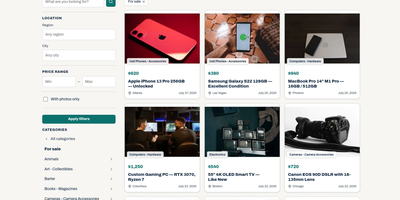
Running a niche marketplace should not mean renting listings from a platform that owns your audience; ShopClass lets you launch your own classifieds site, job board, property portal, or local marketplace. Sellers post listings with photos organized by categories and hierarchical locations, and each category carries its own custom fields, so vehicles ask for make, model, and mileage while jobs ask for salary and type and homes ask for rooms and area. Visitors search and filter across everything with SEO-friendly URLs, registered users manage their own listings, and moderation tools keep spam and abuse under control. You can charge for the privilege through paid plans and listing upgrades such as fees, premium placement, bumps, and highlights, turning the site into a business rather than a hobby. Static pages with a built-in editor cover the rest of the site, themes reshape the frontend, plugins extend it through the established Osclass extension API, and multi-language support serves audiences in their own language. Photos live on disk or S3-compatible storage, cleanup tools purge expired and blocked content, and a one-click updater pulls new releases when you are ready. Running on a dedicated VPS on RepoCloud with guaranteed CPU, RAM, and SSD, full root SSH access, and a browser serial console. GPL-3.0 licensed.
ivfi
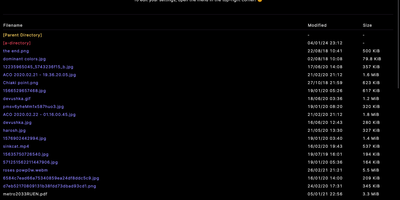
IVFi-PHP turns folders on your server into browsable media galleries: drop one PHP file into a web root and every directory of photos, videos, and audio becomes a polished, searchable index page. Hovering a filename previews the image or video inline, and clicking opens the gallery view where you can move through a whole directory's media, download originals, or reverse-search an image. Audio files play in place with a live visualiser, seeking, and their own volume control. Finding things is instant: filter filenames or file types with plain text, wildcards, or full regular expressions, sort by name, date, or size with settings that persist between visits, and dates automatically match the visitor's timezone. Select any set of files and download them as a single ZIP archive, or share direct download links file by file. Directories can render their README files as documentation pages, listings can hide sensitive entries through server-side filters, and optional Digest authentication keeps a listing private without any account database. Themes and per-visitor display preferences restyle the index, basic listings work even with JavaScript disabled, and the whole application also ships as a Docker image for a one-container deployment. Running on a dedicated VPS on RepoCloud with guaranteed CPU, RAM, and SSD, full root SSH access, and a browser serial console. GPL-3.0 licensed.