RAGFlow
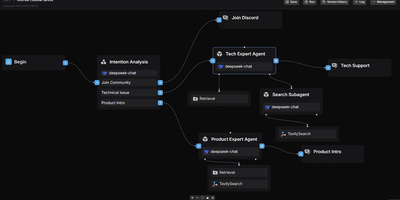
RAGFlow has established itself as one of the most widely adopted open-source RAG engines available, powering production AI systems that demand traceable, hallucination-free answers from complex enterprise data. The platform processes PDF, DOCX, Excel, and PPT files through vision-based deep document understanding with layout analysis and OCR, extracting structured knowledge from tables, charts, and images that simpler parsers miss entirely. RAGFlow's hybrid retrieval pipeline combines vector search with BM25 keyword matching and multi-stage reranking across configurable document stores including Elasticsearch, InfiniFlow's Infinity engine, OpenSearch, and OceanBase. Developers connect any combination of LLM providers — OpenAI, DeepSeek, Anthropic Claude, Google Gemini, and locally-hosted models via Ollama — through a unified configuration layer. The visual agent workflow system enables multi-step reasoning chains with persistent memory, tool calling, and pre-built templates for common enterprise scenarios. RAGFlow synchronizes data from Confluence, S3, Notion, and Google Drive, and delivers answers through chat integrations with Feishu, Discord, Telegram, and Line. The Python SDK and RESTful API on port 9380 provide programmatic access to knowledge base management, document parsing, and conversational retrieval. The full stack deploys via Docker Compose with MySQL for metadata, Redis for task orchestration, and MinIO for object storage. Running on a dedicated VPS on RepoCloud with guaranteed CPU, RAM, and SSD, full root SSH access, and a browser serial console. Apache 2.0 licensed.
code-server
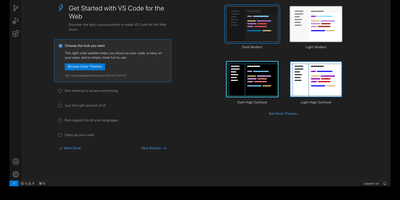
With over 78,000 GitHub stars, 270 contributors, and seven years of continuous development tracking upstream VS Code releases within days, code-server has become the definitive way to run a full Visual Studio Code IDE on any remote machine and access it from any browser on any device. The project applies a curated set of patches to Microsoft's VS Code codebase that add password authentication, sub-path hosting behind reverse proxies, self-contained web views that never call out to Microsoft servers, a built-in proxy for accessing ports on the remote machine directly through the VS Code ports panel, and on-disk settings persistence instead of browser storage. The extension ecosystem works with the Open VSX marketplace by default, giving access to thousands of extensions for Python, JavaScript, Go, Rust, Java, and every other language, along with themes, linters, formatters, and debuggers. The integrated terminal provides direct shell access to the server, Git integration handles version control without leaving the editor, and the debugger supports breakpoints, variable inspection, and step-through execution for Node.js, Python, Go, and other runtimes. DevContainer support enables reproducible development environments defined in JSON configuration files. Installation options include a one-line install script, manual package installation, Docker via the official codercom/code-server image, and DevContainer features. Minimum requirements are a Linux machine with 1GB RAM, 2 vCPUs, and WebSocket support. Running on a dedicated VPS on RepoCloud with guaranteed CPU, RAM, and SSD, full root SSH access, and a browser serial console. MIT licensed.
OpenWiki
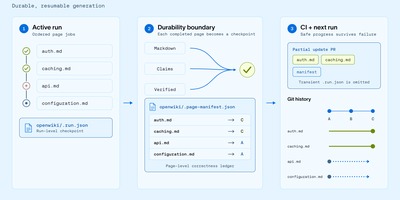
With over 15,900 GitHub stars and 40,000 weekly npm downloads in its first two months, OpenWiki from LangChain has rapidly become the standard for AI-generated codebase documentation. Built on the Deep Agents framework, it deploys a documentation agent that reads your repository's source code, tests, and configuration, then synthesizes a complete linked Markdown wiki with architecture overviews, integration guides, data-flow diagrams, and validated Mermaid visualizations. Two operating modes cover distinct workflows: code mode generates repository documentation in an openwiki/ folder with automatic AGENTS.md and CLAUDE.md integration for Codex, Claude Code, OpenCode, and Cursor, while personal mode builds a local knowledge base from nine connectors including Notion, Slack, Gmail, X/Twitter, Hacker News, LangSmith, Custom MCP, Web Search, and local git repositories. Thirteen model providers are supported out of the box — OpenAI, Anthropic, Gemini, AWS Bedrock, GitHub Copilot, OpenRouter, Nebius, Fireworks, Baseten, NVIDIA NIM, and any OpenAI-compatible endpoint like Ollama or LM Studio. Grounded Claims track every material assertion back to versioned source evidence, flagging stale propositions before they propagate. The interactive visualizer renders wiki pages as an explorable node graph with a side-by-side Markdown reader, exportable as a static site for GitHub Pages or MkDocs. Self-updating CI workflows via GitHub Actions, GitLab CI, or Bitbucket Pipelines open documentation PRs automatically when code changes. Running on a dedicated VPS on RepoCloud with guaranteed CPU, RAM, and SSD, full root SSH access, and a browser serial console. MIT licensed.
Cloudflare OS
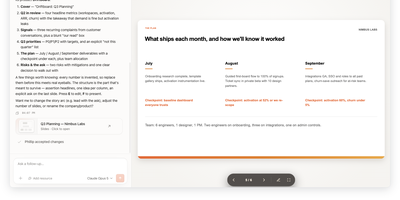
With over 7,700 GitHub stars and thousands of Cloudflare employees using it daily across every function, Cloudflare OS delivers an open-source AI workspace where every employee gets a personal agent grounded in company context, systems, and skills — not a generic chatbot but a programmable workspace that builds real applications, automates workflows, and connects to internal tools through governed access. The Code Mode agent writes and immediately executes code snippets to perform arbitrary tasks, build full-stack Gadgets with client code, server code, APIs, and durable SQLite state, debug errors, and test results within isolated sandboxes. Gadgets are private application instances running in separate sandboxes — each document, spreadsheet, or tool is its own secure runtime that cannot leak data even to attackers with access to other Gadgets. Blueprints enable sharing application code as templates that others instantiate with independent state, credentials, and resources. Gatekeepers provide security governance giving system owners precise control over what agents can see, change, and when human approval is required before actions execute. Built on Cloudflare Workers using Durable Objects for workspace persistence, Dynamic Workers for Gadget execution, and Facets for access management. Zero Trust security via Cloudflare Access verifies every user and request before granting access. Real-time collaboration lets colleagues use shared Gadgets. Deploy to your own Cloudflare account or self-host on workerd, the open-source Workers runtime, on your own servers. Running on a dedicated VPS on RepoCloud with guaranteed CPU, RAM, and SSD, full root SSH access, and a browser serial console. Apache-2.0 licensed.
Octobox
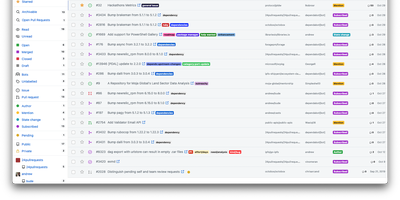
What Gmail did for email, Octobox does for GitHub notifications: an ephemeral, unmanageable stream becomes an inbox you can actually triage. GitHub marks notifications read the moment you glance at them and lets old ones vanish days later; heavy maintainers end up building elaborate Gmail filter systems just to cope. Octobox - a Ruby on Rails app over PostgreSQL - syncs your notifications into a persistent inbox with an explicit archived state: mark a thread done, and if the issue or PR sees new activity, it pops back automatically, so nothing silently falls through. Triage is keyboard-driven with Gmail-style shortcuts (j/k to navigate, e to archive, m to mute, s to star), and multi-select clears noisy repositories in bulk. Filtering is where it earns its keep: slice by repository, organization, type, action, state, reason, CI status, labels, author, assignee, or bot origin, combine prefix search filters, and pin favorite searches to the sidebar. The optional GitHub App enriches entries with live PR/CI status and labels so you can decide without clicking through. Auto-archive rules clear merged PRs and closed issues; muting and snoozing silence the rest. A REST API supports integrations. Self-hosting keeps your notification metadata - a map of everything you work on - on your own server.
Agenta
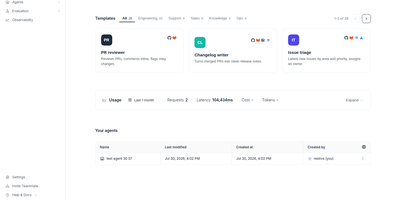
Agenta delivers a comprehensive open-source LLMOps workspace that covers the full lifecycle of AI application development — from prompt engineering through production monitoring. The platform supports 15+ model providers including OpenAI, Anthropic, Google Gemini, Mistral, Groq, Together AI, Azure, AWS Bedrock, and self-hosted models via Ollama, enabling teams to switch between providers without code changes. The prompt playground allows side-by-side comparison of different configurations, while the evaluation system offers LLM-as-a-Judge assessment, 20+ pre-built evaluators covering semantic similarity, regex matching, and factual accuracy, plus custom Python evaluators for domain-specific requirements. Teams run evaluations through both the web UI for subject matter experts and the Evaluation SDK for programmatic CI/CD integration. The observability layer captures full trace visibility across complex agentic workflows, flagging quality issues like hallucinations and off-topic responses in real time. Human annotation workflows let domain experts review and annotate LLM outputs, feeding corrections back into the evaluation loop. The architecture supports Chain of Prompts, RAG pipelines, and multi-step agent workflows, integrating with frameworks like LangChain and LlamaIndex. Self-hosting deploys via Docker Compose with Traefik for routing, requiring only a clone, environment configuration, and a single docker compose command. On RepoCloud, deploy Agenta on a dedicated VPS with root SSH access, persistent storage for evaluation datasets and traces, and complete control over model provider credentials, all under the MIT license with no usage restrictions.
CyberChef
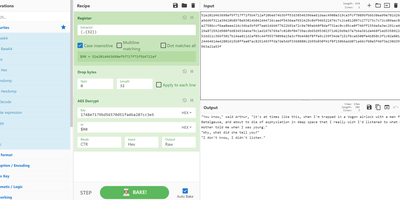
GCHQ open-sourced its "Cyber Swiss Army Knife", and CyberChef became the web app security analysts, incident responders, and CTF players reach for when data needs decoding, decrypting, or dissecting. Its interface is four panes: paste or drag input (files up to 2GB), search a categorized library of hundreds of operations, drag them into a recipe with arguments, and read the output. Operations span Base64, hex, and XOR encoding; AES, DES, and Blowfish encryption; classical ciphers from Caesar to Railfence; hashes and checksums; compression; regex and string extraction of IPs, domains, and URLs; timestamp conversion; and parsers for IPv6, X.509 certificates, and more. Recipes chain arbitrarily - convert from a hexdump then decompress, decrypt AES pulling the IV from the cipher stream, or let the Magic operation auto-detect several layers of nested encoding. Auto Bake re-runs the recipe live as input or arguments change, Step executes one operation at a time for debugging, and flow control (forks, subsections, registers) applies different operations to different parts of the data. Recipes save to files or share as URLs encoding the full pipeline. Crucially, CyberChef is entirely client-side JavaScript - nothing uploads anywhere - and self-hosting guarantees an unmodified copy inside your own network, where malware artifacts belong.
Polar
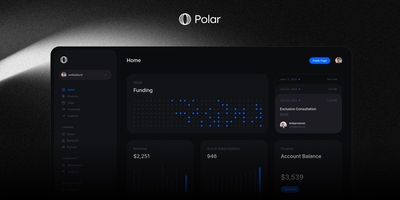
Used by Tailwind Labs and recognized as an official GitHub funding partner, Polar is the open-source billing infrastructure that lets developers ship production-ready monetization in hours instead of weeks. Meter tokens, API calls, agent runs, GPU seconds, and storage with event-level precision, then compose usage billing with subscriptions, seats, credits, trials, and discounts into whatever pricing model your product requires. As Merchant of Record, Polar handles sales tax, VAT, chargebacks, receipts, and regulatory compliance across all supported countries so you receive clean payouts without building tax infrastructure. Integrate via the full REST API with official SDKs for JavaScript, Python, PHP, and Go, plus framework adapters for Next.js, Astro, Remix, SvelteKit, and Laravel enabling checkout integration in minutes. Automatically deliver benefits upon purchase including GitHub repository access, Discord roles, license keys, file downloads, and meter credits through configurable automation rules. The built-in customer portal provides subscription management, payment method updates, invoice history, and benefit access with full white-label branding. Monitor revenue, costs, and margins through real-time analytics dashboards showing the unit economics every AI startup needs to scale. Running on a dedicated VPS on RepoCloud with guaranteed CPU, RAM, and SSD, full root SSH access, and a browser serial console. Apache License 2.0 licensed.
MetaMCP
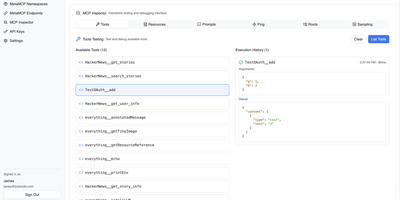
With 2,600+ GitHub stars, MetaMCP solves the MCP server sprawl problem by aggregating any number of upstream servers into a single authenticated endpoint that any MCP client connects to once. Group servers into namespaces — development tools in one, data sources in another — then publish each namespace as its own SSE, Streamable HTTP, or OpenAPI endpoint with API-key authentication in headers or query parameters, or full OAuth per the MCP Spec 2025-06-18 standard. The aggregation engine discovers tools, resources, and prompts from all active servers in parallel, prefixes tool names with server identifiers to prevent collisions, and applies configurable middleware including tool filtering to reduce context-window bloat and description overrides to improve LLM comprehension. The web management UI lets you configure MCP servers with stdio, SSE, or Streamable HTTP transports, toggle servers active or inactive per namespace, create and revoke API keys per endpoint, and inspect discovered tools with their schemas. Nested MetaMCP support enables hierarchical architectures where one MetaMCP instance consumes another, creating multi-level tool organization with automatic name resolution. Compatible with Claude Desktop, Claude Code, Cursor, Open WebUI, and any MCP-compatible client through a single connection URL. The Docker container packages the TypeScript backend with PostgreSQL for configuration persistence, exposing the management UI on port 12005 and MCP endpoints on configurable ports. Running on a dedicated VPS on RepoCloud with guaranteed CPU, RAM, and SSD, full root SSH access, and a browser serial console. MIT licensed.
Sim Studio
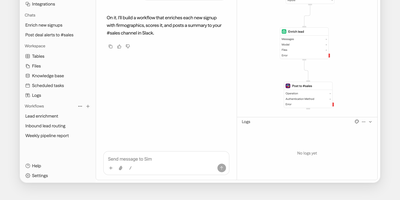
Sim Studio lets teams build, deploy, and monitor AI agent workflows by dragging blocks onto a visual canvas and wiring them into executable pipelines, backed by over 1,000 integrations. The React Flow editor represents each step as a node: LLM calls, tool invocations, conditional branches, and data transformations form directed acyclic graphs that run as complete agent pipelines. Every major LLM provider works natively, including OpenAI, Anthropic, Google Gemini, Groq, and Cerebras, plus local models through Ollama and vLLM. Integrations span Gmail, Slack, Microsoft Teams, Telegram, WhatsApp, Notion, Google Workspace, Airtable, GitHub, Jira, Linear, Perplexity, Firecrawl, PostgreSQL, Supabase, Pinecone, and Qdrant. Built-in tables provide a database layer, a file store offers shared team storage, and knowledge bases powered by PostgreSQL with pgvector enable retrieval-augmented generation. Finished workflows deploy as REST API endpoints, scheduled jobs, or Slack bots, with block-by-block execution traces for full observability. Real-time collaborative editing via Socket.io supports simultaneous multi-user construction. Alternatively, describe agent behavior in natural language and Sim assembles the workflow automatically. Built on Next.js App Router, Bun runtime, Drizzle ORM, and Tailwind CSS. 29,400+ GitHub stars and 100,000+ builders. Apache-2.0 licensed.
Temps
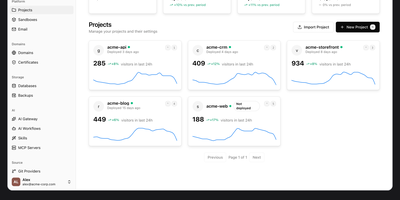
Consolidate application hosting, web analytics, error tracking, and performance monitoring into Temps, an open-source developer platform that replaces disparate SaaS subscriptions with a single compiled Rust binary. Engineering teams deploy full-stack web applications, background daemons, and microservices directly from Git repositories with automated TLS certificate provisioning powered by an embedded Cloudflare Pingora reverse proxy. The centralized web console unifies real-time visitor analytics, conversion funnels, and rrweb-powered session replay recordings without third-party tracking scripts. Integrated error monitoring ingests runtime exceptions with full stack traces and source map resolution, while continuous health checks evaluate container CPU utilization, memory thresholds, and network throughput across custom alerting rules. Developers manage infrastructure through an extensive command line interface containing over 440 operations across 69 command groups, or deploy drop-in skill files that allow AI coding assistants like Claude Code and Codex to provision preview environments autonomously. The platform also provides serverless key-value storage, S3-compatible blob buckets, and native transactional email routing with custom DKIM validation. Running on a dedicated VPS on RepoCloud with guaranteed CPU, RAM, and SSD, full root SSH access, and a browser serial console. Apache 2.0 licensed.
Cognee
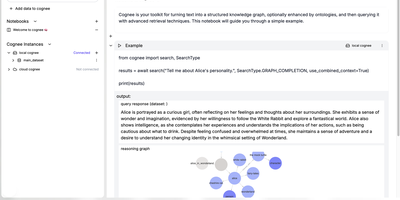
Cognee gives AI agents persistent long-term memory that survives across sessions, replacing the traditional stack of separate graph, vector, and session databases with a unified engine running on a single PostgreSQL instance. The memory-native API exposes four verbs (remember, recall, forget, and improve) enabling agents to persist context, retrieve cited answers, prune outdated knowledge, and self-improve from feedback. Under the hood, Cognee combines pgvector embeddings with a PostgreSQL-native graph store and cognitive-science-grounded ontology generation, delivering hybrid retrieval that fuses semantic similarity, structural graph traversal, and lexical search in a single query. Integrations span Claude Code, Cursor, LangGraph, OpenAI Agents, and any MCP-compatible client through a dedicated MCP server on port 8001, while the Python and TypeScript SDKs provide direct programmatic access. The platform supports swappable backends including Neo4j, FalkorDB, Qdrant, ChromaDB, Weaviate, Milvus, and LanceDB for teams with existing infrastructure. Built-in OpenTelemetry tracing, an experimental dashboard with knowledge graph visualization, multi-tenant user isolation, and audit trails ensure production readiness. Deploy via Docker Compose with optional profiles for PostgreSQL, Neo4j, Redis, and the web frontend. Reached v1.0 in April 2026 with 30,000+ stars. Running on a dedicated VPS on RepoCloud with guaranteed CPU, RAM, and SSD, full root SSH access, and a browser serial console. Apache 2.0 licensed.
GPT Researcher
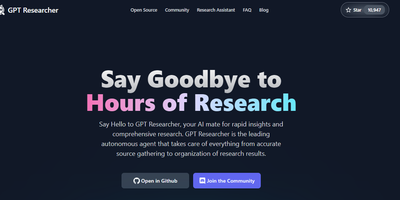
A question goes in; a cited, long-form report comes out - GPT Researcher is an open-source autonomous research agent. A planner agent decomposes the query into sub-questions, execution agents crawl 20+ web sources in parallel with JavaScript-enabled scraping, and a publisher aggregates findings into a 2,000+ word report with inline citations, exportable to PDF, Word, and Markdown. The Deep Research mode extends this recursively: each result yields follow-up questions that are explored to configurable breadth and depth in a tree pattern, while accumulated learnings, citations, and visited URLs are shared across branches. It also researches local documents (PDF, CSV, Word) alongside the web. LLM and search providers are pluggable, including OpenAI, Anthropic, Google, DeepSeek, and Ollama for models, and Tavily, Google, Bing, DuckDuckGo, and SearXNG for retrieval. It ships as a Python package, a FastAPI server with web frontend, a Docker image, and an MCP server for use inside Claude or Cursor. MIT-licensed.
Aptabase
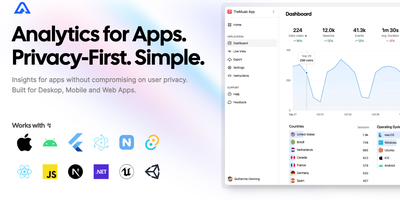
Web analytics tools ignore native mobile, desktop, and game apps; Aptabase was built for exactly those. If Firebase Analytics would force a privacy-policy footnote you don't want to write, this is the alternative - session-based metrics with no cookies, no IDFA or GAID, no device fingerprinting, and a daily-rotated salt that makes cross-day re-identification mathematically impossible. That design means GDPR, CCPA, and PECR compliance out of the box and "Data Not Collected" App Store privacy labels without ATT prompts. The SDK coverage is the widest in its category: eleven first-party libraries spanning Swift, Kotlin, Flutter, React Native, Tauri, Electron, .NET MAUI, NativeScript, Unity, Unreal Engine, and JavaScript for web - each MIT-licensed, following platform conventions, and accepting a custom host parameter that points at your instance. Integration is minutes: initialize with an app key, call trackEvent with optional properties, and the dashboard shows sessions, events, app versions, OS breakdowns, and country-level geography. The self-hosted stack is a .NET server over PostgreSQL for metadata and ClickHouse for high-volume event ingestion, giving cloud-parity features under an AGPL license. For indie iOS/Android apps, Electron and Tauri tools, and Unity or Unreal games, it replaces Firebase without the Google entanglement.
Web-Check
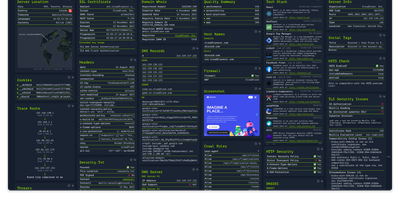
Enter a URL and get a dashboard of everything publicly discoverable about its security posture, server architecture, and technology stack: Web-Check is an all-in-one OSINT tool for analyzing any website. One scan surfaces IP info and server location, the full SSL certificate chain with issuing authority and validity, DNS records (A, MX, NS, CNAME, TXT) with DNSSEC status, HTTP response headers interpreted for security directives like HSTS, CSP, and X-Frame-Options, cookies and their flags, WHOIS domain info, robots.txt crawl rules, a sitemap-derived page map, the redirect ledger, open ports, traceroute, detected technologies, third-party trackers, associated hostnames, site performance, and even carbon footprint. Each card explains what the data means and why it matters, which makes the tool double as a security education resource - junior engineers learn headers and attack surfaces by scanning real sites. Practical uses span pre-deployment security audits (catch missing headers and misconfigurations before they ship), privacy compliance checks (identify trackers and cookie behavior for GDPR work), competitive tech-stack research, and network debugging via DNS and redirect inspection. Built by Lissy93 in TypeScript, it deploys as a single Docker container, and self-hosting keeps your reconnaissance targets and audit activity off third-party services.
ComfyUI
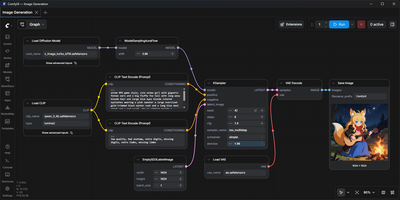
With over 126,000 GitHub stars and adoption across professional studios, research labs, and independent creators, ComfyUI has become the most widely used node-based interface for generative AI workflows — supporting image, video, audio, and 3D content creation through a single visual canvas. The graph editor natively supports Stable Diffusion 1.5, SDXL, SD3.5, Flux.1, Flux.2, HunyuanDiT, Lumina Image 2.0, HiDream, Qwen Image, and Pixart for image generation, plus Wan 2.1 and 2.2, LTX-Video, HunyuanVideo 1.5, CogVideoX, and Mochi for video, ACE-Step and Stable Audio for audio, and Hunyuan3D 2.0 for 3D models. Built-in tools handle inpainting, outpainting, ControlNet conditioning, LoRA and Hypernetwork loading, ESRGAN upscaling, area composition, model merging, and GLIGEN spatial control without writing code. The execution engine implements asynchronous queue processing with partial graph re-execution, running only changed nodes between iterations, and smart VRAM management that offloads models on GPUs with as little as 1 GB of memory. API nodes optionally connect to closed-source models through Comfy API while the core runs fully offline. Reusable subgraphs and App Mode expose complex workflows as simplified interfaces for non-technical users. The V3 custom node schema enables stateless execution with async support and process isolation. The TypeScript and Vue frontend ships as a PyPI package with stable releases every two weeks. Workflows save as JSON and embed in generated PNG, WebP, and FLAC files for reproducibility. Running on a dedicated VPS on RepoCloud with guaranteed CPU, RAM, and SSD, full root SSH access, and a browser serial console. GPL v3.0 licensed.
Stormkit
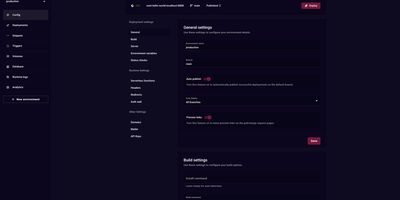
Stormkit delivers a self-hostable PaaS that eliminates vendor lock-in while providing Vercel-class deployment workflows. The Go backend handles build orchestration, hosting, and background job processing while the React frontend provides a complete management dashboard for applications, environments, and team collaboration. Git integration with GitHub, GitLab, and Bitbucket enables push-to-deploy workflows where every commit triggers automated builds with preview links posted directly to pull requests. Serverless functions use filesystem-based routing — each TypeScript or Node.js file in the API directory becomes an endpoint automatically, deploying to AWS Lambda with configurable timeouts. PostgreSQL database schemas ship with automatic migrations, isolated credentials per environment, and secure environment variable injection preventing credential leakage between staging and production. Custom domains provision TLS certificates automatically through Let's Encrypt with support for custom certificates and headers. The environment system creates isolated deployment contexts for production, staging, and development with independent variables, domain bindings, and auto-publish rules per branch. Privacy-respecting server-side analytics track visitors, referrers, and top paths without client cookies or third-party scripts. Role-based access control manages team permissions across applications. Docker Compose deployment provisions the full stack including the API server, hosting service, build runner, and worker server. Running on a dedicated VPS on RepoCloud with guaranteed CPU, RAM, and SSD, full root SSH access, and a browser serial console. AGPL-3.0 licensed.
Omnigent
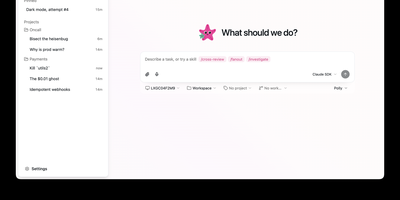
Open-sourced by the Databricks AI team under Apache 2.0 and reaching over 8,500 GitHub stars within two months of launch, Omnigent introduces the meta-harness concept: a common orchestration layer that sits above existing AI coding agents and makes them interoperable parts of a governed, collaborative system. The platform wraps Claude Code, Codex, Cursor, OpenCode, Hermes, Pi, and any custom agent defined in a simple YAML configuration file into sandboxed sessions with a uniform API, then exposes each session through the terminal, a web UI, a native desktop application, mobile interfaces, and a REST API. Built-in multi-agent workflows include Polly, a coding orchestrator that delegates tasks to parallel sub-agents in separate git worktrees and routes each diff to a reviewer from a different vendor, and Deep Research, which plans sub-queries, searches the live web through MCP servers, reads full pages, and cross-checks claims across independent sources. Contextual security policies go beyond static allow/deny rules by maintaining per-session state to enforce spend caps, model routing, approval gates for destructive actions, PII blocking, and repository-scoped write restrictions across server-wide, per-agent, and per-session levels. The OS sandbox restricts filesystem and network access while intercepting egress requests to inject credentials only on approved calls. Cloud sandbox providers including Modal, Daytona, E2B, CoreWeave, Kubernetes, and Databricks launch disposable execution environments per session. Running on a dedicated VPS on RepoCloud with guaranteed CPU, RAM, and SSD, full root SSH access, and a browser serial console. Apache 2.0 licensed.