Faveo Helpdesk
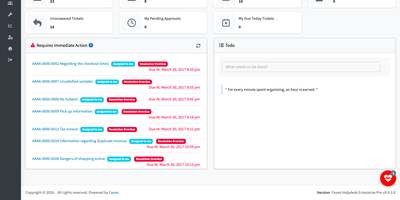
A shared support inbox works until two agents answer the same customer or nobody answers at all, and Faveo Helpdesk, an open-source ticketing system, swaps that guesswork for a queue of tickets with owners, priorities, and deadlines. Each department connects its own mailbox over IMAP or POP3, so incoming email becomes a ticket routed to the right team, and replies go out from that department's address. Colour-coded priorities, custom statuses, and nested help topics sort the queue, tickets can be assigned to an agent, a department, or a team with a lead, and optional ticket locking warns other agents when a colleague already has a ticket open. SLA plans set grace periods against business hours and escalate overdue tickets automatically, while the dashboard counts inbox, unassigned, overdue, and due-today tickets. Workflow rules can set a department or reject spam by subject or channel, a close-ticket workflow auto-closes tickets after a set number of days, and a ban list stops unwanted senders. Customers rate replies and whole tickets on a star scale that defaults to five, a knowledge base with nested categories and public or private articles answers repeat questions, and internal notes stay hidden from customers. Social login, a token-authenticated HTTP API, uploadable language packs, and zip-installed plugins suit IT desks, customer service teams, and internal service teams. Running on a dedicated VPS on RepoCloud with guaranteed CPU, RAM, and SSD, full root SSH access, and a browser serial console. OSL-3.0 licensed.
phpMyFAQ
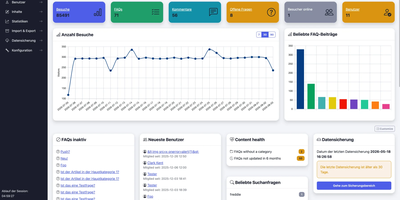
Publish the answers your team keeps repeating as a multilingual, searchable FAQ with phpMyFAQ, a knowledge base whose admin area handles writing, review, and permissions. Organize entries in nested categories that you rearrange by drag and drop, attach files, add tags and related FAQs, and let visitors leave comments. A WYSIWYG editor with an image manager writes each answer, a wiki-style revision history restores earlier versions, and a news system posts announcements. Full-text search covers every language, and optional Elasticsearch or OpenSearch backends handle larger collections. The interface covers more than 40 languages with right-to-left layouts, automatic content negotiation, and translated categories and entries. Privileges work per user and per group, so an editor can change an entry without being allowed to delete it, and categories can be limited to chosen readers. Sign in through LDAP, Active Directory, or Microsoft Entra ID, protect accounts with two-factor authentication, or try experimental passkeys. The dashboard charts 30 days of visits, lists inactive FAQs, and checks installed files against published hashes. Export entries to PDF, publish a dynamic sitemap, back up your content, and filter spam with built-in protections. Dark, light, and high-contrast themes keep the public site comfortable to read. Scripts and AI assistants reach the knowledge base through a REST API with an OpenAPI specification or an experimental MCP server, and plugins extend it. Running on a dedicated VPS on RepoCloud with guaranteed CPU, RAM, and SSD, full root SSH access, and a browser serial console. MPL-2.0 licensed.
Helpdock
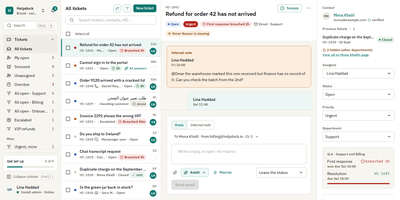
With Helpdock, every brand you run gets its own inboxes, help center and chat widget on one install, plus an AI assistant that answers only from that brand's own knowledge. Email over IMAP or webhook, Telegram, WhatsApp, Messenger, Instagram, a web form and the REST API all land in the same tickets, with shared statuses, assignment and rules. Agents work from saved views, internal notes, macros and a keyboard-first inbox, and a collision warning appears when two people open the same ticket. SLA clocks follow business hours, holidays and time zones, and pause in the statuses you pick. Workflow rules can be test-run before going live, and a CSAT survey goes out when a ticket closes. The help center publishes articles in English and Arabic on each brand's own domain, with right-to-left layouts and search in both languages. The assistant cites its sources, hands the chat to a person when the knowledge base has no answer, drafts articles from closed tickets and suggests replies to agents. Importers for Zendesk, Freshdesk and Zoho Desk bring history across without messaging a single customer. Staff sign in with passkeys, two-factor codes or SAML and OpenID Connect single sign-on. Running on a dedicated VPS on RepoCloud with guaranteed CPU, RAM, and SSD, full root SSH access, and a browser serial console. AGPL-3.0 licensed.
Mabeyn
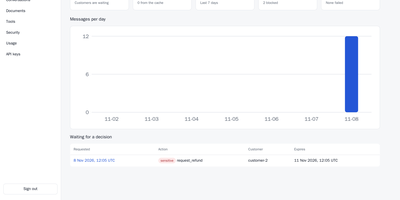
Customer-support bots tend to fail in two ways, inventing answers and taking actions nobody approved, and Mabeyn is a support agent built to stop both. Upload PDF, Markdown, or HTML files, or add a public web page, and policy answers come only from that material, citing the exact section and admitting when nothing fits. Register HTTP endpoints from your backend as tools, label each read, write, or sensitive, and attach policies that check the real order; the customer's identity comes from the verified session, never the model. Sensitive actions such as refunds wait in an approval queue that shows the exact arguments and the thread; once an admin approves, the answer reaches the shopper's chat without a reload. Returning shoppers are remembered: facts they state are kept for 180 days, instructions and personal data are never stored, and customers and admins can read or erase every note. A four-layer firewall screens messages, uploaded documents, tool calls, and replies, masks card numbers and e-mail addresses on the way out, and logs each block as a filterable security event. Businesses stay isolated in separate workspaces, each with secret and publishable API keys, per-customer rate limits, and daily token and cost reports. One script tag adds a streaming chat bubble to any page, and a shopper who asks for a person flags the conversation as escalated. Running on a dedicated VPS on RepoCloud with guaranteed CPU, RAM, and SSD, full root SSH access, and a browser serial console. MIT licensed.
Kvitok
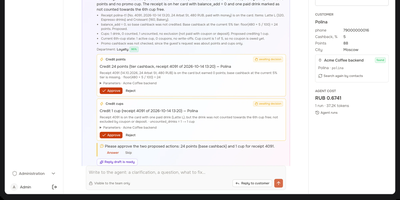
Kvitok is a helpdesk where an AI agent reads your backend, drafts the reply, and lines up the fix, so by the time an operator opens a ticket only the decision is left. Take a guest whose loyalty points never arrived: the agent finds her in your system, reads her receipts, and queues the missing credit for one click of approval. Requests arrive by mailbox or API channel, and your backend matches customers by phone, email, card number, or any identity it exposes. Rules you write run first and can set a department, priority, or tags, or skip the agent for senders such as partners. The agent calls tools your backend publishes, follows your playbooks, and picks a department with a confidence score, while your backend validates every action it proposes. Operators talk to the agent inside the ticket: say the receipt was really 540 and it revises only what that changes. Approved actions run exactly once, and the reply goes out by email or back through the channel the request came from. Each workspace picks its own model from any OpenAI-compatible endpoint, hosted or local, and every ticket shows what the agent spent. Test scenarios run against a real model, so policy or model changes get checked before reaching customers. Claude Code can tune rules and playbooks over MCP. Running on a dedicated VPS on RepoCloud with guaranteed CPU, RAM, and SSD, full root SSH access, and a browser serial console. AGPL-3.0 licensed.
Euron Open SupportDesk
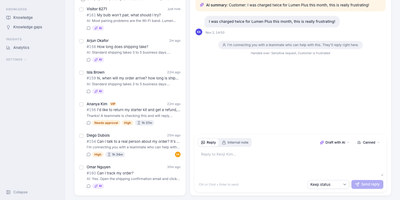
Behind one script tag on your website, Euron Open SupportDesk runs an AI help desk that answers customers from your documents, cites sources, and hands everything else to your team. Feed it PDFs, Word files, Markdown, HTML, or FAQ CSVs, or point it at a page or sitemap, and it indexes them in the background. No source, no answer. Your team gets the handoff with the transcript, a summary, and the reason. Refunds, cancellations, account changes, billing disputes, and data deletion are held for approval, and VIP or frustrated customers go straight to a person. Questions the documents miss become knowledge gaps. An agent's reply turns into the draft article, and publishing it lets the AI answer next time. Start with no API key at all, quoting your documents, or pick a local Ollama model, Anthropic, OpenAI, or vLLM. A ledger tracks tokens, cost, and delay for every model call, and daily or monthly budgets cap the spend. Around the AI sits a full helpdesk: shared inbox, views, round-robin routing by capacity, SLA timers, canned replies, and bulk actions. Customers reach you through the widget, threaded email, a magic-link portal, or a public help center. Analytics track first response, resolution time, deflection, and CSAT, and a REST API with signed webhooks feeds your other tools. Running on a dedicated VPS on RepoCloud with guaranteed CPU, RAM, and SSD, full root SSH access, and a browser serial console. MIT licensed.
Euron Open VoiceOS
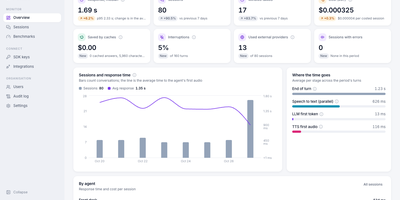
Every second of a voice conversation gets a timestamp and a price tag in Euron Open VoiceOS, a platform for building real-time voice agents that listen, think, and speak. Start from a template, such as receptionist, tutor, or meeting assistant, and talk to it in the browser. Each turn is split into end of turn, speech to text, the model's first token, and first audio, and each session adds usage and an estimated cost, so you see where time and money went. Local Whisper hears and local Kokoro speaks, so a new agent needs no cloud account, and any stage can switch to Deepgram, Sarvam, ElevenLabs, Cartesia, Anthropic, or any OpenAI-compatible endpoint. Callers can interrupt at any moment, and a failing provider earns a spoken apology instead of silence. No audio is ever stored, transcripts are redacted for emails, phone numbers, and cards, and callers are told up front when a provider runs outside your servers. A phrase cache, a response cache, and small-model routing for short turns trim the bill. Developers mint SDK keys scoped to agents and website origins, trade them for one-minute session tickets, and connect from any browser over WebRTC or WebSocket. Hindi templates come ready to use, and a bundled benchmark scores word error rate for English, Hindi, and Marathi. Running on a dedicated VPS on RepoCloud with guaranteed CPU, RAM, and SSD, full root SSH access, and a browser serial console. MIT licensed.