Hi.Events
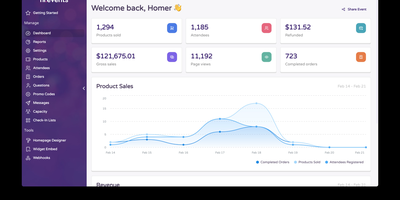
Hi.Events is an alternative to Eventbrite, Tickettailor, and Dice.fm, eliminating per-ticket platform fees entirely when self-hosted. Event organizers create fully brandable event pages supporting paid, free, donation, and tiered ticket types with recurring and multi-date scheduling, sold-out waitlists that automatically release tickets when spots open, and product add-ons with category organization. Stripe Connect integration processes payments directly to the organizer's bank account with instant payouts, while offline payment methods support cash and invoice scenarios. Promo codes offer fixed or percentage discounts with usage limits, expiry dates, and promo-gated hidden tickets for VIP access. QR code check-in enables fast door scanning with multiple check-in lists, scan logs, and real-time attendance tracking across entry points. Custom checkout questions collect attendee information beyond standard fields, with advanced search, filtering, CSV and XLSX export, full and partial refunds, and bulk attendee messaging. The analytics dashboard tracks daily sales, revenue, tax breakdowns, product performance, and promo code usage with exportable reports, while affiliate tracking assigns custom codes to promoters with tracked sales data. Multi-user roles control organizer permissions, automatic invoicing generates receipts, and the REST API ships with interactive OpenAPI documentation. Running on a dedicated VPS on RepoCloud with guaranteed CPU, RAM, and SSD, full root SSH access, and a browser serial console. AGPL-3.0 licensed.
EasyAppointments
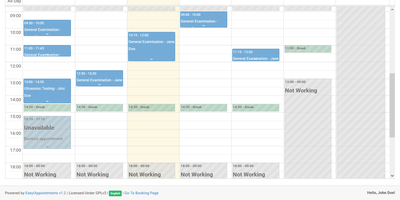
Service businesses get a booking page without per-booking commissions or monthly SaaS fees from Easy!Appointments, the self-hosted appointment scheduler. Customers pick a service, provider, and open time slot from a clean web form; the system enforces working plans, breaks, and booking rules you define per provider, then confirms by email to both sides. The structure fits real service organizations: multiple providers with individual schedules, multiple service types with their own durations and prices, and admin/secretary roles for front-desk management. Two-way Google Calendar synchronization keeps each provider's external calendar authoritative - book in Easy!Appointments and it appears in Google Calendar, block time in Google and the slot disappears from the booking form. Version 1.6 adds SMS notifications and payment support, and a REST API opens the scheduling data to custom integrations. Built on PHP (CodeIgniter) with MySQL, it installs in a single folder and can share a database with your existing site; a WordPress plugin embeds the booking form directly in pages or posts. The interface ships in dozens of languages with time-zone handling throughout. GPL-3.0 licensed and free for commercial use - a helpdesk, clinic, salon, or consultancy runs its whole booking workflow on its own server.
Calcom
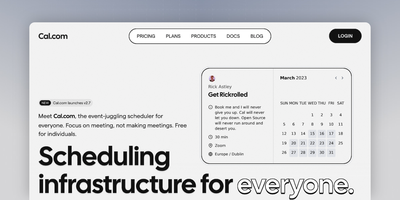
Scheduling infrastructure, not just a booking page - Cal.com is the leading open-source scheduling platform. Share a link, attendees pick a slot, and real-time sync against Google Calendar, Outlook, and CalDAV prevents double-booking. Beyond the basics it covers team workflows: round-robin distribution, collective availability across multiple hosts, recurring meetings, and routing forms that ask bookers questions and send them to the right team member - the feature sales and support teams usually pay enterprise prices for. Paid bookings run through Stripe, video calls through the built-in Cal Video (Daily.co) or Zoom and Google Meet, and an app store connects 100+ tools including HubSpot, Zapier, and n8n. The API-first architecture with webhooks and embeds makes it practical to build scheduling into your own product, white-labeled with your domain and branding. Built on Next.js and Prisma over PostgreSQL, translated into 65+ languages, with the self-hostable community codebase maintained under an open-source license.
Shelf
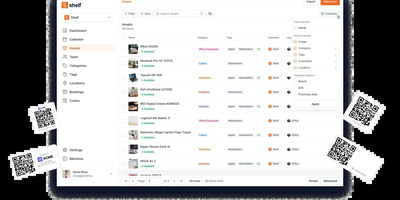
Shelf answers the three questions every equipment manager dreads — who has it, where is it, and when is it coming back — using QR-code-first tracking where every asset gets a unique scannable label, every handover is logged with timestamps and e-signed custody agreements, and every scan captures GPS coordinates displayed on a map. Built on React Router 7 with React 19, TypeScript 5, Prisma 6 ORM, and Tailwind CSS 3 with Radix UI components, the platform generates QR codes and barcodes (Code128, Code39, Datamatrix) printable on DYMO, Brother, and Zebra label printers. The custody system records every handover with user details and generates PDF custody agreements with e-signatures for high-value items, while a complete audit trail tracks responsibility from check-out to return. The visual booking calendar prevents double-bookings automatically, supports partial check-outs and returns with segmented lifecycle bars, and handles quantity-tracked consumables alongside individually serialized equipment. Asset Models enable bulk creation of identical items with shared defaults while maintaining individual QR codes and custody histories. Location tracking displays last-scanned GPS coordinates on MapTiler maps. Supabase Auth provides email and SSO authentication, pg-boss handles background job queuing, and Nodemailer delivers SMTP email. The Shelf Companion app on iOS and Android enables field scanning and bookings. Export Asset Inventory, Asset Distribution, and Custody Snapshot reports for compliance. Deploy via Docker with PostgreSQL and Supabase. Running on a dedicated VPS on RepoCloud with guaranteed CPU, RAM, and SSD, full root SSH access, and a browser serial console. AGPL v3.0 licensed.
Tymeslot
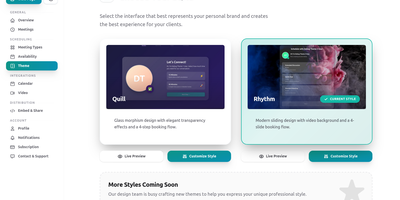
Built on Elixir's fault-tolerant OTP runtime, Tymeslot delivers the complete scheduling toolkit that Calendly charges for and Cal.com relicensed away from open source in 2026. Share one booking link and let clients pick available slots — your calendar stays synchronized and double-bookings disappear automatically through real-time availability checking against Google Calendar, Microsoft Outlook, and any CalDAV server including Nextcloud. Meeting types support configurable durations, buffer times, and availability windows that clients can book without email back-and-forth. Phoenix LiveView powers the real-time UI with WebSocket connections that update instantly as bookings arrive, without client-side JavaScript framework overhead. The platform attaches Zoom video rooms to confirmed bookings through your own Marketplace app credentials, sends confirmation and reminder emails via SMTP, Postmark, SendGrid, Mailgun, or AhaSend, and supports custom booking page themes with embed options for integration into existing websites. Circuit breakers, connection pooling, and graceful degradation maintain availability during provider outages. Authentication supports local accounts, GitHub OAuth, and reCAPTCHA protection on public booking forms. Self-hosting deploys as a single container with PostgreSQL embedded — no separate database container required. Two named volumes persist uploads and database state, while the same image powers the managed cloud at tymeslot.app so self-hosted users get identical features without a crippled community edition. Deploy via Docker, Cloudron with automatic updates, or Railway from a community template. Running on a dedicated VPS on RepoCloud with guaranteed CPU, RAM, and SSD, full root SSH access, and a browser serial console. AGPL-3.0 licensed.
Cal.diy
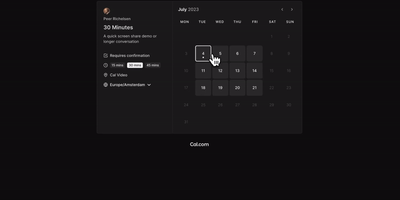
With over 47,000 GitHub stars, Cal.diy is the fully open-source community fork of Cal.com that strips away every proprietary license gate and enterprise paywall to deliver a pure MIT-licensed scheduling platform you completely own. The booking engine supports individual event types including recurring events, seated events with capacity limits, and paid bookings through Stripe and PayPal, all backed by customizable availability schedules with date overrides, buffer times, minimum notice periods, and travel schedule support. Calendar synchronization is bidirectional across nine providers — Google Calendar, Outlook and Office 365, Apple Calendar, CalDAV, Lark, Feishu, Zoho, Exchange, and ICS feeds — so every booking automatically appears on your existing calendar while blocking conflicting slots. Video conferencing links generate automatically for Zoom, Google Meet, Microsoft Teams, Webex, Jitsi, Daily.co, Whereby, and Huddle01, eliminating manual link management. The automation layer connects through webhooks, Zapier, n8n, Make, and Pipedream to CRM platforms like HubSpot, Salesforce, and Close, messaging services including Discord, Telegram, and WhatsApp, and analytics tools such as Google Analytics 4, PostHog, and Fathom. The entire application is built on the T3 stack — Next.js for server-rendered pages, tRPC for end-to-end type-safe APIs, Prisma for PostgreSQL database access, and Tailwind CSS for the responsive interface. Unlike Cal.com's open-core model, Cal.diy requires no license key and includes no gated features. Running on a dedicated VPS on RepoCloud with guaranteed CPU, RAM, and SSD, full root SSH access, and a browser serial console. MIT licensed.
Seatsurfing
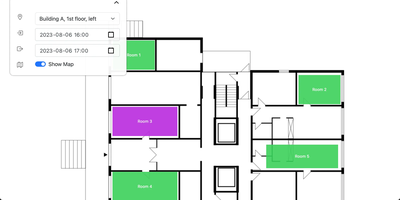
Seatsurfing brings desk booking, room reservations, and parking management to interactive floor plans across multiple office locations, solving the coordination headache of hybrid work. The Go backend serves two React/TypeScript frontends through a single Docker container on port 8080: a Booking UI built as an installable Progressive Web App for mobile and desktop reservations, and an Admin UI for floor plan configuration, capacity enforcement, and analytics. Interactive floor plans accept uploaded office layouts where administrators visually place bookable spaces with per-space metadata and availability rules. Multi-location support handles organizations with distributed offices across multiple buildings and cities. The buddy system displays which colleagues have bookings on a given day, enabling team coordination without manual communication. Capacity management enforces occupancy limits per area with automatic denial when thresholds are reached. SSO integration supports OIDC and OAuth2 providers including Microsoft Azure AD, Keycloak, and Authentik for enterprise identity federation. Microsoft Teams and Confluence integrations embed booking directly into collaboration tools employees already use daily. The REST API enables automation and custom integrations, while the analytics dashboard tracks utilization rates, peak hours, and booking patterns. Docker Compose deployment requires only a PostgreSQL database with multi-architecture images supporting amd64 and arm64. Running on a dedicated VPS on RepoCloud with guaranteed CPU, RAM, and SSD, full root SSH access, and a browser serial console. GPL-3.0 licensed.
eLabFTW
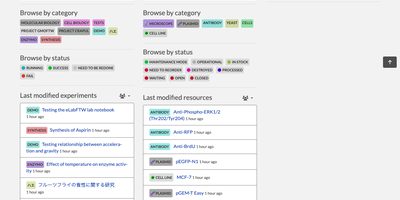
For research teams that need to show what was recorded and when, eLabFTW® is an electronic lab notebook that keeps experiments, lab inventory, and equipment bookings in one shared, searchable system. Each experiment holds rich-text notes, tables, images, checkable steps, custom metadata fields, tags, statuses, and attached files. Templates turn a protocol you repeat into a one-click starting point. A separate resource database catalogs antibodies, plasmids, cell lines, chemicals, and instruments, and typing # in an experiment links straight to any of them. Compounds import from PubChem by CID or CAS number, arriving with formulas, identifiers, and hazard data. The inventory tree maps buildings and their sub-locations, records where each container is stored, and tracks quantity and unit. Book a microscope by dragging a slot on the scheduler, and permissions decide who may reserve what. Entries can be signed with Ed25519 keys and timestamped through RFC 3161 authorities such as DFN, Digicert, and GlobalSign, or anchored on the Bloxberg blockchain; a timestamp archive can never be edited or deleted. Export to PDF, ZIP, CSV, JSON, or .eln archives, and import .eln or CSV files when moving from spreadsheets or another notebook. Users sign in locally or through SAML2 or LDAP, and an API with per-user keys lets instruments and scripts read and write entries. Running on a dedicated VPS on RepoCloud with guaranteed CPU, RAM, and SSD, full root SSH access, and a browser serial console. AGPL-3.0 licensed.
LibreBooking
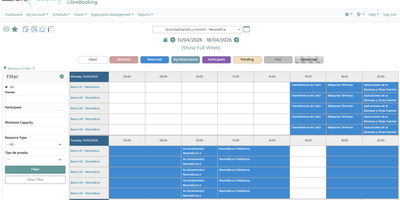
Conference rooms, equipment, boats, and even people can be reserved through LibreBooking, a self-hosted scheduler that keeps double bookings off the calendar. Schedules define bookable time slots with custom layouts and seasonal availability, while each resource carries its own minimum and maximum duration, buffer time, lead time, capacity, and optional approval step. Check-in and check-out can release unclaimed slots automatically, and blackout times close resources for maintenance. Quotas stack limits by hours or reservation count, credits meter peak and off-peak usage, and users can buy credits through Stripe or PayPal. Accessories such as projectors or chairs ride along with a booking under their own quantity limits. Groups carry application, group, resource, and schedule administrator roles, and custom attributes extend reservations, resources, and users with text, dropdown, date, or checkbox fields. Reports can be charted, exported to CSV, printed, or emailed, and public resources publish RSS and iCalendar feeds for Outlook and Thunderbird plus an embeddable calendar snippet. A tablet view beside a door shows live availability for on-the-spot booking, a monitor view fills lobby screens, and a Slack command starts a reservation. Sign-in options include LDAP, Active Directory, OAuth2, and SAML, and the REST JSON API automates bookings. Users can join waitlists, request reminder emails, and accept terms of service before booking, while six color themes restyle the interface. Running on a dedicated VPS on RepoCloud with guaranteed CPU, RAM, and SSD, full root SSH access, and a browser serial console. GPL-3.0 licensed.