ClawMetry
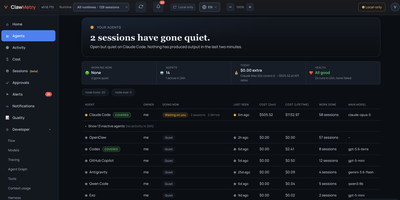
Without an SDK, a proxy, or a single line of agent code changed, ClawMetry reads the session files your AI agents already write and puts every session, tool call, token, and dollar on one live dashboard. The sessions view replays a run turn by turn, with a timeline that gives each tool call its own duration and cost, so a four-minute shell command stands apart from a call that took milliseconds. Usage charts split tokens and spend by runtime, model, session, and day. A live flow diagram follows messages from chat channels through the gateway to models and tools, and a context view tracks window use per turn along with compaction events. The Brain tab streams reasoning, tool calls, and errors as they happen, while memory, skills, health, logs, and cron jobs each get a tab of their own. OTLP receivers accept traces, metrics, and logs from runtimes that keep no local files. The MIT-licensed app reads OpenClaw, NVIDIA NemoClaw, Goose, and Qwen Code for free. Paid plans add the other 28 runtimes, including Claude Code, Codex, and Cursor, plus approval queues for risky tool calls, budget limits, anomaly detection, and a cost optimizer. Session data stays on your server unless you choose to run cloud sync. Running on a dedicated VPS on RepoCloud with guaranteed CPU, RAM, and SSD, full root SSH access, and a browser serial console. MIT licensed.
Codeg
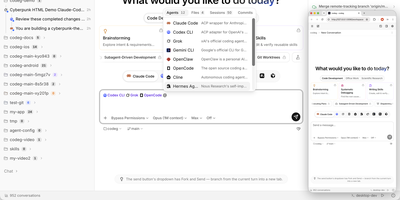
Run Claude Code, Codex, Gemini CLI, OpenCode, and sixteen other AI coding agents from one workspace instead of juggling twenty terminals. Every agent connects through the Agent Client Protocol, so conversations render as structured chats with tool cards, live diffs, and interactive replies rather than raw terminal scrollback. Codeg imports the session history each agent already keeps on disk, making every past conversation searchable and resumable, even when you hand the thread to a different agent. Mention one agent with an @ to delegate work to another, or run several side by side and watch their progress stream into the same conversation. Queued to-dos execute unattended in isolated git worktrees, leaving finished changes ready for your review and approval instead of touching your working tree. An infinite canvas arranges chats, files, terminals, and notes on one board, while git tooling, token usage tracking, and MCP server support stay one panel away. Deployed as a headless server, Codeg answers in any browser and through Telegram, Lark, and WeChat channels, so agent work continues while you are away from your desk. Running on a dedicated VPS on RepoCloud with guaranteed CPU, RAM, and SSD, full root SSH access, and a browser serial console. Apache-2.0 licensed.
HeadlessX
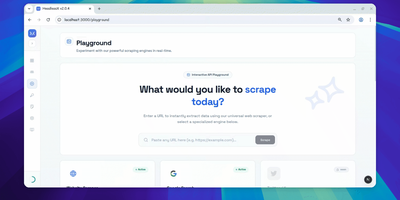
With 2,000 GitHub stars and 10 releases since its September 2025 launch, HeadlessX delivers a self-hosted browser automation platform that replaces Chromium-based scraping with Camoufox — a Firefox fork performing kernel-level fingerprint spoofing to achieve 0% detection across Cloudflare, DataDome, PerimeterX, and other anti-bot systems where Puppeteer and Playwright regularly fail. The web dashboard provides workspace-based job organization with a visual interface for configuring scrape targets, managing browser profiles, monitoring queue status, and viewing extracted results in real time. The protected REST API accepts requests with API key authentication for programmatic access, supporting HTML extraction, screenshot capture, PDF generation, and structured data parsing with configurable stealth parameters. Profile-based scraping maintains persistent browser contexts with cookie jars, localStorage, and fingerprint configurations that survive between requests — reducing cold-start latency from 25 seconds to under 2 seconds on subsequent requests. Queue-backed workflows enable batch processing of URLs with configurable concurrency, retry logic, and webhook notifications on completion. The Google AI Search integration provides AI-assisted web research workflows through dedicated endpoints. Remote MCP support exposes automation capabilities as tool endpoints for AI agent integration. Deploy via the official CLI with `headlessx init` and `headlessx start` commands, scaffolding a Docker Compose stack with Caddy reverse proxy for automatic HTTPS. Running on a dedicated VPS on RepoCloud with guaranteed CPU, RAM, and SSD, full root SSH access, and a browser serial console. MIT licensed.
Pinchy
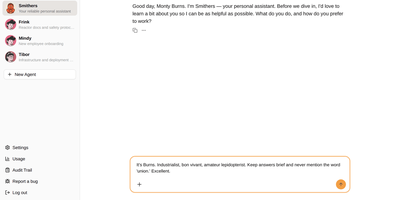
Pinchy gives every team its own AI assistants without handing any of them the keys to the building. Create an agent per role, pick a personality preset like the Butler or the Professor, and choose a model from Anthropic, OpenAI, Google, any OpenAI-compatible endpoint, or a local Ollama. Each agent starts with nothing allowed. You switch on memory, file creation, web search, email, and other tools one by one, and point knowledge base agents at read-only folders so answers arrive with the source document and page cited. A new user meets Smithers, an onboarding assistant that interviews them to learn how they work. Colleagues reach agents in the web chat or in Telegram, with one bot per agent and the same permissions behind both. Email connects to Gmail, Microsoft 365, or any IMAP mailbox for reading, searching, and drafting, and Odoo templates handle sales and invoice chores inside your ERP. Admins invite members, and a tamper-evident audit trail records who did what, with integrity checks and CSV export. Running on a dedicated VPS on RepoCloud with guaranteed CPU, RAM, and SSD, full root SSH access, and a browser serial console. AGPL-3.0 licensed.
Aurora
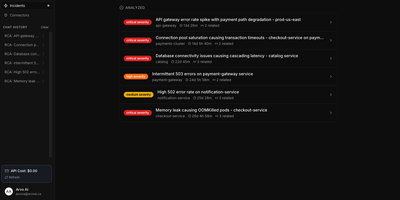
Aurora is an open-source AI SRE agent that investigates production incidents on its own, turning each incoming alert into a structured root cause analysis with evidence and a suggested fix. Alerts arrive from PagerDuty, Datadog, Grafana, New Relic, OpsGenie, incident.io, or CloudWatch, and every one triggers a background investigation without waiting for a human to pick it up. The agents choose from more than thirty tools, run cloud and cluster commands inside sandboxed pods, query logs, compare deployments, and search a knowledge base of past incidents for similar failures. An infrastructure dependency graph shows the blast radius across services and providers. When the root cause is found in code, Aurora can draft the remediation as a pull request instead of stopping at a diagnosis. Finished investigations become postmortems with a timeline, impact assessment, and remediation steps, exportable to Confluence, Notion, or SharePoint, and automated actions can open the fix, notify Slack, or update living documents as new evidence lands. Command policies and guardrails bound what the agents may run, and any major language model provider can power the reasoning, cloud-hosted or local. Running on a dedicated VPS on RepoCloud with guaranteed CPU, RAM, and SSD, full root SSH access, and a browser serial console. Apache-2.0 licensed.
Omni
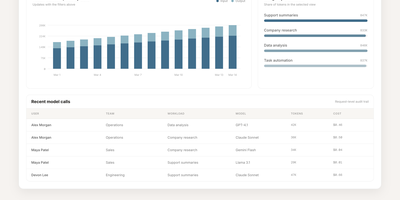
Omni is an open-source workplace AI agent and enterprise search platform that unites your company's scattered tools into a single context-aware workspace where team members can find answers and automate cross-application workflows. Employees can query connected knowledge sources including Google Drive, Gmail, Slack, Jira, GitHub, Confluence, and HubSpot to locate project specifications, customer records, and operational documents without jumping across tabs. The integrated AI assistant answers complex multi-step inquiries, summarizes lengthy email threads, and cites exact source passages so workers can verify factual accuracy before making business decisions. Granular permission inheritance mirrors existing access controls across every connected service, guaranteeing that sensitive personnel files, financial statements, and confidential repositories remain hidden from unauthorized staff. Engineers can construct bespoke data connectors and define automated agent skills through the extensible Python and TypeScript software development kits, triggering multi-service actions directly from interactive chat dialogues. Administrators can monitor background synchronization jobs, inspect audit trails, manage single sign-on access, and configure custom extraction pipelines using centralized operational dashboards. Running on a dedicated VPS on RepoCloud with guaranteed CPU, RAM, and SSD, full root SSH access, and a browser serial console. Apache 2.0 licensed.
PandaDOS
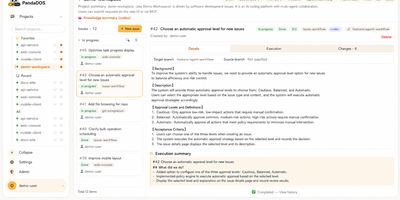
PandaDOS is a self-hosted control plane that turns Claude Code and Codex into long-running coding agents you direct through an issue queue from any browser, instead of babysitting a terminal. You file an issue with the outcome and acceptance criteria, and PandaDOS clarifies missing requirements, plans the work, picks the agent, and drives implementation, verification, and delivery in stages. Three approval levels, cautious, balanced, and automatic, decide which actions proceed alone; safe reversible steps continue automatically while destructive, irreversible, production, or secret-related decisions always come back to you. The browser workspace shows the real agent conversation, a native terminal, project files, Git history and diffs, and an execution summary, so you can inspect or intervene at any moment from a phone or laptop. Agents run on local or SSH-connected executor machines inside tmux sessions, and work sharing one repository is serialized while independent projects proceed in parallel without conflicting edits. Modules keep one assigned agent and durable project knowledge, so context from finished issues carries into the next task instead of evaporating when a chat ends. Teams can sign in through Feishu, ask the project manager questions in chat, and receive subscription notifications and approval cards on their phones. Running on a dedicated VPS on RepoCloud with guaranteed CPU, RAM, and SSD, full root SSH access, and a browser serial console. Apache-2.0 licensed.
CodeRail
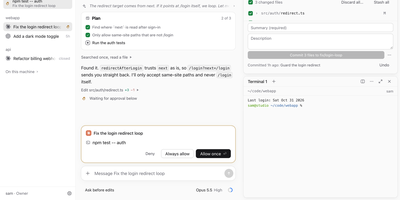
Close the laptop, walk away, and your coding agents keep working; CodeRail is the remote control that lets you supervise them from a browser or your phone without handing your machines to anyone's cloud. A small bridge on each computer connects outbound to your server, so there are no open ports and no VPN to babysit, and each machine keeps its own Claude Code and Codex logins because CodeRail never holds your AI keys. Chats show plans, tool calls, models, modes, and background tasks, and when an agent wants to run something sensitive, the approval lands with you wherever you are, including as a phone push notification. Real terminals outlive the browser tab, files can be viewed, edited, uploaded, and downloaded in place, and git work, pull requests included, sits beside the conversation that produced it. Each chat even gets a browser on the computer itself, shared live with everyone in the chat and drivable by the agent. Roles run Owner, Operator, or Viewer per computer, narrowed down to folders and agents, with every change audited, and sessions keep running with every browser closed while history stays readable offline. Running on a dedicated VPS on RepoCloud with guaranteed CPU, RAM, and SSD, full root SSH access, and a browser serial console. Apache-2.0 licensed.
OpenSuperBot
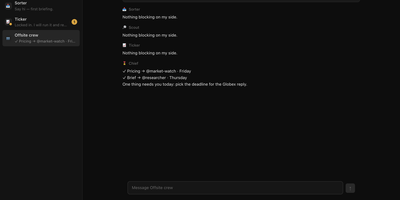
Always-on AI teammates that each get a real computer of their own, with a browser, files and a terminal, working from your hardware instead of a vendor cloud: that is OpenSuperBot. You hire a teammate from the sidebar with a name and a one-line job, and it works inside its own sealed computer with a browser, shell and persistent workspace. At a login wall the bot asks you to take over its live screen and sign in once inside its own browser profile, so passwords never pass through the gateway. Group threads let you ask the whole room at once: everyone answers in parallel, the chief of staff closes with a dispatch table, and @names pick which teammates respond. Nothing leaves the workspace without your say-so, because outward actions stop at a draft-and-hold approval chip. Standing approvals cover repeat sends to one destination for an hour or a day, and money and bookings always ask. Memory is a visible file you control: tell a bot a rule and it posts the exact change as a chip, and forget removes it the same way. Routines come from plain conversation, so a daily digest, a secret webhook trigger or a quiet status-page watch can be scheduled in chat. Each teammate runs a model you pick, with daily token budgets and live step cards for every action. Running on a dedicated VPS on RepoCloud with guaranteed CPU, RAM, and SSD, full root SSH access, and a browser serial console. MIT licensed.
DBHub
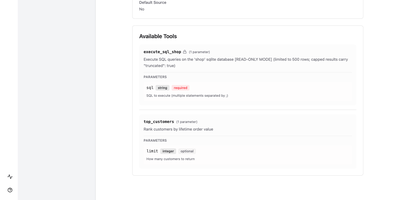
Give every AI assistant on your team safe, structured access to your databases through one small server. DBHub exposes just two tools by default, one to run SQL and one to search schemas, which costs about 1.4k tokens of context where alternatives load nearly 20k. Point Claude Code, Claude Desktop, Cursor, VS Code, or Copilot CLI at it and they can explore tables, columns, indexes, and procedures step by step, then run queries under read-only mode, row limits, and timeouts. Define several sources in one TOML file and DBHub serves PostgreSQL, MySQL, MariaDB, SQL Server, Oracle, and SQLite side by side. Write custom tools for the queries you repeat, with typed parameters and allowed values, so models call a clean function instead of improvising SQL. Opt in to query plans and connection-pool health checks when you need them. A built-in workbench in the browser runs statements, fills in custom tool forms, and lists a trace of every recent request with timing and client. SSH tunnels and SSL reach databases behind bastion hosts, and a bearer token protects the HTTP endpoint. Running on a dedicated VPS on RepoCloud with guaranteed CPU, RAM, and SSD, full root SSH access, and a browser serial console. MIT licensed.
Flowcat
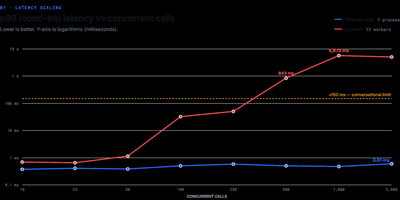
Real-time voice agents get a native Rust runtime in Flowcat: it carries a phone or WebRTC call through a composable media pipeline on your own infrastructure, so latency-sensitive audio never queues behind a managed platform. Audio flows from transport into voice activity detection and turn-taking, then through speech-to-text, an LLM, and text-to-speech, or a single speech-to-speech model, and back out to the caller, with in-process SIP and RTP for telephony. Pair it with local Whisper transcription, Kokoro, Piper, or XTTS for speech, and Ollama for reasoning, and a call's audio and transcript never leave your network; cloud providers plug in by name when you prefer them. Describe one agent in a YAML or JSON node-and-edge graph and the single flowcat-server binary serves it over HTTP, opening a browser page with microphone and live transcript, or bridging a Plivo number into the same agent. The runtime stays flat as call volume grows: benchmarked against a multiprocess Python baseline, one process holds p99 round-trip overhead at or below 0.61 milliseconds from 10 to 2,000 concurrent calls, at roughly 19.6 KB of RAM per idle session. Deploy it inside your VPC or an air-gapped environment where call recordings are sensitive. Running on a dedicated VPS on RepoCloud with guaranteed CPU, RAM, and SSD, full root SSH access, and a browser serial console. Apache-2.0 licensed.
Coder
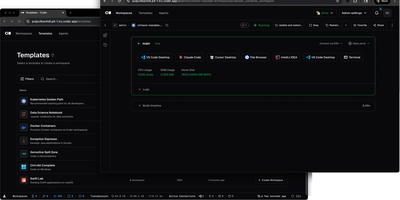
With over 14,000 GitHub stars and enterprise adoption by security-conscious organizations, Coder transforms how development teams provision, manage, and secure their coding environments. Every workspace is defined as a Terraform template, meaning infrastructure engineers can standardize development environments across EC2 instances, Kubernetes pods, Docker containers, or any combination, while developers get self-service provisioning that launches in seconds rather than days of manual setup. The WireGuard-based networking layer establishes encrypted tunnels between developer machines and remote workspaces, providing low-latency access without exposing ports or configuring VPN concentrators. Automatic idle detection shuts down unused workspaces after configurable periods, directly reducing cloud compute costs for organizations running hundreds of developer environments. The Coder Agents feature introduces native AI coding capabilities where the agent loop executes entirely within the control plane on self-hosted infrastructure, keeping LLM API credentials out of individual workspaces and eliminating credential exfiltration risks. Centralized model governance allows platform teams to approve specific AI providers and models, set per-user spend limits, and maintain complete audit logs of all prompts, tool calls, and agent activity. IDE integration supports VS Code through a dedicated extension, JetBrains IDEs via Gateway and Toolbox plugins, and browser-based code-server for web access. The template registry provides pre-built configurations for common development stacks. DevContainer support builds environments from standard devcontainer.json specifications. Deploy on a dedicated VPS on RepoCloud with guaranteed CPU, RAM, and SSD, full root SSH access, and a browser serial console. AGPL-3.0 licensed.
Super Agent Party
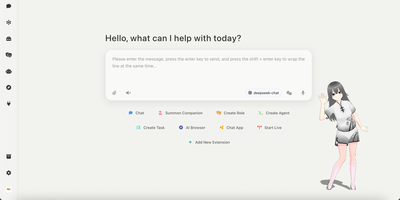
Super Agent Party gives you an AI companion with a face, a memory, and a to-do list, all running on your own server. The home screen starts a chat, summons a companion, creates a role or agent, queues a task, opens an AI browser, or adds an extension. Characters can appear as VRM 3D avatars, and character cards with long-term memory let several personas talk together in one group chat. The Task Center hands longer jobs to an agent that works in the background, calls tools through MCP and Agent Skills, and records every step in an execution timeline. A built-in browser lets agents open pages and act on them, and desktop vision tools can drive the mouse, keyboard, and terminal. One-click bot deployment connects an agent to Telegram, Discord, Slack, QQ, WeChat, Feishu, and DingTalk, and live-stream bots cover Bilibili, YouTube, and Twitch. The developer page serves an OpenAI-style endpoint, so other apps can call an agent as if it were a model. Extensions open in a sidebar or their own window. Running on a dedicated VPS on RepoCloud with guaranteed CPU, RAM, and SSD, full root SSH access, and a browser serial console. AGPL-3.0 licensed.
magpie
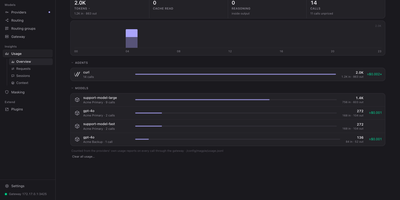
Point every coding agent and chat client at one self-hosted gateway, then choose which model answers from a single browser console. Add providers by preset or custom OpenAI-compatible URL, or sign in with the subscriptions you already pay for. Routing groups bundle several models into one name and move to the next member when a quota runs out, so the calling agent never sees the error. Create a gateway key per client, cap each with daily token or cost budgets, restrict its models, and watch usage counted separately. The Usage pages chart tokens, cost, request counts, cache hit rate, and a yearly heatmap, split by model, provider, or agent, with CSV export. A Routing view replays how each request was routed, with timing for masking, connecting, and the vendor. Masking swaps passwords, API keys, and tokens for placeholders before a prompt leaves your server and restores them in the answer. The browser page is protected by a key you set at launch. Running on a dedicated VPS on RepoCloud with guaranteed CPU, RAM, and SSD, full root SSH access, and a browser serial console. MIT licensed.
Liaison
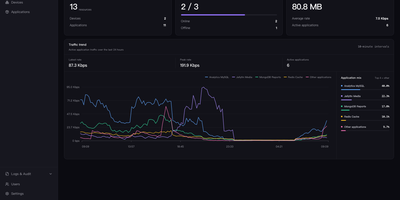
Liaison puts every private service you run behind one browser console, so a laptop, a homelab box, or a customer server becomes reachable without opening a single inbound port. Install a lightweight connector on each device and it dials out to the control plane, where administrators register applications over TCP, HTTP, HTTPS, WebSocket, and SSH and grant access per user. Browser workspaces cover audited Web SSH terminals, RDP and VNC desktops, SFTP file management, read-only S3 browsing, and database clients for MySQL, PostgreSQL, MariaDB, SQL Server, Oracle, MongoDB, and Redis, each with a session Agent that drafts commands and explains query results once you approve them. Local models are shared through authenticated APIs with a browser Playground, scoped keys, token quotas, and usage tracking, while Codex and Claude Code run on your own devices with resumable sessions and permission prompts. A built-in code-server IDE edits projects remotely, and on-demand TCP ports open for 5 to 300 seconds. Casbin-backed identity management, firewall policies by source IP or CIDR, and logs of management actions and supported sessions keep access accountable. Application discovery scans connector devices for existing services and registers them from the console. Running on a dedicated VPS on RepoCloud with guaranteed CPU, RAM, and SSD, full root SSH access, and a browser serial console. AGPL-3.0 licensed.
Pad
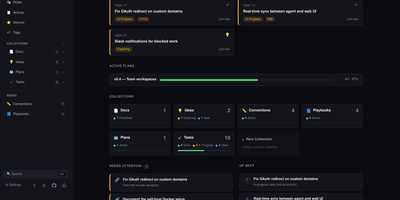
Your coding agents finish a session, close the laptop, and forget everything; Pad is where the project remembers. It holds the tasks, plans, bugs, ideas, and decisions in one workspace that you drive from a browser while your agents drive it from the terminal, so the next session, human or machine, picks up exactly where the last one stopped. You plan on boards, lists, and tables with drag-and-drop status columns, rich item pages, comment threads, and a dashboard that answers what needs attention and what to do next. Your agents read the queue, claim items, leave checkpoints, link their pull requests, and mark work fixed with the fixing PR attached. Conventions teach them the house rules once, like running tests before calling a task done, and playbooks hand them repeatable multi-step workflows they can invoke by name. Every change is versioned with its author, a person or a named agent, and new items appear in the browser the moment an agent creates them in the terminal. The same workspace is reachable three ways: the web interface, the pad CLI, and a bundled MCP server with a natural-language skill that plugs into Claude Code, Cursor, Codex, Windsurf, OpenCode, Copilot, Amazon Q, and Junie. Running on a dedicated VPS on RepoCloud with guaranteed CPU, RAM, and SSD, full root SSH access, and a browser serial console. Apache-2.0 licensed.
LangBot
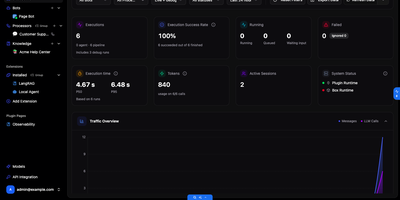
Connect one AI assistant to every chat app your customers already use, then manage it from a single admin panel. Create a bot for Slack, Discord, Telegram, LINE, Lark, DingTalk, WeCom, Matrix, KOOK, or QQ, or embed the Page Bot widget on a website with one script tag. Event routing sends each message to the processor you choose, and a pipeline controls triggers, safety rules, the model and prompt, and how replies are sent. A built-in Debug Chat streams answers as you edit, in private or group sessions. Knowledge bases split uploaded documents into chunks and search them by vector, full-text, or hybrid matching, with query rewriting and reranking options. Add providers like OpenAI, Anthropic, DeepSeek, Gemini, and Ollama, then give each pipeline its own models. The dashboard counts executions, success rate, token usage, and active sessions, and tabs list model calls, user feedback, and error logs. Sessions show the full conversation for each user, with a button to reset context. Install plugins and MCP servers from the extension marketplace to add tools. Use it for a support bot, a community assistant, an internal helpdesk, or a multi-channel front desk. Running on a dedicated VPS on RepoCloud with guaranteed CPU, RAM, and SSD, full root SSH access, and a browser serial console. Apache-2.0 licensed.
Observal
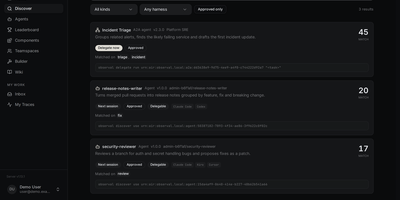
To pull a team's skills, MCP servers, hooks, prompts, and agent files out of scattered Git repositories, Observal keeps them in one reviewed registry and traces real sessions to show which ones help. Build an agent visually, with a live config preview for every harness. Submissions wait in an admin review queue, where reviewers inspect side-by-side version diffs before approving a release. Teamspaces give each team its own namespace, and approved releases can be forked into independent drafts. One pull command then writes the right config for Claude Code, Cursor, Kiro, Codex, Copilot, Pi, OpenCode, Antigravity, or Goose. Every approved resource is discoverable through the open Agentic Resource Discovery standard, and a running agent can hand part of its task to another approved agent or a remote Agent2Agent service. Hooks record each session as a trace of prompts, tool calls, MCP round trips, tokens, and errors, with turn-by-turn replay for debugging and audits. Insight reports, generated through providers such as Anthropic, OpenAI, or Ollama, list what is working, what is hindering, and quick wins. A dashboard follows adoption, cost, and department usage, a leaderboard ranks agents by downloads, and audit logs, SAML single sign-on, and SCIM provisioning are included. Running on a dedicated VPS on RepoCloud with guaranteed CPU, RAM, and SSD, full root SSH access, and a browser serial console. Apache-2.0 licensed.