Suparagent
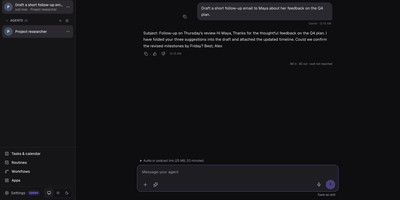
Suparagent turns a single server into a workspace of named AI coworkers that each have a job, a memory, and a folder of their own. Chat with an agent in the browser, pick an engine per conversation, and watch replies stream in as the sidebar keeps every thread searchable. Approval modes decide how much freedom an agent gets: ask first, accept edits, or plan only, so nothing touches a file or runs a command without your say. Routines send a prompt to an agent on chosen weekdays, through a webhook, or on demand, and every run lands in its own conversation. A kanban board with month, week, and upcoming views tracks tasks by owner and priority, and a canvas builds multi-step workflows from schedule triggers, model steps, agent steps, conditions, and approvals. Agents save notes you can edit, delegate to specialists in shared rooms, and reuse saved skills and templates. A usage panel totals turns and tokens by conversation, engine, and day, with a CSV export. Invite teammates with a one-time link, pair a phone, and keep agents working when your laptop is closed. Running on a dedicated VPS on RepoCloud with guaranteed CPU, RAM, and SSD, full root SSH access, and a browser serial console. Apache-2.0 licensed.
Nautilo
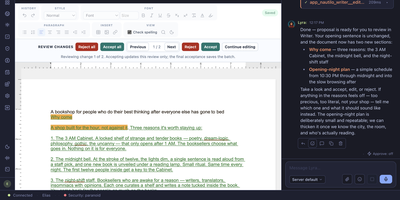
Most AI tools give one person one chat window; Nautilo is built for the room where your whole team, and each person's own AI Genie, work on the same thing at the same time. Give your Genie a personality, memory, face, and voice, then bring colleagues and their Genies into a shared Room to pull an idea apart, draft it, and send an agent off to research the missing piece. Six bundled creative apps cover the work itself: Writer for documents, Sheets for spreadsheets, Slides for decks, Board for planning, Design for visuals, and Video for clips, all editable by people and agents side by side. When the agent's draft misses, you grab the controls and rewrite the paragraph or move the lettering yourself instead of begging a prompt for a three-inch nudge. You choose the models and plug in your own provider API keys, connect tools through MCP, and let Genies operate connected workstations when a task needs real computer use. Membership, access, and tool permissions stay under your server's rules, and web, desktop, and mobile clients all connect to the same self-hosted instance. Running on a dedicated VPS on RepoCloud with guaranteed CPU, RAM, and SSD, full root SSH access, and a browser serial console. MIT licensed.
Tingly Box
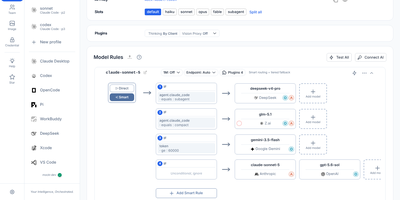
Give every agent your team runs the same front door, and the model chaos behind it becomes manageable. Tingly Box is a self-hosted gateway with a web console where providers, keys, routing rules, and team usage live in one place. Claude Code, OpenCode, Codex, Xcode, and other clients simply call the endpoint. A request arrives. The gateway reads your rules, weighs cost against speed against the policy you wrote, picks a model and a token, translates the protocol if the two ends disagree, and streams the answer back. Existing subscription quotas are spendable here, connected by OAuth beside ordinary API keys, and per-scenario profiles let quick edits and deep refactors land on different models by default. Team mode shares that endpoint properly. Model rules are managed centrally, each member receives a dedicated key, data stays isolated per user, and the usage dashboard shows exactly who consumed what. The gateway also speaks images, generating and editing through the same address with a playground for testing prompts before clients depend on them. Agents remain reachable after you leave the desk, driven through Telegram, DingTalk, Feishu, Lark, Weixin, or WeCom, with guardrails and an MCP gateway available as power-ups. Virtual models give new rules a safe target for testing and benchmarking before real traffic moves over. Running on a dedicated VPS on RepoCloud with guaranteed CPU, RAM, and SSD, full root SSH access, and a browser serial console. MPL-2.0 licensed.
Cloudflare OS
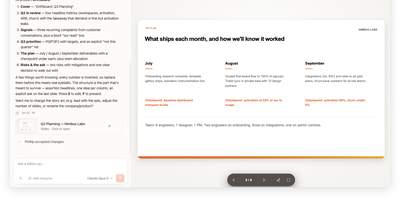
With over 7,700 GitHub stars and thousands of Cloudflare employees using it daily across every function, Cloudflare OS delivers an open-source AI workspace where every employee gets a personal agent grounded in company context, systems, and skills — not a generic chatbot but a programmable workspace that builds real applications, automates workflows, and connects to internal tools through governed access. The Code Mode agent writes and immediately executes code snippets to perform arbitrary tasks, build full-stack Gadgets with client code, server code, APIs, and durable SQLite state, debug errors, and test results within isolated sandboxes. Gadgets are private application instances running in separate sandboxes — each document, spreadsheet, or tool is its own secure runtime that cannot leak data even to attackers with access to other Gadgets. Blueprints enable sharing application code as templates that others instantiate with independent state, credentials, and resources. Gatekeepers provide security governance giving system owners precise control over what agents can see, change, and when human approval is required before actions execute. Built on Cloudflare Workers using Durable Objects for workspace persistence, Dynamic Workers for Gadget execution, and Facets for access management. Zero Trust security via Cloudflare Access verifies every user and request before granting access. Real-time collaboration lets colleagues use shared Gadgets. Deploy to your own Cloudflare account or self-host on workerd, the open-source Workers runtime, on your own servers. Running on a dedicated VPS on RepoCloud with guaranteed CPU, RAM, and SSD, full root SSH access, and a browser serial console. Apache-2.0 licensed.
ByteChef
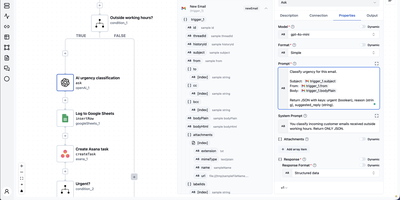
Drag an AI agent onto a canvas beside a Gmail trigger, a condition, and a Google Sheets step, and ByteChef runs the whole thing as one durable workflow that resumes where it stopped. Runs that fail or wait for a human pick up from the step they reached. The visual editor maps values between steps with data pills, and its 250+ connectors double as agent tools and MCP tools. An agent combines a model from twelve LLM providers, including OpenAI, Anthropic, Mistral, and Ollama, with chat memory, knowledge-base retrieval, and tools. It streams structured answers. Flow controls cover conditions, branches, loops, parallel and fork-join paths, subflows, error handling, and approval steps that pause for a person. Workflows start from webhooks, polling, schedules, forms, or app events, and code steps run JavaScript, Python, or Ruby. Workflows can be exposed through an MCP server for Claude Desktop, Cursor, or Windsurf, and ByteChef consumes external MCP servers too. Data Tables add typed relational tables with a spreadsheet-like grid and CSV import and export. The Agent Playbook opens a chat with the agent as you build it. Every run is listed with per-step input, output, and errors. Running on a dedicated VPS on RepoCloud with guaranteed CPU, RAM, and SSD, full root SSH access, and a browser serial console. Apache 2.0 + EE licensed.
LangBot
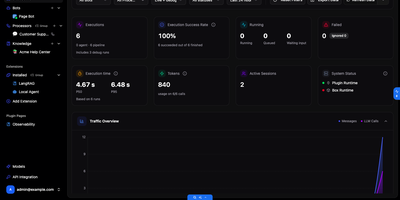
Connect one AI assistant to every chat app your customers already use, then manage it from a single admin panel. Create a bot for Slack, Discord, Telegram, LINE, Lark, DingTalk, WeCom, Matrix, KOOK, or QQ, or embed the Page Bot widget on a website with one script tag. Event routing sends each message to the processor you choose, and a pipeline controls triggers, safety rules, the model and prompt, and how replies are sent. A built-in Debug Chat streams answers as you edit, in private or group sessions. Knowledge bases split uploaded documents into chunks and search them by vector, full-text, or hybrid matching, with query rewriting and reranking options. Add providers like OpenAI, Anthropic, DeepSeek, Gemini, and Ollama, then give each pipeline its own models. The dashboard counts executions, success rate, token usage, and active sessions, and tabs list model calls, user feedback, and error logs. Sessions show the full conversation for each user, with a button to reset context. Install plugins and MCP servers from the extension marketplace to add tools. Use it for a support bot, a community assistant, an internal helpdesk, or a multi-channel front desk. Running on a dedicated VPS on RepoCloud with guaranteed CPU, RAM, and SSD, full root SSH access, and a browser serial console. Apache-2.0 licensed.
Markus
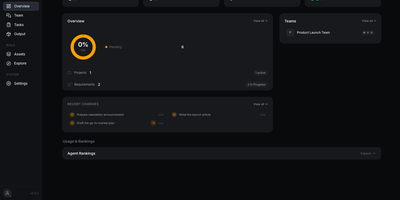
Markus is an AI workforce you run yourself: describe a goal in plain language and a team of specialist agents plans it, splits it into tasks, does the work, and reports back. A built-in Secretary agent hires agents from role templates, groups them into teams, and turns requirements into dependency-linked tasks. Work runs in parallel, each task in its own workspace, and a peer reviewer approves or sends back every delivery before it counts as done. Follow progress on a backlog table, a kanban board, or a dependency graph that shows which task unblocks which. Agents keep persistent memory, patrol their own task board around the clock, and can join team group chats or take direct messages. Connect Slack, Telegram, Discord, WhatsApp, or Feishu so people can reach agents where they already talk, and give agents browser and desktop automation through an optional Chrome extension. Pick any model provider, including Anthropic, OpenAI, Google, DeepSeek, OpenRouter, or a local Ollama server, and import skills from MCP servers or community hubs. A REST and WebSocket API, usage rankings, and an audit trail round out the control room. Running on a dedicated VPS on RepoCloud with guaranteed CPU, RAM, and SSD, full root SSH access, and a browser serial console. Apache-2.0 licensed.
Hatchdoor
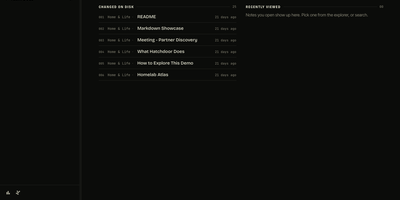
Hatchdoor gives your Markdown notes two front doors at once: a fast web interface for you, and an MCP endpoint where AI agents read and edit the very same vault. Point it at any folder of Markdown files, an existing Obsidian vault included, and it indexes everything into a disposable SQLite read model that rebuilds itself from your files if deleted. In the browser you browse folders, follow wikilinks that survive renames, explore backlinks and graph views, and search by keyword or meaning across every vault you mount. The live editor shows Markdown syntax only on the line you are editing and saves automatically, while concurrency checks refuse a save when the note changed underneath you. Agents connect with their own token and start read-only; turn writes on and Claude Code, Codex, Cursor, or Hermes can create, edit, move, and link notes through the same checked operations the interface uses. Saved queries in Obsidian's Bases syntax render as live tables, attachments preview inline, and optional git integration commits and pushes every change back to your vault's repository. Running on a dedicated VPS on RepoCloud with guaranteed CPU, RAM, and SSD, full root SSH access, and a browser serial console. AGPL-3.0 licensed.
Pizza Bot
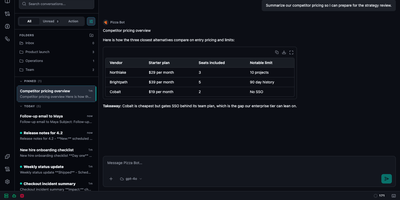
Start an AI task, close the tab, and come back to finished work waiting in an inbox. Pizza Bot keeps agents running when you navigate away or disconnect, sorting results into Unread for completed work and Action for approvals that need your decision. Conversations can be grouped into folders, pinned, searched, and forwarded from any message, without hiding matching items from the global queues. Schedules run a prompt on a cron expression with a time zone, and webhooks start a run from an external alert. A shared pool of Markdown memories carries your preferences into every conversation. Skills package step-by-step playbooks with scoped tools, and plugins bundle skills with MCP servers, so a request can be handed to a specialist subagent whose progress shows in an Activity panel. Connect Amazon Bedrock, Anthropic, Google Gemini, OpenAI, OpenRouter, Requesty, Opper, or Ollama, or point OpenAI at any compatible endpoint. Local folders are visible to the agent only after you grant them, read-only by default. Open it in the browser from one container behind a bearer token, or use the desktop app or terminal client against the same server. Running on a dedicated VPS on RepoCloud with guaranteed CPU, RAM, and SSD, full root SSH access, and a browser serial console. Apache-2.0 licensed.
Kanzo
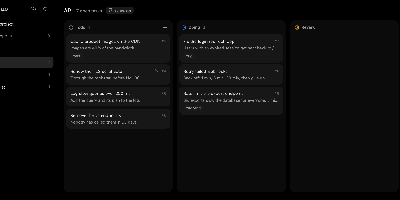
Give your coding agents a board they can work, not just read: Kanzo is a self-hosted kanban board where you and your agents move the same tasks through the same columns at the same time. Tell an agent to take the next task and it moves the card to doing, comments as it works, and leaves the result where you can read it in the browser. Projects follow the code automatically: the agent finds the right board from the Git remote of the repository it is working in, and you can link more repositories to a project from its menu. Press n to add a task, search every project with a slash or Command-K, paste an image straight into a card or comment, and park half-formed ideas in an optional Backlog column that agents leave alone until you promote them. The whole board is one folder, and a private Git repository you own keeps it in step across a laptop, a desktop, and a Raspberry Pi, with conflicts resolved by choosing which side to keep. Statuses are yours to rename in the config file, the board exports cleanly to Markdown or JSON, and one click in the sidebar installs updates and restarts the service. Running on a dedicated VPS on RepoCloud with guaranteed CPU, RAM, and SSD, full root SSH access, and a browser serial console. AGPL-3.0 licensed.
Trina AX
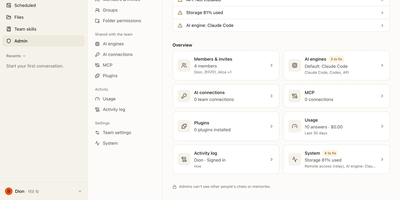
Trina AX is a self-hosted AI workspace where your team chats with real Claude Code and Codex agents that work from your company's own folders, so answers arrive in your formats, with your figures, in your house style. Picture the first morning of a new hire: she asks for a client proposal, and the draft that comes back already reads like the team lead wrote it, because the agent found the same templates and numbers everyone else uses. Admins stock shared, group, and project folders once; everyone else just opens a browser chat on desktop or phone and asks. Nothing leaks sideways in the process, since every file an agent opens is permission-checked as the person asking, and a folder someone cannot see does not exist for their agent in answers, search, previews, or trash. The know-how that makes answers sound right becomes SKILL.md playbooks, governed like ordinary files, and the agent asks a person before editing one. Agents can run up to 150 tool rounds per answer, search the web, spawn sub-agents, and follow scheduled tasks, while admins read an activity log of files touched, never the private conversations themselves. Bring the company Claude or OpenAI account, set per-person usage limits, or route through an Anthropic-compatible gateway to models such as DeepSeek, Kimi, or GLM. Running on a dedicated VPS on RepoCloud with guaranteed CPU, RAM, and SSD, full root SSH access, and a browser serial console. AGPL-3.0 licensed.
BugTraceAI
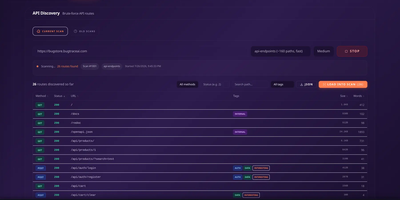
Point an AI pentesting crew at a web app you own and watch it hunt: BugTraceAI plans the checks, sends specialist agents after each weakness class, and brings back evidence you can inspect. A scan moves through six visible phases, from crawling and endpoint discovery through strategy, exploitation and validation, and ends in a findings table where every result carries a severity, a CVSS score and a confirmed status. The web dashboard follows the hunt live as a graph of specialists branching from a coordinating agent, and its API discovery workspace brute-forces routes and loads the interesting ones straight into a scan. Analysts get their own toolbox of more than twenty utilities for poking HTTP traffic by hand, an AI repeater for replaying requests, and ModelLab for comparing models on cost and results. Findings download as a ZIP with the full report, and a terminal workspace with pipeline, findings, agents, timeline and logs views suits keyboard-driven work. Bring your own model through OpenRouter, Anthropic, Z.ai or a local endpoint, and aim the whole suite at the bundled BugStore practice shop when you want to rehearse safely. Running on a dedicated VPS on RepoCloud with guaranteed CPU, RAM, and SSD, full root SSH access, and a browser serial console. Apache-2.0 licensed.
Opik
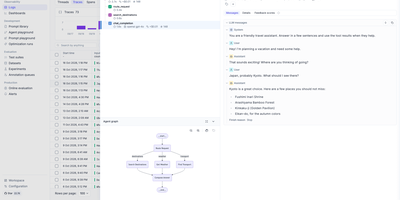
When an AI agent goes wrong at step seven of twelve, Opik, an open-source LLM observability platform, shows the exact trace, tool call, and prompt behind it, then scores your fix against test datasets. Full trace trees capture every LLM call, retrieval step, and tool execution, and you can annotate traces and spans with feedback scores in the UI or through the SDK. Native integrations for OpenAI, Anthropic, LangChain, LlamaIndex, CrewAI, Google ADK, and DSPy, plus OpenTelemetry for any language with an OpenTelemetry SDK, feed traces in, or add the @track decorator to your own functions. Datasets and experiments compare prompt and model versions, scored by LLM-as-a-judge metrics for hallucination, moderation, and RAG relevance, with a PyTest integration to run evaluations in CI. A Prompt Playground tests prompts across models, and the Agent Optimizer SDK helps improve prompts and agents. Production dashboards track feedback scores, trace counts, and token usage, online evaluation rules score live traces, and optional guardrails add safety checks. An MCP server lets Claude Code, Cursor, VS Code Copilot, Codex, or opencode read traces and run evaluations from chat. Run it yourself with the ./opik.sh script on Docker Compose, or a Helm chart on Kubernetes, so trace data stays in your infrastructure. Running on a dedicated VPS on RepoCloud with guaranteed CPU, RAM, and SSD, full root SSH access, and a browser serial console. Apache-2.0 licensed.
Astron RPA
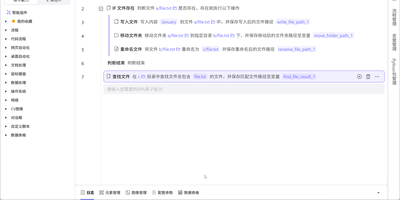
The invoices, reconciliations, and report downloads your team repeats every week are exactly the work a robot should be doing at 2 a.m. Astron RPA is an open-source robotic process automation platform: business users assemble workflows in a visual designer from more than three hundred pre-built components for clicking through desktop applications, driving browsers, reading and writing Excel and PDF files, querying databases, and calling APIs, then robots execute those workflows on schedule, on demand, through API calls, or through MCP services. The platform covers Windows desktop software and web pages alike, reaching office suites, browsers, and the finance and ERP systems that never grew an API, and Python scripting extends any step the components do not cover. A built-in excellence center and team marketplace let organizations publish shared automations, manage permissions, monitor executions, and reuse each other's robots across departments instead of rebuilding the same process ten times. AI components and a native agent platform connect language models to the workflows, so an agent can reason about a task and hand the clicking to a robot, and a workflow can call the agent back when judgment is needed. Self-hosters run the control plane themselves with Docker: database, identity service, and web console behind their own domain and certificates. Running on a dedicated VPS on RepoCloud with guaranteed CPU, RAM, and SSD, full root SSH access, and a browser serial console. Apache-2.0 licensed.
Plandex
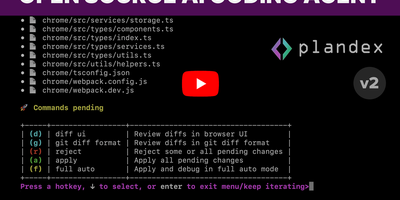
With 15,500 GitHub stars and over 1,100 forks, Plandex delivers a terminal-based AI coding agent purpose-built for the complex, multi-file tasks that overwhelm single-file AI assistants. The Go-powered server maintains a cumulative diff review sandbox that quarantines all AI-generated changes from your project files until you explicitly approve them — enabling 20-file refactors where you cherry-pick good changes and reject bad ones without touching git. A 2M token effective context window loads only what each step requires, while tree-sitter project maps index repositories exceeding 20M tokens across 30+ programming languages, providing structural awareness of class hierarchies, function signatures, and import graphs without burning tokens on full file content. The configurable model pack system assigns different models to different roles — Claude for planning, GPT for coding, Gemini for summarization — supporting Anthropic, OpenAI, Google, OpenRouter, Azure OpenAI, AWS Bedrock, DeepSeek, Perplexity, and Ollama for local models. Full auto mode handles end-to-end autonomous workflows including high-level planning, context loading, implementation, terminal command execution, and automated debugging of both terminal and browser applications. The interactive REPL provides fuzzy auto-complete, version-controlled sandbox branching, rewind to any previous point, and Git integration for commit message generation. The Plandex Server exposes 60+ REST API endpoints for programmatic orchestration across organizations, projects, plans, and branches. Deploy via Docker Compose for self-hosted operation with your own API keys. Running on a dedicated VPS on RepoCloud with guaranteed CPU, RAM, and SSD, full root SSH access, and a browser serial console. MIT licensed.
Lemma
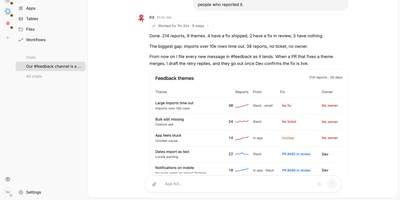
Every job gets its own AI teammate in Lemma, shared with your whole team and busy building the pages, tables, workflows, and apps the work needs. Each teammate lives in its own space, so the briefs it writes, the records it keeps, and the screens it builds stay where your people can open them instead of vanishing up a chat thread. Agents run when asked and also on a schedule, a table change, or an incoming webhook, with every run recorded step by step. Before anything consequential, like sending an email or issuing a refund, the run pauses and asks the person who owns the decision. Workflows hand work between agents, plain code, decisions, loops, and named people, and a run can wait days for an approval. Teammates keep memory as Markdown notes that anyone can open and correct. People reach them from Slack, Microsoft Teams, WhatsApp, Telegram, or email, and one permission model covers roles, rows, and approvals everywhere. Bring a Claude Code or Codex subscription, a hosted model, or any OpenAI or Anthropic compatible key. Running on a dedicated VPS on RepoCloud with guaranteed CPU, RAM, and SSD, full root SSH access, and a browser serial console. AGPL-3.0 licensed.
Casibase
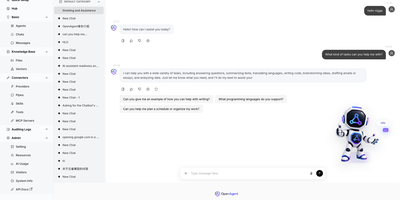
Casibase lets organizations build AI-powered knowledge bases that answer questions from their own documents, connecting to 30+ model providers through a unified admin interface with RAG retrieval and multi-agent orchestration via MCP and A2A protocols. The platform plugs into OpenAI GPT-4o, Anthropic Claude, Meta Llama, Google Gemini, DeepSeek, Ollama local models, HuggingFace, Azure OpenAI, and additional providers, while embedding APIs from OpenAI Ada and Baidu handle vector representation of ingested documents. Document ingestion parses TXT, Markdown, DOCX, PDF, CSV, XLSX, and PPTX files with intelligent chunking strategies for optimal retrieval accuracy. The built-in chat interface provides real-time AI conversations with manual session handover for human agent escalation, and comprehensive chat session logging enables audit trails for compliance. Enterprise identity management integrates Casdoor for Single Sign-On supporting GitHub, Google, WeChat, and OIDC providers with fine-grained access control via the Casbin permission engine. The multi-tenant architecture supports isolated knowledge bases per organization with role-based user management and configurable storage, model, and embedding providers per tenant. The React frontend with Ant Design v5 provides a polished admin dashboard for managing providers, knowledge stores, chat sessions, and user access, while the Go backend with Beego framework handles API logic with MySQL or MariaDB persistence. Running on a dedicated VPS on RepoCloud with guaranteed CPU, RAM, and SSD, full root SSH access, and a browser serial console. Apache 2.0 licensed.
OpenAgent
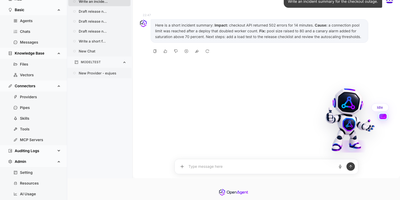
Chat, research, and everyday chores all run through OpenAgent, a private AI assistant hosted on a server you control. Pick from more than thirty model providers, including OpenAI, Anthropic, Gemini, DeepSeek, and local Ollama models, and switch models inside a conversation. Agents can drive a real browser, search the web, run shell commands, read and write Word, Excel, and PowerPoint files, and call any MCP server. Every tool call shows its arguments and result. Upload PDFs and spreadsheets to build isolated knowledge bases with semantic search, then attach them to a chat. A drag and drop workflow builder chains steps with branches, parallel tasks, and schedules. The admin console tracks token use and cost per user and model with charts and a message heatmap, lists every tool, records audit logs, and shows live CPU, memory, and API latency. Single sign-on through OIDC, OAuth2, LDAP, or SAML and separate workspaces keep teams apart, and a REST API with Swagger docs exposes every feature. Running on a dedicated VPS on RepoCloud with guaranteed CPU, RAM, and SSD, full root SSH access, and a browser serial console. Apache-2.0 licensed.