Obsidian Arc
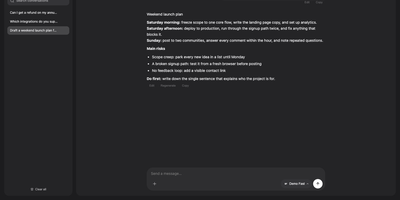
Teams and communities sign in to a private AI chat site, and one admin console routes and meters every request. Users pick a model from the menu and chat with streamed answers, visible reasoning, projects that share a system prompt, searchable history, archives, and an Image Lab for generated pictures. Administrators connect providers that speak the OpenAI or Anthropic protocols, map several models onto each, and place users in groups with their own allowances counted in requests, tokens, or credits per five hours, week, or month. A developer endpoint accepts API keys and serves chat completions, Anthropic messages, responses, images, and a model list, so coding assistants and scripts can share the same pool. The dashboard charts requests, tokens, and spend by model and by person, and Availability probes idle models and trips a circuit breaker after repeated failures. Registration can be open, invite-only, or closed, with invite codes, email rules, authenticator-app two-step sign-in, and GitHub, Google, or OpenID Connect login. Announcements, a feedback inbox, an optional leaderboard, a guest trial chat, and scheduled backups to S3-compatible storage round out the operator toolkit. A company AI portal, a classroom, a research group, or a paid community with trial codes can all run on it. Running on a dedicated VPS on RepoCloud with guaranteed CPU, RAM, and SSD, full root SSH access, and a browser serial console. MIT licensed.
Subpool
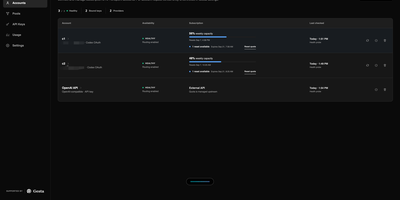
Your company pays for AI subscriptions nobody can see, scattered across personal accounts and team plans, and Subpool is the self-hosted control plane that pools that authorized capacity and hands every employee one key with limits you govern. Administrators combine subscription and API accounts into pools behind a single managed endpoint, then allocate employee-specific keys across whichever provider accounts are healthy. The console watches account health, remaining subscription capacity, and when each plan window resets, and routing prefers subscription capacity first, falling back to paid API accounts under the very same employee key when a window runs dry. Rate-limit, expire, or revoke any person's access independently, and keep every key-to-account assignment visible and auditable instead of buried in a shared credential nobody can trace. The employee API speaks OpenAI-compatible Responses and Chat Completions, so existing tools point at your pool unchanged, while aggregate input and output token telemetry is tracked per key in provider-native units. For OpenAI accounts, a Costs API estimate shows the remaining grant balance; Bailian Token Plan accounts display their five-hour, weekly, or monthly quota windows. Upstream credentials stay encrypted, and prompts, responses, and source code are never persisted. One Go service with an embedded console and PostgreSQL runs from Docker Compose, with sign-in on port 8081 and the employee API on 8080. Running on a dedicated VPS on RepoCloud with guaranteed CPU, RAM, and SSD, full root SSH access, and a browser serial console. Apache-2.0 licensed.
OSRM
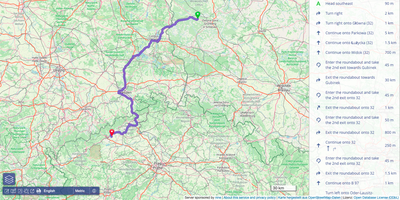
OSRM computes the fastest route between any two points, the travel time between every pair of stops, and the road a noisy GPS trace really followed, all from OpenStreetMap data on your own server. Feed it a map extract for your city or the whole planet, preprocess it with the car, bicycle, or foot profile, and the HTTP API starts answering. The route service returns turn-ready paths with distances, durations, and geometry between any coordinates. The table service computes the full duration or distance matrix between all pairs of points, which is the raw material for dispatching, territory planning, and pickup optimization. Map matching snaps noisy GPS traces onto the road network in the most plausible way, cleaning fleet and fitness data into actual driven streets. The trip service orders a set of stops into an efficient round trip, and the nearest service snaps raw coordinates to the closest road segments. A tile service exposes routing metadata as vector tiles for debugging and visualization, and a public demo frontend shows routes on a live map. Running on a dedicated VPS on RepoCloud with guaranteed CPU, RAM, and SSD, full root SSH access, and a browser serial console. BSD-2-Clause licensed.
Swagger UI
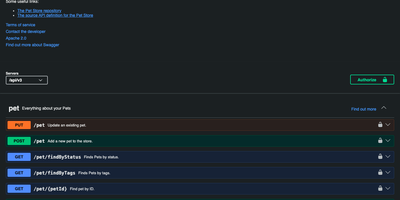
An OpenAPI file is precise but unfriendly to anyone who did not write it, and Swagger UI turns that file into a browsable page where every endpoint is documented and can be called on the spot. Operations are grouped by tag and color coded by HTTP method, and each one lists its parameters, request bodies, example payloads, response codes, and the schemas behind its models. Pressing Try it out unlocks the parameter fields and an Execute button that sends a real request from the browser and shows the response, so front-end developers, testers, and partners can explore an API before writing any client code. The Authorize dialog accepts API keys, HTTP basic credentials, bearer tokens, and OAuth2 flows including PKCE, an optional filter box narrows the page by tag name or path, deep links open a specific tag or operation, and a dropdown switches between several definitions. OpenAPI 2.0, 3.0, 3.1, and 3.2 files are all understood, including 3.1 webhooks, and the page follows the browser's light or dark color scheme with a toggle in the top bar. The Docker image loads a definition from a mounted file or a remote URL, serves it under a custom base path, and exposes most display options as environment variables, which suits an internal developer portal, a public API reference, or a staging sandbox for partners. Running on a dedicated VPS on RepoCloud with guaranteed CPU, RAM, and SSD, full root SSH access, and a browser serial console. Apache-2.0 licensed.
OpenAdServer
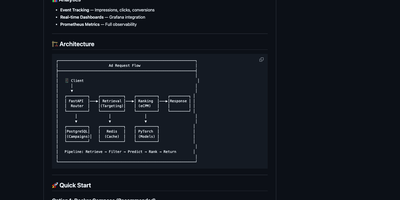
OpenAdServer runs your own ad network on your own infrastructure, ranking every request with machine-learned click predictions instead of static rotation. A request arrives with a slot, user, device, and geo context; the pipeline retrieves matching campaigns, filters them by targeting, budget, and frequency caps, predicts click probability, and ranks survivors by eCPM before responding in milliseconds. You serve banner, native, video, and interstitial formats with geo, device, operating system, demographic, and interest targeting, plus daily and hourly frequency limits per user. Budget pacing smooths delivery across the day so campaigns do not exhaust spend in the first hour. Three prediction models ship ready to train and swap without downtime: logistic regression for speed, factorization machines for feature interactions, and DeepFM for deep learning on your click logs. Automatic feature engineering processes sparse and dense fields, and hot-swapping lets a retrained model replace the live one mid-flight. Impressions, clicks, and conversions stream into event tracking, Prometheus metrics expose full observability, and Grafana dashboards visualize performance in real time. Advertisers, campaigns, and creatives are managed through CRUD APIs, and bid types cover CPM, CPC, CPA, and optimized CPM. Training scripts prepare data from your logs, train a model in a few commands, and report AUC before you promote it. Running on a dedicated VPS on RepoCloud with guaranteed CPU, RAM, and SSD, full root SSH access, and a browser serial console. Apache-2.0 licensed.
HeadlessX
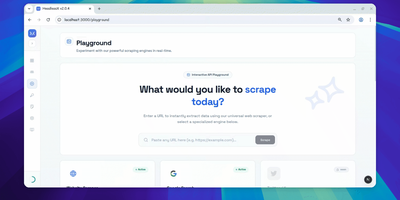
With 2,000 GitHub stars and 10 releases since its September 2025 launch, HeadlessX delivers a self-hosted browser automation platform that replaces Chromium-based scraping with Camoufox — a Firefox fork performing kernel-level fingerprint spoofing to achieve 0% detection across Cloudflare, DataDome, PerimeterX, and other anti-bot systems where Puppeteer and Playwright regularly fail. The web dashboard provides workspace-based job organization with a visual interface for configuring scrape targets, managing browser profiles, monitoring queue status, and viewing extracted results in real time. The protected REST API accepts requests with API key authentication for programmatic access, supporting HTML extraction, screenshot capture, PDF generation, and structured data parsing with configurable stealth parameters. Profile-based scraping maintains persistent browser contexts with cookie jars, localStorage, and fingerprint configurations that survive between requests — reducing cold-start latency from 25 seconds to under 2 seconds on subsequent requests. Queue-backed workflows enable batch processing of URLs with configurable concurrency, retry logic, and webhook notifications on completion. The Google AI Search integration provides AI-assisted web research workflows through dedicated endpoints. Remote MCP support exposes automation capabilities as tool endpoints for AI agent integration. Deploy via the official CLI with `headlessx init` and `headlessx start` commands, scaffolding a Docker Compose stack with Caddy reverse proxy for automatic HTTPS. Running on a dedicated VPS on RepoCloud with guaranteed CPU, RAM, and SSD, full root SSH access, and a browser serial console. MIT licensed.
9Router Pro
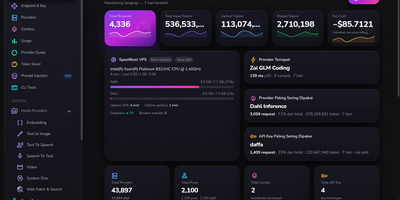
One endpoint for every model account you own: 9Router Pro sits between your applications and a fleet of LLM providers, decides which account answers each request, and keeps the whole operation visible on a live dashboard. Its signature trick is prompt injection scoped three ways, globally, per API key, or per model, delivered either as a system prompt or as a scripted chat history that primes the model far harder than instructions alone. Keys are products here: each carries a rolling token budget over 24 hours, 7 days, or 30 days plus rate limits per minute, hour, and day, so a resold plan enforces itself with polite 429 responses. Routing stays healthy on its own, with accounts tiered as clean, suspect, or cooldown, least-recently-used spreading across the fleet, flaky upstream responses retried against the next account, and proxy pools health-checked with one-click cleanup of the dead. The monitoring dashboard leads with VPS specs, fastest and most-used providers, top API key, and usage spectrum charts, while backup and restore cover providers, combos, keys, and settings section by section. Everything runs as a single application with one SQLite file and a dashboard localized into 34 languages. Running on a dedicated VPS on RepoCloud with guaranteed CPU, RAM, and SSD, full root SSH access, and a browser serial console. MIT licensed.
CLIProxyAPI Dashboard
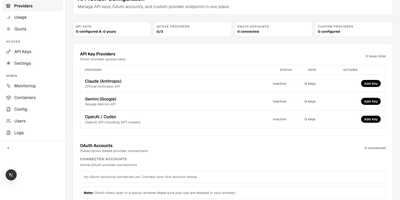
CLIProxyAPI Dashboard puts a web console in front of CLIProxyAPI so you manage AI providers, keys, quotas, and containers through forms instead of YAML files. Connect Claude Code, Codex, xAI, Antigravity, Kimi, and Devin accounts with OAuth, then add Gemini CLI, GitHub Copilot, Kiro, and Cursor through plugins you install and configure from the settings store. Any OpenAI-compatible endpoint can join as a custom provider with model mappings, and admins can mark a provider as shared so the whole team uses it. You create, revoke, and track API keys with per-user ownership, manage dashboard users and admin rights, and stream live logs beside container health. Quota views track rate limits per provider and per model, and Telegram alerts fire when remaining quota drops below your threshold. Usage analytics break down request counts, provider share, model statistics, error rates, and estimated cost. Configuration syncs to OpenCode automatically, model configurations travel as share codes, and backups can be created, scheduled, previewed, and restored from settings. One-click updates refresh the dashboard and proxy images, containers start and stop from the panel, and automatic TLS keeps the console reachable under your domain. Running on a dedicated VPS on RepoCloud with guaranteed CPU, RAM, and SSD, full root SSH access, and a browser serial console. MIT licensed.
Keystone
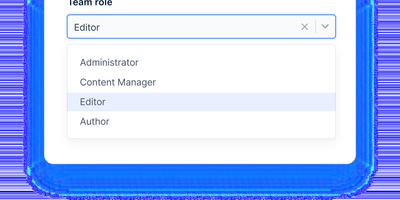
Keystone turns TypeScript schema definitions into a complete GraphQL API and React Admin UI automatically, eliminating the gap between data modeling and application scaffolding. Nearly 10,000 GitHub stars and over 270 contributors across a decade of development back a framework where list definitions map directly to Prisma models on PostgreSQL or SQLite, generating database migrations and exposing every field relationship through Apollo Server's GraphQL endpoint. Granular access control operates at the list, field, and operation level with filter-based restrictions that limit which records users can see, create, update, or delete based on session data and custom logic. The document field provides a structured WYSIWYG editor with content blocks, inline relationships, and custom React components that render consistently across the Admin UI and frontend applications. Event hooks fire before and after create, update, and delete operations for validation, side effects, and external service integration. Custom GraphQL queries and mutations extend the API beyond auto-generated CRUD for bespoke business logic. The Admin UI built with Next.js and the Keystar UI component library supports custom pages, branded navigation, and internationalized interfaces. OpenTelemetry tracing provides observability into operations, queries, and hook execution. Deploys via Docker or any Node.js host with Prisma managing schema evolution. Running on a dedicated VPS on RepoCloud with guaranteed CPU, RAM, and SSD, full root SSH access, and a browser serial console. MIT licensed.
Webclaw
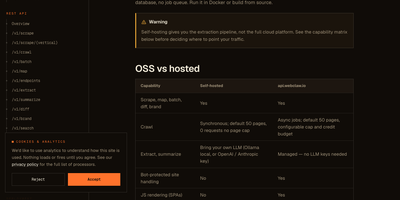
Webclaw turns messy web pages into clean content your AI tools can actually use, extracting the meaningful text and leaving the navigation, ads, and boilerplate behind. You point it at a URL and get back Markdown, plain text, structured JSON, raw HTML, or a format trimmed for language model input, with images stripped, links deduplicated, and whitespace cleaned. Crawl a whole site by following same-origin links page after page, map a domain first to discover every URL from its sitemap before deciding what to fetch, or batch many URLs at once and stream the results as they finish. CSS selectors let you include only the part of a page you care about or exclude the parts you never want, and main-content filtering keeps the article while dropping the chrome around it. Compare today's page against an earlier snapshot to see exactly what changed, or pull a site's colors, fonts, and logo into a brand profile. With your own language model connected, extraction follows a JSON schema or a plain prompt, and summaries come back at the length you ask for. Agents reach the same engine through an MCP server, scripts through the command line, and applications through the REST API. Running on a dedicated VPS on RepoCloud with guaranteed CPU, RAM, and SSD, full root SSH access, and a browser serial console. AGPL-3.0 licensed.
Carbone
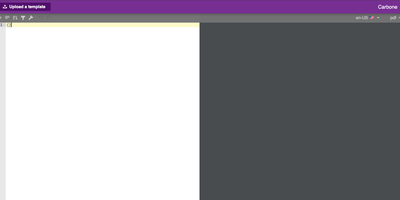
Document-generation code is the worst kind of code in your backlog - Carbone kills it. Its insight is separating design from data - templates are ordinary office documents (DOCX, ODT, XLSX, PPTX, HTML, even custom XML) built in LibreOffice, Microsoft Office, or Google Docs, with mustache-like markers such as {d.companyName} typed directly into the text. Send a template plus JSON from your existing APIs to the HTTP API, and Carbone returns the finished document - exported as-is or converted to PDF, XLSX, CSV, HTML, PNG, EPUB, and more via its integrated LibreOffice converter (Chromium and OnlyOffice engines are also supported for HTML-fidelity and office-format conversions). The template language goes well beyond substitution: loops over arrays render dynamic table rows, filters and aggregations run inside the document, and built-in formatters handle dates, numbers, currencies, timezones, and locales, with custom JavaScript formatters when needed. One template serves multiple languages through translation markers with auto-maintained translation files. The XML-agnostic engine means anything your document editor can design - pagination, headers, footers, nested tables, charts - survives generation intact, and Carbone guarantees no breaking changes in template syntax. Node.js-based, fast via multi-threaded LibreOffice conversion. The invoices, contracts, and reports your product owes its users become template edits, not sprints.
Evolution API
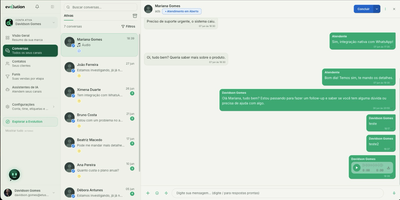
Evolution API gives your applications a production-ready REST interface to WhatsApp, supporting both free Baileys-based Web connections and Meta's official Business Cloud API from the same server. With 9,200+ stars and 7,100+ forks, it is the most widely deployed WhatsApp integration layer available. Each installation handles unlimited isolated instances (one per phone number) with independent auth, webhooks, and database separation via Prisma ORM against PostgreSQL or MySQL, cached through Redis. Message types include text, images, audio, video, documents, contacts, locations, interactive buttons, list messages, carousel cards, and PIX payment links through unified endpoints. Native integrations connect to Typebot for chatbot flows, Chatwoot for multi-agent support, Dify and OpenAI for AI conversations, N8N and Flowise for workflow automation, and RabbitMQ, Kafka, or SQS for enterprise event streaming. Socket.io delivers real-time message and connection events. Amazon S3 or MinIO handles media offloading. The Evolution Manager v2 dashboard provides visual instance creation, QR code scanning, connection monitoring, and integration configuration without touching the API directly. Docker Compose bundles the server, PostgreSQL, and Redis with environment-variable-driven setup. Running on a dedicated VPS on RepoCloud with guaranteed CPU, RAM, and SSD, full root SSH access, and a browser serial console. Apache 2.0 licensed.
Svix
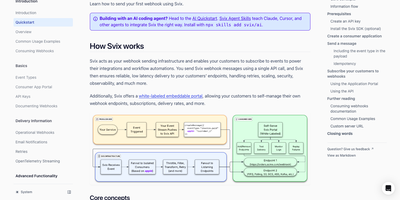
Development teams hand their outgoing webhooks to Svix, which delivers each event to customer endpoints with retries, signed payloads, and a delivery record for every attempt. Your app makes one API call when something happens, a user signs up, an invoice is paid, a build finishes, and Svix delivers the event to every subscribed endpoint your customers registered. Endpoints that fail get automatic retries on a schedule, deliveries are logged attempt by attempt, and failed messages can be resent instead of vanishing. Customers organize their integrations as applications, subscribe endpoints to the event types they care about, filter by channels, and verify signed payloads so forged requests get rejected. You define the event catalog once, and fanout, throttling, and endpoint bookkeeping stop being code you maintain. Official libraries for nine languages and a CLI make the first integration an afternoon task, and the whole service runs from a Docker Compose stack with Postgres and Redis when you want it on your own infrastructure. Your product gains the webhook system customers expect, without your team becoming a deliverability department. Running on a dedicated VPS on RepoCloud with guaranteed CPU, RAM, and SSD, full root SSH access, and a browser serial console. MIT licensed.
imagor
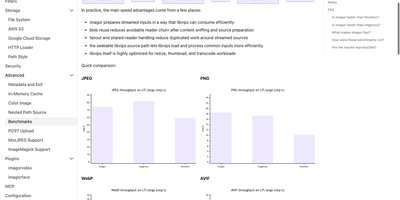
imagor is a self-hosted image server that turns one master photo into every size, crop, and format your site needs, generated on demand from a single URL. You describe the transformation in the address itself: a width and height, a smart crop, then a chain of filters for fill color, format, quality, and watermark. Requests stream through a pipeline built for parallel throughput, so a thumbnail costs milliseconds even when traffic peaks, and the same syntax your team may already know from thumbor works unchanged. Smart cropping keeps the important part of the frame, focal points pin the exact region that must survive, and detection plugins can blur faces automatically for privacy-sensitive publishing. Forty-plus filters cover the daily work of a media pipeline: text overlays with real fonts, image compositing with blend modes, rounded corners, redaction, sharpening, and per-channel color control. Output lands in modern formats including WebP, AVIF, and JPEG XL, with automatic format negotiation and a byte budget that squeezes quality until a file fits your limit. Processed results cache to filesystem, S3, or Google Cloud storage, signed URLs keep strangers from minting their own transformations, and a metadata endpoint returns BlurHash placeholders and average colors for lazy-loading galleries. A companion service adds video thumbnails, and an MCP template layer composes OG cards and product grids. Running on a dedicated VPS on RepoCloud with guaranteed CPU, RAM, and SSD, full root SSH access, and a browser serial console. Apache-2.0 licensed.
llama.cpp
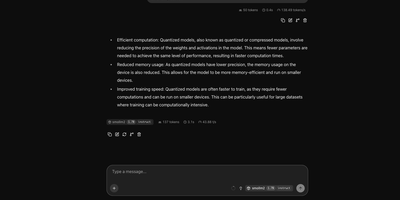
Open-weight language models get a private chat service on your own server, and llama.cpp serves its browser UI the moment the server starts. Conversations appear in a sidebar with search, and each answer shows its token count, generation time, and tokens per second, so you can see how a model really performs. Code replies render in highlighted blocks with a copy button, and messages can be edited, regenerated, forked, or deleted. A Models page lists what the server can run with context sizes and load status, and Settings cover themes, system messages, display options, tools, agentic behavior, import and export, and sampling controls for temperature, top K, top P, and penalties. Remote MCP servers connect by URL, and uploads let multimodal models read files and images. Behind the UI sit OpenAI and Anthropic compatible chat endpoints, embeddings, reranking, function calling, JSON schema constrained output, parallel decoding, and continuous batching for several users at once. Quantized models run on plain CPUs, and official images cover CUDA, ROCm, Vulkan, and other accelerators. Running on a dedicated VPS on RepoCloud with guaranteed CPU, RAM, and SSD, full root SSH access, and a browser serial console. MIT licensed.
Amplication
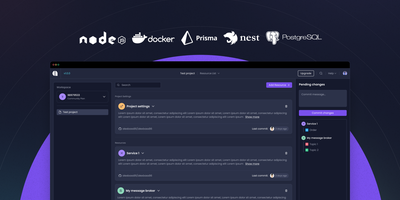
Amplication turns entity definitions into production-ready backend services, generating NestJS with Prisma and Apollo GraphQL for Node.js or ASP.NET Core for .NET, eliminating months of boilerplate. The plugin-driven Data Service Generator hooks into code generation lifecycle events, enabling teams to inject CI/CD manifests, proprietary authentication schemes, testing configurations, and cloud-specific deployment targets for AWS, Azure, and GCP without forking the core generator. Blueprint templates encode organizational architecture standards, security policies, and coding conventions into reusable foundations that keep every generated service consistent across the engineering organization. Jovu AI translates natural language requests into entities, relationships, fields, modules, DTOs, and custom API actions, automatically aligning each resource with predefined standards. Generated services include full CRUD operations with input validation, Swagger/OpenAPI documentation, authentication middleware, database-agnostic ORM via Prisma, optional React Admin interfaces, and Jest test scaffolding. Code output syncs to Git repositories as pull requests, preserving standard review workflows while letting developers edit every generated line and add custom business logic. Supports PostgreSQL, MySQL, and MongoDB as database targets. Over 16,000 GitHub stars with enterprise adoption. Apache 2.0 licensed.
SpiceDB
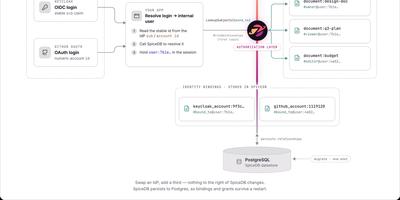
'Can Maria edit this document?' is a simple question with a hard implementation, and SpiceDB is the open-source, Zanzibar-inspired database built to answer it and millions like it correctly. You model your product once in its schema language, defining object types like documents and organizations, relations like owner and member, and computed permissions built from unions, intersections, exclusions, and arrows through other objects. Your application then writes relationships as users join groups, create folders, and share files, and SpiceDB evaluates checks against that live graph in milliseconds. Check a single permission before rendering a button, check hundreds at once to filter a dashboard, look up every resource a user can open for search prefiltering, or list every subject who can access a file for an admin screen. Per-request consistency options, anchored by revision tokens, protect you from the classic race where a revoked user briefly keeps access, and caveats add conditional rules based on context like IP address or time. Relationships persist in PostgreSQL for simple deployments or CockroachDB and Spanner when you need multi-region scale, and the same schema files validate in CI with the command-line tool before they ever reach production. Running on a dedicated VPS on RepoCloud with guaranteed CPU, RAM, and SSD, full root SSH access, and a browser serial console. Apache-2.0 licensed.
Google Browser Scraper
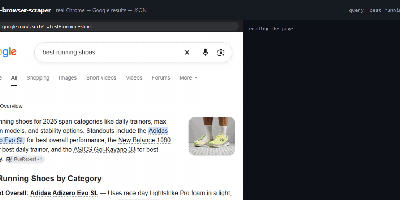
Google Browser Scraper is a self-hosted SERP API that gets Google results from a real Chrome browser and your own residential proxy, because plain HTTP scraping is refused and a fresh browser on a fresh IP is refused almost as fast. It warms a sticky proxy session with ordinary browsing first, lets the browser pass Google's checks, and then switches to a hybrid mode that fetches results pages directly over HTTPS with the browser's own cookies, at about 0.4 MB and 1.4 seconds per search on a warm IP. Every page comes back as SERP-style JSON with organic results, ads, related questions, related searches, pagination, the AI Overview, and local results. If a proxy IP starts serving poisoned pages for some other query, the scraper catches it within a few pages, drops that IP, and asks the query again on a fresh one. Captchas and blocks are reported as captchas and blocks, never disguised as an empty result set, so your pipeline knows when to retry or rotate. Run it as a CLI for keyword files, import it as a Python library, serve it as a local HTTP API, or expose the MCP server so AI agents get live Google search. Every run ends with a traffic and cost summary per thousand pages, and any sticky residential proxy works, with NodeMaven sessions handled for you. Running on a dedicated VPS on RepoCloud with guaranteed CPU, RAM, and SSD, full root SSH access, and a browser serial console. MIT licensed.