Convoy
Convoy is an enterprise-grade webhooks gateway that manages both incoming and outgoing webhook traffic to guarantee reliable event delivery without exposing internal microservices to the public internet. Organizations deploy the platform at the edge to ingest events from message brokers such as Apache Kafka, RabbitMQ, and Google Cloud PubSub, or receive HTTP webhooks from third-party services directly. The gateway enforces delivery policies through configurable rate limiting per endpoint, circuit breaking during downstream outages, and automated retries using constant or exponential backoff with jitter. Developers can generate customer-facing webhook portals embedded via iframes, allowing end users to inspect delivery attempts, verify HMAC-SHA256 signatures, and manually replay failed events. Comprehensive security controls include static egress IP proxying to prevent server-side request forgery, automated rolling secret keys, and instant alerting via Slack or email when endpoints fail consecutively. Running on a dedicated VPS on RepoCloud with guaranteed CPU, RAM, and SSD, full root SSH access, and a browser serial console. Elastic License 2.0 licensed.
imgpush
Your app needs avatars, attachments and user photos, and imgpush is the tiny service that takes them off your hands. Send one upload request with a file or a URL and you get back a filename; ask for that file with a width and height in the address and you receive exactly that crop, converted to the format you configured. Originals live on local disk or in any S3-compatible bucket (AWS S3, Cloudflare R2, MinIO or Backblaze B2), with resized variants cached locally for fast serving. Abuse controls come built in: per-IP upload quotas per minute, hour and day, an allowed-origins whitelist, and an optional nudity filter that can also sample video frames before an upload is accepted. An API key can be required for uploads, deletes remove the original together with every cached size, and a liveness endpoint keeps Docker and Kubernetes health checks honest. One Docker container on port 5000, a page of environment variables, and your application never writes image code again. Running on a dedicated VPS on RepoCloud with guaranteed CPU, RAM, and SSD, full root SSH access, and a browser serial console. MIT licensed.
Magic Cloud
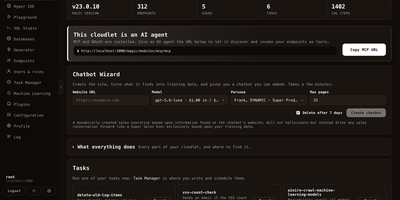
Magic Cloud turns a plain-English app description into a working backend, secured API, and frontend that run on your own server. Point the endpoint generator at a database and it writes CRUD endpoints with roles and validation; paste an OpenAPI or Swagger URL and it wraps any third-party API as documented endpoints. A dashboard shows endpoint counts, users, scheduled tasks, and logs. A built-in MCP URL gives Claude, Cursor, or Codex a way to discover and call every endpoint as a tool. The Chatbot Wizard crawls a website and hands back an embeddable chatbot grounded in that content. Hyper IDE edits any file on the server with an ask-the-AI prompt bar underneath, and Rewind steps through a recorded execution line by line. A visual Web Designer assembles pages from blocks, a Task Manager schedules background jobs, and Chat Ops answers questions about what the cloudlet can do and then does it. Role-based access guards each endpoint, and a SQL Studio handles direct queries. Running on a dedicated VPS on RepoCloud with guaranteed CPU, RAM, and SSD, full root SSH access, and a browser serial console. MIT licensed.
Traduora
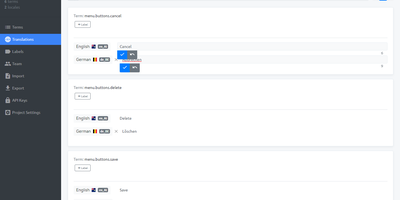
Teams that ship one app in many languages keep every string, translator, and reviewer in a single workspace by hosting their own Traduora translation management platform. Developers import the files they already have: JSON, YAML, PO, XLIFF, CSV, Android XML, iOS Strings, Java properties, PHP array, or RESX. Each string becomes a term that can carry a context note and colored labels. A search bar and a label filter narrow long lists in seconds. Translators open a locale and type inline beside a reference language, with per-locale progress showing how much is finished and a toggle that hides what is already done. Colleagues join by email invitation as admins, editors, or viewers, with optional Google sign-in. Build pipelines get their own API clients, each with a role, to fetch and push translations over a REST API. Exports go back out in whichever format each platform wants, with fallback-locale and untranslated-key options. Mobile and web teams can keep iOS, Android, and website copy in sync from a single source of truth. Running on a dedicated VPS on RepoCloud with guaranteed CPU, RAM, and SSD, full root SSH access, and a browser serial console. AGPL-3.0 licensed.
OpenRouteService
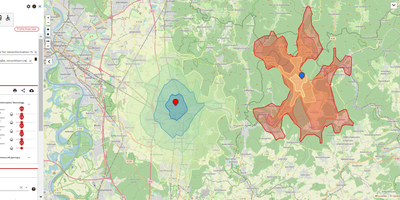
OpenRouteService gives applications driving directions, reachable-area polygons, and origin-destination travel times computed from OpenStreetMap data on hardware you control, with no metered API key. Ask for a route and it answers with turn-by-turn instructions, distance, duration, and elevation gain for cars, heavy trucks, several cycling styles, walking, hiking, and wheelchairs. Draw an isochrone and the map fills with the area reachable inside five, fifteen, or sixty minutes, ready for site selection, delivery zones, and coverage studies. The matrix endpoint prices every pairing in a grid of origins and destinations in one request, so fleet tools and location analytics stop making thousands of single calls. Steer results with avoid areas, controlled borders, tollways, ferries, and road classes, with per-request limits on distance and climb. Snap stray GPS points back onto the road network, export the underlying graph for your own network analysis, and watch instance health from the built-in status endpoints. Load the regional OpenStreetMap extract you actually serve, rebuild graphs on your schedule, and every answer stays inside your network at whatever volume your hardware allows. Running on a dedicated VPS on RepoCloud with guaranteed CPU, RAM, and SSD, full root SSH access, and a browser serial console. GPL-3.0 licensed.
Daptin
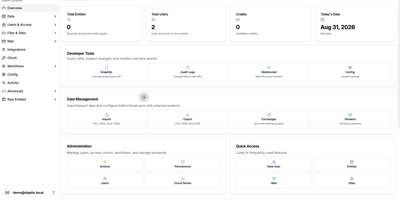
Define your tables once, and Daptin runs the backend around them: every schema becomes a permission-aware JSON:API resource with CRUD, relationships, filtering, and pagination, plus an optional GraphQL surface over the same model. Users, groups, and row-level permissions gate who can read or change each record, with JWT login, one-time codes, and OAuth and OIDC endpoints for sign-in. Files ride along as asset columns backed by local or cloud storage through rclone, with presigned uploads and storage sync. Actions chain validation, conditions, and ordered outcomes into reusable operations, scheduled tasks run them on a cron clock as a chosen user, and state machines track each record's lifecycle with an audit trail. Changes stream out live over WebSockets and feeds, while FTP, calendar and contacts routes, and an OpenAI-compatible LLM gateway expose the same model to other tools. Plans, quotas, and metering let you charge for API and model usage from the same server. Running on a dedicated VPS on RepoCloud with guaranteed CPU, RAM, and SSD, full root SSH access, and a browser serial console. LGPL-3.0 licensed.

Flyimg
Flyimg generates every image size a website needs at request time, turning one original into resized, cropped, and compressed variants through a simple URL. Append options like width, height, crop, and quality to a request, and the service fetches the source image, transforms it, and serves the result, storing it in cache so the next request is answered instantly. Output defaults to AVIF for browsers that support it, with WebP and MozJPEG compression available for lean JPEG delivery, plus PNG and GIF when the source calls for them. Signed URLs keep strangers from using your server as a free image proxy, and domain restrictions limit which sources the service will fetch from. One Docker container gives a website or application a complete image pipeline: originals stay in whatever storage already holds them, and every thumbnail, banner, and product shot is produced at request time in exactly the dimensions the layout needs. Cache headers and repeat serving keep bandwidth costs predictable as traffic grows. Running on a dedicated VPS on RepoCloud with guaranteed CPU, RAM, and SSD, full root SSH access, and a browser serial console. AGPL-3.0 licensed.
Fonrex
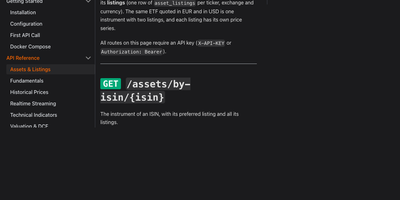
Good European market data is either expensive or wrong, so Fonrex runs it all on your server: a self-hosted API serving per-listing prices, cross-checked fundamentals, DCF valuations, and factor models for European and US shares, with no subscription or per-call meter. Every price is stored per listing in its own currency and dated by trading session, so AIR.PA resolves to Airbus rather than a same-ticker US namesake, and one ISIN can carry many listings cleanly. Fundamentals are cross-checked between sources first; figures that disagree with the consensus are rejected, and every answer names the sources it came from. Value any company three ways with FCF, EPS, and dividend DCF models, compare them side by side, and stress the result with a WACC by growth sensitivity matrix. Factor tools return Kenneth French returns for the US, Europe, and developed markets, compute listing factor exposure, and price equity with the risk-free rate of the right currency, alongside FRED and ECB rates, Treasury curves, and Eurostat indicators. Daily history spans ten years, split-adjusted with a dividend-adjusted close; live ticks stream over WebSocket, indicators and a screener run on your stored prices, and deduplicated news arrives per ticker or as a global feed. Results plug into OpenBB Workspace, Google Sheets, Python notebooks, and Zipline backtests, so spreadsheets, dashboards, and research pipelines all read the same numbers. Running on a dedicated VPS on RepoCloud with guaranteed CPU, RAM, and SSD, full root SSH access, and a browser serial console. AGPL-3.0 licensed.
Kinto
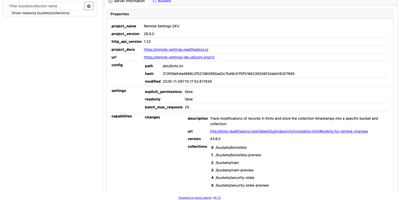
Web and mobile applications get a ready-made backend from Kinto: create buckets and collections through a REST API, save records as plain JSON, and every signed-in device reads the same data without any custom server code. Permissions attach to individual buckets, collections, and records, so you can keep a shared dataset public, limit a collection to a signed-in group, or hand a teammate write access to exactly one collection. Groups bundle people and carry permissions as a unit, which keeps multi-user applications tidy as rosters change. Synchronisation is the headline act: each object carries an incrementing revision number, clients poll for changes since a revision they already hold, and the JavaScript client stores data in IndexedDB so applications keep working offline and publish updates when the connection returns. Collections can declare a JSON schema, and the server rejects records that do not match, which stops malformed writes at the door. The history plugin records every change with its author, an audit trail you can query or roll back from. Records can carry file attachments, and the Kinto Admin web console renders buckets, collections, and records in a browser so you can inspect data, edit entries, and repair permissions without curl. Mozilla runs this model to deliver Firefox configuration and blocklists, and your VPS instance speaks the identical API. Running on a dedicated VPS on RepoCloud with guaranteed CPU, RAM, and SSD, full root SSH access, and a browser serial console. Apache-2.0 licensed.
MongooseIM
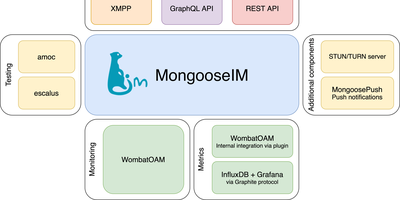
Running chat for a dozen people is easy; running it for a city-sized crowd, on servers you control, with group rooms, archived history, and phones that still buzz when the app is closed, is the job MongooseIM was built for. MongooseIM is an XMPP server at the core of a messaging platform, so any standard XMPP client on desktop, mobile, or web can connect, and browser clients reach it over WebSockets or BOSH. Group conversations run in multi-user chat rooms, message archive management keeps searchable history on the server, and message carbons deliver real-time copies to every signed-in device a person owns. Offline messages wait for reconnecting clients, rosters carry contact lists and presence, and privacy settings plus vCard profiles round out the everyday chat features. Operators manage users, rosters, messages, and settings through a GraphQL API over HTTP or the mongooseimctl command line, and more than fifty built-in metrics show what is happening inside each node. Accounts authenticate against internal storage, MySQL, PostgreSQL, Cassandra, LDAP, or external scripts, and multi-tenancy support creates thousands of chat domains dynamically on one deployment. Adding cluster nodes raises capacity as the audience grows, and the companion push component wakes mobile apps through push notifications. Running on a dedicated VPS on RepoCloud with guaranteed CPU, RAM, and SSD, full root SSH access, and a browser serial console. GPL-2.0 licensed.
Imp
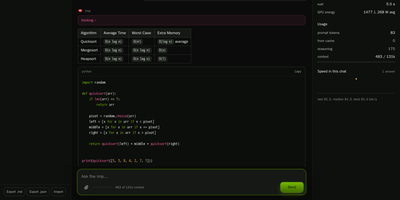
Imp runs large AI chat models privately on one NVIDIA RTX 50 or RTX PRO graphics card, exposing them through OpenAI and Anthropic compatible APIs plus a built-in browser chat. Start it with a single Docker command, point it at a model, and the chat opens in your browser with saved conversations and a live readout of generation speed. Coding agents such as Claude Code and Codex connect by changing one base URL, so your editor talks to the model on your own hardware instead of a rented cloud endpoint. Tool calls, structured JSON output, streaming responses, and reasoning models all work over the wire, and requests can be protected with an API key, per-IP rate limits, and concurrency caps. Load GGUF files you already have or NVFP4 and FP8 SafeTensors checkpoints straight from Hugging Face with no conversion step before the first answer. When a model is bigger than the card, mixture-of-experts weights stay in system RAM while the busiest experts are cached on the GPU, so a 123.6 GiB model still answers from a 32 GB card. Supported models can also read images alongside text, and tokenize, health, and model listing endpoints make the server easy to wire into scripts and monitors. Running on a dedicated VPS on RepoCloud with guaranteed CPU, RAM, and SSD, full root SSH access, and a browser serial console. MIT licensed.
Relay Pulse
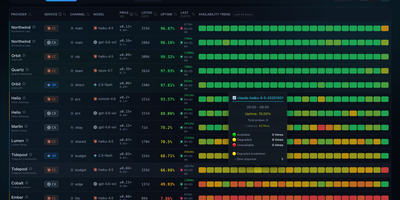
An API relay that answers HTTP 200 with an empty reply is not alive, and Relay Pulse exists to catch exactly that. Every minute, or any interval you set, it sends a tiny real request to each relay, asks a simple arithmetic question, and counts the probe as healthy only when the right answer comes back. Results land in a color-coded availability matrix where green, yellow, and red blocks show good, slow, and failed checks across the last 90 minutes, 24 hours, 7 days, or 30 days. Each row lists provider, service type, channel, model, price multiplier, days listed, uptime percentage, and the latest latency, and hovering a block reveals its probe counts and a breakdown of why it degraded. Filters narrow the table by category, provider, service, channel, vendor, or model, and the page switches between table and card views, four themes, and English or Chinese. Sponsor levels can pin trusted channels to the top, hot and cold boards separate active relays from dormant ones, and Telegram or QQ bots push status changes. Configuration reloads without a restart, templates cover Claude, Codex, and Gemini style endpoints, and a JSON API exposes current status. Running on a dedicated VPS on RepoCloud with guaranteed CPU, RAM, and SSD, full root SSH access, and a browser serial console. MIT licensed.
Nyro
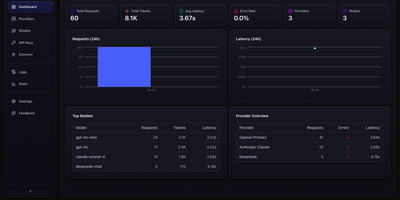
Point Claude Code, Codex CLI, Gemini CLI, or any OpenAI, Anthropic, or Gemini SDK at one address and Nyro routes every request to whichever model provider you choose. The gateway translates protocols on the fly, including streaming, reasoning blocks, and tool calls, so a tool built for one API can run on a model from another. Define virtual model names, bind each to one or more providers, and pick weighted load balancing or priority failover; unhealthy targets are skipped and recover automatically. Issue API keys with limits on requests and tokens per minute and per day, and bind each key only to the models it may call. Exact and semantic caching return repeated answers instantly. A request log records provider, model, token counts, latency, and streaming speed, and usage charts break traffic down by model and provider. The Connect page generates ready-to-paste samples in Python, TypeScript, and cURL, plus one-click configuration for popular coding CLIs. Choose an embedded database for a single host or an external PostgreSQL or MySQL server for production, and run the gateway, the admin UI, or both as separate processes. Running on a dedicated VPS on RepoCloud with guaranteed CPU, RAM, and SSD, full root SSH access, and a browser serial console. Apache-2.0 licensed.
Unla
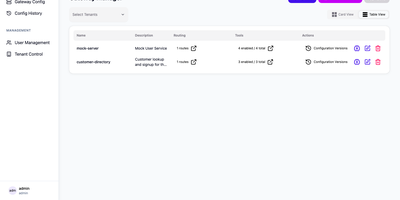
Unla puts a friendly front door on every API you already run, so AI clients can call it as an MCP server without anyone writing a line of glue code. Describe an endpoint in YAML or the form editor, name its arguments, choose where each one goes in the request, and the gateway exposes it as a tool over SSE or streamable HTTP. Import an OpenAPI file to generate a whole server at once, or proxy a third-party MCP server and route it under a prefix of your choice. The Gateway Manager shows every server as a card or table row with its routes, enabled tools, and tool counts. Every save creates a numbered config version with its author and timestamp, so changes are easy to audit and roll back. Tenants keep teams separate, user accounts carry roles, and CORS settings sit next to each route. Configuration hot reloads, syncs across replicas, and persists to disk, SQLite, PostgreSQL, or MySQL. Running on a dedicated VPS on RepoCloud with guaranteed CPU, RAM, and SSD, full root SSH access, and a browser serial console. MIT licensed.

AtroPIM
Manufacturers and distributors can model messy product data exactly as it is in AtroPIM, an open-source product information management system configured through its interface instead of code. Configurable attributes come in twenty-plus data types and are grouped by classifications that give each product class a consistent field set, with automatic unit conversion and per-language values. Variants nest across several levels and inherit values from their parents until overridden; multiple category trees and bidirectional associations such as upsell, cross-sell, and accessories organize the catalog per market. Channel-specific values let one record feed several shops, marketplaces, and catalogs, and product listings gather curated collections for a given purpose. A digital asset library with folders and thumbnail types keeps images and documents attached to the products they describe. Import and export feeds exchange data through files or HTTP requests on a schedule, background workers run the jobs, and dashboard widgets surface failed runs. Roles and teams control who edits what, action history records every change, product statuses such as Draft, Reviewed, and Ready track readiness, and configurable actions run from buttons or on a schedule. Every entity, including custom ones, gets its own REST API for shops, ERP systems, and partner portals. Running on a dedicated VPS on RepoCloud with guaranteed CPU, RAM, and SSD, full root SSH access, and a browser serial console. GPL-3.0 licensed.
RustXNG
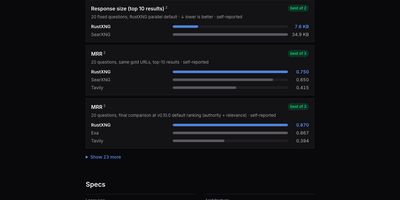
RustXNG gives your AI agents a private web search API that needs no keys, no accounts, and no per-search fees: ask once and get ranked results plus the text of the top pages, ready to ground an answer in real sources. A single request fans out to 180 search engines in parallel, drawn from 226 engine types covering general web, images, video, academic literature, package registries, and news, then merges what comes back with its own ranking that rewards term coverage and canonical-site authority instead of trusting any one engine's order. Engines that time out or keep answering nothing are suspended with backoff and rested automatically, so one dead source never stalls a task, and a repeated query returns from cache in about a hundredth of a second. Call it over HTTP with the familiar SearXNG-shaped JSON, CSV, RSS, or HTML formats, narrow results by domain, engine, or time range, or run the built-in MCP server and hand your agent native search and read_page tools with bounded, truncation-aware responses. Page fetches are hardened against untrusted URLs, an experimental local index can crawl your own corpus and merge it into results, and health, metrics, and per-engine status stay visible through the ops endpoints and the browser UI. Running on a dedicated VPS on RepoCloud with guaranteed CPU, RAM, and SSD, full root SSH access, and a browser serial console. AGPL-3.0 licensed.
Faucet
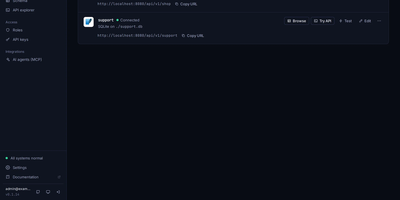
One binary and one command is all it takes: the SQL database you already run gains a secure REST API and MCP server, with no code generation and no ORM boilerplate. Point it at PostgreSQL, MySQL, MariaDB, SQL Server, Oracle, Snowflake, or SQLite and it introspects the schema at runtime, generating full CRUD endpoints with filtering, ordering, and pagination plus a live OpenAPI 3.1 specification. The embedded admin UI connects databases with plain host, port, user, and password fields, tests the connection before saving, and tells you exactly what to fix when it fails. You browse tables, columns, keys, and data, build roles with per-table verb permissions, and issue API keys that are SHA-256 hashed with a role assigned to each. Schema contract locking watches for drift that would silently break your API, with none, auto, and strict modes managed from the UI or CLI. The API explorer builds filtered, paginated requests and copies them out as curl, JavaScript, or Python. An MCP server on the same port gives Claude Code, Cursor, VS Code, Windsurf, and other AI tools governed access to your data under exactly the same roles and keys as any API client. Legacy databases such as SQL Server 2012 or PostgreSQL 9.6 gain a modern API without code changes or migration. Running on a dedicated VPS on RepoCloud with guaranteed CPU, RAM, and SSD, full root SSH access, and a browser serial console. MIT licensed.
KeiRouter
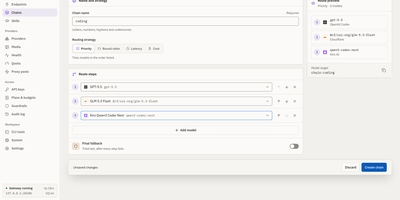
One endpoint, 130+ models from 90+ providers: KeiRouter is a self-hosted AI gateway, so apps, coding tools, and agents connect once and stop juggling provider keys. Your code speaks OpenAI Chat, OpenAI Responses, Anthropic Messages, or native Gemini, and KeiRouter translates to whichever upstream you want, including AWS Bedrock, Azure AI Foundry, Vertex, Snowflake Cortex, and self-hosted runtimes like Ollama and vLLM. Fallback chains keep requests moving when a provider goes down or hits a rate limit, using priority, round-robin, latency, or cost ordering, so coding sessions do not stop mid-task. Five token savers compress prompts on the way in and trim responses on the way out, with a live dashboard showing savings recovered. A response cache answers repeated prompts instantly for zero marginal cost, with optional semantic matching. Per-key budgets and rate plans set USD, token, RPM, and concurrency limits with auto-cutoff, stopping surprise bills. Guardrails scan for PII, prompt injection, toxicity, and banned topics at global, provider, model, chain, and key scopes, with a monitor showing what got blocked and what it cost. The dashboard tracks usage by provider and model, latency, a live console tracing each request through its fallbacks, and provider health. You can import from 9router or OmniRoute, white-label the portal for your team, and run replicas on Postgres and Redis for high availability. Running on a dedicated VPS on RepoCloud with guaranteed CPU, RAM, and SSD, full root SSH access, and a browser serial console. MIT licensed.