llama.cpp
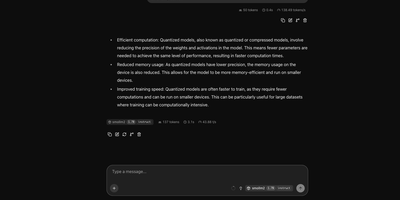
Open-weight language models get a private chat service on your own server, and llama.cpp serves its browser UI the moment the server starts. Conversations appear in a sidebar with search, and each answer shows its token count, generation time, and tokens per second, so you can see how a model really performs. Code replies render in highlighted blocks with a copy button, and messages can be edited, regenerated, forked, or deleted. A Models page lists what the server can run with context sizes and load status, and Settings cover themes, system messages, display options, tools, agentic behavior, import and export, and sampling controls for temperature, top K, top P, and penalties. Remote MCP servers connect by URL, and uploads let multimodal models read files and images. Behind the UI sit OpenAI and Anthropic compatible chat endpoints, embeddings, reranking, function calling, JSON schema constrained output, parallel decoding, and continuous batching for several users at once. Quantized models run on plain CPUs, and official images cover CUDA, ROCm, Vulkan, and other accelerators. Running on a dedicated VPS on RepoCloud with guaranteed CPU, RAM, and SSD, full root SSH access, and a browser serial console. MIT licensed.
Moltis
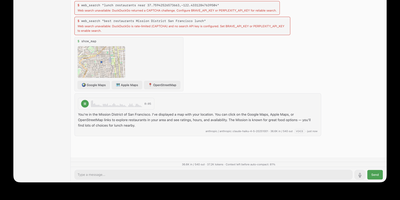
Moltis gives individuals and teams a completely private personal AI agent server that bridges conversational assistants to everyday messaging platforms while executing real-world computing tasks inside secure execution environments. Users can interact with autonomous agents across Telegram, Discord, WhatsApp, Slack, Matrix, and browser interfaces to draft correspondence, automate research, and schedule recurring cron tasks. The system coordinates multi-agent delegation by spinning up specialized sub-agents with dedicated roles for code generation, pull request reviews, quality assurance testing, and technical documentation. Built-in sandboxing isolates tool operations within container boundaries or WebAssembly modules, ensuring shell commands, web scraping routines, and script executions cannot alter underlying operating system files without explicit permission. Native Model Context Protocol integration allows operators to attach external data endpoints, database connectors, and custom command-line utilities without rewriting core routing logic. Persistent memory preserves conversational context and document embeddings across multiple sessions, allowing assistants to recall prior discussions, user preferences, and project guidelines indefinitely. Administrators can configure granular tool approvals, manage WebAuthn passkey authentication, and review real-time WebSocket communication logs through an embedded control panel. Running on a dedicated VPS on RepoCloud with guaranteed CPU, RAM, and SSD, full root SSH access, and a browser serial console. MIT licensed.
Vane
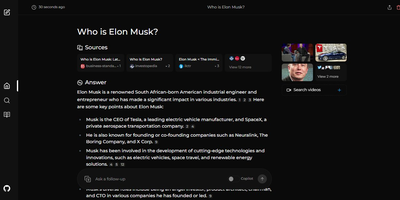
Perplexity's search experience without Perplexity: Vane deploys Perplexica, an open-source AI answer engine built as the self-hosted alternative. Instead of returning a page of links, it reads your question, searches the live web through the SearxNG metasearch engine, and composes a direct answer with cited sources. Retrieval quality comes from embeddings and similarity search: fetched pages are re-ranked against the query so the model answers from the most relevant passages rather than whatever ranked first. Two query modes cover different needs - Normal mode runs a straightforward web search, while Copilot mode generates multiple reformulated queries and actively pulls content from top matches for harder questions. Focus modes specialize retrieval for academic papers, YouTube, Reddit discussions, Wolfram Alpha calculations, or the general web. The answering model is your choice: OpenAI-compatible APIs or fully local LLMs such as Llama 3 and Mixtral through Ollama, which keeps queries entirely on your infrastructure. Because SearxNG pulls live results, answers reflect current information, and no search history is tracked.
JobNavigator
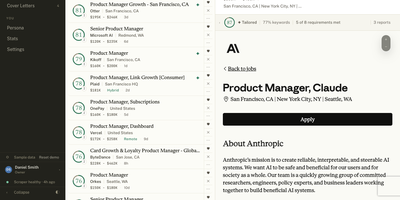
JobNavigator runs your whole job hunt as an automated pipeline, scraping career pages and job boards, scoring every posting against your résumés, and tracking each application to its outcome. Discovery fans out across company career pages through twelve ATS handlers, aggregators like LinkedIn, Indeed, and ZipRecruiter, and a Chrome extension that saves any posting you stumble on. Each new job is scored against your base résumés, lightly for a quick number or in full, with keyword coverage and requirement mapping that show exactly where you match and where you do not. Strong matches get a tailored résumé from eight PDF templates and a cover letter written from your persona, ready for your review before anything is sent. The extension then auto-fills application forms and drafts answers to free-text questions from your stored Q&A bank. Every application moves through stages and interviews in one tracker, while Gmail polling spots replies and updates the status for you, and Telegram delivers new-job alerts and a daily digest. A household can share one install with up to five accounts, each keeping its own jobs, résumés, and PIN, while scraping runs once for everyone. Running on a dedicated VPS on RepoCloud with guaranteed CPU, RAM, and SSD, full root SSH access, and a browser serial console. MIT licensed.
OpenUI
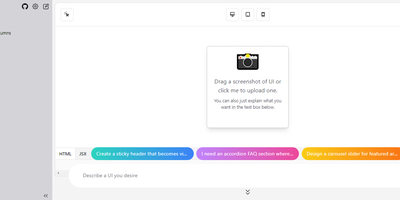
Describe a component in natural language and watch it render: OpenUI, from Weights & Biases, is an open alternative to Vercel's v0. Type a prompt like "a dark-themed dashboard with a sidebar and charts" and the LLM renders working HTML with Tailwind styling live in the browser. You then iterate conversationally, asking for changes until the design is right, and convert the result to React, Svelte, or Web Components for use in a real project. The backend is Python with LiteLLM routing, so it works with OpenAI, Anthropic, Gemini, Groq, and Mistral API keys, or fully offline against local Ollama models, including vision models like LLaVA that can generate UI from screenshot input - feed a screenshot and the model reproduces or riffs on an existing interface. Generated markup is inspectable at any point, with light and dark mode toggles, theme selection, and responsive previews across device sizes. The practical effect is compressing the mockup-review-revise loop from hours to minutes: a described layout renders in seconds and iterates through follow-up prompts, and because output converts to real framework code, prototypes feed directly into production codebases instead of staying trapped in a design tool. Self-hosting keeps unreleased product interfaces and prompts on your own server, and LiteLLM routing lets you pick the model per task - a cheap fast model for rough drafts, a stronger one for final passes, or free local models for unlimited experimentation.
Dograh
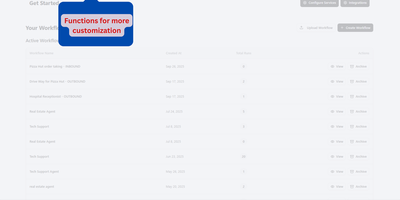
Build a voice AI agent that answers calls, qualifies leads, books appointments, and transfers to a human when needed, all from a drag-and-drop workflow builder in your browser. Dograh ships as a Docker Compose stack (API, web UI, Postgres, Redis, MinIO) that you self-host on any Linux server with automatic HTTPS provisioning via Let's Encrypt. The visual workflow builder lets you design multi-turn conversation flows by connecting nodes for greetings, intent classification, tool calls, and handoffs; describe your use case in plain English and the platform generates the LLM prompt and node graph for you. Connect your own speech-to-text, LLM, and text-to-speech providers (OpenAI, Anthropic, Gemini, ElevenLabs, Deepgram, local Whisper, Kokoro, or any OpenAI-compatible endpoint) or use the built-in Speech-to-Speech mode with Gemini Flash Live and GPT-Realtime-2 for sub-200ms latency. Telephony plugs in through Twilio, Vonage, Vobiz, or Cloudonix for inbound and outbound calling, with live agent transfer when the conversation needs a human. Webhook tool calls connect to Salesforce, HubSpot, Google Calendar, Cal.com, or any REST API without writing orchestration code. The ClonedVoice feature mixes real human voice recordings for high-frequency phrases with neural TTS fallback for dynamic content, cutting costs while improving caller trust. A built-in MCP server lets AI coding agents like Claude Code or Cursor design, test, and edit workflows through natural language. Deploy on a dedicated VPS on RepoCloud with guaranteed CPU, RAM, and SSD, full root SSH access, and a browser serial console. BSD 2-Clause licensed.
Slashdocs
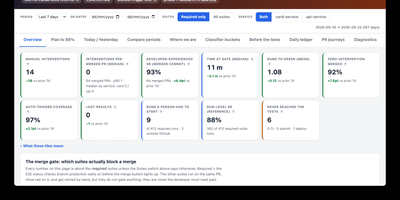
Slashdocs gives AI agents and the people who supervise them one shared home for finished work, replacing reports pasted into chat threads with reviewable HTML documents that live at a permanent address. An agent publishes a single self-contained HTML file, an architecture review, incident postmortem, product spec, data analysis, or QA report, and teammates open it in the browser to read the rendered page rather than raw markup. Reviewers anchor comments to exact words, resolve or reopen threads, and follow links straight to a heading or discussion, while Slack notifications announce new activity with personal mute controls for quieter channels. Every publish creates an immutable version guarded by optimistic concurrency, so an agent can read the feedback and push the next revision without overwriting anyone's copy. Agents connect through a remote MCP endpoint with browser OAuth or service-account keys, and people sign in through OpenID Connect with providers such as Google, Okta, Entra ID, or Keycloak. The companion CLI creates, pulls, pushes, and comments on documents with compact output or JSON for scripts, and folders plus sharing controls keep a growing library organized. Running on a dedicated VPS on RepoCloud with guaranteed CPU, RAM, and SSD, full root SSH access, and a browser serial console. MIT licensed.
EdgeQuake
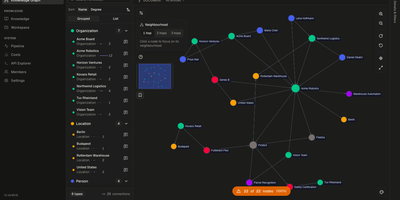
A folder of documents stops being a pile of files once EdgeQuake extracts a knowledge graph you can explore and question. Upload text, PDFs, or markdown and the pipeline extracts people, organizations, places, and the relationships between them, then shows progress and entity counts for every file. The graph viewer draws the network with color-coded entity types, a searchable entity list, and a details panel that lists descriptions, properties, and linked entities. Ask a question in the query chat and pick a retrieval mode, from keyword lookups to hybrid and global themes, and each answer arrives with numbered sources and a button that highlights the matching nodes on the graph. Workspaces keep projects separate, and each can assign a different model to extraction, answering, keywords, summaries, and embeddings. A cost dashboard breaks token use and spend down by stage with a monthly budget bar. A members page, an API explorer, and Swagger docs round out administration. Running on a dedicated VPS on RepoCloud with guaranteed CPU, RAM, and SSD, full root SSH access, and a browser serial console. Apache-2.0 licensed.
Trinity
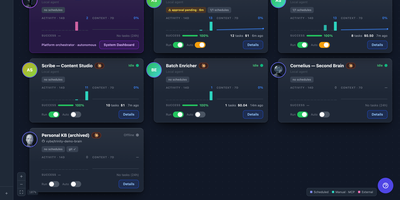
Trinity runs your AI agents the way a company runs employees, with departments, roles, reporting lines, and receipts for everything they do. Each agent holds a seat on record tied to an objective and a declared metric, so whether it is working is a number with a date on it rather than an impression. Agents work on three runtimes, Claude Code, OpenAI Codex, and Gemini CLI, chosen per chat without changing the agent's state, history, or permissions. A schedule fires, the agent works inside its own container, and anything irreversible waits in a human approver's Inbox as a card naming the agent, the skill, and the input until someone approves, discusses, or rejects it. Every agent is a git repository you own: it commits its own work, its tool calls land in an append-only audit log, and every run appears in an execution ledger with its trigger, cost, and outcome, searchable across the fleet. The same agents answer in the browser Workspace, in Slack, Telegram, and WhatsApp, over a public chat link, through MCP, and from the CLI. Guardrails bind agents by what they hold rather than what they are told, with hooks they cannot switch off, cost limits, loop budgets, and a kill switch for outbound calls. Running on a dedicated VPS on RepoCloud with guaranteed CPU, RAM, and SSD, full root SSH access, and a browser serial console. Apache-2.0 licensed.
SwanLab
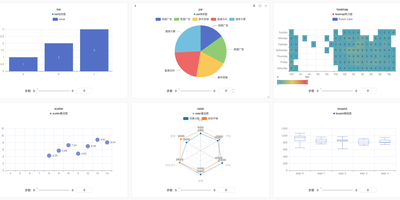
Training runs stop being terminal scrollback and become a board you can read at a glance. SwanLab is an open-source experiment tracking and visualization platform for AI model training that records metrics, hyperparameters, logs, and hardware signals from your training code into a modern web dashboard you can self-host. A few lines of Python start an experiment, and the dashboard follows loss curves, learning rates, and custom scalars live, with line chart configuration, smoothing, grouping, and detailed hover inspection for comparing runs. Experiments organize into projects and groups with tags, pinning, filtering, and a table view that sorts and aligns runs against a baseline with difference percentages. Media logging goes far beyond scalars: images, audio, video, text with Markdown rendering, 3D point clouds, molecular structures, and custom ECharts visualizations including PR curves, ROC curves, and confusion matrices. Hardware monitoring records GPU, CPU, memory, disk, and network behavior from NVIDIA, AMD, Ascend, and other accelerators alongside the metrics they produced. Integrations cover more than fifty frameworks, from PyTorch Lightning and Hugging Face Transformers to LLaMA Factory, veRL, and XGBoost, and existing histories migrate in through sync tools for MLflow, TensorBoard, and Weights and Biases. Teams collaborate with organizations, roles, project sharing, webhooks, and notification plugins. Running on a dedicated VPS on RepoCloud with guaranteed CPU, RAM, and SSD, full root SSH access, and a browser serial console. Apache-2.0 licensed.
Open Notebook
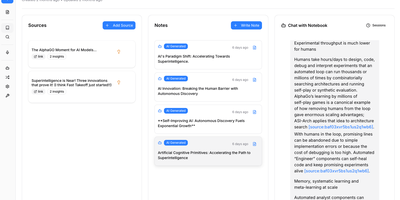
The most feature-complete open-source alternative to Google's NotebookLM — a self-hosted research platform where you upload PDFs, videos, audio files, and web pages into organized notebooks, then chat with your content, generate multi-speaker podcasts, and run semantic search across everything without sending a single byte to Google's servers. The podcast engine supports 1-4 fully customizable speakers with backstories, personalities, and expertise profiles, generating professional audio dialogue through OpenAI, ElevenLabs, Google TTS, or completely local text-to-speech via Kokoro for maximum privacy. Content processing uses token-based chunking with RAG-powered retrieval grounded in your uploaded sources, while both full-text keyword search and semantic vector search via SurrealDB enable conceptual discovery across all notebooks. The 18+ supported AI providers include OpenAI, Anthropic, Google Gemini, Groq, Ollama, LM Studio, and more — configurable per task so you can route cheap models to summarization and powerful models to analysis. Content transformations extract insights, generate summaries, create study guides, and produce structured outputs from any source material. The MCP integration connects Open Notebook to Claude Desktop, VS Code, and other MCP clients for seamless workflow integration. A full REST API on port 5055 enables complete automation of notebook management, source upload, and podcast generation. Deploy via Docker Compose with the application container, SurrealDB v2 on RocksDB, and optional TTS containers. Running on a dedicated VPS on RepoCloud with guaranteed CPU, RAM, and SSD, full root SSH access, and a browser serial console. MIT licensed.
Dagu
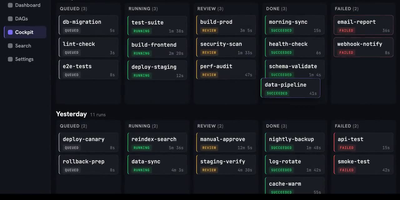
With over 3,700 GitHub stars and growing adoption among teams tired of managing complex orchestration platforms, Dagu delivers a complete workflow engine as a single Go binary that requires no external database, message broker, or framework installation. Define directed acyclic graphs in declarative YAML — specifying dependencies, schedules, retries, timeouts, approvals, and notifications — while keeping existing shell scripts, containers, and tools completely unchanged. The built-in Web UI provides live pipeline visualization, per-step log streaming, run history browsing, artifact previewing, manual retry controls, and workflow YAML editing without SSHing into servers. Execute steps as shell commands, Docker containers, Kubernetes Jobs, SSH remote commands, SQL queries, or HTTP requests, with conditional branching and parallel execution handled natively. The integrated Model Context Protocol server exposes dagu_read, dagu_change, and dagu_execute tools, enabling AI agents like Claude, Codex, and Cursor to inspect workflow state, preview YAML modifications, and control runs through authenticated endpoints. The harness.run executor lets external coding-agent CLIs operate inside DAG steps with full scheduling and approval gate support. Scale beyond a single machine with the distributed worker mode, which dispatches tasks to remote nodes via gRPC with automatic label-based routing and worker selection. Deploy with Docker, the official Helm chart for Kubernetes, or a simple binary download requiring only a Linux, macOS, or Windows host. Running on a dedicated VPS on RepoCloud with guaranteed CPU, RAM, and SSD, full root SSH access, and a browser serial console. GPLv3 licensed.
AMUX
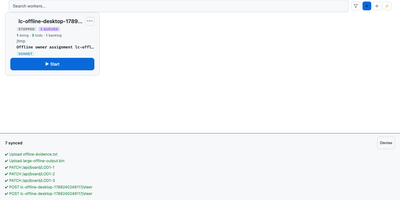
To coordinate swarms of autonomous coding agents across complex software projects, AMUX provides a concurrency-safe kanban workspace with real-time thought stream inspection and live steering controls. Engineers assign development tasks through an interactive board where autonomous worker processes claim cards using compare-and-swap mutexes to eliminate race conditions between parallel sessions. Operators monitor active reasoning streams, inspect streaming terminal outputs, and inject guidance commands mid-turn without interrupting background execution. A cryptographic origin router relays messages between agents, enabling workers to delegate sub-tasks, request automated peer code reviews, and share environment state safely. Built-in schedulers trigger recurring automated maintenance routines, dependency updates, and bug triage sweeps on cron-like timers or autonomous loop cadences. Teams can switch language models dynamically on active sessions to tackle complex architecture challenges with high-capability reasoning engines while conserving resources on routine tasks. An integrated self-healing supervisor watches over agent runtimes, automatically compacting context windows, restarting crashed terminal sessions, and resuming pending instructions seamlessly. Running on a dedicated VPS on RepoCloud with guaranteed CPU, RAM, and SSD, full root SSH access, and a browser serial console. MIT licensed.
Asterisk AI Voice Agent
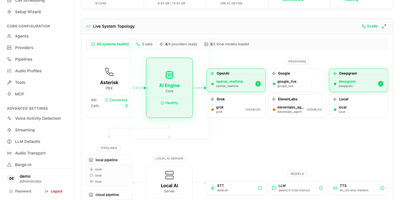
Asterisk AI Voice Agent answers calls on your existing Asterisk or FreePBX phone system with a configurable AI receptionist, and you manage every agent from a self-hosted web console. Choose a full realtime voice provider such as Deepgram, OpenAI Realtime, Google Live, ElevenLabs, or xAI Grok, or assemble a pipeline from separate speech-to-text, language-model, and text-to-speech services, including local models with optional GPU acceleration. Each agent bundles a prompt, greeting, voice, audio profile, and tool list, and one dialplan variable routes any extension to it, so a receptionist, sales line, and support desk can share an install. During a call the agent can transfer to extensions, check extension availability, take voicemail, email summaries, and book appointments through Google Calendar, Microsoft Calendar, or Calendly, while MCP servers and HTTP tools add custom actions. Callers can interrupt mid-sentence, and an inactivity watchdog politely ends silent calls. Call History keeps searchable transcripts with tool-call details, quality metrics, filters, and CSV or JSON export. A live topology dashboard shows ARI connection status, providers, pipelines, and containers, a setup wizard walks through the provider, API keys, and Asterisk connection, and a model catalog of about 250 entries downloads and switches local speech and language models. AudioSocket, ExternalMedia RTP, or WebSocket transports and tunable audio profiles match your carrier's codecs. Running on a dedicated VPS on RepoCloud with guaranteed CPU, RAM, and SSD, full root SSH access, and a browser serial console. MIT licensed.
Suparagent
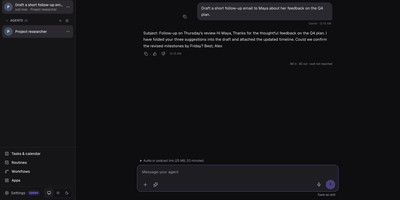
Suparagent turns a single server into a workspace of named AI coworkers that each have a job, a memory, and a folder of their own. Chat with an agent in the browser, pick an engine per conversation, and watch replies stream in as the sidebar keeps every thread searchable. Approval modes decide how much freedom an agent gets: ask first, accept edits, or plan only, so nothing touches a file or runs a command without your say. Routines send a prompt to an agent on chosen weekdays, through a webhook, or on demand, and every run lands in its own conversation. A kanban board with month, week, and upcoming views tracks tasks by owner and priority, and a canvas builds multi-step workflows from schedule triggers, model steps, agent steps, conditions, and approvals. Agents save notes you can edit, delegate to specialists in shared rooms, and reuse saved skills and templates. A usage panel totals turns and tokens by conversation, engine, and day, with a CSV export. Invite teammates with a one-time link, pair a phone, and keep agents working when your laptop is closed. Running on a dedicated VPS on RepoCloud with guaranteed CPU, RAM, and SSD, full root SSH access, and a browser serial console. Apache-2.0 licensed.
OASM
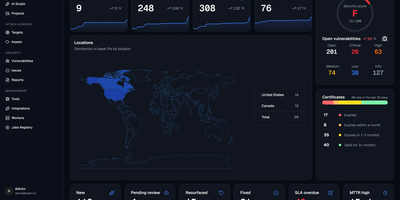
Know every internet-facing asset your team exposes, and which weakness to fix first, before an attacker maps them for you. Add domains, IP addresses, CIDR ranges, or Git organizations as targets, with internal or external scope, and OASM builds one searchable inventory of hosts, ports, services, technologies, URLs, TLS certificates, and screenshots, with a topology graph and CSV export. Scanners such as Nuclei, Nmap, OWASP ZAP, Nikto, WPScan, and Gitleaks install from a marketplace as isolated connector containers, and distributed workers run them on demand or on a schedule. Findings move through new, active, resurfaced, and fixed states with CVSS, EPSS, and SLA timers, and teams accept risk, dismiss, or open remediation issues with priority, assignee, and due date. Projects keep chosen assets scanned on a schedule, when new assets join, or when a vulnerability appears. AI Studio is a security agent that runs on the model you connect: it answers questions from workspace data, writes a plan for your approval, dispatches parallel subagents, runs commands on your workers, and drives a headless browser, filing its findings as proposals a reviewer must approve. An MCP server opens the same workspace data to Claude, Cursor, and VS Code with a workspace API key. Assets sync from AWS, Cloudflare, and Vercel, and alerts reach Slack, Discord, Telegram, or webhooks. Running on a dedicated VPS on RepoCloud with guaranteed CPU, RAM, and SSD, full root SSH access, and a browser serial console. AGPL-3.0 licensed.
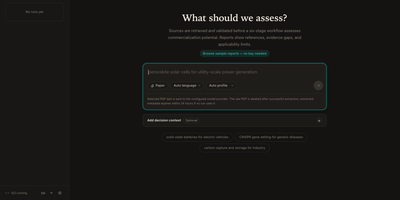
Academic Commercialization Agent
Got a research paper and no idea if anyone would pay for it? Academic Commercialization Agent answers with a cited triage report instead of a hunch. Type a topic or attach a paper PDF, pick a report language and scoring profile, and follow the run as it works through academic, patent, and market evidence. The result opens with a decision brief: an overall readiness score out of 100, the strongest evidence, the biggest risk, and a recommended first step. A scorecard breaks that number into technology readiness, manufacturing readiness, patent position, market accessibility, and evidence confidence, with a short reason behind each bar. The full report adds opportunities, risks, evidence limitations, reviewer notes, and a numbered reference list. Optional decision context captures who is deciding, what they own, and what choice is on the table, so the verdict reads as a license, invest, pilot, or spin-out call. Run history keeps every analysis searchable, interrupted runs resume from their last checkpoint, and two runs can be compared side by side. Reports export to Markdown or PDF and share by link, and a Sources search finds saved excerpts by ID or keyword. Six finished sample reports, one in Chinese, open without any key. A technology transfer office facing a pile of new disclosures can rank them in a first pass before spending expert time. Running on a dedicated VPS on RepoCloud with guaranteed CPU, RAM, and SSD, full root SSH access, and a browser serial console. MIT licensed.
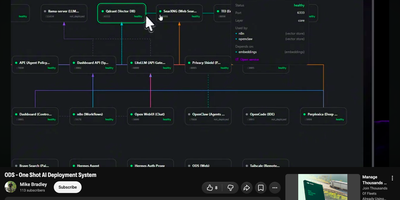
ODS
ODS turns a GPU machine or server you already own into a complete private AI stack with a single install command, replacing a shelf of separate tools with one system that serves models, chat, agents, automation, and search from your own hardware. The installer reads your GPU, VRAM, memory, and disk, then downloads a GGUF model matched to that hardware tier, and a compact bootstrap model starts answering within minutes while the full model finishes downloading. From the web dashboard you watch every service's health, ports, and resource use, restart what misbehaves, and check storage and updates without touching a terminal. You chat with local models in Open WebUI, hand background work to the Hermes and Portal agents, and build automations in n8n that connect the stack to more than 400 other apps. Documents you add become searchable knowledge through Qdrant vector storage, so answers cite your files instead of the model's memory. SearXNG and Perplexica answer web questions without trackers or accounts, Whisper transcribes speech, Kokoro reads text aloud, and ComfyUI generates images, all on the same box. Every bundled service is an extension you can enable, disable, or replace, and a Privacy Shield scrubs personal data before anything reaches an optional cloud model through the LiteLLM gateway. Running on a dedicated VPS on RepoCloud with guaranteed CPU, RAM, and SSD, full root SSH access, and a browser serial console. Apache-2.0 licensed.