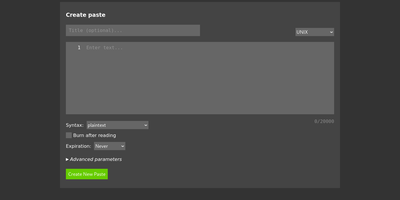
Lenpaste
Share code snippets, logs, configs, and notes without registration, tracking, or ads: Lenpaste is a minimal, self-hosted, anonymous alternative to pastebin.com. It is deliberately spartan in the right ways: no accounts, no JavaScript required (the entire site works in text browsers and hardened setups), and cookies used solely to store display preferences. Pastes support syntax highlighting across a long list of languages (from ApacheConf and Arduino to mainstream stacks), configurable expiration from minutes to unlimited, one-use "burn after reading" pastes that self-delete on first view, optional author attribution, and iframe embedding for dropping pastes into other pages. The form-encoded HTTP API covers everything the UI does - create pastes with title, syntax, expiration, and line-ending normalization, fetch them by ID, and query server capabilities - making it trivial to pipe command output to your paste server from shell scripts. Server operators control maximum title and body lengths, maximum paste lifetime, rate limits for viewing and creation, search-engine indexing policy, and can lock private instances behind HTTP Basic authentication. It deploys as a single lightweight Docker container, giving your team a snippet-sharing endpoint where the content never touches a third-party service.
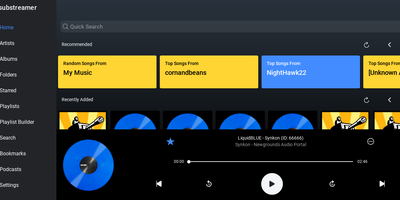
Substreamer
A free, polished web client for Subsonic-compatible music servers: Substreamer is the browser-based frontend you point at your existing streaming backend to play your own library from anywhere. It speaks the Subsonic API (v1.13 and higher), which makes it compatible with the whole ecosystem that has grown around that protocol: the original Subsonic server, its forks Airsonic and Madsonic, and modern implementations like Navidrome and Ampache. That decoupling is the point - your music files, transcoding, and library indexing live on whichever server you prefer, while Substreamer provides the listening experience: browse by artist, album, and genre, build and manage playlists, search your collection, and stream on demand. This RepoCloud deployment runs the containerized web edition, so the same interface is available from any browser without installing a native app, and it pairs with the Substreamer mobile apps that made the client popular. For anyone assembling a self-hosted Spotify replacement - typically Navidrome for the backend plus a good client - Substreamer fills the client half with a clean, familiar player UI. Because it is a stateless client, the container is lightweight and low-maintenance: connect it to your server's URL and credentials, and your entire collection is streaming in minutes, with no subscription and no catalog that can disappear.
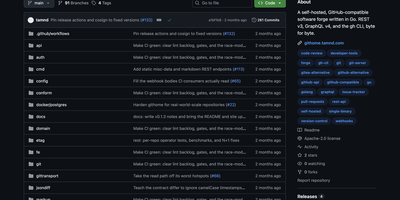
Githome
Point the gh CLI at your private Githome server and it works identically to github.com, because every REST v3 and GraphQL v4 endpoint returns byte-for-byte compatible JSON shapes, headers, Link pagination, and ETag caching. A single compiled Go binary serves the REST API under /api/v3, GraphQL under /api/graphql, git smart-HTTP transport, and a server-rendered web UI implementing the GitHub Primer design system with full functionality when JavaScript is disabled. The web interface provides repository browsing with Markdown rendering and syntax highlighting, issue tracking, pull requests with unified diffs and inline code review threads, full-text search, user profiles, and a notifications inbox. Authentication supports personal access tokens with prefix-based identification, OAuth device and web flows, and scoped permissions on every response header with only token hashes stored. The pull request system implements the complete lifecycle including async mergeable state computation, squash, merge, and rebase strategies, commit statuses, check runs, and statusCheckRollup fields. Webhooks deliver events with X-Hub-Signature-256 verification, SSRF protection, and at-least-once retry semantics. Storage supports SQLite for single-node deployments or PostgreSQL for production configurations. Performance optimizations include batch loaders replacing N+1 queries, keyset pagination, FTS-backed search, and GraphQL dataloaders. Docker deployment pulls the official multi-arch container image from GitHub Container Registry. Running on a dedicated VPS on RepoCloud with guaranteed CPU, RAM, and SSD, full root SSH access, and a browser serial console. Apache-2.0 licensed.
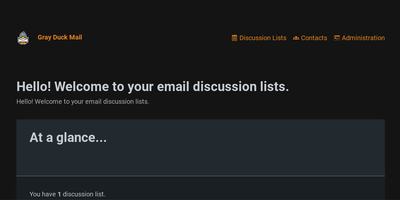
Gray Duck Mail
Email discussion lists - the venerable listserv pattern where one address relays to a whole group - without the notorious setup pain of Mailman or Sympa: that is Gray Duck Mail. Its architectural trick is requiring no mail server of your own: the C#/ASP.NET Core app monitors a POP3 inbox at any external email host supporting POP3/SMTP and aliasing, relays each incoming message to all list members via SMTP, and archives it for browsing in the web interface. Replies route back to the entire group automatically. The tedious parts of list management are handled by convention: dedicated aliases process join requests, subscription confirmations, and unsubscribes, while a bounce alias in the return-path catches delivery failures so dead addresses get handled instead of silently rotting. The web administration interface creates and removes lists, manages contacts, browses message archives, and imports or exports the local database for backup. GPLv3-licensed, Docker-distributed, and fully code-documented, it targets exactly the groups email still serves best - neighborhoods, schools, congregations, workplaces, and families - where one message keeping everyone in the loop beats yet another app nobody wants to install.
HyperLevel
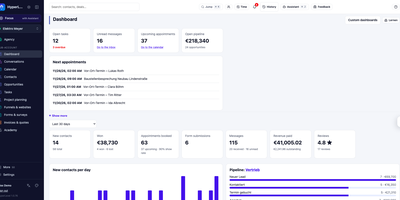
An AI agent that works with the permissions of whoever opens it lives inside HyperLevel, an open-source CRM, inbox, calendar and invoicing platform for small businesses and agencies. It opens with Ctrl+J and shows a confirmation card with the exact action before it changes anything. Changes to the main records are journaled, so an undo link, a history and a trash bin take most of them back. Focus mode turns the screen into one prompt, and asking "What's burning?" returns the most urgent items, from overdue invoices to stale deals, with next steps. Outside agents get 340+ tools through its MCP server: Claude, ChatGPT, Codex and Cursor sign in with OAuth or API keys, and every change lands in the audit log. Contacts, companies and deals move through drag-and-drop pipelines. One inbox gathers email, SMS, live chat, WhatsApp, Messenger and Instagram, with owners, snoozing and deadlines. Booking pages sync with Google Calendar and Outlook. Workflows with 140+ triggers and 130+ actions, AI steps included, run on a visual canvas. A page builder makes funnels, websites and forms, and invoices, quotes and subscriptions are paid through Stripe, PayPal or Mollie. Project planning offers list, board, Gantt and workload views with time tracking. Agencies get unlimited white-label sub-accounts, and models come from your own OpenAI, Anthropic or Gemini keys or local Ollama. Running on a dedicated VPS on RepoCloud with guaranteed CPU, RAM, and SSD, full root SSH access, and a browser serial console. AGPL-3.0 licensed.
GlitchTip
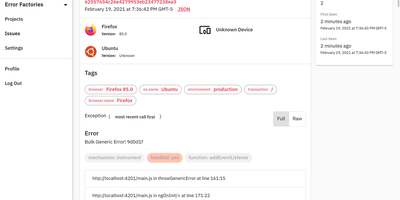
GlitchTip speaks Sentry's protocol without Sentry's operational weight - open-source error tracking that your existing SDKs already understand. The pitch is pragmatic: instrument your application with the official Sentry SDKs you already know - any language they cover - and point the DSN at your own GlitchTip instance instead. Errors, exceptions, log messages, and Content Security Policy violations flow into one place for triage, grouped into issues with stack traces, with alerts delivered by email or webhook the moment things break. Where self-hosted Sentry has ballooned into a docker-compose stack of twenty-plus containers, GlitchTip is a deliberately lean Django and PostgreSQL application a small team can actually run. Beyond errors, it bundles three more monitoring concerns: performance monitoring takes a works-out-of-the-box approach - no dashboard building, just your slowest web requests, database queries, and transactions surfaced automatically; uptime monitoring pings your sites and alerts on failures, or runs in reverse as a dead-man's-switch heartbeat for cron jobs that must check in on schedule; and log search puts application logs alongside errors for faster debugging. Unlimited projects and team members, MIT-licensed, built by Burke Software - your event volume is limited only by your own hardware.
Agents Platform
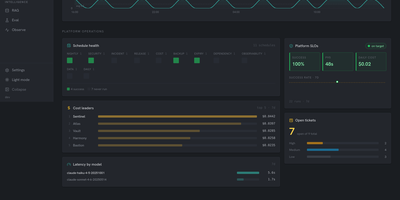
Twenty ready-made AI agent personas, a scheduler, a pipeline builder and a ticket board share one dashboard in Agents Platform, so recurring operations audits run, get summarized and turn into tracked work. Each agent carries a system prompt, skills in the SKILL.md format (adopted from the Anthropic skills catalog or imported by URL), MCP tool servers provisioned into SSH runs, and memories distilled from earlier results. Work runs in parallel, in sequence or as structured meetings, through conditional DAG pipelines or saved crews, on cron schedules or from inbound webhooks such as Prometheus alerts, git pushes and n8n flows. Execution happens over SSH on a host with Claude Code, through the Anthropic API, or against any OpenAI-compatible endpoint including local Ollama models. On SSH runs every tool call streams live into a step timeline, safety tiers stop read-only agents from writing files, supervised runs wait for approval, and scoped API keys guard the trigger endpoints. Recurring runs fuse into Combined Reports with a health score and metric trends, critical verdicts open tickets on a Kanban, Table or Gantt board, and Discord announces results. Cost, latency and SLO dashboards show per-agent spend, while eval suites with LLM-as-judge scoring and prompt A/B tests promote better prompts. A demo mode seeds weeks of sample history so everything can be explored without an API key. Running on a dedicated VPS on RepoCloud with guaranteed CPU, RAM, and SSD, full root SSH access, and a browser serial console. MIT licensed.
Inkling
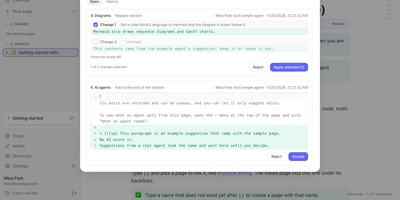
Built for small teams whose members each bring their own AI agent, Inkling keeps one shared set of notes that agents read by the section and change only through edits people can review. An agent asks a question and receives just the sections that answer it, packed into a token budget. It then edits one section against the version it read; if a teammate changed that section meanwhile, the agent gets the current text to merge instead of overwriting it. Edits can wait as suggestions that people accept in part or reject, and anything an agent changed can be reverted, one change or everything a connection touched on a page. A comment or database cell can hand a task to one member's agent, and a Team agents board shows what each connection is working on. The notes themselves cover Notion-style databases with table, board, calendar, gallery, timeline, chart, form and list views, plus wikilinks, backlinks, a graph, JSON Canvas whiteboards, Dataview-style query blocks and daily notes. Live co-editing shows cursors and presence, while roles, guests, edit locks and expiring password links control who sees what. Claude, Cursor and VS Code connect through OAuth to a built-in MCP server with 48 tools, and Slack or webhooks announce changes. Running on a dedicated VPS on RepoCloud with guaranteed CPU, RAM, and SSD, full root SSH access, and a browser serial console. MIT licensed.
PlainBoard
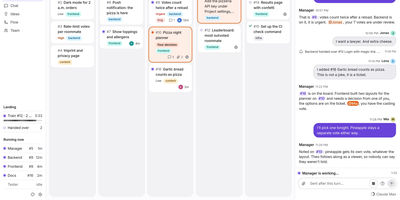
Tell PlainBoard's manager agent what software you want, and a team of AI agents builds it while PlainBoard checks the finished branches and lands them on main. The manager turns chat messages into tickets, builds a team per project with its own roles, models and tools, and gives every agent a complete assignment. A live board shows which agent works on each ticket and for how long, with Markdown, labels, priorities, attachments and comments on every card. Claude and Codex agents work side by side on API keys or personal subscriptions, and local servers like Ollama or vLLM and hosts like OpenRouter and Groq are supported too. Finished branches join one merge train that runs your check command once, so ten changes cost a single test run and a failed train gets one agent to repair it. When an agent needs a decision, its ticket asks with clickable options and pictures while the rest of the team keeps working. An Ideas pinboard sorts loose thoughts into topics, and the Flow view follows every repository from agent to main branch. Teammates join with viewer, member or owner roles, mention each other with @name, and share subscriptions. Claude skills and MCP servers extend the agents, and PlainBoard itself serves as an MCP server for Claude Desktop, Claude Code and Cursor. Running on a dedicated VPS on RepoCloud with guaranteed CPU, RAM, and SSD, full root SSH access, and a browser serial console. MIT licensed.
Tuff
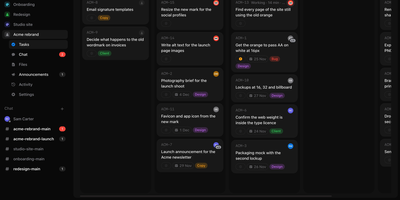
Tuff gives every project its own tasks, chat, files and announcements in one workspace, so a decision made in a thread is never lost between a tracker and a wiki. Tasks switch between list and board, with labels, due dates, priorities, sub-tasks, blockers and sprints, and My Tasks gathers everything assigned to you. Chat rooms, direct messages and threads sit beside the board, and any message can name a task or become one. Files hold documents that several people write at once, plus pictures, uploads and links, with version history and drafts. Hours logged on tasks add up by person and project, and ⌘K searches across all of it. AI agents such as Claude Code, Codex and Cursor connect over MCP and work as the person who connected them, show up in Activity under their own name, never delete anything, and leave questions in a Needs you list. Give a list to an agent and new unassigned tasks go straight to it, while its page shows tasks taken, questions answered and spend. Branches, pull requests and commits that name a task show on it, GitHub issues sync both ways, and imports bring over Asana, Jira, Linear, Slack and GitHub Issues. Sign-in takes email with a second factor or Google, Apple and GitHub, and the interface speaks English and French. Running on a dedicated VPS on RepoCloud with guaranteed CPU, RAM, and SSD, full root SSH access, and a browser serial console. AGPL-3.0 licensed.
Luna AI Engine
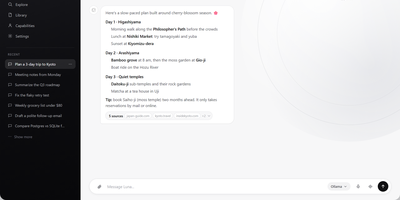
Chat, voice and files meet in Luna, an AI assistant that remembers your preferences, writes meeting minutes and answers through a local Ollama model or any cloud model you choose. Claude, Gemini, OpenAI, Groq, Mistral, Cohere, NVIDIA NIM and OpenRouter work through a setting, and several Ollama servers can be ranked ahead of a cloud fallback. Attached PDFs, Word files, spreadsheets, slides and code land in a searchable Library, and persistent memory carries facts and a learned style between chats. Wake-word and push-to-talk voice let Luna listen and answer back with local text-to-speech. Meeting mode records audio, transcribes it locally and writes minutes with decisions, action items and open questions. A skill is a JSON file plus a Markdown file, with built-ins for research, coding, documents, datasets, job search, news, papers and store-price comparison. Google Workspace, Microsoft 365, GitHub and Spotify connect as integrations, and six MCP servers hand memory, web research and workspace files to Claude Desktop and other clients. Fitbit, Oura, Garmin and Apple Health data sync into local metrics for questions such as how last week's sleep went. A business variant adds multi-user sign-in, rate limits and Telegram, Discord, Slack and webhook channels. The desktop, Android and home-screen iPhone apps reach the server privately over Tailscale. Running on a dedicated VPS on RepoCloud with guaranteed CPU, RAM, and SSD, full root SSH access, and a browser serial console. MIT licensed.
Ontoplano
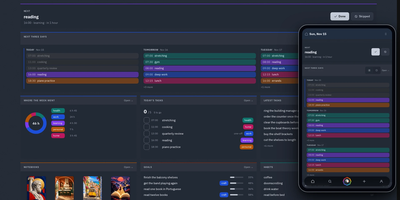
Open Ontoplano on a Monday and the whole week is in front of you: calendar blocks, tasks, bills falling due and a shopping list that fills itself as stock runs short. Blocks repeat or happen once, and any one day's block can be moved, skipped or finished without touching the rest. A day board lines up what is pending, doing and done. Reminders ring even when the app is closed. Goals count their own progress from linked tasks and workouts. The weekly review asks about every block that was skipped. Each notebook holds one subject's notes, tasks, shopping and bills. Beside them sit a diary, ideas and a people list with birthdays. Inventory tracks places, quantities and restocking. Recipes are made from what is in the cupboard. Ledgers import statements, and each movement is classified as an expense, income, transfer, refund, fee or cash withdrawal. Monthly budgets and insights show where the money goes. A capture wheel writes down a task, note or reminder in one gesture. Assistants such as Claude or ChatGPT connect to the built-in MCP server from a screen where each permission can be unticked, and a tool without permission is never offered to them. Exports keep their pictures, while webhooks and a calendar feed link other tools. The app is translated into six languages. Running on a dedicated VPS on RepoCloud with guaranteed CPU, RAM, and SSD, full root SSH access, and a browser serial console. AGPL-3.0 licensed.
Agentic Customer Service Platform
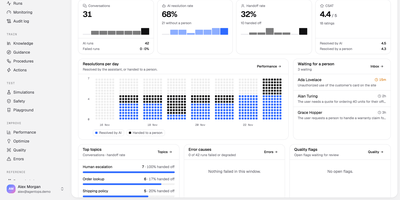
When a customer asks to cancel their latest order, this platform lets the AI propose the action while deterministic code checks the customer, applies policy, asks for confirmation and runs it exactly once. The assistant answers policy and FAQ questions from a knowledge base with hybrid dense and keyword retrieval, quotes its evidence and abstains when the evidence is thin. It looks up orders and tickets, handles refunds and cancellations, opens support tickets and escalates sensitive requests to a person with a priority, a reason and a first-reply deadline. Workflows pause at confirmation points and resume after a browser or backend restart, with duplicate effects prevented. AgentOps, the operator console, shows conversations, AI resolution rate, handoff rate and CSAT. A person can take over a live chat, reply, leave internal notes and hand back, and any run opens to show the model's proposal, the system's decision and what was allowed to execute. Teams edit knowledge articles, step-by-step procedures and plain-language guidance as versioned changes, and a knowledge-gaps list ranks the questions nobody could answer. Monitoring charts success rate, latency, token use and escalations per run, an audit log records every decision and takeover, and a safety page lists the release gates. Any OpenAI-compatible model works, including a local one. Running on a dedicated VPS on RepoCloud with guaranteed CPU, RAM, and SSD, full root SSH access, and a browser serial console. MIT licensed.
AI API Cost Tracker
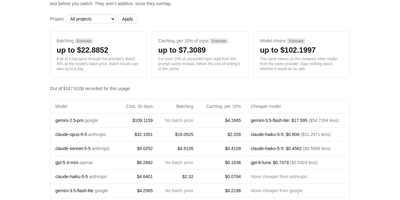
AI API Cost Tracker is an open-source ledger that prices every OpenAI, Anthropic and Gemini request and charges it to the customer, feature or agent run behind it. Apps report token counts through one HTTP endpoint, dependency-free client libraries or OpenTelemetry traces. Prompts and responses are never stored. Each request is costed at the price in force that day, so a rate change never rewrites history. Dashboards break spend down by project, provider, model, customer, feature and run, forecast month-end spend and flag spikes. Budgets, monthly or per run, alert at 80% and 100% by signed webhook, Slack or email. Agents can check a budget before they spend, or reserve it so concurrent steps cannot overspend. A "Why spend changed" page splits a rise into volume, model mix, tokens per request and price, and savings estimates size batching, caching and cheaper models. Outcomes turn spend into cost per resolved ticket. Reconciliation compares recorded costs with Anthropic's cost report, OpenAI's costs API and Google Cloud's billing export. An optional billing ledger sets each customer's revenue against their AI cost, drafts Stripe invoices and shares read-only portal links. Exports cover CSV, FinOps FOCUS and a reporting API. Roles, invitations and an audit log serve teams, with OpenID Connect sign-in for providers such as Okta or Keycloak. Running on a dedicated VPS on RepoCloud with guaranteed CPU, RAM, and SSD, full root SSH access, and a browser serial console. MIT licensed.
Outbound OS
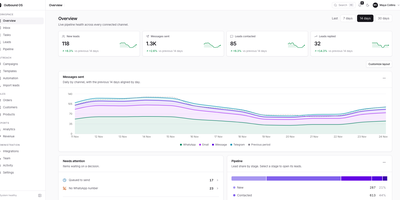
For sales desks that live in WhatsApp, Outbound OS is a CRM where the shared inbox, the follow-up sequences and the pipeline all hang off one lead record. Leads flow in from website forms (plain HTML, Webflow, WordPress, Framer), Facebook Lead Ads, Zapier, Make and n8n webhooks, and CSV or JSON imports, and a configured first contact goes out on an eligible channel. WhatsApp runs through Meta's official Cloud API: the composer checks the 24-hour reply window and offers an approved template once it has closed, while photos, PDFs and voice notes open in the inbox. Email works with any SMTP/IMAP mailbox or Brevo, and Telegram and iMessage (through a Mac running BlueBubbles) join the same thread list. Sequences follow each lead's working hours and stop on a reply, an opt-out or a closed deal, and campaigns target any slice by tag, status, country or score. A pipeline board, tasks, orders, invoices, shipments and revenue reports carry the sale past the first reply, with admin, manager, agent and viewer roles for the team. Dashboard widgets can be rearranged per account, and the phone workspace installs to the Home Screen from the browser. An MCP server lets ChatGPT, Codex, Claude and other remote clients search leads, read replies, preview audiences and prepare campaigns, with sends governed by the client's approval settings. Running on a dedicated VPS on RepoCloud with guaranteed CPU, RAM, and SSD, full root SSH access, and a browser serial console. AGPL-3.0 licensed.