Iso
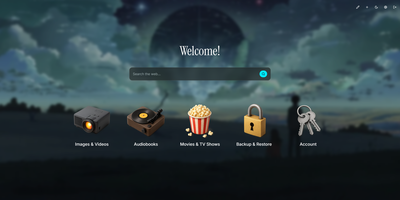
Drop a single container onto your host to launch Iso, a minimalist self-hosted startpage and service launcher that organizes every homelab web application behind a clean isometric icon grid and integrated search bar. No external database is required. Everything lives inside one human-readable JSON file or gets edited directly through the in-browser visual configuration modal. Add new service tiles in seconds, drag to reorder their display priority, and pick from a curated library of 3D isometric icons or upload custom graphics up to 25 megabytes. Switch instantly between built-in color palettes like Amethyst or upload a custom wallpaper with adjustable background blur and opacity sliders. A central search bar sits at the top of your startpage, routing queries directly to Google, DuckDuckGo, Startpage, Qwant, Searx, Bing, or any custom query URL template. Localize the interface into English, Spanish, French, or German with a single toggle. Custom greeting banners and optional page-load animations personalize the daily browsing experience for family members or lab users. Protect the dashboard and its visual editor behind shared password authentication configured via environment variables. Running on a dedicated VPS on RepoCloud with guaranteed CPU, RAM, and SSD, full root SSH access, and a browser serial console. MIT licensed.
Manager.io
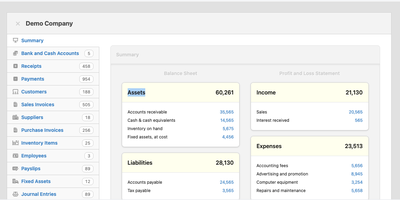
Full double-entry accounting on your own server: Manager.io Server Edition runs the same engine as the free desktop edition as a web server, so unlimited users work in unlimited businesses concurrently, with all books on infrastructure you control. The module coverage is genuinely comprehensive - general ledger with a customizable chart of accounts, sales and purchase invoices, quotes and orders, bank and cash account reconciliation, inventory with stock tracking, fixed assets with depreciation, payroll, multi-currency with exchange gains and losses, tax codes for VAT and GST regimes, and the complete reporting stack: balance sheet, profit and loss, trial balance, aged receivables and payables, and cash flow statements. The interface is translated into more than seventy languages, reflecting a genuinely global user base. The licensing model is the refreshing part: a server license is a one-time perpetual purchase, not a subscription - twelve months of updates included, optional renewals after, no per-user tiers, no data limits, and you can downgrade to the free desktop edition anytime, so your books are never hostage. Businesses wanting collaborative accounting behind their own firewall, with data sovereignty and no monthly fees, get exactly that.
Forgejo
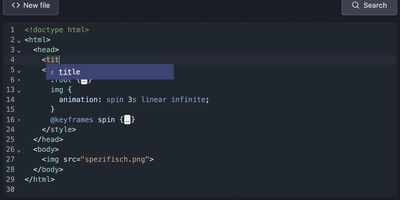
Governed by the non-profit Codeberg e.V. with over 150 contributors and quarterly major releases reaching v16.0 in July 2026, Forgejo delivers a complete code collaboration platform in a single Go binary that runs comfortably on 512 MB of RAM — providing full Git hosting with SSH and HTTPS, pull requests with inline code review, issue tracking with labels and milestones, kanban project boards, wikis, and an integrated package registry supporting Docker, npm, PyPI, Maven, NuGet, and Cargo. Forgejo Actions provides GitHub Actions-compatible CI/CD with reusable workflows, OpenID Connect for secure third-party access, ephemeral runners for autoscaling, and dynamic matrix support for complex build pipelines. The platform implements ActivityPub-based forge federation allowing issues, pull requests, and stars to work across independent instances — enabling a decentralized development ecosystem similar to how Mastodon federates social networks. Organizations and team permissions provide fine-grained access control, while LDAP, OAuth2, and OpenID authentication integrate with existing identity infrastructure. Code search indexes repositories for fast discovery, LFS handles large files efficiently, and mirror synchronization imports repositories from GitHub, GitLab, and other forges. Deploy via a single static binary, Docker container, or official Helm charts with SQLite for small instances or PostgreSQL and MySQL for production workloads. Running on a dedicated VPS on RepoCloud with guaranteed CPU, RAM, and SSD, full root SSH access, and a browser serial console. GPLv3+ licensed.

Ntfy
ntfy sends push notifications to your phone or desktop with a single curl command: publish a message to any topic and every subscriber receives it instantly, no signup or API key required. Over 31,000 GitHub stars and 106 releases since 2021 back a server supporting five priority levels mapped to distinct notification sounds and vibration patterns, emoji tags for visual classification, click actions that open URLs when tapped, and up to three action buttons per notification for view, HTTP callback, broadcast, or clipboard copy operations. File attachments push images from surveillance cameras, documents, or any binary payload directly to mobile devices. Subscriptions work through JSON streams, Server-Sent Events, WebSockets, or raw text, with server-side filtering by priority, tags, and message ID. Authentication enforces topic-level access control through Basic Auth, Bearer tokens, or query parameters, with a built-in user and ACL management system. UnifiedPush compatibility lets ntfy serve as a push distributor for Mastodon, Matrix, and other federated services. Web Push via VAPID keys delivers browser notifications without the mobile app. The server ships as a single statically linked Go binary or Docker image supporting amd64, armv7, and arm64 architectures, consuming 30-50 MB RAM at idle with SQLite-backed message caching. Integrations include Grafana, Prometheus Alertmanager, Uptime Kuma, Home Assistant, and Ansible Semaphore. Running on a dedicated VPS on RepoCloud with guaranteed CPU, RAM, and SSD, full root SSH access, and a browser serial console. Apache 2.0 / GPLv2 dual-licensed.

Ubuntu VPS
A minimal Ubuntu 24.04 LTS virtual private server — no pre-installed applications, no opinionated configuration, just the operating system and root access. Start from a clean slate and install exactly what you need: web servers, databases, development toolchains, CI runners, monitoring stacks, VPN endpoints, game servers, or anything else that runs on Linux. The server ships with apt package management, systemd service supervision, and standard networking configured out of the box, giving you access to over 36,000 packages in the Universe repository alone. Connect via SSH with the key you select during deployment; a dedicated IPv4 address is included with every server at no extra charge. A browser-based serial console in the RepoCloud dashboard provides emergency access without an SSH client. Snapshots let you capture the server state before risky changes and roll back with one click. Resize CPU and RAM on demand without reinstalling. Canonical's standard security maintenance covers this LTS release through May 2029 — five years of patches for the Main repository. Ubuntu Pro extends that to ten years with additional Universe coverage, kernel livepatching, and compliance tooling, available free for up to five machines.
Lenpaste
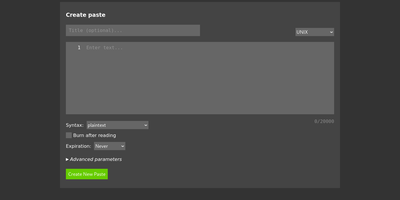
Share code snippets, logs, configs, and notes without registration, tracking, or ads: Lenpaste is a minimal, self-hosted, anonymous alternative to pastebin.com. It is deliberately spartan in the right ways: no accounts, no JavaScript required (the entire site works in text browsers and hardened setups), and cookies used solely to store display preferences. Pastes support syntax highlighting across a long list of languages (from ApacheConf and Arduino to mainstream stacks), configurable expiration from minutes to unlimited, one-use "burn after reading" pastes that self-delete on first view, optional author attribution, and iframe embedding for dropping pastes into other pages. The form-encoded HTTP API covers everything the UI does - create pastes with title, syntax, expiration, and line-ending normalization, fetch them by ID, and query server capabilities - making it trivial to pipe command output to your paste server from shell scripts. Server operators control maximum title and body lengths, maximum paste lifetime, rate limits for viewing and creation, search-engine indexing policy, and can lock private instances behind HTTP Basic authentication. It deploys as a single lightweight Docker container, giving your team a snippet-sharing endpoint where the content never touches a third-party service.
Commento++
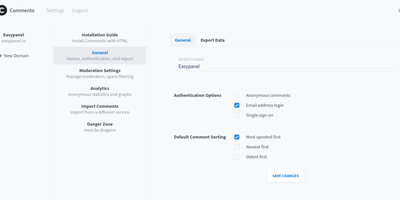
When Commento's original maintainer went quiet, Commento++ bundled the community's bug fixes and stalled merge requests into a batteries-included release of the beloved Go-based Disqus alternative - and kept building. The core promise is unchanged: an embeddable comments box that is orders of magnitude lighter and faster than Disqus, with no ads, tracking, or data sales - two lines of HTML and a PostgreSQL database. On top of Markdown comments, voting, Disqus import, OAuth login (Google, GitHub, Twitter) plus SSO, sticky comments, thread locking, and email notifications, the fork's additions are substantial: WebSocket-powered live comment updates with permalinks and highlight animations for new arrivals, guest commenting with a name, a cross-domain moderation dashboard for approving and deleting comments in one place, MathJax rendering support, wildcard domain matching, a reInit hook that makes single-page-application integration clean, and Perspective API spam scoring alongside the existing Akismet integration. Optional page-view logging graphs traffic on the dashboard, native SSL termination works without a proxy, and script-tag data attributes control fonts, CSS overrides, deleted-comment visibility, and polling-versus-WebSocket behavior.
Substreamer
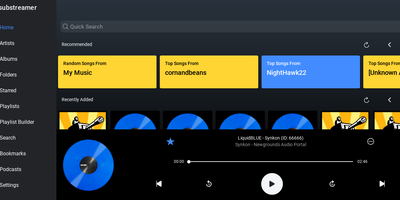
A free, polished web client for Subsonic-compatible music servers: Substreamer is the browser-based frontend you point at your existing streaming backend to play your own library from anywhere. It speaks the Subsonic API (v1.13 and higher), which makes it compatible with the whole ecosystem that has grown around that protocol: the original Subsonic server, its forks Airsonic and Madsonic, and modern implementations like Navidrome and Ampache. That decoupling is the point - your music files, transcoding, and library indexing live on whichever server you prefer, while Substreamer provides the listening experience: browse by artist, album, and genre, build and manage playlists, search your collection, and stream on demand. This RepoCloud deployment runs the containerized web edition, so the same interface is available from any browser without installing a native app, and it pairs with the Substreamer mobile apps that made the client popular. For anyone assembling a self-hosted Spotify replacement - typically Navidrome for the backend plus a good client - Substreamer fills the client half with a clean, familiar player UI. Because it is a stateless client, the container is lightweight and low-maintenance: connect it to your server's URL and credentials, and your entire collection is streaming in minutes, with no subscription and no catalog that can disappear.
Githome
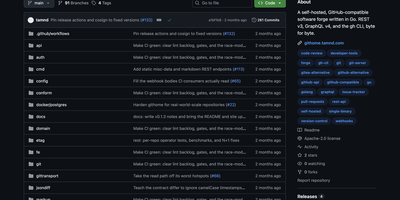
Point the gh CLI at your private Githome server and it works identically to github.com, because every REST v3 and GraphQL v4 endpoint returns byte-for-byte compatible JSON shapes, headers, Link pagination, and ETag caching. A single compiled Go binary serves the REST API under /api/v3, GraphQL under /api/graphql, git smart-HTTP transport, and a server-rendered web UI implementing the GitHub Primer design system with full functionality when JavaScript is disabled. The web interface provides repository browsing with Markdown rendering and syntax highlighting, issue tracking, pull requests with unified diffs and inline code review threads, full-text search, user profiles, and a notifications inbox. Authentication supports personal access tokens with prefix-based identification, OAuth device and web flows, and scoped permissions on every response header with only token hashes stored. The pull request system implements the complete lifecycle including async mergeable state computation, squash, merge, and rebase strategies, commit statuses, check runs, and statusCheckRollup fields. Webhooks deliver events with X-Hub-Signature-256 verification, SSRF protection, and at-least-once retry semantics. Storage supports SQLite for single-node deployments or PostgreSQL for production configurations. Performance optimizations include batch loaders replacing N+1 queries, keyset pagination, FTS-backed search, and GraphQL dataloaders. Docker deployment pulls the official multi-arch container image from GitHub Container Registry. Running on a dedicated VPS on RepoCloud with guaranteed CPU, RAM, and SSD, full root SSH access, and a browser serial console. Apache-2.0 licensed.

Gray Duck Mail
Email discussion lists - the venerable listserv pattern where one address relays to a whole group - without the notorious setup pain of Mailman or Sympa: that is Gray Duck Mail. Its architectural trick is requiring no mail server of your own: the C#/ASP.NET Core app monitors a POP3 inbox at any external email host supporting POP3/SMTP and aliasing, relays each incoming message to all list members via SMTP, and archives it for browsing in the web interface. Replies route back to the entire group automatically. The tedious parts of list management are handled by convention: dedicated aliases process join requests, subscription confirmations, and unsubscribes, while a bounce alias in the return-path catches delivery failures so dead addresses get handled instead of silently rotting. The web administration interface creates and removes lists, manages contacts, browses message archives, and imports or exports the local database for backup. GPLv3-licensed, Docker-distributed, and fully code-documented, it targets exactly the groups email still serves best - neighborhoods, schools, congregations, workplaces, and families - where one message keeping everyone in the loop beats yet another app nobody wants to install.
Bloom
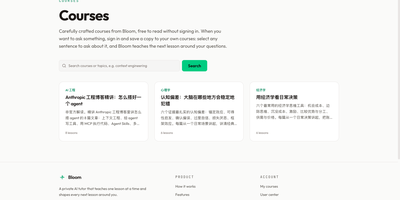
Bloom hires you a private tutor for any subject, then teaches one lesson at a time and rewrites the next lesson around what you actually understood. You begin with a topic, an uploaded PDF, text, or Markdown source, or a set of project files, and Bloom drafts a syllabus of concrete mastery items at simple, standard, or deep expansion. Each lesson arrives focused and readable, with a chapter sidebar for quick jumps and a collapsible syllabus tracking what is already mastered. Reading is active work: highlight any passage and a question thread opens beside it, streaming an answer that stays attached to that sentence for later follow-ups. Reflection questions close every lesson, and your answers, annotations, and highlighted gaps become the raw material for the next lesson, which opens by reviewing the previous answers. Source mode keeps page numbers and sections so lessons can cite where an idea came from, and project files render each document as its own page for highlight questions without generated lessons. Finished courses produce an evaluation and a summary, followed by three recommended next topics drawn from your learning history. A personal center shows a study calendar, daily activity, and streaks across your courses. Running on a dedicated VPS on RepoCloud with guaranteed CPU, RAM, and SSD, full root SSH access, and a browser serial console. MIT licensed.
Containarium
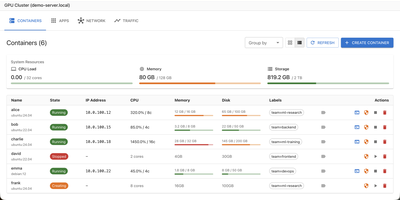
Containarium gives every AI agent a persistent Linux box of its own, reachable over SSH and driven through structured tools instead of a fragile terminal session. One command creates a named sandbox, syncs the SSH configuration, and wires the box into Claude Code, Codex, Gemini or Cursor through an MCP server that runs inside the container. From there the agent can execute shell commands, read and write files, install services, and expose a port on a public hostname with TLS terminated by a Caddy sentinel. Detached code runs keep working after a laptop sleeps or a connection drops, and the operator reattaches to the same byte-exact log later, checks status, or stops the run without losing output. An optional per-tenant eBPF egress policy limits outbound traffic per box, logs denied attempts for audit, and keeps provider API keys inside a model gateway rather than inside the agent environment. Boxes run on LXC or Kubernetes, keep state between agent sessions, support GPU passthrough for local model work, and stay separate from the host operating system and the cluster control plane. The dashboard presents containers, traffic, security events, audit records, GPU state and monitoring in one place. Running on a dedicated VPS on RepoCloud with guaranteed CPU, RAM, and SSD, full root SSH access, and a browser serial console. Apache-2.0 licensed.

AI Real Estate Assistant
AI Real Estate Assistant puts a conversational search engine on top of your own property catalogue, so buyers type a request in plain language and receive matched listings in return. A query about a two-bedroom apartment in a named city under a price limit becomes extracted filters, semantic ranking over the catalogue, and a shortlist that matches the words instead of a rigid form. Behind the chat sits a working toolbelt: a mortgage calculator, a rent-versus-buy comparison, ROI and total-cost-of-ownership estimates, and an AI valuation that projects a property value one, three, five and ten years ahead with a confidence band. Every listing card shows an estimated monthly payment, and every property page carries an AI neighbourhood summary covering district character, nearby amenities and ease of getting around. Interactive maps cluster markers by area, a city overview page compares markets across districts, and a documents section accepts uploaded files that visitors can question in the same conversation. An agent directory presents the people behind the listings together with their stock, and the interface speaks nine languages with compliance labels on AI output. The demo mode answers with a local model and needs no paid key, and a real deployment routes each request to any of sixteen providers. Running on a dedicated VPS on RepoCloud with guaranteed CPU, RAM, and SSD, full root SSH access, and a browser serial console. MIT licensed.
CatGPT Gateway
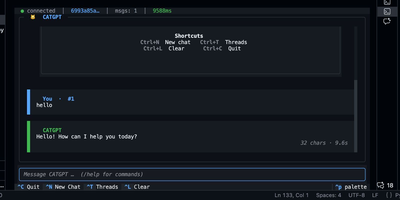
CatGPT Gateway turns the ChatGPT or Claude account a team already pays for into an OpenAI-compatible API that ordinary tools can call. Point the OpenAI Python SDK, LangChain, or a plain curl request at the gateway and choose the browser-backed model for Claude or ChatGPT; the service opens the provider web interface in a real Chromium session, enters the prompt, waits for completion, extracts the answer, and returns standard OpenAI JSON. Streaming responses arrive over SSE, persistent session headers keep multi-turn conversations on one browser tab to avoid reloads, and a browser page pool handles concurrent requests across several tabs. Tool calling round-trips through structured prompt injection, so LangChain agents can invoke local functions and receive parsed tool calls in the normal format. Vision inputs, PDF and document attachments, and ChatGPT image generation through DALL-E pass through the same endpoint shape that existing clients already speak. A live monitor at the preview route shows every active browser tab in a double-buffered grid, with tab switching and safe tab closure for the operator. One browser login through a noVNC page persists in a Docker volume, so the API keeps serving after restarts without storing provider API keys. Running on a dedicated VPS on RepoCloud with guaranteed CPU, RAM, and SSD, full root SSH access, and a browser serial console. MIT licensed.
ProductFlow
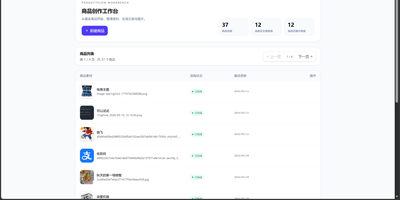
ProductFlow turns a product photo and a few facts into finished selling material, giving solo merchants and small teams one workspace for copy, posters, and repeatable image generation. You start by creating a product record, attaching original and reference images, then arranging product data, copy nodes, and image nodes on a zoomable canvas with drag, pan, multi-select, and connections. Copy nodes generate editable structured text that you can review, confirm, and keep in history before downstream image nodes read it. Poster generation runs in template mode with local rendering or generated mode through an image provider, and completed results can be downloaded, saved as product references, or promoted to the main product image slot. A separate image session view supports text-to-image and image-to-image runs with base image selection, candidate comparison, queue position, progress, cancel, and retry. Every finished image can move into the gallery with its source session, linked product, prompt, size, and model recorded for later reuse. Runtime settings cover provider profiles, model bindings, image tool parameters, prompt templates, upload limits, and concurrency, guarded by a separate settings token. The built-in help pages document the canvas, gallery, image sessions, and configuration in searchable sections. Running on a dedicated VPS on RepoCloud with guaranteed CPU, RAM, and SSD, full root SSH access, and a browser serial console. MIT licensed.
GlitchTip
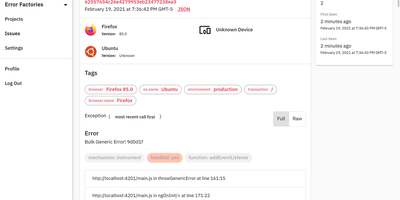
GlitchTip speaks Sentry's protocol without Sentry's operational weight - open-source error tracking that your existing SDKs already understand. The pitch is pragmatic: instrument your application with the official Sentry SDKs you already know - any language they cover - and point the DSN at your own GlitchTip instance instead. Errors, exceptions, log messages, and Content Security Policy violations flow into one place for triage, grouped into issues with stack traces, with alerts delivered by email or webhook the moment things break. Where self-hosted Sentry has ballooned into a docker-compose stack of twenty-plus containers, GlitchTip is a deliberately lean Django and PostgreSQL application a small team can actually run. Beyond errors, it bundles three more monitoring concerns: performance monitoring takes a works-out-of-the-box approach - no dashboard building, just your slowest web requests, database queries, and transactions surfaced automatically; uptime monitoring pings your sites and alerts on failures, or runs in reverse as a dead-man's-switch heartbeat for cron jobs that must check in on schedule; and log search puts application logs alongside errors for faster debugging. Unlimited projects and team members, MIT-licensed, built by Burke Software - your event volume is limited only by your own hardware.
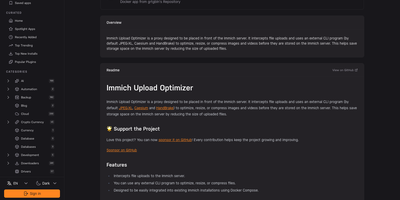
Immich Upload Optimizer
Immich Upload Optimizer shrinks every photo and video at the moment of upload, so a self-hosted Immich library stops growing faster than the disk beneath it. The proxy sits in front of your Immich server and receives uploads first, matching each file by extension against a task list you define in a YAML file. Images pass through JPEG-XL or Caesium command line tools for lossless optimization by default, preserving every pixel of the original capture. Owners who prefer smaller files can switch a task to lossy settings that cut image size dramatically at the same perceived quality. Video conversion ships disabled because lossless transcoding rarely wins space, and owners can enable HandBrake profiles for lossy conversion with strong savings. Tasks run in sequence with fallback: the first matching command that succeeds supplies the stored file, and an upload with no matching task is refused rather than stored unprocessed. Long conversions keep working in the background after a client disconnects, and the processed file still reaches Immich. Deployment adds one service to an existing Docker Compose stack, points clients at the proxy port, and removes the direct public port from the Immich server itself. Running on a dedicated VPS on RepoCloud with guaranteed CPU, RAM, and SSD, full root SSH access, and a browser serial console. MIT licensed.
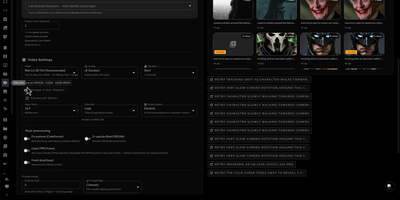
Guaardvark
Guaardvark is a complete AI studio that lives on your own GPU, so chat, retrieval, agents and media generation happen on hardware you own instead of a metered cloud account. Upload documents and question them through local retrieval that fuses keyword and vector search, reranks candidates, and cites the passages behind each answer, with the chunks and scores visible for inspection. Plan mode turns a request into an approve-or-edit plan card before tools run, and approved steps execute one at a time with a pause on failure. Screen agents receive a desktop of their own, see it through a vision model, and operate a real browser while the operator watches from any page. Coding swarms split a task across parallel agents in separate git worktrees and merge results back in dependency order. The generator bench covers thirteen local video models, image models for generation, editing, inpainting and upscaling, full songs with vocals, sound effects and three text-to-speech engines, with consent required before any voice clone or public post. Character, environment and prop LoRAs train from a few reference photos and keep the same character consistent across images and films. A GPU orchestrator with a live VRAM budget schedules renders, chat and training so jobs stop competing for the card. Running on a dedicated VPS on RepoCloud with guaranteed CPU, RAM, and SSD, full root SSH access, and a browser serial console. MIT licensed.