FalkorDB
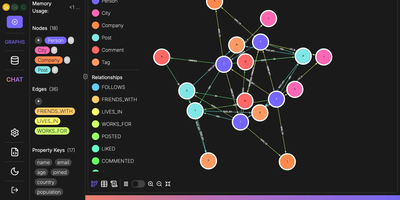
FalkorDB is the first queryable property graph database to leverage sparse adjacency matrices and linear algebra for graph traversal, replacing traditional pointer-chasing with GraphBLAS-accelerated computation. Originally the RedisGraph engine, it was relaunched as FalkorDB in 2023 and rewritten from C to Rust in 2026 for improved memory safety and performance. The database supports the OpenCypher query language with proprietary extensions, translating queries into linear algebra expressions that exploit AVX hardware acceleration. Indexing options include full-text search, vector similarity for embedding-based retrieval, and range indexing, while connectivity supports both the RESP protocol for Redis clients and the Bolt protocol for Neo4j-compatible tooling. The GraphRAG SDK enables ingestion of documents in text, PDF, and Markdown formats into knowledge graphs, with schema-guided entity extraction, hybrid retrieval combining vector and graph traversal, relationship expansion, and cited answers for LLM applications. Official client libraries cover Python, Node.js, Java, Rust, Go, PHP, and C#. Multi-tenant support handles over 10,000 concurrent graphs with zero overhead and full isolation. Docker deployment runs the falkordb/falkordb image on ports 6379 for the database server and 3000 for the built-in browser UI, with persistent volume storage and optional authentication. A production falkordb-server image excludes the browser for lighter deployments. On RepoCloud, deploy FalkorDB on a dedicated VPS with root SSH access, persistent storage for your graph data, and complete control over authentication, thread count, and memory configuration, all under the SSPLv1 license.

Wanderer
Wanderer provides a privacy-first alternative to AllTrails and Komoot, giving outdoor enthusiasts complete ownership of their GPS data on a self-hosted server. The platform accepts uploads in GPX, KML, FIT, and TCX formats, automatically extracting distance, elevation gain and loss, duration, and speed statistics to build a searchable trail catalogue. The built-in route planner uses the Valhalla routing engine to calculate hiking, cycling, and walking routes directly on the map, while MapLibre GL renders smooth vector tiles from OpenStreetMap data with configurable tile sources and overlay layers. Each trail supports rich metadata including difficulty ratings, categories, waypoints with descriptions, photo galleries, and summit log entries that track completion dates with optional GPS data. Meilisearch powers instant full-text search across trail names, descriptions, and tags, complemented by map-based spatial filtering and advanced date, distance, and elevation filters. The ActivityPub integration follows the same federation protocol as Mastodon, allowing users to follow explorers on other Wanderer instances and see their public trails, comments, and summit logs in a unified feed without requiring cross-instance accounts. The WASM-based plugin system enables third-party extensions for custom integrations. The Docker Compose stack runs three containers — SvelteKit frontend on port 3000, PocketBase backend with embedded SQLite, and Meilisearch — with startup completing in under 90 seconds. On RepoCloud, deploy Wanderer on a dedicated VPS with root SSH access, persistent storage for your trail database and uploaded photos, and complete control over routing, geocoding, and tile server configurations, all under the AGPL v3 license.

LearnHouse
LearnHouse delivers a modern open-source learning platform that replaces proprietary course builders with a self-hosted alternative shipping a rich feature set out of the box. The Tiptap-powered block editor supports videos, documents, embeds, quizzes, and file uploads in a Notion-like interface with real-time co-editing powered by Hocuspocus and Yjs CRDT synchronization over WebSocket. AI tutoring integrates Google Gemini and LlamaIndex for RAG-powered context-aware assistance that adapts to course content, while interactive Playgrounds use AI to generate simulations, diagrams, and learning exercises. The platform handles the full course lifecycle: chapters and activities organize into collections and learning paths, assignments support automated and manual grading, and code blocks execute student submissions in 30+ languages with auto-grading. Analytics dashboards track learner engagement, progress, and completion rates in real time. The backend runs on FastAPI with SQLModel and Alembic migrations against PostgreSQL 16 with pgvector for AI embeddings, while Redis handles caching and session management. The frontend builds on Next.js 16 with React 19 and Tailwind CSS v4. Deployment uses an interactive CLI wizard that configures domain, database, admin account, SSL via Let's Encrypt, and optional features like email via Resend, S3 storage, and Google OAuth, then generates a Docker Compose stack ready to start. On RepoCloud, deploy LearnHouse on a dedicated VPS with root SSH access, persistent PostgreSQL storage for your course data, and complete control over AI provider keys and branding customization, all under the AGPL v3 license.
Agenta
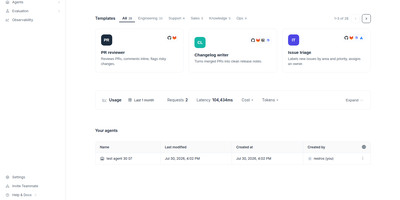
Agenta delivers a comprehensive open-source LLMOps workspace that covers the full lifecycle of AI application development — from prompt engineering through production monitoring. The platform supports 15+ model providers including OpenAI, Anthropic, Google Gemini, Mistral, Groq, Together AI, Azure, AWS Bedrock, and self-hosted models via Ollama, enabling teams to switch between providers without code changes. The prompt playground allows side-by-side comparison of different configurations, while the evaluation system offers LLM-as-a-Judge assessment, 20+ pre-built evaluators covering semantic similarity, regex matching, and factual accuracy, plus custom Python evaluators for domain-specific requirements. Teams run evaluations through both the web UI for subject matter experts and the Evaluation SDK for programmatic CI/CD integration. The observability layer captures full trace visibility across complex agentic workflows, flagging quality issues like hallucinations and off-topic responses in real time. Human annotation workflows let domain experts review and annotate LLM outputs, feeding corrections back into the evaluation loop. The architecture supports Chain of Prompts, RAG pipelines, and multi-step agent workflows, integrating with frameworks like LangChain and LlamaIndex. Self-hosting deploys via Docker Compose with Traefik for routing, requiring only a clone, environment configuration, and a single docker compose command. On RepoCloud, deploy Agenta on a dedicated VPS with root SSH access, persistent storage for evaluation datasets and traces, and complete control over model provider credentials, all under the MIT license with no usage restrictions.
Open Design
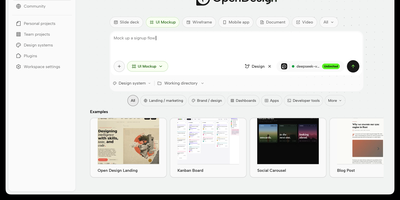
With over 84,000 GitHub stars since its April 2026 launch, Open Design has emerged as the definitive open-source alternative to Anthropic's Claude Design. Rather than shipping its own language model, Open Design acts as an agent-agnostic design orchestration layer that auto-detects 25+ coding CLI executables on your PATH — including Claude Code, Codex, Cursor, Gemini CLI, OpenCode, Qwen, GitHub Copilot CLI, Hermes, and Kimi — or connects to any OpenAI-compatible endpoint via its built-in BYOK proxy at /api/proxy/stream. The platform introduces a file-based protocol where SKILL.md files define composable design workflows and DESIGN.md files establish version-controlled brand systems, currently shipping 31 first-party skills and 72 brand-grade design systems. Output spans web and mobile prototypes, live dashboards, presentation decks, raster images, video, and HyperFrames motion graphics, with export pipelines for HTML, PDF, PPTX, MP4, and ZIP. The daemon architecture uses SQLite for project state and serves a sandboxed iframe preview renderer with vendored React and Babel for JSX artifacts. Deployment options include the native desktop app for macOS, Windows, and Linux, local daemon mode via pnpm tools-dev, a single-container Docker Compose path serving both API and Next.js frontend on port 7456, and Vercel deployment for the web layer. On RepoCloud, deploy Open Design on a dedicated VPS with full root SSH access, persistent storage for your design systems and generated artifacts, and complete control over which AI providers and agent CLIs your instance connects to, all under the Apache-2.0 license.
TeamPass
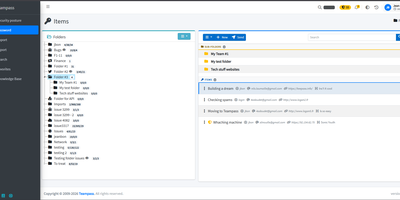
TeamPass is a dedicated on-premise password manager built specifically for teams that need collaborative credential sharing with fine-grained access controls. Role-based access control defines user permissions through hierarchical folder trees where each folder and item can be independently set to write, read, or no access against assigned roles, enabling organizations to segment credentials across departments without exposing sensitive data. Passwords are encrypted in the database using Defuse PHP Encryption with per-installation unique saltkeys, while two-factor authentication supports configurable RFC 6238 TOTP profiles with custom digits, period, and algorithm settings alongside Duo Security and Yubico hardware key integration. LDAP and Active Directory native integration enables enterprise SSO with automatic user provisioning. The Security Posture Dashboard surfaces weak, reused, breached, overdue, no-expiry, widely-shared, and unreadable credentials through indicator cards that filter and deep-link directly to items. Secure Send creates expiring, view-count-limited one-time links optionally protected by recipient passphrases for sharing credentials with external users. Import from Bitwarden, LastPass, 1Password, and KeePassXC through a unified source selector, with export to encrypted offline files. Email notifications, password expiration policies, custom fields, and attachment support round out item management. Running on a dedicated VPS on RepoCloud with guaranteed CPU, RAM, and SSD, full root SSH access, and a browser serial console. GPL-3.0 licensed.
Yaade
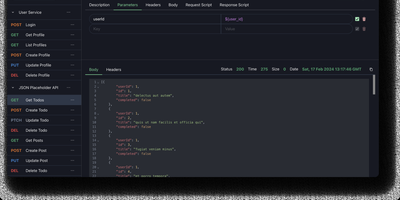
Yet Another API Development Environment delivers a self-hosted alternative to Postman designed from the ground up for teams that need secure, collaborative API development without sending sensitive credentials through third-party cloud services. The multi-user system manages team members with role-based permissions and supports external authentication through OAuth2 and OIDC providers, while all data persists in an H2 file-based database that survives container and server restarts. REST and WebSocket request testing includes environment variable substitution, request chaining, and Markdown documentation for each endpoint. The JavaScript scripting engine runs request and response scripts for automated testing and data extraction, with cron job scheduling and API-triggered execution for continuous integration workflows. Collections import directly from OpenAPI specifications and Postman exports, while outbound export generates request code in multiple languages and frameworks. The browser extension proxy for Chrome and Firefox routes requests through the user's browser to bypass CORS restrictions when testing localhost and internal APIs, with an alternative server-side proxy for headless environments. Single-file data import and export simplifies backup and migration between instances. The React and Vite frontend ships with dark mode enabled by default. Running on a dedicated VPS on RepoCloud with guaranteed CPU, RAM, and SSD, full root SSH access, and a browser serial console. MIT licensed.

Frappe LMS
Frappe LMS is a learning management system built on the same Frappe Framework that powers ERPNext. The 3-level course hierarchy organizes content into courses, chapters, and lessons supporting videos, PDFs, SCORM packages, and rich HTML content with heading, code block, and list formatting through the redesigned inline lesson editor. Batch management groups learners by course and duration with scheduled instructor-led live sessions through integrated Zoom and Google Meet, where learners see upcoming classes on their batch dashboard. The assessment engine supports single-choice, multiple-choice, and open-ended quiz questions alongside assignment submissions as PDFs or documents, with progress tracking monitoring completion rates and quiz performance across all enrolled courses. Certificate generation uses built-in templates or custom designs to validate course completion, while the job board connects certified learners with opportunities. Course monetization integrates payment processing to transform courses into revenue streams with financial tracking. Role-based access controls assign Instructor, Learner, Admin, and Manager permissions, while course package import and export enables sharing structured content between instances. The platform integrates with ERPNext HR and CRM modules through the Frappe ecosystem with RTL language support and notification slide-overs. Running on a dedicated VPS on RepoCloud with guaranteed CPU, RAM, and SSD, full root SSH access, and a browser serial console. AGPLv3 licensed.
OpenDeepWiki
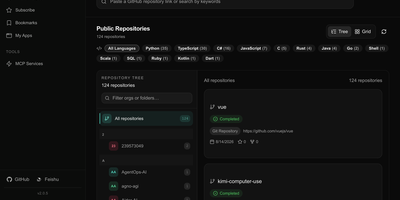
OpenDeepWiki transforms code repositories from GitHub, GitLab, Gitee, Gitea, and AtomGit into structured, searchable knowledge bases by leveraging Microsoft's Semantic Kernel for AI orchestration across OpenAI, Azure OpenAI, Anthropic, and DeepSeek providers. The three-phase Gather-Think-Write pipeline analyzes repository tree structures, generates README summaries, project overviews, wiki catalogs, and document content while producing Mermaid mind maps and optional Graphify visualization artifacts. Repository-scoped MCP endpoints at /api/mcp/{owner}/{repo} expose indexed knowledge to external AI tools, while the built-in chat assistant, embedded chat APIs, and share links provide conversational access to repository understanding. The Next.js 16 frontend serves public documentation on SEO-friendly routes with multi-language translation support, and the admin console manages repositories, users, roles, API keys, AI provider and model configuration, skills, and GitHub App imports. Background workers handle incremental updates using LibGit2Sharp to keep documentation synchronized with evolving codebases, while Polly integration provides transient failure retry handling for LLM requests. The platform supports SQLite, PostgreSQL, and MySQL database backends with Entity Framework Core providers. Running on a dedicated VPS on RepoCloud with guaranteed CPU, RAM, and SSD, full root SSH access, and a browser serial console. MIT licensed.
Flexprice
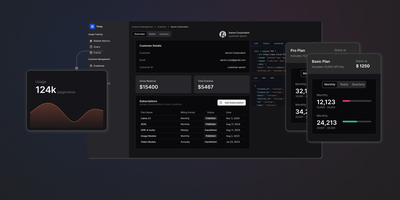
Flexprice is a developer-first billing platform built specifically for AI-native and SaaS companies that need usage-based, credit-based, and hybrid pricing models without building custom billing infrastructure. The metering engine ingests millions of usage events in real time through HTTP APIs or SDK calls, supporting sum, count, unique count, latest value, and multiplier aggregation strategies across custom event schemas like API calls, token counts, compute minutes, and GPU time. Credit management handles prepaid wallets with promotional grants, rollover caps, auto top-ups, and priority-based credit application during invoice generation. The pricing engine supports per-unit, tiered, volume, package, and flat-rate models with per-customer overrides, committed minimums, and enterprise contract terms. Feature entitlements enforce boolean toggles, metered usage limits, and configuration values per plan, enabling applications to gate functionality through simple API checks. Automated invoicing calculates charges from real-time usage data with proration for mid-cycle upgrades and downgrades, generating detailed line items linked to tracked consumption. The architecture separates event ingestion through Kafka from billing computation via Temporal workflow orchestration, allowing each layer to scale independently with ClickHouse handling high-performance usage aggregation. Stripe Connect integration processes payments and manages customer payment methods. Running on a dedicated VPS on RepoCloud with guaranteed CPU, RAM, and SSD, full root SSH access, and a browser serial console. AGPLv3 licensed.
PilotDeck
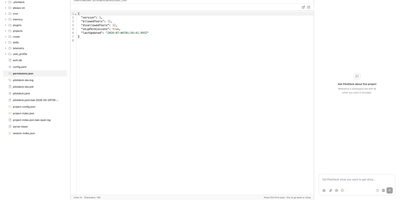
PilotDeck introduces a WorkSpace-first architecture where each project receives its own isolated file system, memory store, and skill set, preventing context bleed between parallel tasks. White-box memory makes generation, extraction, storage, and retrieval fully visible, letting users audit, edit, pin, and rollback individual entries when the agent misremembers, while Dream Mode consolidates memory fragments during idle windows. Smart Routing auto-detects task difficulty and sends complex calls to flagship models like Claude Sonnet or GPT-4o while routing simple requests to lighter models, achieving claimed 70% cost savings through on-device and cloud co-orchestration with TokenSaver tiering and sticky session binding. Always-on background execution keeps agents running after the user closes the browser, with Discovery and Cron-based scheduling for recurring workflows. The platform natively supports the Model Context Protocol for first-class MCP server integration, community skills via ClawHub on npm, lifecycle hooks intercepting PreToolUse and UserPromptSubmit events, and custom memory store providers. Multi-provider fallback automatically switches to backup providers on timeout or rate-limit errors. The WebSocket and HTTP gateway serves web, CLI, desktop, and Feishu IM channels from a single configuration. Running on a dedicated VPS on RepoCloud with guaranteed CPU, RAM, and SSD, full root SSH access, and a browser serial console. AGPL-3.0 licensed.
Hi.Events
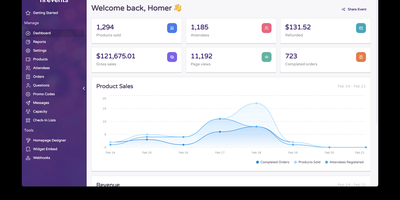
Hi.Events is an alternative to Eventbrite, Tickettailor, and Dice.fm, eliminating per-ticket platform fees entirely when self-hosted. Event organizers create fully brandable event pages supporting paid, free, donation, and tiered ticket types with recurring and multi-date scheduling, sold-out waitlists that automatically release tickets when spots open, and product add-ons with category organization. Stripe Connect integration processes payments directly to the organizer's bank account with instant payouts, while offline payment methods support cash and invoice scenarios. Promo codes offer fixed or percentage discounts with usage limits, expiry dates, and promo-gated hidden tickets for VIP access. QR code check-in enables fast door scanning with multiple check-in lists, scan logs, and real-time attendance tracking across entry points. Custom checkout questions collect attendee information beyond standard fields, with advanced search, filtering, CSV and XLSX export, full and partial refunds, and bulk attendee messaging. The analytics dashboard tracks daily sales, revenue, tax breakdowns, product performance, and promo code usage with exportable reports, while affiliate tracking assigns custom codes to promoters with tracked sales data. Multi-user roles control organizer permissions, automatic invoicing generates receipts, and the REST API ships with interactive OpenAPI documentation. Running on a dedicated VPS on RepoCloud with guaranteed CPU, RAM, and SSD, full root SSH access, and a browser serial console. AGPL-3.0 licensed.
Pi Web
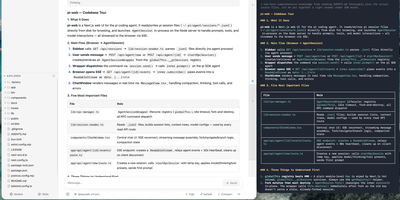
Pi Web is a browser interface for the Pi coding agent ecosystem, providing a visual workspace that reads the same local configuration and session files as the CLI. The session workspace groups conversations by project with running state indicators, context usage percentages, cost tracking, and compaction details, while two branching modes let users create independent session files from earlier messages or fork branches within existing sessions to explore alternative coding directions. Real-time streaming via Server-Sent Events delivers agent responses with structured Markdown rendering, thinking steps, tool call visualization, and image drag-and-drop input. The project file explorer browses working directories with syntax-highlighted source preview, Git diff inspection, and rendering for Markdown, images, audio, PDFs, and DOCX files with automatic refresh. Git worktree support switches checkouts from the sidebar while keeping sessions from the same repository grouped together. The Models panel manages provider authentication via OAuth and API keys, model selection, model smoke tests, and models.json configuration shared bidirectionally with the CLI agent. The Skills panel lists, searches, installs, and toggles agent skills without terminal access. The interface ships with English and Simplified Chinese translations, light and dark themes, a chat minimap, keyboard shortcuts, and completion sounds. Basic Auth protects remote access when binding to non-loopback addresses. Running on a dedicated VPS on RepoCloud with guaranteed CPU, RAM, and SSD, full root SSH access, and a browser serial console. MIT licensed.
Dockhand
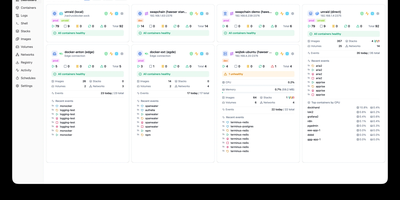
Dockhand is a Docker management platforms, offering a modern alternative to Portainer with free OIDC SSO and vulnerability scanning that competitors gate behind paid tiers. Real-time container management provides start, stop, restart, and remove operations with live resource monitoring across CPU, memory, and network usage on a dashboard with real-time metrics. The visual Docker Compose editor enables stack creation and modification with syntax highlighting, while Git integration deploys stacks directly from repositories with webhooks and auto-sync for GitOps workflows. Vulnerability scanning powered by Grype and Trivy analyzes container images against CVE databases, with configurable auto-update scheduling that can trigger updates based on vulnerability severity criteria. The Hawser Go agent enables management of remote Docker hosts in Standard mode for LAN environments or Edge mode using outbound WebSocket connections for hosts behind NAT, firewalls, or dynamic IPs without exposing inbound ports. Interactive terminal sessions provide shell access into running containers, while the file browser enables uploading, downloading, and editing files directly within containers. Image management includes registry browsing, pull operations, and layer inspection alongside network and volume administration. The security-focused architecture builds its own OS layer from scratch using Wolfi packages via apko with every package explicitly declared. Running on a dedicated VPS on RepoCloud with guaranteed CPU, RAM, and SSD, full root SSH access, and a browser serial console. BSL 1.1 licensed, converting to Apache 2.0 in 2029.
Mox
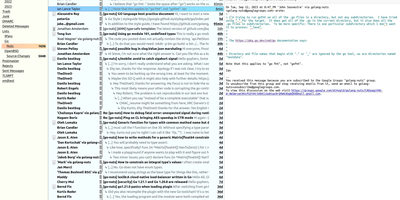
Mox offers a complete mail server stack in a single Go binary requiring no external dependencies. The quickstart command configures a working mail server with SMTP, IMAP4, webmail, and full DNS authentication in under ten minutes. SMTP handling includes a delivery server on port 25, a submission server for authenticated clients, and a queue with automatic retries and DKIM signing. IMAP4rev2 implementation provides full mailbox synchronization with CONDSTORE and QRESYNC for efficient offline clients, NOTIFY for multi-mailbox monitoring, MULTISEARCH across mailboxes, and TLS client certificate authentication via the EXTERNAL SASL mechanism. The built-in webmail provides browser-based reading and composing with message threading, attachments, and HTML rendering without requiring a separate web client. Email authentication implements SPF validation, DKIM signing and verification with automatic key rotation, DMARC policy enforcement with aggregate and failure reporting, DANE with DNSSEC-protected TLSA records, and MTA-STS for certificate verification. Junk filtering combines reputation-based sender scoring with Bayesian content analysis trained per account. The web administration interface manages domains, accounts, DNS records, TLS certificates, delivery queue, and real-time log viewing. Internationalized email addresses with EAI and IDNA support handle non-ASCII domains and mailboxes. Account autoconfiguration publishes settings for Thunderbird autoconfig and Outlook autodiscover. Running on a dedicated VPS on RepoCloud with guaranteed CPU, RAM, and SSD, full root SSH access, and a browser serial console. MIT licensed.
InvenTree
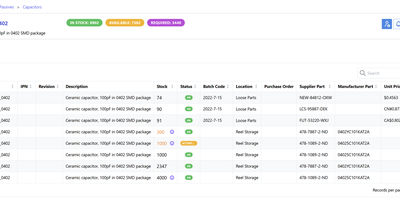
InvenTree is an inventory management system for electronics manufacturers, makerspaces, and small-to-medium businesses. The hierarchical part categorization system organizes components into unlimited nested categories, while stock items tracked across cascading locations and sub-locations provide instant visibility into current inventory levels, with optional serial number tracking for individual item traceability and acceptance testing. Intelligent BOM management calculates sub-part requirements, validates availability against current stock, supports multi-format BOM upload including KiCad integration, and generates detailed bills of materials with full database enrichment. Build orders consume BOM-allocated stock to produce assembled parts with step-by-step work order tracking, while purchase orders manage supplier relationships with pricing history, lead times, and automatic stock receipt processing. The modern React frontend built with Mantine, TanStack Query, and Zustand provides responsive data tables, tree-select navigation, a preview drawer, and a snippet editor. The extensible plugin system supports 19 mixin types including BarcodeMixin for scanner integration, LabelPrintingMixin for Zebra and Brother printers, AppMixin for custom database tables, and ScheduleMixin for periodic background tasks. Companion mobile apps on Android and iOS provide barcode scanning and stock operations in the warehouse. Docker Compose deploys with PostgreSQL, MySQL, or MariaDB backends behind any reverse proxy. Running on a dedicated VPS on RepoCloud with guaranteed CPU, RAM, and SSD, full root SSH access, and a browser serial console. MIT licensed.
Solidtime
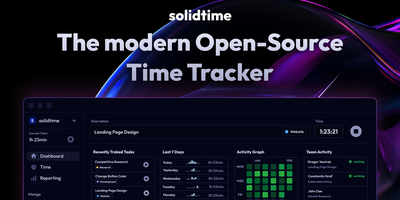
Solidtime is a time tracker for freelancers and agencies, offering a modern SaaS-quality interface that rivals commercial tools like Toggl and Clockify. The time tracking interface provides a running timer, calendar view, and weekly timesheet for flexible entry across desktop, mobile, and the dedicated macOS, Windows, and Linux desktop applications. Project management organizes work by client with hierarchical billable rates configurable at organization, member, project, and project-member levels, ensuring accurate billing across complex team structures. The invoicing module generates polished PDF invoices and structured EU e-invoices with configurable VAT rates, percentage and fixed discounts, EU reverse-charge handling, reusable company templates, and automatic line item generation from billable time entries. Reporting provides filterable summaries by user, project, client, and date range with exportable data for billing audits and team retrospectives. Multi-organization support manages separate workspaces from a single account with role-based permissions controlling access across organizations. Data import from Toggl, Clockify, and generic Timeentry CSV files enables migration from existing tools without losing historical records. The RESTful API with bearer token authentication enables automation and integration with external services. Docker deployment with PostgreSQL runs behind Nginx or Traefik reverse proxy. Running on a dedicated VPS on RepoCloud with guaranteed CPU, RAM, and SSD, full root SSH access, and a browser serial console. AGPL-3.0 licensed.
Grocy
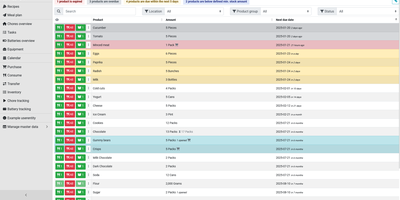
Grocy is a household management system, bringing ERP-grade inventory tracking to kitchens, pantries, and homes worldwide. The stock management system tracks products with expiration dates, best-before dates, and opened tracking, while barcode scanning via USB readers or device cameras with Open Food Facts product lookup enables rapid item entry. Minimum stock amounts trigger automatic shopping list entries so frequently used products never run out, and multiple shopping lists can be maintained and shared across household members. Recipe management links ingredients directly to stock inventory, showing at-a-glance fulfillment status and a Due Score that highlights recipes best suited for consuming items approaching expiration. The meal planner organizes daily meals across customizable time periods and adds all missing ingredients to shopping lists with one click. Chore tracking schedules recurring household tasks with assignment to specific members, due date tracking, and completion history logging. Battery management monitors charge cycles for household devices with configurable reminder intervals. Custom fields and userfields extend any entity with additional data, while feature flags disable unused modules to simplify the interface. The RESTful API with integrated Swagger UI at the /api endpoint exposes every operation the web frontend uses, enabling third-party integrations with home automation systems. Running on a dedicated VPS on RepoCloud with guaranteed CPU, RAM, and SSD, full root SSH access, and a browser serial console. MIT licensed.