neTV
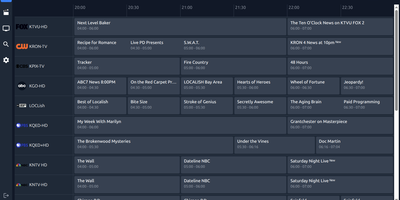
neTV turns any Xtream Codes or M3U IPTV subscription into a clean, fast player that you host yourself and open from a browser, iPhone, iPad, Apple TV, Mac, or Chromecast. The EPG grid guide shows what is on now and next, and catchup lets you browse earlier listings, replay a program from the beginning, or start over a show already airing, with timeline seeking whenever your provider keeps an archive. Intelligent Handoff lets you switch off the living room TV mid-match and resume on your phone from the exact moment you stopped, because the server keeps the stream going until the program ends. Movies and series arrive with metadata, seasons, episodes, and resume points, while search accepts regular expressions and favorites support drag-and-drop ordering alongside playlists that you build on the web and see in every app. Smart passthrough remuxes h264 and AAC streams without re-encoding, and NVENC or VAAPI hardware transcoding serves low-latency HLS to clients that need it. Owners of an NVIDIA GPU can switch on real-time 4K AI upscaling that lifts 1080p channels above 70 frames per second on an RTX 5090. A separate gateway port exposes your live sources as an Xtream-compatible endpoint for other native players, with per-user source access and stream limits. Running on a dedicated VPS on RepoCloud with guaranteed CPU, RAM, and SSD, full root SSH access, and a browser serial console. Apache 2.0 licensed.
AgentVerse OS
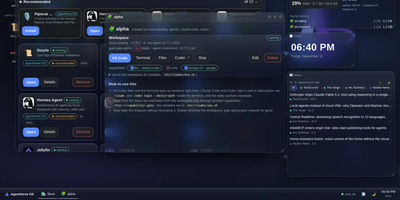
AgentVerse OS turns a single Ubuntu server into a personal cloud with a real desktop in the browser, built for a developer and their AI agents. You work in a windowed desktop with a taskbar, start menu, and widgets for system monitoring, clock, news, weather, and projects, and the same desktop opens from a laptop, tablet, or phone while everything stays on the server. Each project gets an isolated Incus container with Docker inside, its own network and gate, plus VS Code, a terminal, files, and git in the browser. The Agents app runs Claude Code, Codex, Gemini CLI, pi, and Antigravity inside the workspace, with permission prompts you approve from any device, scheduled routines, model menus, conversation search and export, and a ledger of what each session spent. When you close your laptop the agents keep working, and you pick the conversation up later exactly where it stopped. A built-in store merges the Runtipi, Coolify, and Umbrel catalogs into about 945 installable apps with guided setup, credentials shown in the app card, snapshots, and rollback. Projects request capabilities such as storage.s3, llm, or notify instead of hardcoding addresses, scheduled ZFS snapshots feed a restic backup repository, and access arrives only through your Tailscale network with real certificates. Running on a dedicated VPS on RepoCloud with guaranteed CPU, RAM, and SSD, full root SSH access, and a browser serial console. Apache-2.0 licensed.
AnythingMCP
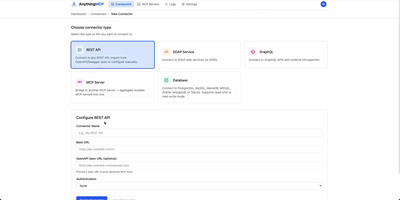
Connecting autonomous AI assistants to internal enterprise databases and legacy systems is streamlined by AnythingMCP, a visual Model Context Protocol gateway with automated knowledge graph generation and granular access controls. Engineers can import OpenAPI specifications, Postman collections, SOAP WSDL files, or raw database credentials to generate standardized Model Context Protocol tools in minutes without writing custom code. The built-in knowledge graph automatically maps entity relationships across disparate databases and software platforms, teaching agents how to correlate customer records in CRM tools with live order histories in enterprise resource planning software. System administrators can enforce fine-grained access policies by restricting tool execution permissions to specific roles and scoping database operations to read-only queries with strict row limits. An interactive web console provides real-time tool inspection, payload testing, request tracing, and comprehensive audit logs that capture every upstream invocation with full parameter visibility. Enterprise teams can integrate identity providers through OAuth2, SAML single sign-on, and SCIM automated user provisioning while protecting sensitive credentials using AES-256-GCM encryption at rest. Running on a dedicated VPS on RepoCloud with guaranteed CPU, RAM, and SSD, full root SSH access, and a browser serial console. GNU AGPLv3 licensed.
Crumbs
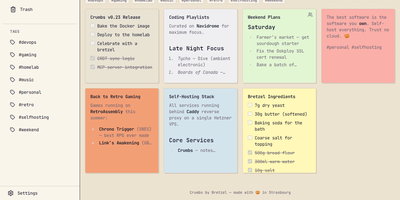
Capture a thought before it evaporates: Crumbs is a self-hosted, privacy-first alternative to Google Keep for notes you would rather keep on your own server. You write rich notes with Markdown, checklists, and image attachments, then give each one a personality from twelve color themes. Hashtags organize everything without folders, pinning keeps the important notes on top, and archive and trash clear the rest out of sight. Full-text search reaches across titles, content, and tags, so last month's idea is one query away. Every note keeps a version history you can browse and restore, which turns accidental deletions and bad edits into non-events. Notes can be shared with other users on your instance, with optional email notifications over SMTP for share alerts and account events. The installable PWA works offline through IndexedDB with last-write-wins CRDT sync, so a note captured on a plane reconciles when you land. Accounts are protected with Argon2 password hashing, and Google, GitHub, or any OIDC provider can handle sign-in instead. A built-in MCP server even lets AI assistants manage your notes on your behalf. Running on a dedicated VPS on RepoCloud with guaranteed CPU, RAM, and SSD, full root SSH access, and a browser serial console. MIT licensed.
Sage Wiki
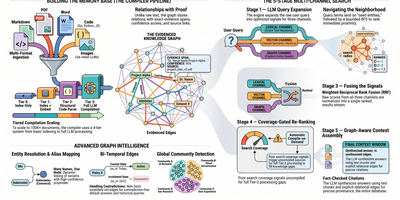
Sage Wiki turns a pile of unstructured documents into a fully interlinked, searchable wiki by running them through a five-pass LLM compiler pipeline. Inspired by Andrej Karpathy's vision of LLM-compiled knowledge bases, the pipeline processes source files through diff detection, summarization, concept extraction, image captioning, and cross-reference discovery, with parallel LLM calls and checkpoint/resume for vaults scaling to 100,000+ documents. The typed ontology graph stores entities and relations with BFS traversal, configurable relation types, multilingual synonyms, and a promotion/demotion lifecycle backed by grounding verification and consensus scoring. Multi-format ingestion handles Markdown, PDF, Word, Excel, PowerPoint, EPUB, email, CSV, images, and code files without manual tagging. LLM provider support spans Anthropic, OpenAI, Gemini, Ollama, and any OpenAI-compatible API, with per-pass model routing enabling cost optimization by assigning cheaper models to simpler tasks. The built-in MCP server exposes 17 tools over SSE transport for integration with Claude, Cursor, and any MCP-compatible agent, while native Obsidian vault overlay ensures existing note workflows remain undisrupted. Team deployment supports Git-synced shared wikis, centralized server access, and hub federation across multiple projects. Ships as a single Go binary with Docker Compose multi-arch images serving the web UI on port 3333. Running on a dedicated VPS on RepoCloud with guaranteed CPU, RAM, and SSD, full root SSH access, and a browser serial console. MIT licensed.
Input
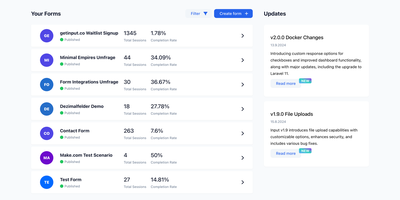
Input is a no-code form builder you host yourself, so the forms your customers answer and the data they submit stay on your infrastructure instead of a form vendor's cloud. Build in the drag-and-drop workbench by stacking blocks: short and long text, email, phone, number, date, checkboxes, multiple choice, rating, scale, file upload, link, secret, and consent fields, fifteen types in all. Conditional logic shows or hides blocks based on earlier answers, so a form can branch like a conversation instead of interrogating everyone with every question. Style the result in your brand colors and fonts until it looks like part of your site, then embed it on any page or share it directly. Respondents get a responsive form that adapts to desktop, tablet, and mobile, in multiple languages when your audience needs them. Submissions collect into a table view with one row per response and a summary view that charts choice distributions, common text answers, averages, and rating ranges, and everything exports to CSV for analysis elsewhere. Webhooks fire each submission as JSON to your other tools, with simplified setup for Make, and a custom completion page closes the loop with your message or a redirect. Consent fields and encrypted storage keep GDPR duties manageable, and unlimited forms and responses come standard because the server is yours. Running on a dedicated VPS on RepoCloud with guaranteed CPU, RAM, and SSD, full root SSH access, and a browser serial console. AGPL-3.0 licensed.

Family Ledger
Family Ledger gathers every account a household owns into one private picture of net worth, using ten minutes of data entry per month. Bank cards, brokerage accounts, funds, property, loans, crypto, precious metals, and insurance sit together, grouped by family member, with CNY, USD, and HKD support. Each month the app lists the balances to fill in, so two partners can finish the job at different times from a phone or desktop. The dashboard separates what you earned from what your money earned, and it reports true annualized return with XIRR and TWR, plus a net-worth line adjusted for inflation. An asset lens slices holdings by risk, platform, industry, currency, and region through sunburst charts and pivot tables, and fund look-through shows the real stock, bond, and industry exposure behind each fund. Upload a brokerage screenshot and a vision model reads every holding for you to confirm. AI checkups score allocation, risk, liquidity, and returns, then suggest rebalancing steps. Goals for retirement, education, and emergency reserves come with optimistic, neutral, and pessimistic forecasts. Running on a dedicated VPS on RepoCloud with guaranteed CPU, RAM, and SSD, full root SSH access, and a browser serial console. AGPL-3.0 licensed.
Airbroke
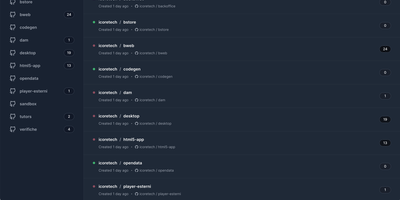
Engineering teams use Airbroke to catch application exceptions in one self-hosted error tracker where they can triage issues, replay failing requests, and debug without a per-event bill. Your existing Airbrake or Sentry clients point at its compatible HTTP collector endpoints, so instrumented applications keep reporting with no new SDK to adopt, and every occurrence lands in storage where the footprint stays small even under heavy ingestion. The web interface groups errors into issues you can triage, bookmark important occurrences for follow-up, and read occurrence charts that show whether a bug is a one-off or a slow-building wave. When an HTTP exception looks suspicious, you can replay the original request directly or copy a generated cURL command that reproduces it exactly, turning vague log complaints into debuggable cases. An AI assistant answers questions about issues in context, an MCP API lets LLM agents query your error data programmatically, and multiple OAuth providers secure sign-in for the team. It runs as a small service needing only a database, a single core, and a few hundred megabytes of memory. Running on a dedicated VPS on RepoCloud with guaranteed CPU, RAM, and SSD, full root SSH access, and a browser serial console. MIT licensed.
Malloy Publisher
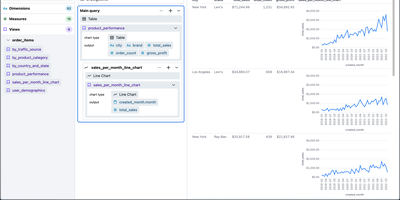
Analytics teams, and increasingly the AI agents working beside them, get one shared definition of the business from Malloy Publisher instead of a pile of SQL queries that each compute revenue slightly differently. You model what your data means once: the sources, the joins, the measures, and who may see what. Agents then compose queries against that model over MCP, so there is no wrong join, no invented column, and no fan-out that double-counts while looking plausible, and the same question returns the same numbers tomorrow. Applications and BI tools reach the same model over REST, and unattended agents use the same governed path instead of scraping raw tables. Reports declared in Malloy read top to bottom or lay out as tile grids you can build by dragging, no-build HTML data apps ship inside the package, and the built-in Console lets anyone browse environments, packages, models, and results without writing code. Access rules decide who may query and which rows they see, discovery curation decides what is even visible, and a single annotation materializes an expensive source or pre-aggregates it on a schedule. Local files work through built-in DuckDB, while BigQuery, Snowflake, Postgres, Databricks, and others connect when the data already lives there. Running on a dedicated VPS on RepoCloud with guaranteed CPU, RAM, and SSD, full root SSH access, and a browser serial console. MIT licensed.
NeXroll
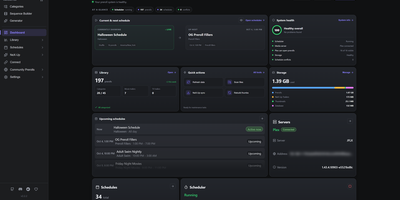
Give movie night a proper cinema preshow: NeXroll plays intros, trailers, and custom welcome screens before the feature on Plex, Jellyfin, and Emby. Build sequences in a list or a visual Flow view, with branches that pick a fallback when no trailer is available and rules for time of day, age rating, genre, or audio format. Schedules rotate the lineup automatically, with holiday themes, special event dates, priorities, and filler between them, all visible in month, week, and day calendars. Import your own videos, preview them, tag them, and sort them into categories, then pull in more from a community collection filtered by creator or platform. NeX-Up fetches upcoming movie and TV trailers through Radarr and Sonarr, and Library Trailers replays trailers for films you already own. Generator Studio makes welcome videos, announcements, QR code screens, and Coming Soon clips from your own text, logo, backdrop, and soundtrack, with a live preview. Connect several media servers to one install, switch among eight themes, back up and restore settings, and automate with the External API. Running on a dedicated VPS on RepoCloud with guaranteed CPU, RAM, and SSD, full root SSH access, and a browser serial console. MIT licensed.
Krawl
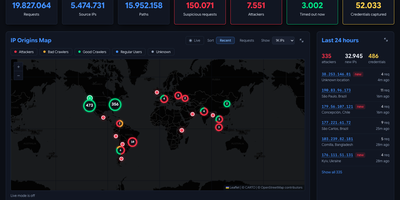
Leave a fake door unlocked and see who walks through: Krawl is a self-hosted honeypot that poses as a sloppy web server and records everything scanners and scrapers try. Fake WordPress, phpMyAdmin, and admin logins. Every attempt logged, every credential captured. A .env file leaking fake database strings, AWS keys, and Stripe secrets. SQL injection, XSS, path traversal, XXE, and command injection traps that answer with believable fake output. SQLMap gets a different database error on every request. Malicious crawlers wander an endless maze of random links. An optional tarpit adds delay and word salad that cost scrapers time, storage, and tokens. Optional AI-generated pages write a plausible decoy for any path an attacker requests. A hidden dashboard shows an attacker map, top IPs, captured credentials, and per-IP forensics. TLSH fuzzy hashing groups webshell variants into campaigns. A behavior score labels each IP attacker, bad crawler, good crawler, or regular user. Export bans as raw lists, iptables, or nftables rules, with guides for Fail2Ban, OPNsense, and RouterOS. A canary-token link in decoy pages emails you the IP and user agent of anyone who follows it. Running on a dedicated VPS on RepoCloud with guaranteed CPU, RAM, and SSD, full root SSH access, and a browser serial console. MIT licensed.
DBackup
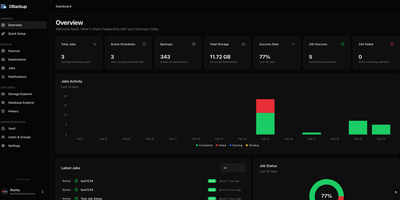
When a bad migration or disk failure strikes at 3 AM, DBackup guarantees that your PostgreSQL, MySQL, MariaDB, MongoDB, SQL Server, Redis, Valkey, SQLite, and Firebird databases, along with the application directories that belong to them, are encrypted, verified, and ready to restore in a few clicks. Connect directly over TCP or tunnel through SSH with zero agents installed on your target servers. Bundle database dumps and Docker volumes or remote SFTP directories into a single atomic job so your schema and uploaded assets always share the exact same recovery point. Every archive is compressed with Brotli or GZIP, sealed with AES-256-GCM encryption before leaving the host, and pushed simultaneously to up to 14 storage backends including Amazon S3, Cloudflare R2, Hetzner, Google Drive, Dropbox, OneDrive, SMB, and WebDAV. Reusable Grandfather-Father-Son retention policies prune daily, weekly, monthly, and yearly snapshots automatically. Need to inspect live tables or recover a single file? Use the built-in Database Explorer, remap a dump into a staging schema, or extract individual files over HTTP byte ranges without downloading the entire archive. Even if your backup server goes offline, the downloadable Recovery Kit decrypts standard SQL dumps and plain TAR archives using a standalone script. Running on a dedicated VPS on RepoCloud with guaranteed CPU, RAM, and SSD, full root SSH access, and a browser serial console. GPL-3.0 licensed.
Agenticos
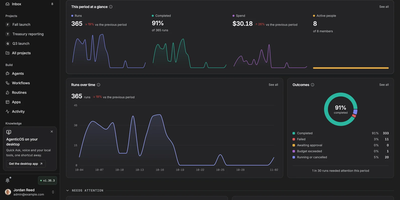
Give each team an AI teammate that works where the team already works: AgenticOS lets colleagues and agents share one live chat and the same project files, so an agent can answer in the thread, apply a correction from a reply, and show its work as it writes. You build an agent in the browser by writing its instructions, picking a model, and switching on tools, then publish it to web chat, Slack, Teams, Discord, Mattermost, Telegram, a website widget, or an API. Agents analyze spreadsheets, run code in a sandbox, browse the web in a browser you can watch and take over, and hand programming work to Claude Code or Codex. Company knowledge comes from uploaded documents and synced drives, searched with cited answers, while reusable skills teach agents how your team writes reports, reviews code, or researches a market. Agents can draw charts and diagrams in chat and publish dashboards as apps with stable links your team opens anywhere. Administrators set roles and department groups, cap each agent's monthly budget, require approval for sensitive tools, and read a recorded run history with costs. Running on a dedicated VPS on RepoCloud with guaranteed CPU, RAM, and SSD, full root SSH access, and a browser serial console. Apache-2.0 licensed.
OpenFlowKit
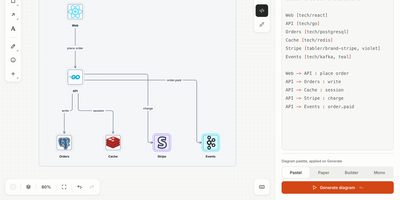
Draw it, write it as code, or hand it to your AI agent: OpenFlowKit is an open-source diagram canvas where the picture and the text behind it are always the same diagram. Drag shapes on the canvas or type a few forgiving lines, and each side regenerates the other as a single undo step. Ten diagram types share that one language: architecture with C4 views and cloud icons, sequence, flowchart, entity-relationship, state, class, mind maps, git graphs, charts, and wireframes. Paste Mermaid, Structurizr, or D2 and it converts into editable shapes, and Copy as Mermaid sends a flowchart or sequence back out for your README. Paste a GitHub repository instead and Map mode draws its architecture for you, with every arrow citing the exact file and line behind it, and a CLI that maps a local checkout for private repos. Connect Claude Code, Cursor, or any MCP client and the agent draws on your live canvas, restyles what is there, and screenshots its own work to check it. A built-in assistant works with your own key from Claude, OpenAI, Gemini, Groq, Mistral, OpenRouter, or a local Ollama, and exports cover PNG, SVG, PDF, JSON, and animated SVG, GIF, MP4, or WebM you can drop into documentation. Running on a dedicated VPS on RepoCloud with guaranteed CPU, RAM, and SSD, full root SSH access, and a browser serial console. MIT licensed.
Supercheck
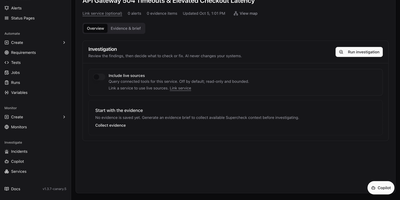
Browser tests, load tests, uptime checks, public status pages, and an AI incident investigator all live in one self-hosted dashboard called Supercheck. Write browser, API, database, custom, and k6 performance tests in a built-in code editor, or record a flow with the Chrome and Edge Recorder extension and save it as a Playwright script. Group tests into scheduled jobs, trigger them from CI with trigger keys, and review run logs, screenshots, traces, and reports. Five monitor types cover HTTP endpoints, website SSL expiry, ping, TCP and UDP ports, and scheduled synthetic browser journeys, with administrator-defined check locations and alerts to email, Slack, Discord, Telegram, Microsoft Teams, or webhooks. Status pages publish component health with 90-day uptime, incidents, scheduled maintenance, badges, and subscriber notifications under a subdomain or custom domain. When something breaks, the incident workspace collects evidence, drafts an evidence brief, and runs a read-only AI investigation across connectors such as GitHub, Prometheus, Grafana, and Kubernetes, while Copilot answers questions about that evidence. Requirements link expectations to tests and show coverage, and AI can extract them from a PRD. Organizations, projects, six roles, API keys, and audit trails keep teams in their lanes, and the CLI pulls, diffs, and deploys resources as code. Running on a dedicated VPS on RepoCloud with guaranteed CPU, RAM, and SSD, full root SSH access, and a browser serial console. AGPL-3.0 licensed.
Fireshare
FireShare turns a folder of game captures on your server into a browsable library where every clip gets its own permanent link, ready to paste into Discord the moment something worth bragging about happens. Point it at the directories you already record to and it scans what is there: the file people watch is always your untouched original, in MP4, WebM, or MOV, never a recompressed stand-in. Privacy is set per file, public for the feed, link-only for friends, or behind a password, and whole folders can be shared as a single link. It also sorts the chaos for you, detecting the game in each capture and shelving hundreds of timestamped filenames under proper cover art you can search and browse. Trim the dead air off a clip before posting it, add a title, description, tags, and a custom thumbnail, and watch the view count climb. For screens that struggle with huge originals, optional transcoding adds adaptive lower qualities on CPU or an NVIDIA GPU, and HDR captures get tone-mapped to SDR instead of looking washed out. Friends can upload through the browser or by token from scripts, new public clips can announce themselves to Discord or an RSS reader, and accounts come with permissions, profiles, and two-factor sign-in. Running on a dedicated VPS on RepoCloud with guaranteed CPU, RAM, and SSD, full root SSH access, and a browser serial console. GPL-3.0 licensed.
Movary
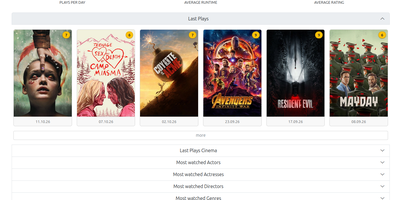
Catalog, rate, and analyze every film you watch with Movary, a self-hosted movie tracking hub and personal cinema diary that replaces Letterboxd and Trakt. Each time a movie finishes playing on Plex, Jellyfin, Emby, or Kodi, automated webhook scrobblers record the viewing session and star rating directly into your timeline without manual logging. You can also bring over years of existing watch history by importing exports from Letterboxd, Trakt, or Netflix, and automatically cross-post newly logged reviews and ratings to Mastodon or feed Watchlist additions straight into Radarr. Customizing your personal dashboard lets you rearrange analytical widgets that break down your viewing habits by most-watched actors, directors, genres, original languages, release decades, and custom watch locations like local cinemas or home theaters. Movie metadata, posters, and ratings pulled from TMDB and IMDb are cached locally on your server, while built-in background job schedules keep artwork and cast details refreshed automatically. Multi-user account controls, TOTP two-factor authentication, granular profile visibility settings, and personal Bearer API tokens make it easy to run a private household log or a shared film club server. Running on a dedicated VPS on RepoCloud with guaranteed CPU, RAM, and SSD, full root SSH access, and a browser serial console. MIT licensed.
multi-scrobbler
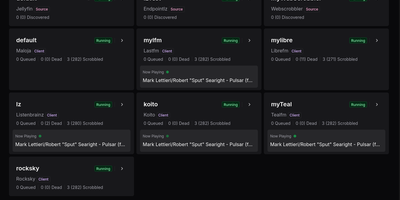
Listening to music across Spotify on your commute, Jellyfin at your desk, and Sonos in the living room usually leaves your play history fragmented across walled gardens, which is why multi-scrobbler unifies over 30 music sources and routes every track to your chosen scrobble backends automatically. Instead of relying on brittle browser plugins per device, you configure active polling or ingress webhooks once for sources including Plex, Navidrome, Subsonic, Apple Music, Deezer, YouTube Music, MPD, VLC, Chromecast, and Music Assistant. Every detected play passes through an intelligent pipeline that verifies listen duration thresholds, cleans messy track titles or featured artist tags using regex rules, and enriches missing metadata against the MusicBrainz, Spotify, or Rocksky catalogs. Before forwarding a play to Last.fm, ListenBrainz, Libre.fm, Maloja, Koito, teal.fm, Discord Now Playing, or Tuneshine, the engine checks temporal and title similarity scores to block duplicate scrobbles. When a downstream service goes offline, failed scrobbles enter a persistent retry queue so you never lose listening history, while Gotify, Ntfy, and Apprise webhooks alert you to source issues. Running on a dedicated VPS on RepoCloud with guaranteed CPU, RAM, and SSD, full root SSH access, and a browser serial console. MIT licensed.