SmarterRouter
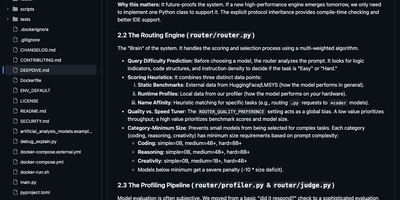
SmarterRouter stops you from playing model roulette with your local AI setup, choosing the right model for every prompt so you never have to. Point your applications at one familiar endpoint and send the request; the router studies the prompt, weighs category and complexity against benchmark results gathered on your actual hardware, and hands the job to the model most likely to answer well. It discovers the models your backend already serves, profiles each one with standard tests the first time it meets them, and keeps learning from the feedback your usage generates. When the first choice fails, a backup model takes over without your application noticing. Repeated questions come straight back from cache instead of burning another generation. Your graphics memory is watched continuously across one card or several, and models are unloaded before an ambitious request runs the machine dry. Cloud providers can join the same routing pool when a question deserves them, while everything local stays local and free. Running on a dedicated VPS on RepoCloud with guaranteed CPU, RAM, and SSD, full root SSH access, and a browser serial console. MIT licensed.
Wardrowbe
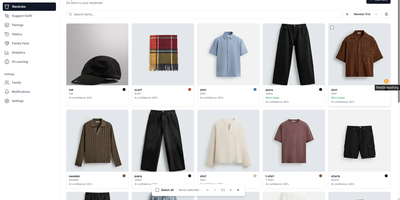
Your closet already knows what you own; Wardrowbe is the part that remembers it for you and decides what goes together tomorrow morning. Photograph garments one at a time or several in a single shot, and a vision model tags each piece with its type, color, pattern, fabric, style, and formality, with a confidence score you can correct. From that catalog the app builds complete outfits out of clothes you already have, weighing your local weather, the occasion, notes you attached to individual pieces, and the aesthetic you described. A daily suggestion can arrive on a schedule through ntfy, Mattermost, or email, so the outfit is waiting before you are. Accept, reject, and rate what you wear, and the history calendar keeps every past recommendation while the feedback sharpens the next ones. Pairings work the other way around too: pick one item and get outfits built around it, each with a plain-language explanation of why the combination works. Analytics show what you actually wear, what never leaves the rail, and how your colors distribute, and the wardrobe view flags pieces that need washing. Households manage several members' wardrobes with personalized suggestions for each person. Everything runs against any OpenAI-compatible endpoint, so Ollama with a local multimodal model keeps the whole pipeline offline and free. The interface speaks eight languages and follows your browser by default. Running on a dedicated VPS on RepoCloud with guaranteed CPU, RAM, and SSD, full root SSH access, and a browser serial console. MIT licensed.

Tonkatsu Box
Tonkatsu Box is a collection manager for games, movies, TV shows, anime, visual novels, manga, books, music, and podcasts that tracks progress, ratings, and shelves for all of them in one place. One search field queries fifteen catalogues, from IGDB, TMDB, and TVmaze to AniList, MangaDex, OpenLibrary, ComicVine, and Podcast Index, and a result can land in several collections at once. Collections organize by platform, genre, or anything else, with grid, list, table, and board views, drag and drop ordering, global tags, and bulk actions across a selection. Progress speaks each medium's grammar: episodes for series, pages for books, chapters for manga, listened track checklists for albums, plus statuses, ratings, dates, and replays. The episode tracker unfolds seasons with posters, stills, air dates, and synopses, and marks one episode, a whole season, or the next unwatched one in a tap. Statistics turn the library into numbers with per type breakdowns, a month by month ribbon, platforms, formats, tags, best against worst, and a shareable summary card. Visual boards arrange posters, notes, and connections on a free canvas, and tier lists and mood grids rank and lay out items for export as PNG. Importers read Steam, Trakt, Simkl, MyAnimeList, AniList, Hardcover, and RetroAchievements libraries, plus JSON and CSV, and collections travel as offline .xcollx packages. Running on a dedicated VPS on RepoCloud with guaranteed CPU, RAM, and SSD, full root SSH access, and a browser serial console. MIT licensed.
PocketPaw
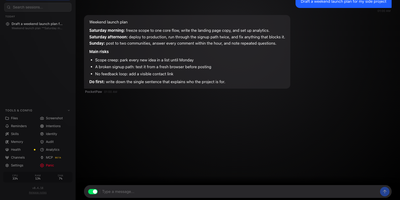
Ask for a recycling reminder from your phone on Sunday and have a research report waiting by Monday, without handing your data to a subscription service. PocketPaw is a personal agent you host yourself, reachable from the browser dashboard or the chat apps you already use, including Discord, Slack, WhatsApp, Telegram, Signal, Matrix, Teams, and Google Chat. Pick a backend for the work: Claude Agent SDK, OpenAI Agents, Google ADK, Codex CLI, OpenCode, or Copilot SDK, then point it at a cloud key or a local Ollama model. Over fifty tools cover browsing, web search, files, shell commands, OCR, voice, image generation, and delegation to helper agents. Reminders and scheduled intentions run on their own, and memory keeps long-term facts and compacts old sessions. Identity files shape the agent's tone and instructions, and a skills library adds new slash commands. A guardian model reviews tool calls, with injection scanning, plan mode approvals, tool profiles, and an audit log for oversight. Analytics show cost, latency, and traces against monthly budget caps. Memory, tool logs, and cost traces all live on your own server. Running on a dedicated VPS on RepoCloud with guaranteed CPU, RAM, and SSD, full root SSH access, and a browser serial console. MIT licensed.
Easy Invoice PDF
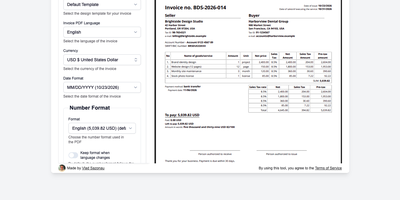
Freelancers, contractors, and small shops can turn a short form into a client-ready PDF invoice, with a live preview that redraws on every keystroke and no account to create. Fill in seller and buyer details, then add line items with quantity, unit, net price, and tax rate; net amounts, tax, totals, and the amount in words are calculated automatically. Item discounts take a percentage or fixed amount off any line under a custom label, and tax applies to the discounted figure. Pick a classic layout or a Stripe-style template, and add your logo as a JPEG, PNG, or WebP file. Invoices can be written in 13 languages, including Brazilian Portuguese, with 122 currencies, 18 date formats, and a number format setting that survives a language switch. Tax labels can read VAT, GST, Sales Tax, or anything else, or the tax columns can be dropped entirely. Bank account, SWIFT/BIC, payment method, due date, and notes sit alongside an optional QR code that can carry a payment link, UPI details, or contact information. Long invoices flow onto extra pages automatically. Saved seller and buyer profiles fill in the next invoice for you, and the data stays in the browser. Download the PDF or copy a shareable link that opens the same invoice for your client. Running on a dedicated VPS on RepoCloud with guaranteed CPU, RAM, and SSD, full root SSH access, and a browser serial console. AGPL-3.0 licensed.
MIND
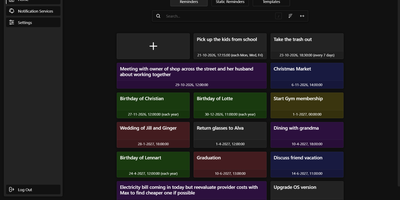
Unlike a calendar alert that rings on one phone, a MIND reminder reaches any of 100+ services, including email, Pushbullet, BlueSky, Cisco Webex Teams, and SMS gateways, from a self-hosted reminder app that you control. Normal reminders fire with second precision once or repeat every few days, once a year, on chosen weekdays, or on a custom cron schedule, while static reminders wait for a button press, so a single tap can tell the family that you are running late. Templates store colour, title, services, and text for fast creation, and the colour-coded library can be searched and sorted, with each reminder enabled, disabled, or tested on demand. Time zone changes, including daylight saving shifts, are accounted for, and sends that fail on a connection error are retried every two minutes until they succeed. Several users can share one instance: the admin panel handles accounts and registration, login lifetime, reverse-proxy URL prefix, debug logs, and scheduled database backups that can be exported and imported, and sign-in supports two-factor authentication. A documented REST API covers reminders, templates, notification services, and static triggers, and the web interface adapts to phone screens. Running on a dedicated VPS on RepoCloud with guaranteed CPU, RAM, and SSD, full root SSH access, and a browser serial console. GPL-3.0 licensed.
Feedlog
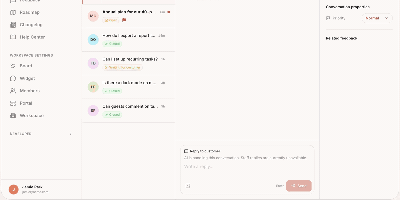
FeedLog gives SaaS teams an AI support agent, a shared inbox, and a feedback-to-roadmap loop in one open-source platform they can host themselves. Customers ask questions inside your product through an embeddable widget, and the agent answers from your help center articles, which you mark as approved knowledge before it can use them. When a question needs a person, the conversation moves into a shared inbox with its full context intact, so customers never repeat themselves and your team replies with email notifications keeping the thread alive. The same widget collects bug reports and feature ideas into feedback boards with posts, voting, comments, and status workflows, while similar-feedback detection finds duplicates and merges fragmented requests before they scatter your priorities. Prioritized work becomes a public roadmap showing what is planned, in progress, and completed, and shipped changes close the loop as changelog entries you can draft with AI from your update notes. Guest access, email and password, Google, GitHub, and SSO sign-in options decide how customers identify themselves, and human support guidance routes billing, account, and privacy requests straight to people. An MCP server connects AI assistants to your boards and articles so agents can query and manage feedback in natural language. Running on a dedicated VPS on RepoCloud with guaranteed CPU, RAM, and SSD, full root SSH access, and a browser serial console. MIT licensed.

Beancount.io
Your money lives in plain text forever here: Beancount.io keeps double-entry books in readable .bean files you can diff, back up, and open in any editor, then turns them into polished reports you can explore in a browser. Open the income statement to see monthly net profit with income and expense trees, switch to the balance sheet for net worth over time with assets, liabilities, and equity broken down by account, or browse the journal to filter more than a thousand transactions by date, account, narration, or payee. The accounts page lists every account with its status, open date, and posting count, and the overview pulls net worth, account balances, recent activity, and income against expenses onto one page. Record the same entry from the web journal, the bea command line, Python, or native phone apps, because every surface reads and writes the same ledger file. Statement import, bank reconciliation, BQL queries, and month-end close prompts are built in for automation, and an MCP server lets coding agents query and edit the ledger with dry-run previews and per-call authorization. Running on a dedicated VPS on RepoCloud with guaranteed CPU, RAM, and SSD, full root SSH access, and a browser serial console. MIT licensed.
Prospex
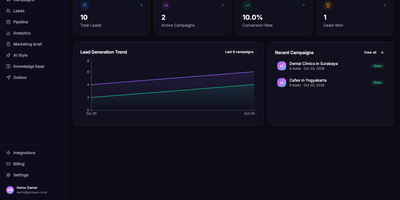
Local businesses that need what you sell turn up in one dashboard, each with an AI-drafted outreach message built from real data that you approve before it goes out. Prospex reads your website, documents, or pasted text to write a marketing brief and fill in a campaign form, listing anything your sources do not say instead of inventing it. A campaign scrapes Google Maps by business type and city, gathers up to 2,000 leads, and ranks each from 0 to 100 using rating, review volume, reachability, and an AI judgement of fit with the reason shown. The Outbox holds every draft as a WhatsApp bubble to edit, approve, or reject, and one message can fan out to many leads with name and category filled in. Approved messages send one at a time with hourly and daily caps, quiet hours, random gaps, and typing indicators, or go by email through your own SMTP account. Replies are classified, follow-ups are cancelled or drafted, and a pipeline tracks deal value, won and lost reasons, and what needs your attention. AI Style learns your voice from exported chats, a knowledge base grounds drafts in your facts, and any OpenAI-compatible model works, including Ollama. The interface is available in English and Indonesian. Running on a dedicated VPS on RepoCloud with guaranteed CPU, RAM, and SSD, full root SSH access, and a browser serial console. AGPL-3.0 licensed.
Ferron
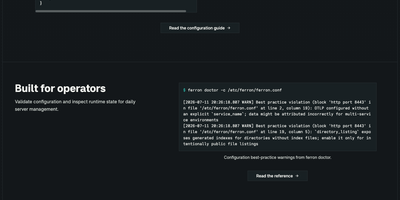
Ferron is a web server and reverse proxy that serves your sites and applications with automatic HTTPS, a configuration file you can read at a glance, and logs that explain exactly why a request failed. Declare a hostname with a root directive and it serves files from disk; swap in a proxy directive and the same block forwards traffic to your application on localhost, with PHP handled through one fcgi_php line to PHP-FPM. Every public hostname receives a TLS certificate automatically, issued and renewed without certificate paths or renewal scripts in your config. The differentiator is debugging: each request carries a trace ID printed in the access log, repeated in the error log lines it generates, and returned to the client inside JSON error responses, so one grep reconstructs the whole failure. The ferron doctor command validates a configuration before you reload it, pointing at the file, line, and column of each mistake and flagging violations like an overexposed directory listing. Its admin API answers /config and /status queries with live running state, and metrics and traces flow to Grafana or any OpenTelemetry collector through OTLP. Reverse proxying spreads requests across backend upstreams with health awareness and circuit breaker events you can watch live. HTTP/2 and HTTP/3 are on by default, and there are no worker counts or pool sizes waiting to be tuned. Running on a dedicated VPS on RepoCloud with guaranteed CPU, RAM, and SSD, full root SSH access, and a browser serial console. MIT licensed.

Pipelock
Your AI coding agent has your API keys in its environment and unrestricted network access, which means one prompt injection away from sending those secrets anywhere. Pipelock closes that gap by sitting as a proxy between your agents and every outbound connection, scanning the actual content of HTTP, WebSocket, MCP, and Agent-to-Agent traffic before it leaves your server. An 11-layer scanner pipeline checks every request against 62 credential patterns covering AWS, GCP, Azure, GitHub, OpenAI, Anthropic, SSH keys, and database URLs, then inspects every response for prompt injection using 29 detection patterns with six-pass normalization that catches base64-encoded, leetspeak, and whitespace-obfuscated payloads. The MCP proxy wraps any Model Context Protocol server (stdio, HTTP, or WebSocket) with bidirectional scanning that detects tool description poisoning and mid-session rug-pull changes via SHA-256 fingerprinting. Every scanning decision produces a cryptographically signed action receipt that third parties can verify offline without trusting the agent or the vendor. The Operator Console provides a web dashboard for reviewing evidence scorecards, receipt timelines, agent sessions, enforcement decisions, and fleet posture at a glance. Cross-request taint tracking catches slow-drip exfiltration attempts that spread a secret across multiple calls. Canary tokens plant synthetic secrets that trip alerts the moment an agent tries to exfiltrate them. Pre-built Prometheus metrics and a Grafana dashboard provide real-time visibility into traffic volumes and block rates. Deploy on a dedicated VPS on RepoCloud with guaranteed CPU, RAM, and SSD, full root SSH access, and a browser serial console. Apache 2.0 licensed.

Claper
Passive slide decks put audiences to sleep, which is why Claper turns any presentation into a two-way live session where every attendee can vote in polls, submit questions, and react in real time from their phone. Speakers upload existing PDF or PowerPoint decks directly into the web studio and interleave interactive poll, quiz, form, and web embed slides between their static pages without rebuilding presentations from scratch. Conference organizers and educators share a short join code or QR link so hundreds of participants can enter the attendee room instantly from any mobile browser without installing an app or creating an account. During the talk, the presenter console displays incoming audience questions sorted by upvote popularity, alongside moderation controls to approve, pin, hide, or mark inquiries as answered on the main screen. Live polling supports multiple-choice, rating scale, and open-text prompts that animate into real-time bar charts and percentage breakdowns as votes arrive, while timed quizzes grade participant responses automatically. Integrated real-time speech transcription generates live captions and searchable session transcripts so international and hearing-impaired attendees can follow every spoken word. Universities and corporate training teams connect Claper directly to Moodle or OpenID Connect identity providers via LTI 1.3 to synchronize student rosters, push quiz scores to gradebooks, and export complete CSV engagement reports after every session. Running on a dedicated VPS on RepoCloud with guaranteed CPU, RAM, and SSD, full root SSH access, and a browser serial console. AGPL-3.0 licensed.
Ruvio
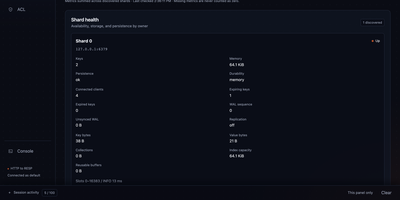
Ruvio is a Redis-compatible in-memory database that folds the cache, the lock service, the rate limiter, and the delay queue into one Rust process your existing clients already speak to. Connect with redis-cli or the first-party clients for Rust, .NET, Go, Java, Python, and Node.js, and the familiar strings, hashes, lists, sets, sorted sets, and streams are there, 287 commands in all. The difference shows in the primitives that usually need a second system: LEASE grants a fencing token for a key, SEMAPHORE caps concurrent holders with per-holder TTLs, INCRBY with MAX builds a counter that refuses to pass capacity, SETV writes only when your version is still current, CHANGES arms a feed of later writes on a shard, and XADD DELAY stores a stream entry now and reveals it to consumer groups when the delay passes. Each shard owns its keys outright, parsing, recording, and applying without a lock on the hot path, and features cost memory only on keys that use them. Durability is a startup choice you name, memory, snapshot, everysec, or always, written through a write-ahead log, and replicas copy shard by shard while optional coordinators agree through Raft to promote a replica when a primary stops answering. A browser operator UI shows data, command forms, Pub/Sub, and ACL users on the running server. Running on a dedicated VPS on RepoCloud with guaranteed CPU, RAM, and SSD, full root SSH access, and a browser serial console. AGPL-3.0 licensed.
Borg Backup Server
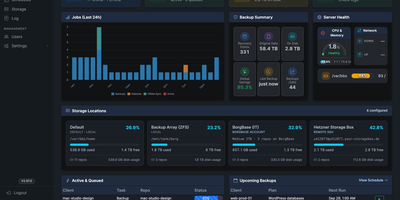
Every connection starts at the endpoint, never at the server, so Borg Backup Server can back up Linux, Mac, and Windows machines behind NAT and firewalls without opening a single inbound port. A lightweight agent on each machine polls for tasks over HTTPS, pushes deduplicated archives over SSH, and reports live progress. Append-only SSH access means an endpoint can add and restore archives but never prune or delete them. The dashboard shows backup charts, server stats, and active jobs at a glance. Plans run from hourly to monthly, several per client, built from reusable directory templates for common server roles, with per-plan retention from hourly to yearly. Lost a file? Browse the archive tree in your browser, tick what you need, and restore it to the client or download a .tar.gz. MySQL and PostgreSQL dumps run before each backup and restore as a copy or a replacement. Repositories can live on the server, on BorgBase, Hetzner, or rsync.net, and mirror to S3-compatible storage such as AWS, Wasabi, or Backblaze B2. Apprise alerts reach more than 100 services, and a nightly report lands in your inbox. Two-factor login and role-based access guard the console. Upgrades roll out to the server and every agent together, and the server backs itself up daily. Running on a dedicated VPS on RepoCloud with guaranteed CPU, RAM, and SSD, full root SSH access, and a browser serial console. MIT licensed.

Split Pro
Split Pro settles the question that ruins group dinners, who owes whom, with a private expense ledger that runs on your own server instead of an ad-supported app. Create a group for the apartment, the trip, or the team lunch rotation, then log each shared cost with its category, currency, date, and a photo of the receipt. Every expense splits your way: equally, by percentage, by shares, by exact amounts, or with manual adjustments when someone covered the tip. Rent, utilities, and subscriptions can repeat on a schedule so recurring bills enter the ledger on their own. The balances view shows exactly who is ahead and who owes, and debt simplification collapses a web of small obligations into the fewest possible payments. Negative expenses record refunds and corrections without breaking the math, and the activity feed keeps a visible history of every edit and deletion. Coming from Splitwise, you can import your friends and groups to pick up where you left off, and bank transactions from supported providers convert straight into expenses. On phones it installs as a progressive web app with push notifications whenever a new expense lands. Logins use email magic links, Google, or your own OIDC provider, and signups can be closed so the instance stays limited to your circle. Running on a dedicated VPS on RepoCloud with guaranteed CPU, RAM, and SSD, full root SSH access, and a browser serial console. MIT licensed.
Norish
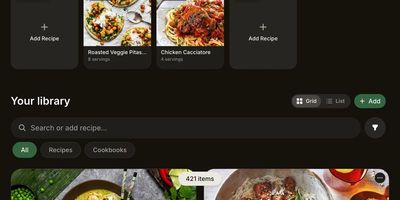
Planning weekly dinners across a busy household becomes effortless with Norish, a real-time recipe manager, meal planner, and smart grocery list platform that captures dishes from any link, video, or cookbook photo. Families and roommates can paste a food blog URL, drop in a YouTube Short, Instagram Reel, or TikTok link, or snap up to ten photos of handwritten recipe cards to generate a clean, structured dish with automatic tags, cuisines, and allergen alerts. When you drag meals onto the shared household calendar or sync your schedule over CalDAV, every ingredient flows into a live grocery list that remembers which supermarket aisle or store each item belongs to and automatically excludes staples already sitting in your pantry inventory. Splitting up in the supermarket aisles works seamlessly because checked-off items disappear on your partner's phone screen the instant you tap them, even across fifteen supported interface languages. In the kitchen, step-by-step cooking mode keeps your screen awake, embeds countdown timers directly inside preparation steps, links fractional ingredient quantities to the exact step where they are used, and scales servings or swaps between metric and US measurements with a single tap. Automatic macro calculations powered by USDA FoodData Central and CIQUAL databases break down calories, protein, carbohydrates, and fat per serving. Running on a dedicated VPS on RepoCloud with guaranteed CPU, RAM, and SSD, full root SSH access, and a browser serial console. AGPL-3.0 licensed.
Glass Keep
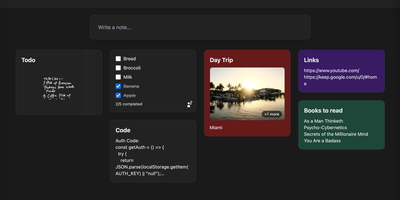
With nearly 600 GitHub stars and a feature set that rivals commercial note apps, Glass Keep is the self-hosted Google Keep alternative that wraps a full-featured notes system in a glassmorphism UI with blurred backdrops, translucent modals, and smooth transitions. The React and Vite frontend renders notes in a masonry card grid with pinning, color themes, tag chips, and drag-and-drop reordering. Text notes support Markdown with headings, bold, italic, strikethrough, blockquotes, and fenced code blocks, while checklists offer inline editing, drag-to-reorder items, and direct toggle from the grid without opening the note. A freehand drawing mode provides customizable brush sizes and colors for handwritten notes. The private AI assistant runs an optimized Llama 3.2 (1B) model entirely inside the Docker container using RAG over your own notes, answering queries like "what are my AWS commands?" without any data leaving your server. Deep search spans titles, Markdown text, tags, checklist items, and image names. Import notes from Google Keep via Takeout JSON files or export your entire vault as JSON with per-note Markdown downloads. The Express backend with better-sqlite3 requires no external database. Real-time collaboration enables shared checklists with live item toggling. Dark and light themes persist across sessions, and the PWA manifest supports installation on any device. Running on a dedicated VPS on RepoCloud with guaranteed CPU, RAM, and SSD, full root SSH access, and a browser serial console. MIT licensed.
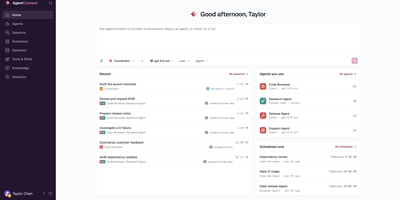
AgentConnect
AgentConnect brings Claude Code, Codex, Grok Build, DeepSeek, and any other ACP-compatible coding agent into the chat channels and repositories where your team already works, each with a role of its own. Mention an agent in Slack, Microsoft Teams, Google Chat, Lark, Discord, or Telegram and it replies in the thread, calls on a colleague agent when needed, and keeps its session visible to teammates who can step in. Work can also start from a GitHub, GitLab, Gitea, or Azure DevOps pull request, a Linear issue, a webhook, or a schedule. The web console organizes the fleet into Agents, Sessions, Schedules, Tools and Skills, Knowledge, and Daemons views. Every agent gets its own memory, skills, MCP servers, workspace, and sandbox policy, and reviewed Knowledge pages can be published for all agents to search. Decisions route new conversations to specialist agents and pick the runtime and model for each session. Review bots can run several reviewers with separate instructions on one pull request. Set who may see each agent or session, which repositories it can touch, and which agents it may call. Running on a dedicated VPS on RepoCloud with guaranteed CPU, RAM, and SSD, full root SSH access, and a browser serial console. Apache-2.0 licensed.