World Monitor
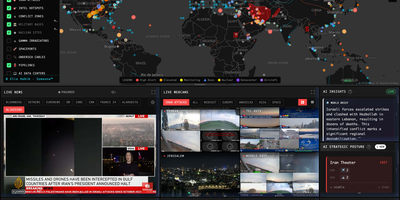
World Monitor replaces twenty or more browser tabs by fusing geopolitical, military, financial, and infrastructure signals onto a single interactive canvas built with TypeScript, Vite, globe.gl with Three.js for the 3D globe, and deck.gl with MapLibre GL for the flat map. World Monitor ingests live data from 530 upstream sources including ACLED and UCDP for conflict events, OpenSky Network for military and civilian aircraft, AISStream for vessel positions, NASA FIRMS for satellite fire detection, USGS for earthquakes, and FRED, IMF, BIS, and Finnhub for macroeconomic and market data. The Country Instability Index v8 computes real-time stress scores across 31 Tier-1 nations, while the finance radar tracks 29 stock exchanges, commodities, and cryptocurrency with a 7-signal market composite. Six specialized dashboard variants — World, Tech, Finance, Commodity, Energy, and Happy — deploy from a single codebase. AI summarization runs locally through Ollama and LM Studio integration or optionally via Groq and OpenRouter cloud providers, with Transformers.js powering browser-side inference. The platform supports 26 languages with native-language feeds and RTL layout, and provides MCP server integration for AI agent connectivity. Running on a dedicated VPS on RepoCloud with guaranteed CPU, RAM, and SSD, full root SSH access, and a browser serial console. AGPL-3.0 licensed.
Gitea
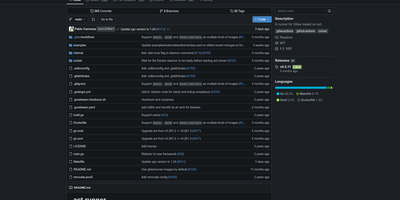
With over 57,000 GitHub stars and deployment across thousands of organizations worldwide, Gitea is the most popular self-hosted Git service, delivering a complete software development platform in a single Go binary that runs on as little as 512MB of RAM. The platform provides full repository management with pull requests featuring inline code review, branch protection rules, merge strategies including squash, rebase, and merge commit, and automated status checks through Gitea Actions. The built-in CI/CD system uses the same YAML workflow syntax as GitHub Actions and can directly reuse over 20,000 existing Actions plugins, allowing teams to migrate from GitHub with minimal pipeline rewrites using the open-source act_runner executor. The integrated package registry supports over 20 formats including npm, PyPI, Maven, NuGet, Cargo, Helm, Composer, Conda, RubyGems, Pub, and an OCI-compatible Container registry for Docker images with no additional configuration required. Project management features include issue tracking with labels, milestones, dependencies, and time tracking, alongside kanban project boards for visual workflow management. Gitea supports LFS for large file storage, built-in wiki pages per repository, webhook integrations with Slack, Discord, Telegram, Microsoft Teams, and custom HTTP endpoints, and OAuth2 authentication with LDAP, SAML, and PAM backend support. Repository mirroring enables bidirectional synchronization with GitHub, GitLab, and Bitbucket, while the comprehensive REST and GraphQL APIs power external integrations and the official tea CLI tool. Running on a dedicated VPS on RepoCloud with guaranteed CPU, RAM, and SSD, full root SSH access, and a browser serial console. MIT licensed.

Joplin
Notes on Windows, macOS, Linux, Android, iOS, and the terminal, synced through your own server: Joplin pairs its open-source clients with Joplin Server, the official self-hosted backend that replaces Dropbox, OneDrive, or Nextcloud as the synchronization target. Notes are Markdown with inline attachments (images, PDFs, audio), organized into hierarchical notebooks and sub-notebooks with cross-cutting tags, alongside to-do lists with reminders and alarms. End-to-end encryption is the headline feature: enabled in the clients, it encrypts sync payloads on-device before upload, so the server stores blobs it cannot read - genuine protection even if the host is compromised. The desktop app offers both Rich Text and Markdown editors, extended by a plugin ecosystem, custom themes, and an Extension API for writing your own scripts; a Web Clipper for Chrome and Firefox captures full pages or screenshots straight into notebooks. Joplin Server ships as a Docker image with SQLite for evaluation and PostgreSQL for production, offers a filesystem storage driver for large content, and includes multi-user support and note sharing - all free under AGPL-3.0 when self-hosted. Notes stay in an open format, so the exit path always exists.
Halo
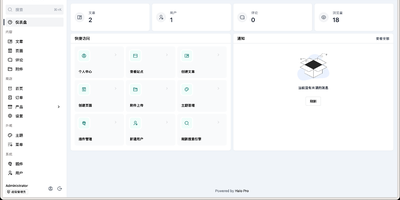
Halo is a modern CMS that handles blogs, knowledge bases, corporate sites, and full e-commerce storefronts from a single installation, distinguished by a polyglot plugin architecture that runs both Java and JavaScript extensions on a GraalVM runtime. Built on Spring Boot 3 with a Vue.js admin console, the platform delivers a clean content management experience with Markdown and rich-text editing, live preview, scheduled publishing, draft management, media uploads, and granular multi-user role-based access controls. Plugins can be enabled or disabled at runtime without restarting the server, and the official marketplace offers over 100 free themes plus a growing library of extensions covering SEO optimization, search integration, paid content access, AI writing assistance, and Q&A chatbots. Storage backends are configurable through plugins, supporting local disk, S3-compatible object storage, and other providers. The fully documented RESTful API enables headless CMS usage for decoupled frontend architectures. Database support includes embedded H2 for quick starts, with production deployments on PostgreSQL or MySQL. Nearly 40,000 GitHub stars and over 2.5 million Docker pulls reflect the project's maturity and active development pace. A single Docker command gets a functional instance running on port 8090. Running on a dedicated VPS on RepoCloud with guaranteed CPU, RAM, and SSD, full root SSH access, and a browser serial console. GPL-3.0 licensed.
Odysseus
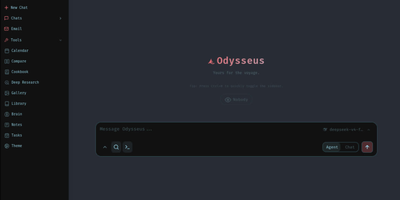
Agents with tool use, deep research, a document editor, an IMAP/SMTP email client with AI triage, notes, tasks, and a CalDAV-synced calendar - Odysseus bundles all of it into one open-source, self-hosted AI workspace. It runs local models through Ollama, vLLM, or llama.cpp and cloud APIs like OpenAI and OpenRouter, with a hardware-aware Cookbook that scans your machine and recommends quantized models that fit. Persistent memory uses ChromaDB with hybrid vector-plus-keyword retrieval, web search runs through a bundled SearXNG instance, and agents can use MCP servers, files, and shell access with safety controls, plus custom skills and scheduled agent tasks. A blind Compare mode runs side-by-side model duels with identities hidden and accumulates Elo-style ratings from your votes, so model selection is based on your actual workloads rather than leaderboard claims. Deep research mode - adapted from the Tongyi DeepResearch approach - reads sources through SearXNG and produces cited reports, while the email client tags, summarizes, sets reminders, and drafts replies locally rather than through a third-party mail AI. The writing-first document editor adds AI edits, Markdown and HTML support, and version history. The stack is Python 3.11 with FastAPI, SQLite for state, and a vanilla JS frontend, licensed AGPL-3.0 with zero telemetry. Because agents can read email and execute commands, keep authentication enabled and never expose it as a public unauthenticated service.
OpenBB
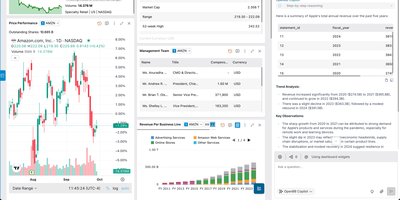
OpenBB stands as the world's most popular open-source finance repository — an Open Data Platform that evolved from a pandemic-era Reddit post into a full-blown infrastructure layer challenging Bloomberg's $25 billion empire. The "connect once, consume everywhere" architecture consolidates proprietary, licensed, and public financial data sources into multiple consumption surfaces simultaneously: Python environments for quants building models, OpenBB Workspace and Excel for analysts creating dashboards, MCP servers for AI agents performing automated research, and REST APIs for custom applications. The modular extension system supports dozens of data providers including Yahoo Finance, Alpha Vantage, FRED, Intrinio, Polygon, and Tradier with standardized schemas that normalize responses across vendors. The CLI offers a terminal-style interactive interface with autocomplete, parameter hints, and chart rendering for rapid data exploration. Provider routing handles authentication, rate limiting, and response normalization transparently so switching between free and premium data sources requires changing a single parameter. The platform covers equities, options, fixed income, crypto, forex, ETFs, mutual funds, economics, technical analysis, quantitative analysis, and alternative data across global markets. AI agent integration exposes every data endpoint as tool-callable functions with schema discovery enabling LLMs to query financial data programmatically. Install via pip with Python 3.9+ and deploy the REST API server for team access. Running on a dedicated VPS on RepoCloud with guaranteed CPU, RAM, and SSD, full root SSH access, and a browser serial console. AGPL-3.0 licensed.
Firecrawl
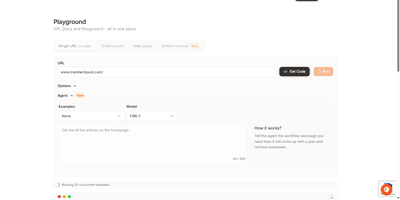
With over 164,000 GitHub stars and one of the fastest-growing open-source projects in the AI tooling ecosystem, Firecrawl is the web context API that turns any website into clean markdown, structured JSON, or screenshots optimized for large language models. The Scrape endpoint converts a single URL into LLM-ready output with approximately 67% fewer tokens than raw HTML, handling JavaScript rendering, rotating proxies, anti-bot bypasses, and dynamic content extraction with zero configuration. The Crawl endpoint recursively scrapes entire websites from a single request with configurable depth, URL filters, and concurrent page limits. The Map endpoint discovers all URLs on a domain instantly for sitemap generation. The Search endpoint performs web searches and returns full page content from results. The Interact endpoint scrapes a page then continues working with it — clicking buttons, filling forms, and extracting dynamic content using AI prompts or code. The Agent endpoint provides autonomous web data gathering where users describe what they need in plain English. SDKs are available for Python, Node.js, Go, Rust, Ruby, PHP, Java, C#/.NET, and Elixir, with an MCP server for connecting to any AI agent or MCP client. Self-hosting deploys via Docker Compose and requires Redis and a Playwright-based browser service for JavaScript rendering. Running on a dedicated VPS on RepoCloud with guaranteed CPU, RAM, and SSD, full root SSH access, and a browser serial console. AGPL-3.0 licensed.
Diaspora
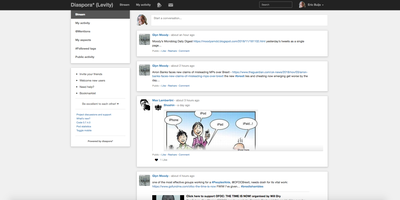
Diaspora lets you run your own social network node that federates with thousands of others, creating a network with no central authority and no advertising engine mining your behavior. The defining feature is aspect-based sharing: organize contacts into groups like Family, Work, and Close Friends, then control exactly who sees each post with granularity that mainstream platforms have never matched. Hashtag-based discovery connects conversations across the entire federation regardless of which pod participants call home, building communities around topics rather than algorithmic engagement bait. The Ruby on Rails backend (now running on Puma with Sidekiq workers instead of the heavier Unicorn configuration) handles federation delivery, media processing, and notifications efficiently. Photo albums, video embedding, Markdown posts, mentions, reactions, and resharing provide familiar social primitives for rich communication. Cross-posting bridges to Twitter and Tumblr maintain your presence on legacy networks while your canonical data lives on your own infrastructure. With 13,700+ GitHub stars and 270+ contributors since its 2010 launch, Diaspora proved early that social media can work without surveillance capitalism. The Docker Compose deployment runs the application alongside PostgreSQL, Redis, Sidekiq workers, and Nginx, providing a production-ready pod for your community.
MindsHub
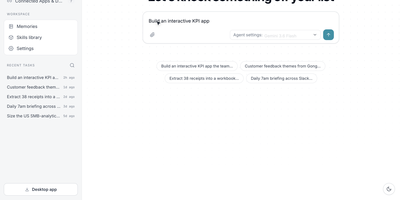
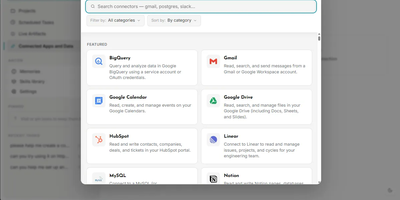
Backed by $50M+ from Benchmark, Y Combinator, and NVIDIA with 800+ contributors and 39,000+ GitHub stars, MindsHub Cowork is the unified AI workspace where open-source models handle entire projects — research, reporting, internal tools, scheduled operations — and return finished, shareable deliverables. The platform runs two interchangeable open-source agent harnesses, Anton and Hermes, swappable from a dropdown without losing context. A built-in Model Router pre-wires 25+ models spanning Anthropic Claude, OpenAI GPT, Google Gemini, DeepSeek, Qwen, Kimi, Grok, and MindsHub Air with automatic failover — no per-provider API keys required. A secure credentials vault connects BigQuery, PostgreSQL, Salesforce, HubSpot, Zendesk, Gong, Gmail, Google Drive, Notion, Linear, Stripe, and Slack, keeping secrets scoped per connection so agents never see raw keys. Agent output becomes publishable artifacts — documents, dashboards, apps, and code — each deployable to a live shareable URL. Cross-session persistent memory, a reusable skill library, and a background scheduler supporting hourly, daily, and weekly cadences enable autonomous recurring workflows. The architecture separates a React/Vite frontend (shipping as both Electron desktop app and web SPA) from a FastAPI backend with a versioned REST API at /api/v1 covering conversations, projects, artifacts, schedules, and connectors. Self-host via Docker Compose with nginx on port 3000 and the API on port 26866, or deploy on-prem, in a VPC, or air-gapped. Running on a dedicated VPS on RepoCloud with guaranteed CPU, RAM, and SSD, full root SSH access, and a browser serial console. MIT licensed.
MindsDB
Backed by 39,500+ GitHub stars and over 339 releases, MindsDB delivers the open-source federated query engine that gives AI agents a single SQL interface to read, join, and aggregate across 200+ live data sources without any ETL pipelines or data movement. The Connect-Unify-Respond architecture wires up Postgres, MySQL, MongoDB, Snowflake, BigQuery, ClickHouse, Redshift, Databricks, Salesforce, Shopify, Slack, S3, GCS, Azure Blob, and dozens more through self-contained Python handler packages merged in the open from the community. Knowledge Bases fuse structured tables with vectorized unstructured data from PDFs, emails, support tickets, and documents using hybrid search combining vector similarity with keyword matching for retrieval-augmented generation. Jobs execute queries on configurable schedules refreshing Knowledge Bases nightly or syncing derived tables hourly, while Triggers fire on data changes to automatically vectorize new rows into the appropriate store. The SQL-compatible query language extends standard SQL with constructs for creating models, defining agents, managing workflows, and searching unstructured data. The built-in web editor at port 47334 provides interactive SQL authoring, while the MySQL-compatible API at port 47335 and PostgreSQL API at port 47336 connect any database client directly. An MCP Server integration exposes MindsDB to AI assistants, and the Python SDK enables programmatic access from application code. Docker deployment runs with a single command exposing all APIs immediately. Running on a dedicated VPS on RepoCloud with guaranteed CPU, RAM, and SSD, full root SSH access, and a browser serial console. MIT licensed.
Owncloud
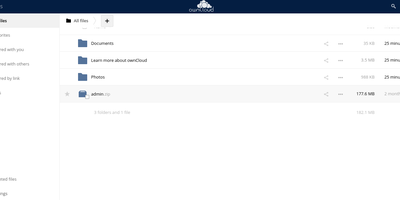
The project that proved organizations could have Dropbox-style convenience with complete data ownership: ownCloud is the original open-source file sync and share platform - the codebase Nextcloud later forked from. This deployment runs the classic ownCloud Server (PHP over PostgreSQL or MariaDB, with Redis caching), the battle-tested edition trusted across enterprises, universities, and public institutions worldwide. The core loop: store files on your server, sync them via desktop clients for Windows, macOS, and Linux plus iOS and Android apps, and access everything through the web interface or standard WebDAV. Sharing is granular - internal users and groups, external recipients via public links with passwords and expiration dates, and federated sharing that connects separate ownCloud instances into one network. Security controls include file firewall rules, multi-factor authentication, encryption, and detailed audit-friendly lifecycle management with versioning and trash-bin recovery. An app marketplace extends the platform, and Web Office integrations bring collaborative document editing through Collabora Online, OnlyOffice, or Microsoft Office Online directly into your files. LDAP and Active Directory integration slots it into existing identity infrastructure. For teams that need a proven, self-hosted alternative to Dropbox or Google Drive - where compliance demands knowing exactly which disk your data sits on - ownCloud remains a foundational choice.

Social Analyzer
Social Analyzer scans over 1,000 social media platforms in parallel to discover and correlate user profiles from a single username query, making it the most comprehensive OSINT reconnaissance tool of its kind. Three detection modes cover different accuracy and speed tradeoffs: fast HTTP library checks for rapid sweeps, Selenium WebDriver validation for JavaScript-heavy sites, and a special mode for stubborn edge cases. String analysis generates username permutations and combinations to catch related accounts with slight naming variations. Three interfaces serve different workflows: a Node.js web application on port 9005 with a browser-based GUI, a CLI for scripted batch operations, and Python plus Node.js APIs for embedding into automated investigation pipelines. The QeeqBox OSINT library extracts profile metadata, screenshots, titles, descriptions, and activity patterns, all visualized through Ixora-based force-directed graphs that map relationships between discovered accounts. Tesseract OCR analyzes profile images for additional detection vectors. Search results narrow by country codes, website categories, Alexa ranking thresholds, and confidence levels. Optional Google API and DuckDuckGo API integration adds search engine correlation alongside direct platform queries. Docker deployment bundles Node.js, Firefox ESR, Tesseract, and all dependencies into one container. Trusted by law enforcement and security researchers for digital forensics and identity verification. 23,000+ GitHub stars. AGPL-3.0 licensed.
Appwrite
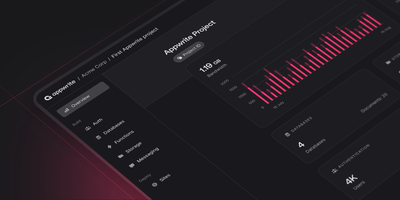
Backed by over 56,000 GitHub stars and a growing ecosystem of client and server SDKs covering Flutter, React Native, Swift, Kotlin, Python, Node.js, Deno, and more, Appwrite provides a complete backend platform that replaces Firebase and Supabase with a fully self-hostable architecture. The authentication module supports email and password, phone OTP, magic links, OAuth providers including Google, GitHub, Apple, and Facebook, anonymous sessions, and JWT token management with configurable session policies. The database service provides a document-oriented store with collections, indexes, query filters, pagination, and real-time subscriptions that push changes to connected clients instantly via WebSocket. The storage service handles file uploads with built-in image manipulation including cropping, resizing, format conversion, and compression, served through a CDN-ready URL structure. Serverless functions execute custom backend logic triggered by HTTP requests, scheduled cron jobs, or database events, with runtime support for Node.js, Python, PHP, Ruby, Dart, Swift, Kotlin, and Java. The messaging service enables push notifications, SMS, and email delivery through configurable providers including APNS, FCM, Twilio, Vonage, Mailgun, and Sendgrid. Team management with role-based permissions, webhook integrations, and health monitoring APIs complete the platform. The admin console provides a web-based dashboard for managing all services, monitoring usage metrics, and configuring project settings. Deployment runs via Docker Compose with MariaDB for metadata and configurable storage adapters. Running on a dedicated VPS on RepoCloud with guaranteed CPU, RAM, and SSD, full root SSH access, and a browser serial console. BSD 3-Clause licensed.
Crawl4AI
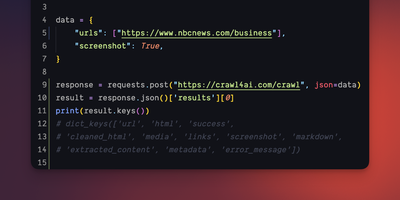
With over 77,000 GitHub stars, Crawl4AI is the most-starred open-source web crawler on GitHub and the go-to tool for converting the web into AI-ready data. Built on Python and Playwright, it transforms any website into clean Markdown with headings, tables, code blocks, and citation hints optimized for LLM ingestion, or extracts structured JSON via CSS selectors, XPath expressions, or direct LLM-based schema extraction through OpenAI, Anthropic, and Ollama providers. The self-hosted Docker server exposes a REST API on port 11235 with endpoints for crawling, streaming results, screenshots, PDF generation, JavaScript execution, and LLM-powered extraction. Version 0.9.x introduced secure-by-default operation with mandatory JWT authentication, strict request validation, declarative hooks replacing inline code, and bounded job queues. Adaptive crawling uses information foraging algorithms to determine when sufficient data has been gathered, while deep crawl mode traverses link graphs intelligently. The async browser pool manages concurrent sessions with stealth plugins, proxy rotation, custom headers, and session persistence for authenticated scraping. A built-in MCP server enables direct integration with Claude, ChatGPT, and Cursor for AI-driven web research workflows. Content filtering applies BM25 and TF-IDF relevance scoring to extract only pertinent sections from noisy pages. Running on a dedicated VPS on RepoCloud with guaranteed CPU, RAM, and SSD, full root SSH access, and a browser serial console. Apache 2.0 licensed.
AnythingLLM
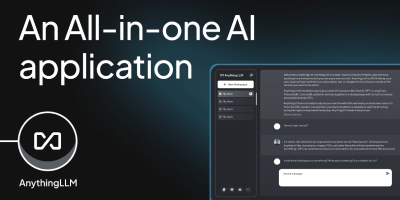
Chat with your own documents: AnythingLLM, from Mintplex Labs, wraps retrieval-augmented generation (RAG) in an open-source application anyone can run. You organize content into workspaces, each an isolated namespace with its own documents, vector embeddings, chat history, and settings, so one instance can hold several separate knowledge bases. Upload PDFs, DOCX, TXT, and other formats, or scrape web pages; the built-in collector parses and chunks them into a vector database (LanceDB by default, with Pinecone, Chroma, Qdrant, and others supported). Answers cite their source documents. It works with both cloud LLMs (OpenAI, Anthropic, Gemini) and local ones via Ollama or LM Studio, and the embedding model is separately configurable. Beyond RAG chat, it includes AI agents that can browse the web and run tools, an embeddable chat widget for your website, a developer API, and multi-user mode with admin, manager, and default roles plus per-workspace access control. Context assembly is smarter than naive RAG: pinned documents, attached files, vector search hits, and recent chat history are combined under a token budget so the model's context window is filled efficiently, and each workspace supports multiple independent conversation threads against the same knowledge base. Because the embedding model, vector store, and chat LLM are all independently swappable, you can move between providers without re-ingesting a single document. The stack is Node.js with a React frontend, MIT-licensed.
AppFlowy
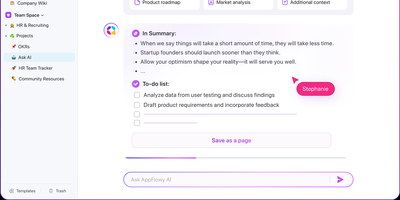
With over 75,000 GitHub stars and native apps across macOS, Windows, Linux, iOS, and Android, AppFlowy is the most widely adopted open-source alternative to Notion — delivering the same block-based workspace model with full data sovereignty. The Flutter frontend renders natively on every platform while a Rust backend powered by Actix-web and Tokio handles CRDT-based real-time collaboration, ensuring sub-second sync across devices with conflict-free concurrent editing. Relational databases support grid, board, kanban, calendar, and gallery views over the same dataset, with two-way relations, rollups, advanced filters, sorts, and formula calculations that cover the majority of Notion's database workflows. The block editor supports 40+ content types including nested pages, toggles, callouts, code blocks with syntax highlighting, embeds, and slash-command insertion. AI integration connects to OpenAI, Anthropic, or local models via Ollama for writing assistance, summarization, and translation — all without sending data off-premises when using on-prem LLMs. Team spaces with workspace-level and per-page permissions, OAuth and SSO authentication through GoTrue, and S3-compatible object storage via MinIO provide enterprise-grade access control and file management. The self-hosted stack deploys through Docker Compose with PostgreSQL for metadata, Redis for caching and pub/sub, and a dedicated background worker for imports and email notifications. Offline-first architecture ensures the desktop app functions without connectivity, syncing changes when the connection resumes. Running on a dedicated VPS on RepoCloud with guaranteed CPU, RAM, and SSD, full root SSH access, and a browser serial console. AGPL-3.0 licensed.
Utopia
The first open-source substrate for enterprise knowledge engineering that learns passively and governs itself. The Rust-built backend paired with PostgreSQL and pgvector delivers a bitemporal knowledge graph where every fact carries two timelines: when it held in the real world and when the system came to believe it — enabling full audit trail replay of how understanding evolved. Document ingestion handles PDF, DOCX, PPTX, XLSX, CSV, Markdown, HTML, and plain text with legacy encoding detection, while scheduled syncing pulls from web pages, RSS feeds, GitHub, Jira, Notion, WebDAV, and S3-compatible buckets. Search fuses Tantivy full-text indexing with pgvector semantic vectors using Reciprocal Rank Fusion, streaming answers with inline citations that link directly to source passages. The built-in agent harness drives agentic RAG through conversation — searching documents, walking the knowledge graph at any historical date, and querying mounted databases via Ontology2SQL which achieves state-of-the-art results on BIRD Mini-Dev benchmarks. Five ontology packs ship inside the binary (schema.org, W3C Org, PROV-O, FOAF, IOF Core) with forward-chaining reasoning for transitivity, symmetry, inverses, and relation hierarchy. Entity resolution operates in three stages: exact name matching, embedding similarity, then model-based judgment with every merge reversible. Any OpenAI-compatible endpoint works including DeepSeek, Qwen, Ollama, and vLLM for fully air-gapped deployment. Running on a dedicated VPS on RepoCloud with guaranteed CPU, RAM, and SSD, full root SSH access, and a browser serial console. Apache-2.0 licensed.
Ubuntu VPS
A minimal Ubuntu 24.04 LTS virtual private server — no pre-installed applications, no opinionated configuration, just the operating system and root access. Start from a clean slate and install exactly what you need: web servers, databases, development toolchains, CI runners, monitoring stacks, VPN endpoints, game servers, or anything else that runs on Linux. The server ships with apt package management, systemd service supervision, and standard networking configured out of the box, giving you access to over 36,000 packages in the Universe repository alone. Connect via SSH with the key you select during deployment; a dedicated IPv4 address is included with every server at no extra charge. A browser-based serial console in the RepoCloud dashboard provides emergency access without an SSH client. Snapshots let you capture the server state before risky changes and roll back with one click. Resize CPU and RAM on demand without reinstalling. Canonical's standard security maintenance covers this LTS release through May 2029 — five years of patches for the Main repository. Ubuntu Pro extends that to ten years with additional Universe coverage, kernel livepatching, and compliance tooling, available free for up to five machines.