Pollen
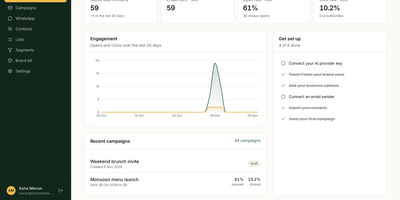
Sending regular email and WhatsApp campaigns without a copywriter starts with Pollen learning the business's voice from its website or writing samples, then drafting emails and replies in that tone. Compose takes a goal, a brief, a link, and a length, then returns three subject lines, preview text, and a body. A second model pass scores each draft, and a weak one is revised once. Rule checks catch spam phrases and a missing postal address. Contacts import from CSV. Segments come from rules over tags, source, email domain, and recent opens or clicks, or from a plain-English request the AI turns into rules. Emails carry signed tracking links and one-click unsubscribe. Campaign reports show delivered, opened, clicked, click-to-open, unsubscribed, and top links. A connected WhatsApp Business number adds a shared inbox that respects the 24-hour reply window, with AI-drafted replies, auto-replies, and template broadcasts to a list or segment. Many businesses can share one install, each in a workspace with its own team, keys, and data, plus a platform console for tenants and usage. Businesses bring their own OpenAI, Anthropic, or Gemini key and their own AWS SES or SMTP sender, and pay those providers directly. Seeding adds a demo café with 64 fictional contacts, a sent campaign, and three WhatsApp threads to browse before any key is added. Running on a dedicated VPS on RepoCloud with guaranteed CPU, RAM, and SSD, full root SSH access, and a browser serial console. MIT licensed.
Aperture Chat
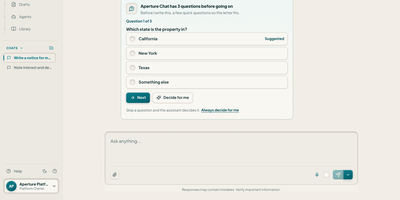
Aperture Chat is one governed workspace where chat, documents, slide decks, spreadsheets, agents, and automations draw on the same approved models, knowledge, and access rules. Choose any model or agent you are allowed to use and the answers arrive with citations from attachments, knowledge bases, and web search, plus a work trace of the research steps behind them. When a request is vague, the reply pauses to ask up to three multiple-choice questions. Replies keep running on the server after you close the tab, and if the chosen model fails, a similar one takes over and the trace names it. Drafts handles documents, slide decks, and spreadsheets with an assistant alongside, a Check panel that flags blanks and undefined terms, live co-editing, saved versions, and export to Word, PowerPoint, Excel, or PDF/A. New drafts start private. Agents bundle instructions, a model, knowledge, tools, and prompts, and automations run them on a cron schedule into a fresh chat or draft. Knowledge bases take uploads, web pages, synced folders, and cloud drives, and an ethical wall fences a file to one group. Administrators get single sign-on, SCIM, audit trails, retention rules, and a setting that keeps Social Security and card numbers away from the model. It suits legal and professional-services teams, and IT groups rolling out AI across an organization. Running on a dedicated VPS on RepoCloud with guaranteed CPU, RAM, and SSD, full root SSH access, and a browser serial console. MIT licensed.

Something
By the time you sit down each morning, your AI coworker can have read the inbox, checked the store for stuck orders, and drafted a plan for the day. You reach the same coworker in a web workspace, Chrome's side panel, Telegram, or Slack, and its memory follows you between them. A first-login interview learns what the company does, shows what it found online for you to fix, and proposes a starter plan of tools and routines. Memory keeps one fact per thing, tied to its source conversation; corrections add dated remarks, and outdated facts are struck through beside their replacements. Routines cover standing chores, from hourly inbox scans and stuck-order checks to weekly ad reviews and meeting prep, and a Marketplace tab suggests more for each connected tool. Tasks live on a list or board with owner, priority, and deadline. Skills are markdown playbooks you can edit in the browser. Dozens of services connect through a sign-in popup or a pasted key, among them Notion, Stripe, Linear, Shopify, and Google Workspace. It asks before anything goes out. In team mode, each person gets private files, memory, and routines, the board stays shared, and hand-offs reach teammates where they will see them. Claude Code or Codex can ask the coworker about the business and write back only after confirmation. Running on a dedicated VPS on RepoCloud with guaranteed CPU, RAM, and SSD, full root SSH access, and a browser serial console. AGPL-3.0 licensed.
LLMxRay
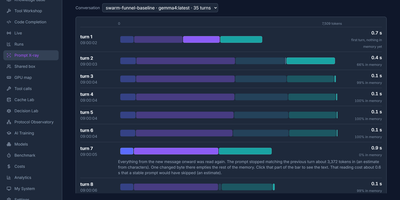
Point VS Code Copilot, Open WebUI, Continue, n8n or your own agent at LLMxRay instead of Ollama, and every turn shows what the cache kept, what was read again and what the daemon silently cut. Prompt X-ray draws each turn to scale, colored by part (system prompt, tool schemas, earlier turns) and dimmed where the model already remembered it. Runs lays one agent's calls out as a waterfall of waiting, loading, prompt reading and answering, with the tool time between them. Shared box names the tool that slowed the others and the setting to change. The GPU map shows what sits in video memory and which pulled models still fit. Tool calls scores a model on thirteen request shapes agents send, and Cache Lab finds the value that breaks the prompt cache and measures the fix. Chat colors each streaming token by the model's own probability, Compare streams up to four slots side by side, and Surgical Benchmark scores models on real token logprobs. A Knowledge Base searches PDF, DOCX, Markdown and CSV files, and Code Completion fills the gap between prefix and suffix. A read-only MCP server lets an agent diagnose its own calls. Turns can flow on to Jaeger, Phoenix, Langfuse or Grafana as OpenTelemetry spans, and nothing leaves the machine unless you send it. Running on a dedicated VPS on RepoCloud with guaranteed CPU, RAM, and SSD, full root SSH access, and a browser serial console. Apache-2.0 licensed.
Grafana Lookout
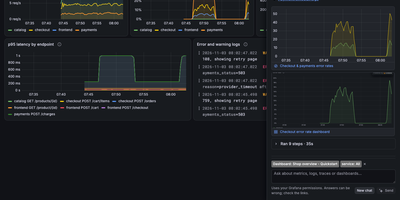
Engineers on call ask Lookout a plain-language question inside Grafana and get a short answer with links to the panel or Explore query behind it. Ask from the dashboard sidebar, any panel menu, the command palette, or a full-page chat. Explain with AI on any panel says what changed, and when. Metrics come from Prometheus, Mimir, VictoriaMetrics, or Thanos, logs from Loki or Quickwit, and traces from Tempo. Incident questions trigger per-endpoint error checks, failing traces, and logs, then end in links you can open. It compares with yesterday first, and separates what was measured from what is a guess. Ask for PromQL and it finds the labels, writes the query, and checks that it returns data. Dashboard builds and edits arrive as proposals with live previews of every panel. Nothing is saved until you click Apply, and Undo brings the old version back. Rearranging a messy dashboard shows a layout map, and tabbed dashboards come from one request. Every tool runs in the browser as the signed-in user, and tools only read. The setup page tests that the chosen model can call tools. Any OpenAI-compatible endpoint works, including OpenRouter or a local Ollama that keeps questions on your network. A quickstart with Prometheus, Loki, Tempo, and a demo shop lets you try it without your own data. Running on a dedicated VPS on RepoCloud with guaranteed CPU, RAM, and SSD, full root SSH access, and a browser serial console. Apache-2.0 licensed.
Mandate
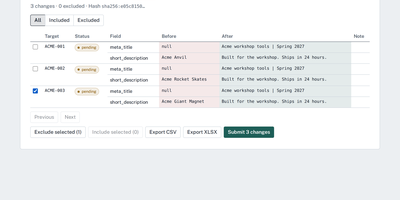
Let Claude or ChatGPT propose changes to your online shop, issue tracker, or internal APIs, and Mandate makes sure a person approves the exact before-and-after list before a single record is written. Requesters can exclude records or export the list as CSV or XLSX, while the approver's page is rendered by the server from stored data, never from text the model wrote. Approval rules depend on record count and role, chains can have several steps, and nobody approves their own request. Roles default to deny: an operation no role grants is never listed to the client, grants can pin an argument such as one brand, and fields like cost stay hidden. Approved changes are applied in batches by a durable workflow that survives restarts, and rollback restores the values recorded before the write. Any REST API with an OpenAPI document or any MCP server attaches without code, and presets for Magento 2 catalogs and Gitea issues ship ready to use. Typical uses include bulk shop edits, issue triage, read-only lookups for support staff with sensitive fields removed, and nightly automation that proposes while a person approves. One endpoint, one login, and one audit log with JSON Lines export serve every connected client, and credentials stay in an encrypted vault the model never sees. Running on a dedicated VPS on RepoCloud with guaranteed CPU, RAM, and SSD, full root SSH access, and a browser serial console. Apache-2.0 licensed.
Helpdock
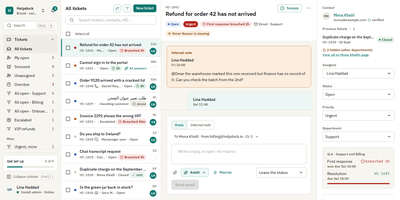
With Helpdock, every brand you run gets its own inboxes, help center and chat widget on one install, plus an AI assistant that answers only from that brand's own knowledge. Email over IMAP or webhook, Telegram, WhatsApp, Messenger, Instagram, a web form and the REST API all land in the same tickets, with shared statuses, assignment and rules. Agents work from saved views, internal notes, macros and a keyboard-first inbox, and a collision warning appears when two people open the same ticket. SLA clocks follow business hours, holidays and time zones, and pause in the statuses you pick. Workflow rules can be test-run before going live, and a CSAT survey goes out when a ticket closes. The help center publishes articles in English and Arabic on each brand's own domain, with right-to-left layouts and search in both languages. The assistant cites its sources, hands the chat to a person when the knowledge base has no answer, drafts articles from closed tickets and suggests replies to agents. Importers for Zendesk, Freshdesk and Zoho Desk bring history across without messaging a single customer. Staff sign in with passkeys, two-factor codes or SAML and OpenID Connect single sign-on. Running on a dedicated VPS on RepoCloud with guaranteed CPU, RAM, and SSD, full root SSH access, and a browser serial console. AGPL-3.0 licensed.
SocialCoach
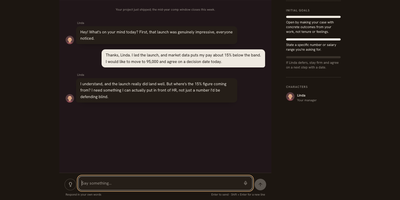
Asking for a raise, declining extra hours, or setting a boundary with a friend can all be rehearsed first in SocialCoach, an AI coach built for the conversations people dread. Pick one of 63 scenarios across seven areas of life, or describe your own situation, and talk to a character who has real goals, doubts, and limits, so politeness alone does not win the argument. A stance meter shows how firmly the other person holds their position as you speak, and optional timed replies add pressure for readiness practice. The debrief quotes what you actually said before judging it, separates communication quality from the outcome, and suggests one thing to change on the next attempt. A Today page recommends a daily scene from your goals, Growth tracks practice history against five competencies, and a Learn library offers short videos, theories, and cases with sources. Step into 3D dinners, elevator lobbies, and offices to answer by typing or speaking. Practice history stays in the browser and can be exported, with no sign-up needed, and the mobile-first layout installs as an app on a phone. Settings accept your own Anthropic or OpenAI-compatible model, or a server key, so a self-hosted copy runs on any gateway. English and Simplified Chinese are both built in. Rehearse a hard conversation three times here and the real one feels smaller. Running on a dedicated VPS on RepoCloud with guaranteed CPU, RAM, and SSD, full root SSH access, and a browser serial console. Apache-2.0 licensed.
Remyral
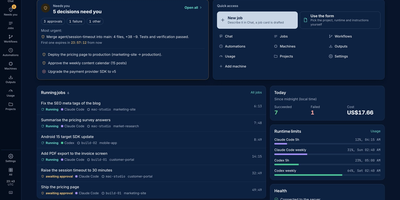
Remyral is a self-hosted control plane that runs Claude Code, Codex, Pi, and OpenCode across your own machines, with a shared queue, approvals, and an audit log. Requests start in chat, where the assistant drafts a job card that you approve, edit, or dismiss; plan mode writes phases and open decisions first and changes nothing until you approve the plan. The queue places each job on a Linux, macOS, Windows, or Docker worker by capacity, disk state, and required runtime, and the project's sandbox applies a network policy of off, allow-list, or web. Workflows mix agent steps with conditions, loops, HTTP calls, code, and approval nodes, started by a schedule, a signed webhook, or the API. A shared memory of rules, facts, decisions, and lessons reaches every runtime the same way, and lessons that agents propose wait for a person to accept them. Three security presets decide which actions need a person plus an authenticator code, and privileged actions land on a hash-chained audit log. Software jobs end as pull requests on GitHub, GitLab, or Bitbucket, with a merge decision and a deploy through Coolify or Cloudflare Pages, while usage and cost are tracked per runtime and account. Transient failures retry on another machine, and jobs that hit a usage limit wait for the window to reopen. Running on a dedicated VPS on RepoCloud with guaranteed CPU, RAM, and SSD, full root SSH access, and a browser serial console. Apache-2.0 licensed.
Agents Platform
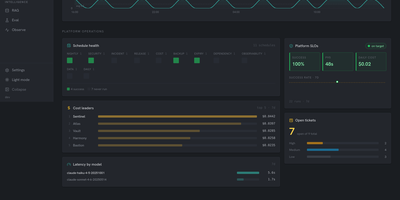
Twenty ready-made AI agent personas, a scheduler, a pipeline builder and a ticket board share one dashboard in Agents Platform, so recurring operations audits run, get summarized and turn into tracked work. Each agent carries a system prompt, skills in the SKILL.md format (adopted from the Anthropic skills catalog or imported by URL), MCP tool servers provisioned into SSH runs, and memories distilled from earlier results. Work runs in parallel, in sequence or as structured meetings, through conditional DAG pipelines or saved crews, on cron schedules or from inbound webhooks such as Prometheus alerts, git pushes and n8n flows. Execution happens over SSH on a host with Claude Code, through the Anthropic API, or against any OpenAI-compatible endpoint including local Ollama models. On SSH runs every tool call streams live into a step timeline, safety tiers stop read-only agents from writing files, supervised runs wait for approval, and scoped API keys guard the trigger endpoints. Recurring runs fuse into Combined Reports with a health score and metric trends, critical verdicts open tickets on a Kanban, Table or Gantt board, and Discord announces results. Cost, latency and SLO dashboards show per-agent spend, while eval suites with LLM-as-judge scoring and prompt A/B tests promote better prompts. A demo mode seeds weeks of sample history so everything can be explored without an API key. Running on a dedicated VPS on RepoCloud with guaranteed CPU, RAM, and SSD, full root SSH access, and a browser serial console. MIT licensed.
Mynah
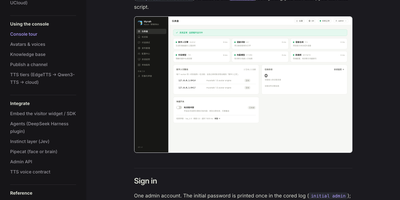
A visitor clicks your link and a face is already there, listening, answering within a fraction of a second, and stopping the moment they interrupt, because Mynah runs live digital humans in the browser instead of playing back rendered video. Underneath, cored takes WebRTC offers, runs the conversation through your chosen language model, speech recognition, and text to speech, and drives a lip synced avatar engine such as MuseTalk, FlashHead, or Wav2Lip, with a semantic end of turn model deciding when a person has finished speaking. The admin console is where you shape the experience: bake a new avatar from a talking video with explicit consent, clone or audition voices, swap avatars per channel without cold starts, and tune green screen keying and gestures live in the playground. Knowledge bases take your documents through ingestion and embedding so answers ground in your material, with retrieval tests before anything ships. Publishing freezes a model, voice, and knowledge snapshot into a channel: a shareable link with token, domain, or CIDR access control, its own branding, and a concurrency cap drawn from an engine pool that computes how many workers your VRAM can hold. Session monitoring shows who is connected and lets you kick a session, health checks watch every dependency, and light and dark themes with Chinese and English interfaces cover both console and visitor pages. Running on a dedicated VPS on RepoCloud with guaranteed CPU, RAM, and SSD, full root SSH access, and a browser serial console. Apache-2.0 licensed.
Nerla
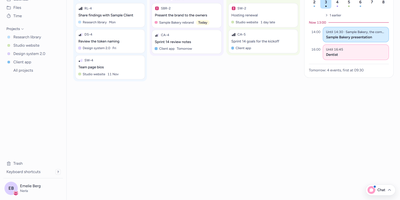
Your team's tasks, calendar, chat, video calls, documents, whiteboards, files, and time sheets all live in Nerla, a workspace with an AI teammate and a pink cat mascot. Home shows tasks from all projects as a board or list beside today's events. Ctrl K jumps to any task, project, file, or teammate. Projects bring their own members, board, chat, and files; tasks carry a status, priority, assignee, due date, and a short number like WEB-12. The calendar handles repeating events, guests, out-of-office days, and working hours, and a team view lines up everyone's week. Chats cover direct messages, groups, and one per project, and any can start a video call with screen sharing and a lobby for outside guests. Papers and whiteboards are edited live by several people and sit in the same folders as files, which can be shared by outside link. The AI teammate acts only as you, answers wherever you mention it, and asks before changing what others see, at a caution level the admin sets. Ollama, OpenRouter, or any model that speaks the OpenAI chat API with tool calling can power it, and outside agents like Claude Desktop connect over MCP. Nothing phones home. A setup script installs the stack and HTTPS, then prints the code that makes your first account the admin. Others join by invite link. Running on a dedicated VPS on RepoCloud with guaranteed CPU, RAM, and SSD, full root SSH access, and a browser serial console. MIT licensed.
Trina AX
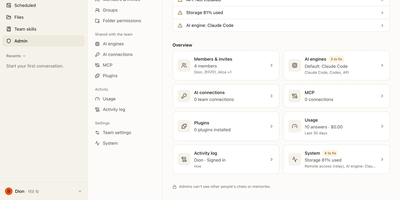
Trina AX is a self-hosted AI workspace where your team chats with real Claude Code and Codex agents that work from your company's own folders, so answers arrive in your formats, with your figures, in your house style. Picture the first morning of a new hire: she asks for a client proposal, and the draft that comes back already reads like the team lead wrote it, because the agent found the same templates and numbers everyone else uses. Admins stock shared, group, and project folders once; everyone else just opens a browser chat on desktop or phone and asks. Nothing leaks sideways in the process, since every file an agent opens is permission-checked as the person asking, and a folder someone cannot see does not exist for their agent in answers, search, previews, or trash. The know-how that makes answers sound right becomes SKILL.md playbooks, governed like ordinary files, and the agent asks a person before editing one. Agents can run up to 150 tool rounds per answer, search the web, spawn sub-agents, and follow scheduled tasks, while admins read an activity log of files touched, never the private conversations themselves. Bring the company Claude or OpenAI account, set per-person usage limits, or route through an Anthropic-compatible gateway to models such as DeepSeek, Kimi, or GLM. Running on a dedicated VPS on RepoCloud with guaranteed CPU, RAM, and SSD, full root SSH access, and a browser serial console. AGPL-3.0 licensed.
lastGLANCE
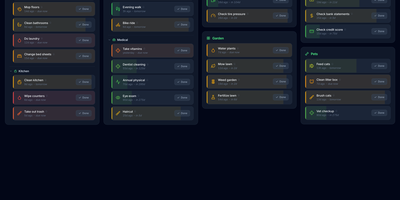
Green means handled, amber means soon, red means overdue: lastGLANCE turns recurring chores and neglected catch-ups into one recency dial you can read at a glance. Add a chore once, set how often it should happen, and its color ages from fresh green through amber to red as days pass, with overdue items floating to the top on their own. Mark a job done and the timer restarts; backdate the entry when you finished it yesterday but only remembered to log it today. Seasonal work hides outside its active months, categories and subcategories arrange into a masonry board, and reminders fire when something crosses its due line. Each chore keeps its own statistics, average interval against target, and a timestamped history with notes, and a contribution-style heatmap in the header charts your whole completion record. People get the same treatment: circles for family, friends, and work contacts show when you last reached out, who usually initiates, and which birthdays arrive in the next thirty days. Households share chores with assignments and a Mine view, everything works offline as an installable PWA, and optional WebDAV or Nextcloud sync merges changes without conflicts under optional end-to-end encryption, with hourly, daily, and weekly remote backups. Running on a dedicated VPS on RepoCloud with guaranteed CPU, RAM, and SSD, full root SSH access, and a browser serial console. MIT licensed.
Etude
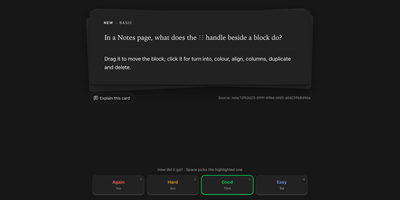
Because every flashcard is a small program, Etude can ask for a fresh calculation on each review, play a chord on a piano, pose a chess puzzle, or grade a proof by what you wrote. A card is graded by self rating, by a script, by AI that explains what you missed, or by a hybrid that hands the hard cases to the model. Math answers are compared by equivalence, so x(x+1) matches x^2+x. FSRS-6 schedules the reviews. Give a deck an exam date and every card is pulled in before the day. Anki .apkg decks import with their review history. The Market installs shared decks, card types, and themes, and an in-app editor with live preview lets you design your own. Notebook pages hold equations, runnable code, canvases, kanban boards, and a link graph. The Ask assistant builds decks from your notes or a PDF. Every action is also a CLI command with JSON output, so Claude Code or Codex can quiz you and flag weak topics, and an MCP server opens your collection and notes to them. AI grading stays off until you add an API key or sign in with ChatGPT, and any address other than localhost requires an access token. Running on a dedicated VPS on RepoCloud with guaranteed CPU, RAM, and SSD, full root SSH access, and a browser serial console. AGPL-3.0 licensed.
Teleharness
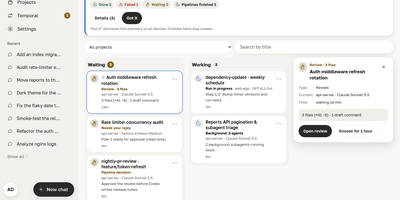
From any phone browser, Teleharness lets you chat with Claude Code, Codex, Gemini, and opencode, approve their plans, and review their diffs while the real CLIs keep working where your code lives. A board gathers every chat and pipeline into Waiting for you, Working, Done, and Failed, topped by a summary of what happened while you were away. Tap lines in a diff to leave draft comments, send structured feedback to the agent, or accept and commit. Turn on Plan first and the agent writes a read-only plan, then waits for your approval before touching a file. Each chat or pipeline run can get its own git worktree, with file overlaps and dry-run merge conflicts flagged early. Hit a usage limit mid-task? Continue the same chat on another CLI or model with one tap, or let the server hand it over automatically. A cost ledger prices every turn at API rates and compares it with your real subscriptions, showing savings, payback multiplier, and monthly budgets. Chain agents into pipelines where Claude reviews, you approve from the phone, and Codex writes release notes; runs survive restarts and resume from any step. GitHub issue labels, comment commands, and failing CI can start those pipelines and open draft pull requests. Full-text search finds any old conversation. Pair a phone with a one-time QR code. Running on a dedicated VPS on RepoCloud with guaranteed CPU, RAM, and SSD, full root SSH access, and a browser serial console. MIT licensed.
intentic
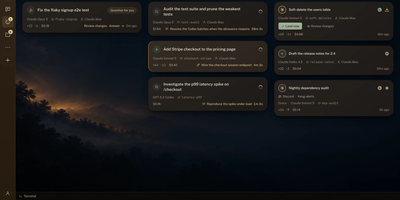
Claude Code, Codex, Cursor and Gemini work side by side in one intentic workspace, each on its own git worktree, and nothing lands until you have read the diff. Each agent reads the code and writes a plan first; you approve it or reply to keep planning, with a permission mode from plan-only to fully automatic per turn. One board sorts agents into Attention, Active and Finished lanes and prints the model, branch, diff size and cost on every card. Finished work waits on its branch with the agent's own report. Read it file by file, then land it or discard it. A background service on your own machine or server does the work, so closing the browser stops nothing and any phone reopens the same board. Agents can run on the Claude, ChatGPT, Cursor, Google, Grok, Kimi or Z.ai plans you already pay for, or on a local model, with one usage page for every plan's limits. Capabilities connect GitHub, Sentry, Stripe, Discord, SSH, a VPN and any MCP server, and automations start an agent on a schedule, a push, a failed pipeline or an email. Owners invite people by email and give each a tier from guest to maintainer, and landing work is reserved for maintainers and the owner. Running on a dedicated VPS on RepoCloud with guaranteed CPU, RAM, and SSD, full root SSH access, and a browser serial console. MIT licensed.
KeiRouter
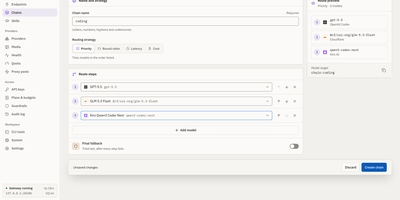
One endpoint, 130+ models from 90+ providers: KeiRouter is a self-hosted AI gateway, so apps, coding tools, and agents connect once and stop juggling provider keys. Your code speaks OpenAI Chat, OpenAI Responses, Anthropic Messages, or native Gemini, and KeiRouter translates to whichever upstream you want, including AWS Bedrock, Azure AI Foundry, Vertex, Snowflake Cortex, and self-hosted runtimes like Ollama and vLLM. Fallback chains keep requests moving when a provider goes down or hits a rate limit, using priority, round-robin, latency, or cost ordering, so coding sessions do not stop mid-task. Five token savers compress prompts on the way in and trim responses on the way out, with a live dashboard showing savings recovered. A response cache answers repeated prompts instantly for zero marginal cost, with optional semantic matching. Per-key budgets and rate plans set USD, token, RPM, and concurrency limits with auto-cutoff, stopping surprise bills. Guardrails scan for PII, prompt injection, toxicity, and banned topics at global, provider, model, chain, and key scopes, with a monitor showing what got blocked and what it cost. The dashboard tracks usage by provider and model, latency, a live console tracing each request through its fallbacks, and provider health. You can import from 9router or OmniRoute, white-label the portal for your team, and run replicas on Postgres and Redis for high availability. Running on a dedicated VPS on RepoCloud with guaranteed CPU, RAM, and SSD, full root SSH access, and a browser serial console. MIT licensed.