MikoPBX
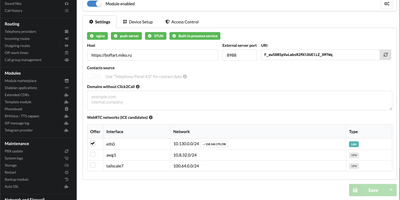
MikoPBX gives a small business a complete phone system on a server it controls, with extensions, call queues, IVR menus, and call recording instead of per-seat hosted PBX fees. Follow a call through it: incoming rules per provider match exact numbers or patterns, fall through by priority when nobody answers, and end at a default route. Each employee gets an extension with SIP credentials, forwarding for no-answer, busy, and unavailable states, and an optional recording switch. Queues offer seven distribution strategies, including Ring All, Least Recent, Fewest Calls, and Memory Hunt, and can announce each caller's position and estimated wait. IVR menus play a recorded greeting, route keypad choices to departments or extensions, and fall back to a default number after a set number of retries. Call history filters by caller, destination, or DID, flags missed calls in red, and plays or downloads recordings as WebM, MP3, WAV, or OGG. Voicemail, call transfer, call pickup, and a holiday and night-time switcher serve daily needs, while free and paid marketplace modules, among them a softphone, auto dialer, and LDAP/AD sync, handle the rest. A firewall, Fail2Ban, passkey sign-in, and CrowdSec integration protect the system, and a REST API with more than 250 endpoints lets other tools manage it. The interface speaks 26 languages. Running on a dedicated VPS on RepoCloud with guaranteed CPU, RAM, and SSD, full root SSH access, and a browser serial console. GPL-3.0 licensed.
QBitWebUI
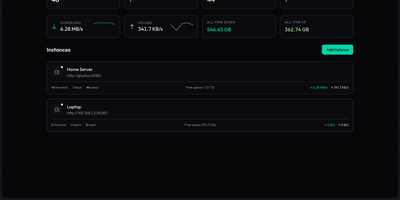
QBitWebUI is a single self-hosted dashboard that manages every qBittorrent instance you run, whether that is one seedbox or five, from one place. Instance cards show each client's status, live speeds, and torrent counts, with aggregate statistics across all of them and quick switching between instances. The torrent list brings sortable, resizable columns you can reorder and hide, filters for status, category, tag, and tracker, multi-select bulk actions with a context menu, and a details panel covering trackers, peers, files, and web seeds. Search your Prowlarr indexers from inside the UI and send results straight to the right instance, then let RSS feeds with regex auto-download rules keep recurring releases flowing in unattended. Browse the downloads directory and pull finished files or whole folders as tar archives, run an automatic cross-seed pass to match torrents across trackers, and check the connection with the network agent's speedtest, IP check, and DNS diagnostics. Edit qBittorrent preferences directly from the settings tabs, pick a color theme, and keep working from your phone with the installable PWA and mobile view. Running on a dedicated VPS on RepoCloud with guaranteed CPU, RAM, and SSD, full root SSH access, and a browser serial console. MIT licensed.
Bisibility
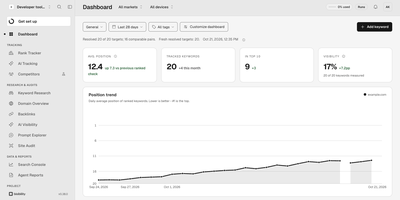
Bisibility puts your Google rankings, keyword research, and backlink profile in one application that runs on your server instead of behind a per-seat subscription. Track every keyword by market and device, watch positions move over time, and open the stored snapshot of the actual results page behind any check to see exactly what Google showed. Alerts flag the movements that matter, while competitor share of voice shows whose visibility is growing at your expense. The keyword explorer surfaces suggestions with search volume, trends, cost per click, difficulty, and intent, and shows the estimated price before a lookup runs, so research never surprises your wallet. Backlink and domain views break down referring domains, anchors, and new and lost links next to estimated traffic and top pages for any site you type in. Search Console clicks, impressions, and queries are kept beyond the usual retention window, and a recurring prompt tracker follows how AI answer engines cite your brand over time. Results flow outward through a versioned API, MCP access, signed webhooks, and CSV exports. Running on a dedicated VPS on RepoCloud with guaranteed CPU, RAM, and SSD, full root SSH access, and a browser serial console. AGPL-3.0 licensed.

Scrob
Scrob is your own private Letterboxd and Trakt: it syncs Jellyfin, Plex, and Emby libraries, tracks every movie and episode you watch, and keeps ratings and lists on your server. Connect Jellyfin, Plex, Emby, Nuvio, ARVIO, or Stremio and Scrob imports libraries, watched status, and playback progress, then pushes watched state and ratings back to keep every server aligned. Webhooks from Jellyfin, Plex, and Emby and the scrob-kodi addon mark items watched the moment playback finishes; a manual scrobble starts a live session from any title page. Rate titles on a ten point scale, score seasons separately, add reviews, and log repeat plays with their own dates. Personal lists stay private or open to other users on your instance, comments attach to titles, seasons, and episodes, and following users surfaces their ratings and activity. TMDB powers discovery: trending titles, genre and provider filters, release schedules, and search across people and collections merged with your library. Detail pages combine posters, cast, trailers, and your files' quality details, and one click sends a missing title to Radarr or Sonarr. Continue Watching and Next Up cards, a fifteen day episode calendar, and Pick a Movie or Pick a Show suggestions answer what to watch next. Trakt, Simkl, and MDBList sync moves history and ratings in both directions. Running on a dedicated VPS on RepoCloud with guaranteed CPU, RAM, and SSD, full root SSH access, and a browser serial console. GPL-3.0 licensed.

Hammond
When Clarkson, the once-popular fuel logger, stopped receiving updates, Hammond stepped in as its logical successor - a self-hosted vehicle expense tracker. Written in Go with a Vue.js interface and SQLite storage - a single lightweight container, no external database - it tracks every cost your vehicles generate: fuel fill-ups with cost, volume, and odometer readings; maintenance and repairs; and arbitrary other expenses, each attachable with photos and documents stored against the vehicle. The multi-user, multi-vehicle design is what sets it apart from phone apps: a household or small business adds all its vehicles and all its drivers, shares vehicles across users, and every fill-up lands in one ledger no matter who was driving. The Quick Entries feature respects how expenses actually happen - snap a photo of the receipt or pump screen at the gas station, then complete the structured entry later when you have a minute. Reporting works at both the vehicle level (cost per distance, fuel economy trends) and across the whole fleet. Migration matters here: importers for Clarkson, Fuelly, and Drivvo bring years of fill-up history along, so switching does not mean starting your data over.
REI3
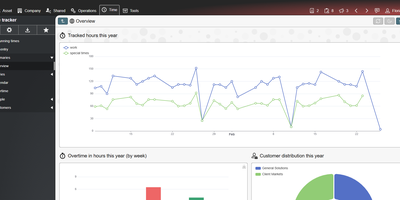
Replace the spreadsheet that quietly runs your department with a proper multi-user application that you design in a browser with REI3, a self-hosted low-code platform. Authors define their data model once, then assemble forms, lists, calendars, Gantt plans, Kanban boards, and charts around it, with form states that show, hide, or require inputs as a record moves through its workflow. Calendars create records from a drag-selected time range, Kanban cards change state by drag and drop, and bulk-update forms edit hundreds of records at once. Phones scan barcodes and QR codes through the camera, and signature pads capture drawings. Roles and record-level access policies decide who sees what, sign-in runs through LDAP, OpenID Connect, or multi-factor authentication, and end-to-end encryption keeps selected fields unreadable even to administrators. REST endpoints work in both directions, ICS feeds publish calendars, CSV moves data in bulk, and IMAP and SMTP accounts connect applications to email. A drag-and-drop PDF editor produces letterheads, labels, and documents with signatures and barcodes. More than a dozen free ready-made applications, including tickets, time tracking, IT assets, a password safe, and a CRM, install from the admin panel. Running on a dedicated VPS on RepoCloud with guaranteed CPU, RAM, and SSD, full root SSH access, and a browser serial console. MIT licensed.
Wavelog
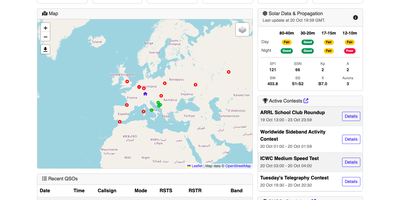
Whether operating from a home shack, a portable Parks on the Air activation, or a multi-operator club station, Wavelog gives amateur radio operators a browser-accessible logbook for recording and confirming QSO contacts from anywhere. Real-time transceiver frequency and mode data flow directly into the Live QSO logging interface from Hamlib, FLRig, and WSJT-X through the companion WavelogGate helper or REST API endpoints. An integrated DX Cluster and visual band waterfall display active spots filtered by continent, band, and DXCC status so operators can click a spot and QSY their rig immediately. Built-in two-way synchronization handles QSL confirmations and log uploads across Logbook of The World (LoTW), eQSL, QRZ.com, HRDLog, ClubLog, and the QO-100 DX Club alongside ADIF 3.1.8 and Cabrillo file imports and exports. Interactive Maidenhead grid maps, satellite pass tracking, and automated progress matrices for over 20 international awards (including DXCC, WAS, WAC, WAZ, IOTA, SOTA, POTA, and WWFF) show exactly which bands and modes still need confirmation. Dedicated contest logging windows and role-based club station permissions let teams work the same event simultaneously without log conflicts. Running on a dedicated VPS on RepoCloud with guaranteed CPU, RAM, and SSD, full root SSH access, and a browser serial console. MIT licensed.
Eclipse Kura
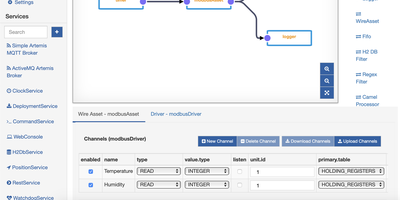
Between the factory floor and the cloud sits a gateway that has to speak Modbus to a PLC, OPC-UA to a machine, and MQTT to your platform, and Eclipse Kura is the framework that runs that gateway as a managed, programmable container. Drivers encapsulate each field protocol and its settings, while Assets model the data channels of attached devices, giving every sensor and controller a uniform mirror that applications can read, write, and publish. Kura Wires turns edge logic into a diagram: drag an asset onto the canvas, wire it through timers, filters, and SQL-based aggregation, and publish the result to the cloud, installing extra components from the Eclipse Kura Marketplace when the palette runs short. Telemetry survives bad networks because the data service stores messages locally and forwards them when the connection returns, with publishing policies abstracting the underlying MQTT transport. Administrators manage the whole gateway from the web console: network interfaces, firewall, installed bundles, snapshots of the full configuration that can be exported and restored, and remote deployment and upgrade of applications through the cloud connection. Hardware services expose serial ports, USB, Bluetooth, GPS position, GPIO, I2C, and a watchdog that resets the system when a critical component stops reporting. Running on a dedicated VPS on RepoCloud with guaranteed CPU, RAM, and SSD, full root SSH access, and a browser serial console. EPL-2.0 licensed.
Ocular
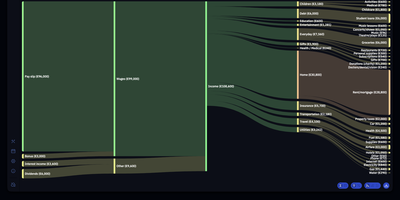
Ocular provides a modern personal finance workspace that plots your household income and expenditures across multi-year horizons to eliminate surprises in annual budgeting. Users can define custom income streams, configure recurring fixed obligations like rent and utilities, and allocate discretionary spending allowances into designated category groups. Interactive Sankey diagrams and cumulative balance curves visualize projected net savings trajectories, signaling upcoming cash crunches months in advance. The annual planning matrix breaks down monthly figures across twelve periods, calculates automatic net savings, and highlights active fiscal cycles. Keyboard shortcuts accelerate data entry with inline arithmetic expression evaluation directly inside currency cells. Built-in multi-currency conversion and localization settings allow international households and remote professionals to manage diverse revenue streams effortlessly. A dedicated privacy mode masks sensitive monetary amounts when working in public spaces, while complete ledgers export cleanly as portable JSON archives. Running on a dedicated VPS on RepoCloud with guaranteed CPU, RAM, and SSD, full root SSH access, and a browser serial console. MIT licensed.
Bex
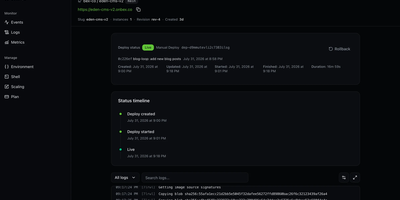
To give engineering teams a Render-style workflow of connecting a repository and getting a live HTTPS URL on infrastructure they control, Bex builds and runs web services, private services, background workers, cron jobs, and static sites from Git or container images. Dockerfiles and native builds for Node.js, Python, Go, Ruby, Rust, and Elixir deploy from public or private GitHub repositories with push-to-deploy, health checks, pre-deploy commands, and manual or policy-driven autoscaling. Blueprints in render.yaml format describe multi-resource environments in one file, and a Render-compatible CLI and API let existing tooling carry over where supported. Deploy history with cancel and rollback, live log tailing with search and filters, CPU and memory charts marked with deploy events, and suspend, resume, restart, native SSH, and browser shell controls cover daily operations. Custom domains receive automatic TLS certificates, and environment variables and secret files save and deploy in one step. Managed PostgreSQL provides backups with point-in-time recovery, high availability, and read replicas, and managed Valkey-compatible Key Value adds persistence and backups. Workspaces, projects, and environments come with OpenFGA roles, OAuth 2.1, API keys, audit logs, and signed outbound webhooks. Coding agents operate the same control plane through a remote or stdio MCP server with OAuth consent, deploy-from-chat, managed sandboxes, and structured machine-readable status, since no action is dashboard-only. Running on a dedicated VPS on RepoCloud with guaranteed CPU, RAM, and SSD, full root SSH access, and a browser serial console. Apache-2.0 licensed.
Para
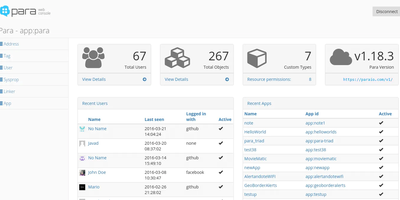
The name means steam in Bulgarian, and the job matches: Para is the boiler room that powers your application's backend so you never build one from scratch. You store plain JSON objects through a REST API and get them back persisted, indexed for full-text search, and cached on every write, without designing schemas or gluing three systems together yourself. One server hosts many applications at once, each with its own table, search index, and cache, so a client project, a side app, and an internal tool can share a single deployment without sharing data. Users sign in with social accounts, LDAP, or SAML and receive JSON Web Tokens, while resource permissions decide exactly which objects each client may touch. Queries go beyond key lookups: field, wildcard, geo point, and more-like-this searches all run against the same stored objects. Signed webhooks notify your own endpoints when data changes, and an MCP server lets AI assistants manage configuration, data, and search against the same backend. The admin Web Console handles users, objects, backups, and permissions from the browser, and client libraries cover JavaScript, PHP, Java, C#, Android, and iOS. Running on a dedicated VPS on RepoCloud with guaranteed CPU, RAM, and SSD, full root SSH access, and a browser serial console. Apache-2.0 licensed.

RSSMonster
Staying on top of hundreds of RSS feeds is impossible when every reader just dumps articles in chronological order. RSSMonster takes a different approach: it evaluates, scores, and prioritizes every article so the signal rises above the noise. The three-pane reading interface automatically marks articles as read when you scroll past them, while the built-in quality scoring engine rates content by freshness, originality, trust, and attention metrics. Compose advanced search expressions using field operators like star:true, quality:>0.6, hot:true, and date filters like @today or @lastweek, then save those expressions as persistent Smart Folders for one-click access to curated views. Semantic event clustering groups related articles across sources so you see one coherent story instead of fifteen duplicates. Connect your favorite mobile client through the Fever API (supporting Reeder for iOS) or the Google Reader API (compatible with News+, FeedMe, Vienna RSS, and ReadKit). The AI chat assistant powered by the Model Context Protocol lets you ask questions about your feed content and get summarized answers. Import your existing subscriptions via OPML, switch between light and dark themes, and install the app as a Progressive Web App for offline reading. On RepoCloud, deploy RSSMonster on a dedicated VPS with root SSH access, full data ownership, and persistent storage under the MIT license.
EdenText
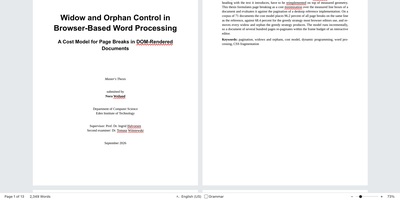
EdenText is a full word processor, from quick notes to full-length books, that opens the docx and odt files you already have and keeps them looking the way Word or LibreOffice made them. Pages are real pages: A4 or Letter sizes, margins, headers and footers, footnotes, columns, and watermarks, with mirrored margins and chapters opening on the right-hand page when you are laying out a book. Paragraph, character, table, and list styles cascade with inheritance and chapter numbering, and tables sort rows and compute spreadsheet-style formulas. The academic toolbox is complete: table of contents, captions, cross-references, citations with bibliography, an alphabetical index, and LaTeX formulas. Reviewing works the way editors expect, with tracked changes, threaded comments in margin balloons, printable markup, spell checking in eight languages, and grammar checking for English. An optional AI assistant answers questions about the document and proposes edits as tracked changes through your own model provider. Nothing waits on a server: documents autosave in the browser, the app installs and works offline, and your words never leave the machine. Running on a dedicated VPS on RepoCloud with guaranteed CPU, RAM, and SSD, full root SSH access, and a browser serial console. AGPL-3.0 licensed.
Paaster
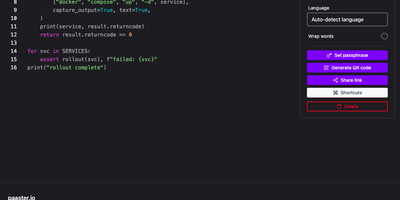
Paaster is the pastebin for snippets too sensitive for a public paste site: every paste is encrypted in your browser before upload, so the server only ever stores ciphertext it cannot read. Paste code or logs and the text is sealed with libsodium the moment you stop typing, with the secret riding in the link fragment that browsers never send to a server. Share the link and only its holder can open the paste; share it as a QR code, or beam it to your other device with a five-minute code using Send to device. Set a paste to delete after its first view or after a chosen time, protect it with an access code, and let automatic language detection syntax-highlight the result. Your own pastes stay browsable in a local history, themes and keyboard shortcuts keep the editor fast, and drag-and-drop file sharing works the same encrypted way. Upload from the terminal with the companion CLI or the REST API, and store everything in MongoDB with MinIO, S3, or Cloudflare R2 holding the encrypted blobs. Running on a dedicated VPS on RepoCloud with guaranteed CPU, RAM, and SSD, full root SSH access, and a browser serial console. AGPL-3.0 licensed.
Trade Journal
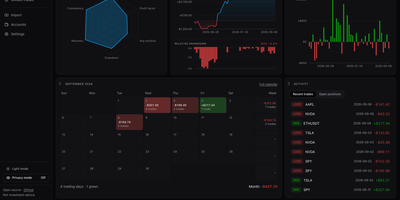
A trading journal you host yourself, Trade Journal rebuilds broker fills and statement exports into round-trip trades, a profit and loss calendar, and daily notes that show what actually works. Read-only sync covers more than twenty brokers and exchanges, including Alpaca, Binance, Coinbase, Kraken, and IBKR Flex. Statement import auto-detects TradingView, MetaTrader, NinjaTrader, Tradovate, and thinkorswim files, handles TradeZella and Tradervue CSV migrations, and maps columns for anything else. Trades can be matched first-in-first-out, last-in-first-out, or by weighted average, with partial fills, scale-ins, and futures multipliers handled. The dashboard offers gauges, cumulative and daily P&L, an Edge Score radar, and cards you can rearrange into named layouts, while Reports break results down by symbol, tag, mistake, playbook, weekday, and time of day. Each trade page charts entries and exits and can replay candles you load, with estimated MAE and MFE. Daily journal pages hold Markdown notes, templates, attachments, and voice dictation, and optional AI recaps use your own Anthropic or OpenAI key or a local Ollama model. Playbook checklists score rule adherence, a prop firm ledger tracks costs and payouts, and privacy mode masks every amount. Running on a dedicated VPS on RepoCloud with guaranteed CPU, RAM, and SSD, full root SSH access, and a browser serial console. MIT licensed.
Elmo
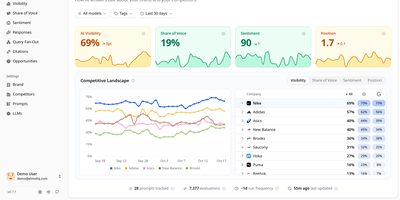
Tracking how ChatGPT, Claude, Gemini, Perplexity, and Google's AI answers talk about your brand, Elmo gives you a self-hosted dashboard for measuring and improving your AI search visibility. A setup wizard reads your website and suggests keywords, competitors, buyer personas, and tracking prompts. Behind the scenes, a worker reruns every tracked prompt on a schedule against the engines you connect, using scraping providers such as BrightData, Oxylabs, or SearchApi for real consumer experiences, or direct OpenAI, Anthropic, Mistral, and OpenRouter APIs. Each run feeds visibility scores per prompt and per model, mention tracking across names, aliases, and domains, sentiment from positive to negative, and each company's position in the answer. The Responses page filters answers by model, tag, prompt, or sentiment and highlights the passage behind each judgment. Citation analysis sorts cited URLs into your domains, competitors, social media, Google properties, and institutional sources. A share-of-voice leaderboard ranks competitors against you over time. Query fan-out shows the web searches engines ran before answering. Opportunities turns the numbers into a prioritized list of content to create, pitch, and seed. Shareable reports reach stakeholders without an account, and a REST API with TypeScript and Python SDKs plus an MCP server lets coding agents query the data. Raw engine output stays in your own database for later audit. Running on a dedicated VPS on RepoCloud with guaranteed CPU, RAM, and SSD, full root SSH access, and a browser serial console. MIT licensed.
Pingvin Share X
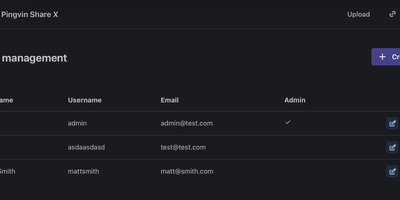
Pingvin Share X is your own WeTransfer, running on your server, with none of the transfer limits or expiring-link anxiety of the free tiers. Drop in a file of any size, get a link, and decide exactly how it behaves: an expiration date after which it vanishes, a password gate, a cap on how many visitors may open it, or all three. Email the link straight to recipients from the share dialog, and get notified when they download. Reverse shares flip the flow around: send someone a link and they upload files to you through it, which is perfect for collecting client deliverables, application documents, or the family photo archive without a single email attachment thread. Attachments can be scanned with ClamAV before anyone touches them, and storage lives on your disks or in S3-compatible buckets. Accounts connect through OIDC or LDAP single sign-on for teams, and an extensive admin panel tunes everything from password policy to upload chunk sizes. Registration rules decide whether your instance is a private family tool or an open drop point for your whole crew. Running on a dedicated VPS on RepoCloud with guaranteed CPU, RAM, and SSD, full root SSH access, and a browser serial console. BSD-2-Clause licensed.

Pomodoist
Pomodoist pairs a task manager with a Pomodoro timer, so the list of what to do and the clock that gets it done live in the same app. Type a task the way you would say it and the quick-add bar sets its priority and estimates its Pomodoros as you type, filing it into the Inbox, Today, or Upcoming views. Plan the week on a calendar, drag cards across a kanban board, spread work along a timeline, or sort it into a four-quadrant priority matrix when everything feels urgent. Start a focus session and the timer tracks intervals against the task at hand, with configurable work and break lengths, while a 3D desktop companion focuses, rests, and celebrates along with you. Share a project and the discussion stays beside the tasks, with comments on shared items and the team's focus time visible next to the work itself. Reports chart weekly focus time, completed tasks, and habit streaks, and voice notes can become task checklists when typing is not an option. An MCP endpoint lets your AI tools manage the same projects after an OAuth sign-in, and optional Google Calendar and Telegram integrations meet the planner where you already are. The self-hosted instance unlocks every feature locally, with your own accounts and one-command backups of the whole database. Running on a dedicated VPS on RepoCloud with guaranteed CPU, RAM, and SSD, full root SSH access, and a browser serial console. AGPL-3.0 licensed.