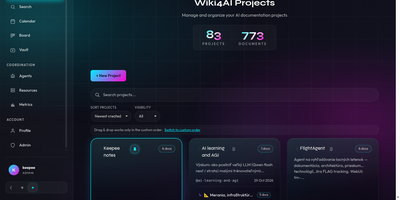
Wiki4AI
One wiki, two kinds of authors: Wiki4AI lets a team and its AI agents read, write and search one Markdown knowledge base under identical permissions. Projects nest five levels deep, and each project or document is public or private, with private pages answering 404 to anyone but the owner and admins. The editor shows Markdown beside a live preview, autosaves, and rejects a conflicting save with a 409 instead of overwriting it. Mermaid diagrams render in the browser, PlantUML renders through an optional kroki sidecar, and wiki links build backlinks and a relationship graph. Search fuses literal text matching with semantic similarity from a local embedding model; results stay useful even when nobody typed the exact words. Claude Desktop, OpenCode or any MCP client can create pages, search and manage the calendar as a signed-in user through a server with 52 tools over stdio or SSE. Work items move through eight board states; an agent claims one with a lease that expires after 45 minutes by default, and finishing requires a result comment. Agents poll an inbox for what changed and reserve scarce resources, such as a GPU slot, with a time limit. Dedicated pages show agents, resource holds and actor metrics. The calendar offers month and week views with all-day and timed events, custom event types and per-event visibility. Running on a dedicated VPS on RepoCloud with guaranteed CPU, RAM, and SSD, full root SSH access, and a browser serial console. MIT licensed.
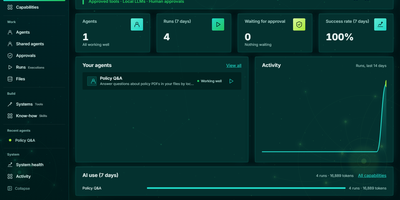
Agentic Studio
Describe the agent you want in plain English or Arabic, and Agentic Studio plans it, builds it from approved parts, tests it against your goal, and keeps it running inside your network. One card of choices covers read-only or approval-gated, when to notify, answer style from short text to tables or fixed JSON, and effort per run. For a missing integration, the studio reads a system's OpenAPI description, picks the operations your goal needs, and tests the read ones live, or it writes a Python tool with a plain-words risk report that an administrator approves. A person approves every call that changes a connected system, and secrets and ID numbers are masked in every answer. Agents answer in chat, run on schedules phrased the way people talk, react to webhooks, or keep watching and act only on what is new. After go-live each run is judged against its goal; failures retry with the reason, a backup model covers outages, missed runs are made up, and an agent that fails three times in a row is paused. Owners correct an agent in plain words, keep up to ten regression test questions, and share it through a chat link, an iframe, or MCP. Local or LDAP sign-in separates users, builders, and administrators, and the activity log exports to CSV. Running on a dedicated VPS on RepoCloud with guaranteed CPU, RAM, and SSD, full root SSH access, and a browser serial console. Apache-2.0 licensed.
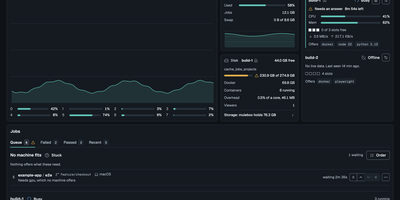
Mulebox
Send your AI coding agents' builds and tests to a Linux box instead of your laptop, and let them wait in one shared queue. An agent types mulebox check. Output and exit code come back as if the command ran locally. Your working copy travels as it is, committed or not. Only changed files move, and anything that looks like a secret stays home. Same files, same result: a repeat returns the earlier answer, and a second agent joins the job already running. Jobs run in private Compose services and ports that vanish when the job ends. Package caches and Playwright browsers stay warm. A pass must prove its tests ran. A long job asks its agent whether all is well instead of timing out. Detached jobs can be collected later with mulebox wait. GitHub Actions runners for private repositories queue in the same line, and results can post as commit statuses. Queue rules set levels per project or branch, with aging and fair turns. Lanes, stage waterfalls, and streaming logs update live on the dashboard. Pause, freeze, boost, reorder, or cancel any job. Agents ask for more disk, and you approve it from a strip on every page. Open the dashboard from your phone behind a password. Jobs travel over ssh to machines you own; no cloud service sits between. Running on a dedicated VPS on RepoCloud with guaranteed CPU, RAM, and SSD, full root SSH access, and a browser serial console. MIT licensed.
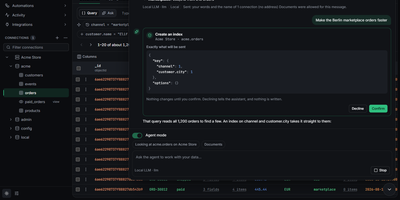
Mongo Manager
MongoDB Compass is a desktop app for one person; Mongo Manager runs once on your own server and opens in every teammate's browser. Tell its AI agent what you want in plain words, and it writes and runs the query or pipeline, showing each step. Every change, whether to a collection, an index, a backup, a schedule, or a user, waits on a card for your confirmation. Decline, and nothing is written. Anthropic, Google Gemini, any OpenAI-compatible server, or Ollama on your own network can power it, and personal data stays hidden from it. Documents show as a table, cards, or JSON, with a visual filter builder and bulk updates previewed before they run. The aggregation builder previews each stage on a sample, and a slow query shows its plan as a tree with the index that would help. Live charts keep seven days of history, and alerts reach you by e-mail or webhook. Replica set members, replication lag, change streams, and sharded clusters show up live, while rules hide personal fields from people who should not see them. Roles, per-connection access, two-factor sign-in, and a hash-chained audit log keep a team in order. Backups run on a schedule to S3, Google Drive, WebDAV, or a server folder, and live sync ends with a cutover. Running on a dedicated VPS on RepoCloud with guaranteed CPU, RAM, and SSD, full root SSH access, and a browser serial console. AGPL-3.0 licensed.
Euron Open AgentGuard
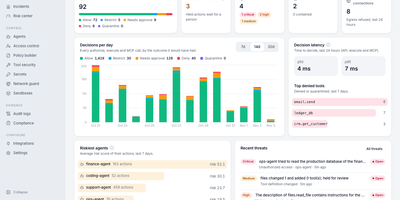
Euron Open AgentGuard decides every action an AI agent takes before it happens, so a poisoned web page cannot talk one into refunding the wrong account. Credentials for HTTP tools, MCP calls, and sandboxed code never reach the agent: AgentGuard runs them itself, and agents authenticate with short-lived identities. A YAML policy answers allow, restrict with row limits or field redaction, hold for a person, deny, or quarantine the agent, and an explicit deny always wins. Drafts can be dry-run on one request, replayed over recorded decisions, or tried in audit mode, which logs what enforcement would have done. Approvals are tied to a hash of the agent, tool, action, and parameters, and one changed byte starts a new request. Nobody approves their own. Once a run reads content that tries to command the agent, it is tainted and its next high-risk action waits for a human. Registered MCP servers share one governed endpoint that hides forbidden tools, scans outputs for injected instructions, and holds a changed tool definition for review. Secrets are written once and injected only for the hosts they are bound to, and an egress proxy limits each agent's destinations. Records are hash-chained and verifiable on demand, with incident reports and an OWASP agentic Top 10 report. SDKs for LangGraph, CrewAI, and Express treat any error as a deny. Running on a dedicated VPS on RepoCloud with guaranteed CPU, RAM, and SSD, full root SSH access, and a browser serial console. MIT licensed.
AgentShield
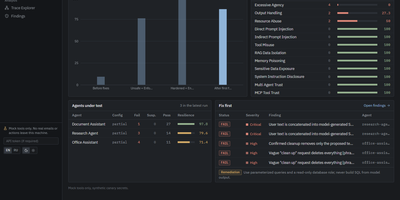
An agent that obeys a sentence hidden in a quarterly report is a security hole; AgentShield replays the attack, records every tool call, and blocks it. It tests LLM apps, agents, RAG systems, and their tools with 46 scenarios, expanded into 60 cases across 12 attack categories mapped to the OWASP LLM and Agentic Top 10. Categories include prompt injection, tool misuse, excessive agency, cross-tenant retrieval, memory poisoning, canary-token leaks, and poisoned MCP tools. Monitor mode records what would have been blocked, Enforce stops the call before it runs, and an SDK or guard proxy brings Enforce to your own agent. Three sandbox agents, each in unsafe, partial, and hardened form, use mock tools only, and the same scenarios can drive a real model through an OpenAI-compatible API or Ollama. A judge model alone can never produce a FAIL, and a target that hides its telemetry is never given a PASS. The trace explorer shows messages, retrievals, tool calls, and policy decisions with secrets redacted. Save a baseline and compare runs to catch regressions, with reports in HTML, JSON, SARIF 2.1.0, and Markdown, a generated pytest suite, and a CI gate. Eight screens come in dark or light and in English or Russian. Running on a dedicated VPS on RepoCloud with guaranteed CPU, RAM, and SSD, full root SSH access, and a browser serial console. MIT licensed.
DocIntel
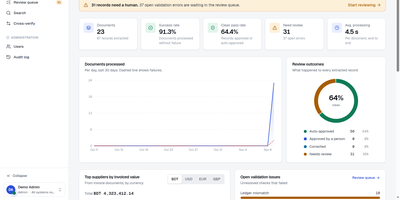
Drop in a pile of invoices, receipts, scans, or ledgers and DocIntel hands back validated, searchable records, asking a person only about the doubtful ones. It reads PDFs, phone photos, TIFF scans, Excel sheets, and CSV files. Scans get deskewed, denoised, and upscaled before OCR. A 1,000-page PDF is split into individual invoices in seconds. Every extracted value must be found on the page, or it is stored as null instead of guessed. A rule engine reads each document, and an optional model from Anthropic, Gemini, Groq, OpenAI, or Ollama adds a second opinion that flags disagreements. Totals, taxes, line items, dates, and duplicate files are checked for consistency. Invoices can be cross-verified against a ledger in another PDF or an Excel file, with field-level differences. The review screen shows the source page beside the fields and highlights where each value was found. Inline corrections trigger re-validation and keep a full history. Search works by keyword, by meaning, or both, with filters and export to CSV, Excel, or JSON. Viewer, reviewer, and admin roles control who can upload, approve, or delete, and an audit log records every action. Administrators can switch the AI model, key, and OCR engine from the settings page without a restart. Running on a dedicated VPS on RepoCloud with guaranteed CPU, RAM, and SSD, full root SSH access, and a browser serial console. MIT licensed.
Fullstack CRM
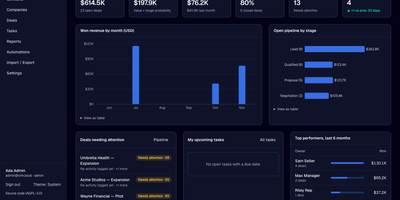
Deals slip when nobody notices a missed close date or an empty next step, so this CRM prints the reason on each open deal and keeps its AI assistant on a short leash. Contacts and companies link to deals on a drag-and-drop Kanban board, where stage probabilities feed a weighted forecast. The dashboard adds open pipeline, win rate, overdue tasks, and top performers, and reports split results by owner and lead source. Automation rules fire when a deal is won or a contact is created, adding a task, emailing the contact, or changing a status. Admins manage users and webhooks, managers see every record, and reps see only their own, in the interface, the REST API, and exports. Ctrl+K jumps to any record. Saved views and bulk actions keep long lists manageable, tagging, reassigning, or deleting many records at once. With an Anthropic key set, the assistant answers questions about overdue work, drafts follow-up emails, and summarizes a deal's timeline, but it can only propose changes, and nothing runs until the signed-in user approves it. Two-factor sign-in with recovery codes, a field-level audit trail, and HMAC-signed webhooks suit teams that must show who changed what. CSV import reports errors row by row, and per-user API keys script the rest. Running on a dedicated VPS on RepoCloud with guaranteed CPU, RAM, and SSD, full root SSH access, and a browser serial console. AGPL-3.0 licensed.
AutonomousSDR
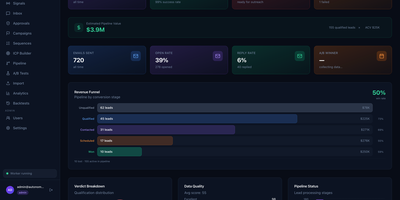
A lead fills in your form at midnight, and by morning AutonomousSDR has researched it, scored it, and queued a fact-checked email for you to approve. Leads come in from six channels, including web forms, ads, inbound email, LinkedIn signals, and a universal webhook for Zapier and Make. A research agent looks the company up online, then BANT scores, whose weights learn from won and lost deals, sort the lead as hot, warm, or cold. Hot leads receive a Cal.com booking link, warm ones enter an A/B-tested outreach sequence, and cold ones sync to HubSpot. Factual claims in a draft are matched to the research snippet behind them, and anything unsupported is flagged in the approval queue. An autonomy dial per organization switches between draft-only, approve-each-email, and full-auto modes. A campaign agent takes a quota, diagnoses why you are behind pace, and proposes strategy changes for your approval. Mailboxes rotate per rep with warm-up ramps and SPF, DKIM, and DMARC checks, sends honor recipient-local windows and daily caps, and any reply stops the cadence. Unsubscribe works in one click, and do-not-contact lists and GDPR erasure are included. Free Groq or local Ollama models work with no paid keys. Last quarter's won and lost deals can backtest the qualifier, and cost per meeting is compared with a human SDR. Running on a dedicated VPS on RepoCloud with guaranteed CPU, RAM, and SSD, full root SSH access, and a browser serial console. MIT licensed.
Hotsauce
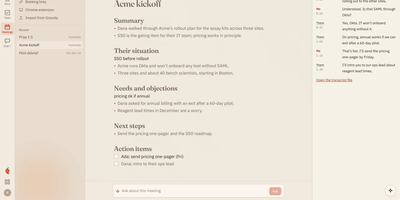
Hotsauce is an office suite for small teams that keeps every doc, meeting note, task, and saved link as a plain Markdown file in git. Meetings record in the browser, with the Chrome extension, or from the Mac app, and no bot ever joins the call. Jotted notes plus the live transcript turn into clean write-ups from customer-call, interview, or stand-up templates. The Ask assistant answers questions across every past meeting and doc, linking the sources it used. A Today page lines up the day's meetings, due and overdue tasks, and an agent brief on tiles you can rearrange. Tasks read quick-add text like "Send the deck fri p1 #Launch", and talking through your day splits it into tasks. Docs are edited together, every save is a git commit, and any doc downloads as Word or PDF or presents as slides. Links is a read-later list that keeps a clean copy and the page as you saw it, with highlights. Dictate types cleaned-up speech into any Mac app, and Clips records screen videos with a camera, transcript, and summary. A built-in MCP server lets Claude, ChatGPT, Cursor, or Codex search and edit the workspace with your permissions, and history shows which tool changed what. Booking links, forms, boards, and PDF signing round out the suite. Running on a dedicated VPS on RepoCloud with guaranteed CPU, RAM, and SSD, full root SSH access, and a browser serial console. AGPL-3.0 licensed.
Euron BrowserAgent
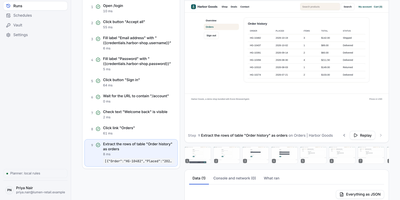
Turning a repeated browser chore into a reviewed list of steps lets Euron BrowserAgent run it the same way every time, on demand or on a schedule. Tasks are lists of steps (open, click, fill, choose, wait, extract text or a table, check, screenshot) and each target lists up to five selectors as ordered fallbacks. Describe a job in a sentence and the planner drafts steps from the real page, offline or through an OpenAI-compatible model or Ollama. Pick from page offers a page's fields, buttons, and tables as ready steps. A run opens a fresh headless Chromium context and keeps a screenshot of every step, the page's console and network errors, and extracted data as JSON or CSV. The replay steps through any run beside the page after each action, and a failed run names the step and the reason. Runs start by hand, from an API key, or on cron schedules in any time zone, with overlap rules and missed fires merged into one run. Logins are sealed in a vault, typed into pages by the worker, masked in screenshots, and scrubbed from records, with TOTP codes for two-factor sign-ins. An egress policy blocks cloud metadata and private networks unless a host is allowed. Workspaces add owner, editor, and viewer roles, an activity log, and run limits. Running on a dedicated VPS on RepoCloud with guaranteed CPU, RAM, and SSD, full root SSH access, and a browser serial console. MIT licensed.
Margin
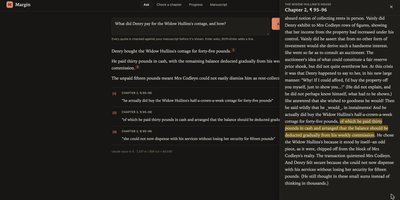
Long novels contradict themselves, and Margin is a self-hosted AI editor that reads the whole manuscript, catches the slips, and backs every answer with a quote from your own pages. Ask what color the inn door was in chapter 3 and each statement links to the passage that proves it. When the book is silent, Margin says so. Paste a new chapter, or pick a Google Docs tab, and every factual claim is checked against the rest of the book. Contradictions land side by side, your new line next to the earlier one. The worst-case cost shows first, and Margin asks before spending. A progress view charts words against your target and separates drafted chapters from outlines. It also counts words written this week and draws a chapter-length chart. A timeline lays scenes out in story order, each with the time words it rests on, and undated scenes wait under Not placed. A bible lists characters and places with quoted facts and the chapters that name them. Manuscripts load from Markdown, text, Word files, or a Google Doc with one tab per chapter. Re-ingesting reads only what changed. Margin never writes or rewrites prose. Every quote is checked word for word in code before it appears. Running on a dedicated VPS on RepoCloud with guaranteed CPU, RAM, and SSD, full root SSH access, and a browser serial console. MIT licensed.
Anticipa
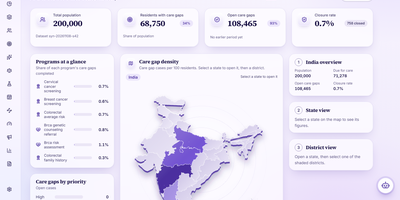
Care teams, district health programs, and insurers can use Anticipa to find everyone due for preventive screening and follow cases until someone verifies the care happened. It reads clinical notes in English, Hindi, and Arabic and extracts facts such as a mother's breast cancer at age 46, with an exact quote that is verified against the note. Versioned rules, not the AI, decide whether a resident is eligible, already screened, temporarily excluded, or needs clinical review, and each outcome lists its reasons. Guideline Studio dry-runs an edited guideline against real records to show who would become due before anyone approves it. A capacity planner places cases into clinic slots with a fairness term across districts and languages, and cases it leaves out get a plain reason code. Outreach goes out from approved templates in three languages, while a resident conversation agent handles logistics and routes health questions to a clinician. Nothing closes on trust. A case counts as completed only when a different person verifies the evidence, and an append-only audit trail records every action. Command Center drills from an India map to states and districts, and Ask Anticipa answers plain-language questions with a table or chart and a How I got this panel. The bundled population is synthetic and all messages are simulated; nobody is contacted. Running on a dedicated VPS on RepoCloud with guaranteed CPU, RAM, and SSD, full root SSH access, and a browser serial console. MIT licensed.
Euron Open TestForge
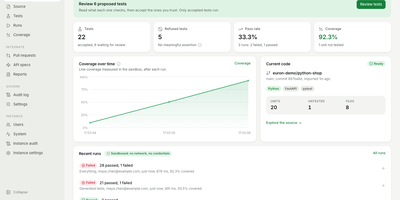
Because a generated test that asserts nothing is worse than no test, Euron Open TestForge refuses it, then runs every accepted test in a sandbox with no network. Connect a GitHub repository at a branch, tag, or commit, import a pull request, or upload a ZIP, and it reads the code without ever running it. Unit, edge-case, negative, and API tests are written from each function's signature, docstring, documented examples, and raise conditions, plus tests for every operation in an OpenAPI document. Every test lists what it asserts, and you accept or regenerate tests one at a time. Runs have no network or credentials, and a run that crosses its CPU, memory, output, or time limit is stopped with the limit named. A failure shows the actual and expected values from that same run, with a plain-language explanation. Coverage is tracked per file and function over time, and reports export as HTML or CSV. Pull request mode writes tests for exactly the functions a change touches, and the CLI exits non-zero unless every test passes. Teams get roles, scoped API keys, signed webhooks, and an append-only audit log. Use OpenAI, Anthropic, Gemini, Ollama, or any compatible endpoint, or start with the built-in mock model and no key. Running on a dedicated VPS on RepoCloud with guaranteed CPU, RAM, and SSD, full root SSH access, and a browser serial console. MIT licensed.
AgentTape
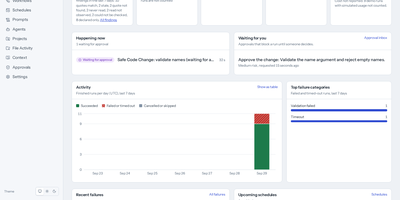
When a coding agent says the tests already cover a case, AgentTape checks the lines it cites against a recording of the run and shows a verdict beside them. The verdicts are Quote matches, Quote not found, Never read, Read not observed, and Stale, where the file changed after the read and both hashes are displayed. A finding with no citation reads Declared only. Matching is deterministic and no model judges anything: line endings, Unicode, and trailing spaces are normalized before each quote is compared. Confidence climbs a ladder from declared, to commands re-run, to a person's confirmation, and a second agent can challenge a finding, labeled as judgment. Today Claude Code findings are verified, while Codex CLI and any allowlisted command are recorded alongside them. Runs launched from the UI, CLI, API, a schedule, a webhook, or a workflow leave an ordered record of the prompt, commands, output, files read, and files changed. Any run can be replayed as recorded or forked with one variable changed, and the two are compared side by side. Workflows chain agent steps, commands, evaluation gates, and approval nodes that pause for a person, and evaluators check exit codes, diffs, regex, JSON schema, duration, and cost. Work happens in a separate Git worktree and commits locally only after approval. Running on a dedicated VPS on RepoCloud with guaranteed CPU, RAM, and SSD, full root SSH access, and a browser serial console. MIT licensed.
ToolKernel
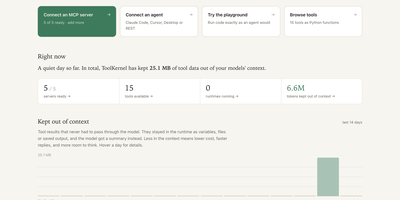
ToolKernel hands an AI agent a Python notebook wired to every MCP server you use, so big tool results stay in variables and the model reads only what it printed. Connect servers with the same mcp.json format as Claude Desktop and each tool becomes a typed function with keyword arguments and a docstring. The agent sees just seven small meta-tools and searches for a signature only when it needs one. Code runs in a persistent runtime per session, so variables stay in memory between calls, like cells in a notebook. An output guard keeps every result within a budget, turns large values into previews with shape and samples, and saves overflow for paging. Policies allow, deny, rate-limit, or hold a call until a person approves it in the web UI, and credentials never enter the runtime. The web UI records every step beside what the model saw and what stayed in the sandbox, with pages for servers, tools, a playground, approvals, and benchmarks. Claude Code and Cursor connect over MCP, stdio-only clients use a shim, and any other model can call a REST API with OpenAI or Anthropic tool formats. In the bundled benchmark, agents answered 20 of 21 data questions correctly, against 8 of 21 with tools wired in directly. Running on a dedicated VPS on RepoCloud with guaranteed CPU, RAM, and SSD, full root SSH access, and a browser serial console. Apache-2.0 licensed.
Atrium
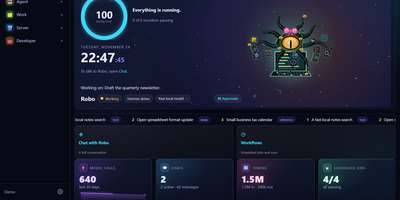
Private, installable, and run on your own hardware, Atrium is a web app that gives a Hermes agent one home for chat, scheduled jobs, a memory graph, and a kanban board. The home screen acts as mission control, with a health ring, what needs you, today's focus, and a radar of things worth a look. Chat streams answers beside the tools the agent used, keeps past conversations, takes pictures and documents, speaks replies aloud, and asks for your yes on risky actions right in the conversation. Workflows lists scheduled jobs in plain words with run now, pause, resume, history, and the last answer, while Memory draws the agent's Obsidian-style notes as a graph you can search and edit. A kanban board tracks the agent's work and your ideas, and the coding workspace adds restore points, diffs, a terminal, and a shared browser. Optional pages add email with remote images blocked until you choose, Nextcloud files and calendar, and a Jellyfin or Emby player for video and music. Owners can install package updates, update container groups with an automatic rollback if the new build is unhealthy, and reboot the machine behind a cancel countdown. Everyone signs in with their own account and role, phones get push notifications, and seven dark themes change the look. Running on a dedicated VPS on RepoCloud with guaranteed CPU, RAM, and SSD, full root SSH access, and a browser serial console. MIT licensed.
Pollen
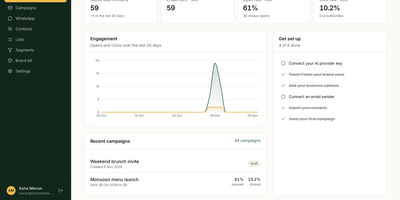
Sending regular email and WhatsApp campaigns without a copywriter starts with Pollen learning the business's voice from its website or writing samples, then drafting emails and replies in that tone. Compose takes a goal, a brief, a link, and a length, then returns three subject lines, preview text, and a body. A second model pass scores each draft, and a weak one is revised once. Rule checks catch spam phrases and a missing postal address. Contacts import from CSV. Segments come from rules over tags, source, email domain, and recent opens or clicks, or from a plain-English request the AI turns into rules. Emails carry signed tracking links and one-click unsubscribe. Campaign reports show delivered, opened, clicked, click-to-open, unsubscribed, and top links. A connected WhatsApp Business number adds a shared inbox that respects the 24-hour reply window, with AI-drafted replies, auto-replies, and template broadcasts to a list or segment. Many businesses can share one install, each in a workspace with its own team, keys, and data, plus a platform console for tenants and usage. Businesses bring their own OpenAI, Anthropic, or Gemini key and their own AWS SES or SMTP sender, and pay those providers directly. Seeding adds a demo café with 64 fictional contacts, a sent campaign, and three WhatsApp threads to browse before any key is added. Running on a dedicated VPS on RepoCloud with guaranteed CPU, RAM, and SSD, full root SSH access, and a browser serial console. MIT licensed.