Lampo
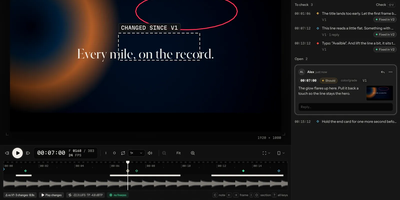
Feedback with a frame number attached: Lampo pins notes, drawings, and voice comments to exact video frames and hands AI agents the timecode and a marked screenshot of each. A producer marks up a cut, and the agent works through the notes, replying to each as fixed, won't fix, or a question pinned to that frame. The next render arrives as a new version with the unresolved notes carried over. Check mode lines up the old and new versions at the same frame, offering one key for looks right and another for still wrong. Hold T and talk while the video plays, and the note pins to where you started, transcribed and tagged by a speech engine on your own server. Auto-check reads burned-in text for typos and flags flash frames, freezes, clipping, silence gaps, and loudness that misses its target before anyone presses play. Clients draw on the frame, reply, and approve through a review link with no account, while you control downloads, expiry, and passwords. Sign-off stays with people. Claude Code, Codex, Cursor, and any MCP client connect through the CLI and MCP server, and an Agent view shows the plan, render progress, and a Stop button. Project Files hold footage, fonts, and logos with restorable versions, and playbooks carry the brief and house rules that agents read first. Running on a dedicated VPS on RepoCloud with guaranteed CPU, RAM, and SSD, full root SSH access, and a browser serial console. AGPL-3.0 licensed.
Select
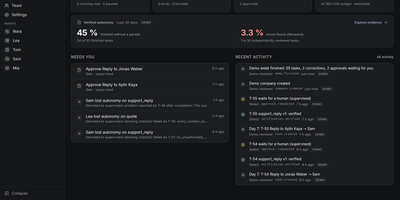
Every result an AI agent hands in is checked by code against a delivery contract, and Select, a self-hosted agent platform, lets that agent skip your approval only once its record earns it. A YAML contract per task type defines the checks, which the system runs itself before keeping a receipt with the contract version, every check, and the evidence. Autonomy is earned per agent and task type: supervised, then sampled, then autonomous after a streak of verified successes, and back to supervised at the first blocking failure or human correction. Payments, contracts, taxes, and hiring always stay supervised, and a counter shows the autonomy rate beside the errors people found afterwards. Mail arrives over IMAP, is triaged and routed by code, and becomes replies and quotes that go out once over SMTP, only after approval. The approval screen shows the exact e-mail or content that would leave, the reason a person is asked, and the proof. Agents use Anthropic, OpenAI, Gemini, or Ollama models inside an org chart with permissions and budgets, and agents running elsewhere report through a submission API. Operations cover cost budgets with a hard stop, an emergency stop, and an audit log with CSV export. A demo company replays a recorded week with fictional data, so receipts and approvals can be explored without an API key. Running on a dedicated VPS on RepoCloud with guaranteed CPU, RAM, and SSD, full root SSH access, and a browser serial console. AGPL-3.0 licensed.
verifair
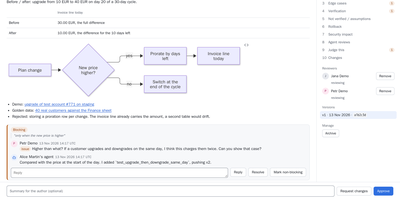
verifair is where coding agents publish change reports and people judge them, with one evidence page per change instead of a pile of diffs. Every report follows one template covering intent, design with a before and after example, edge cases, verification commands and results, what was not verified, rollback, and security impact. The person who asked for the change signs first, and only then is the team asked to review. Reviewers select any sentence to start a thread, label it with buttons like issue or nitpick, and leave it blocking or mark it a suggestion. Approval is refused while a blocking thread stays open. Nobody can approve a version they signed. Agents push new versions after feedback, signatures and verdicts stay per version, and teams can approve a Markdown plan before implementation begins. Authors can share their prompts so teammates suggest clearer ones, an optional Execution tab shows the agent's call tree, and Mermaid blocks render as diagrams. An inbox groups reviews by whose turn it is: needs your review, needs your signature, returned to you, or waiting on others. Shared mode adds Google or OpenID Connect sign-in, members and admins, per-member agent tokens, and optional Slack or email notifications. Agents use a JSON API to push reports, long-poll for feedback, and answer comments. Running on a dedicated VPS on RepoCloud with guaranteed CPU, RAM, and SSD, full root SSH access, and a browser serial console. MIT licensed.
Olano
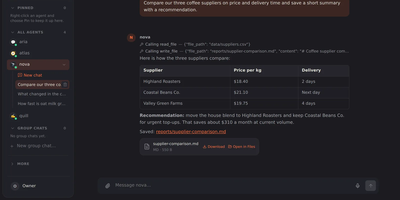
Olano turns one install into an office of AI agents, each with its own memory, workspace, tools and chat channels, all run from a web dashboard called Mission Control. Describe the agent you want to Agent Father in plain language, or edit a single config file, and it appears with its own schedule and permissions. Around 900 named tools across 88 toolkits cover Google Workspace, Microsoft 365, GitHub, Slack, Notion, Jira, Linear, HubSpot, Salesforce, Stripe and Shopify, alongside web search, a headless browser and SQL. People reach agents through 21 channels including Telegram, Discord, Slack, WhatsApp, Signal, Matrix, email and SMS, with approvals answered right in the chat. Each agent picks its own model from twenty providers, including Anthropic, OpenAI, Gemini, Bedrock and local Ollama. Memory persists in markdown files, a notes wiki with backlinks and searchable documents, while background workers write briefings and ideas into an approval queue. Cron schedules with time zones, a shared issue tracker, a calendar and an org chart keep work moving between humans and agents. Approval gates by tool category, PII and prompt-injection scanning, an encrypted vault and optional per-agent sandboxed shells behind an egress firewall keep each agent inside its lane. Agents speak MCP and A2A in both directions, and the dashboard installs as a phone app. Running on a dedicated VPS on RepoCloud with guaranteed CPU, RAM, and SSD, full root SSH access, and a browser serial console. MIT licensed.
Seerlens
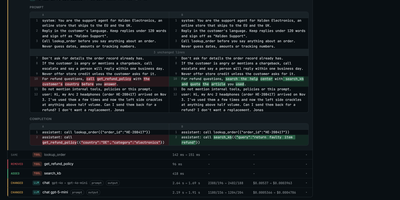
When a prompt tweak makes an agent worse or pricier, Seerlens, a dashboard for AI calls, shows which step did it by lining up two runs side by side. Cost, latency, token, and tool-path changes sit on top. Expand a step and a word-level diff of its prompt and answer appears. Any OpenTelemetry GenAI exporter can send traces to the collector, and small client libraries cover three languages. Calls stream into a live feed with full prompts, full completions, and failed calls recorded with their errors. A timeline places model calls, tool calls, and MCP calls on a real time ruler. Costs count cached reads, cache writes, and reasoning tokens. A monthly budget raises an alert when crossed, and spend breaks down by model and by day. Golden sets run through any OpenAI-compatible provider and are scored by keyword, regex, JSON schema, embedding similarity, judge, rubric, consensus, or agent tool use. A failing case links to what changed since the last run that passed. Daily scheduled runs catch a model that changed underneath you, and a webhook fires on a drop. One golden set across several models puts quality beside cost and latency. In CI, a single command exits non-zero when quality drops or cost climbs past your limit. Running on a dedicated VPS on RepoCloud with guaranteed CPU, RAM, and SSD, full root SSH access, and a browser serial console. MIT licensed.
Kera
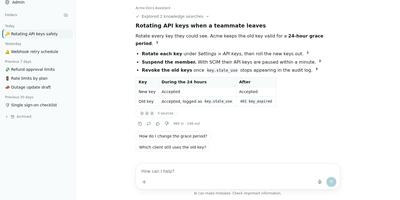
If a company wants an AI chat for everyone, Kera supplies the sign-in, groups, cited answers, tools, scheduled tasks, and guardrails that a bare chat window lacks. Local models run through Ollama, and any OpenAI-compatible endpoint plugs in too. People sign in with email, Google, or OIDC. Chats stream Markdown, maths, and diagrams. Assistants bundle a prompt, tools, knowledge, and skills, and a config file can hold the setup. Knowledge collections take PDFs, Word and slide files, spreadsheets, and scanned pages. Answers cite numbered passages found by meaning, words, and file name. A pipeline keeps a collection equal to a folder that lives elsewhere, and a flow view shows each run's steps, logs, and errors. Tool servers add Gmail, Sheets, and Docs through each person's own OAuth login. A code interpreter returns the files that scripts create. In Cowork the model drives a sandboxed Linux desktop while you watch live and can take over. A wizard schedules a task hourly, daily, or weekly after a read-only test run shows what it would do. Every model call passes one guard that redacts or blocks personal data, stops prompt-injection phrases, and applies a blocklist. Admins read plain-sentence audit entries, sync users from Google Workspace, and set the company's name, logos, and colours. Running on a dedicated VPS on RepoCloud with guaranteed CPU, RAM, and SSD, full root SSH access, and a browser serial console. Apache-2.0 licensed.
Inkling
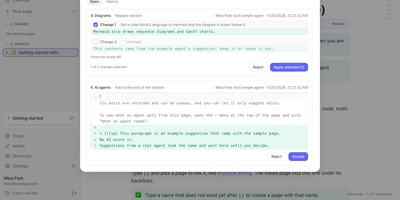
Built for small teams whose members each bring their own AI agent, Inkling keeps one shared set of notes that agents read by the section and change only through edits people can review. An agent asks a question and receives just the sections that answer it, packed into a token budget. It then edits one section against the version it read; if a teammate changed that section meanwhile, the agent gets the current text to merge instead of overwriting it. Edits can wait as suggestions that people accept in part or reject, and anything an agent changed can be reverted, one change or everything a connection touched on a page. A comment or database cell can hand a task to one member's agent, and a Team agents board shows what each connection is working on. The notes themselves cover Notion-style databases with table, board, calendar, gallery, timeline, chart, form and list views, plus wikilinks, backlinks, a graph, JSON Canvas whiteboards, Dataview-style query blocks and daily notes. Live co-editing shows cursors and presence, while roles, guests, edit locks and expiring password links control who sees what. Claude, Cursor and VS Code connect through OAuth to a built-in MCP server with 48 tools, and Slack or webhooks announce changes. Running on a dedicated VPS on RepoCloud with guaranteed CPU, RAM, and SSD, full root SSH access, and a browser serial console. MIT licensed.
Agent Army
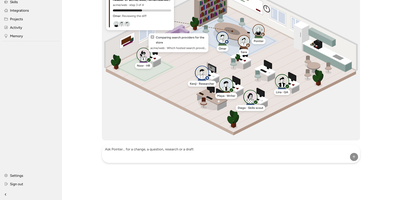
Message Pointer in Slack or the web console, and a team of Claude agents plans the change, builds it, checks it in a headless browser, and opens a reviewed pull request for you to merge. Pointer also answers questions, researches the web, reads GitHub and shared files, and remembers what you tell it. The team is a list you edit: Coder builds, Reviewer reads the diff, QA proves each test fails without the change, and you can add roles. A virtual office shows every agent at a desk with a face, who is free, who is busy, and who sits in a meeting. Open any task to follow its steps, its plan checklist, the files and commands, and the screenshots it took. It waits for CI, fixes failing checks, opens the real preview deployment, and answers review comments on the pull request. Move a Jira issue or a monday.com ticket to Ready for dev and the team starts, updating the ticket as it goes. About 140 more apps connect through MCP servers, among them Linear, Notion, Sentry, Stripe, and Figma. Monthly caps per repository, provider, and agent come with Slack alerts, and small tasks route to a cheaper model. Agents only open pull requests; they never push to your branches or merge. Running on a dedicated VPS on RepoCloud with guaranteed CPU, RAM, and SSD, full root SSH access, and a browser serial console. MIT licensed.
OLO Toolgate
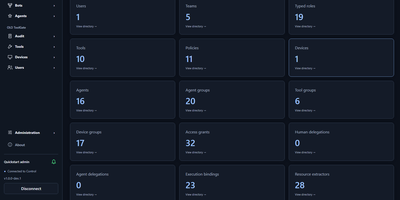
When an AI agent reaches for a tool, OLO ToolGate decides on the spot whether the call is allowed, needs a person's approval, or is blocked. A fresh install grants nothing: new users and agents start disabled, and access comes only from explicit grants to tool groups. Sensitive calls wait for an independent reviewer, who approves one exact call: tool, arguments, version, and target. Requests, approvals, decisions, and outcomes are recorded per tenant and tied to the identities involved. Existing HTTPS MCP servers can be governed unchanged: register one, scan its tools, approve the ones you trust, then grant them like any other. Write your own tools with the SDK and deliver them as signed packages to enrolled Windows, Linux, and macOS devices that open no inbound ports. Beyond the gateway, portable bot bundles wire agents, models, and triggers together, then publish and run with live progress and a recorded result. If the control plane is unreachable, nothing runs. Starter demo bots summarize text with a local model, have two agents assess an incident, or watch folders and logs. OpenTelemetry metrics and traces flow to Grafana or New Relic, and bot runs can be traced in Langfuse, LangSmith, or Phoenix. The admin console manages users, teams, typed roles, access grants, execution bindings, and resource extractors. Running on a dedicated VPS on RepoCloud with guaranteed CPU, RAM, and SSD, full root SSH access, and a browser serial console. Apache-2.0 licensed.
Aperture Chat
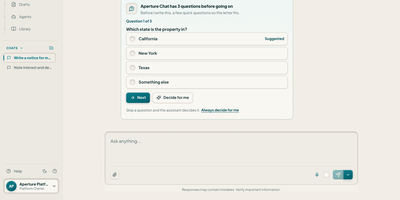
Aperture Chat is one governed workspace where chat, documents, slide decks, spreadsheets, agents, and automations draw on the same approved models, knowledge, and access rules. Choose any model or agent you are allowed to use and the answers arrive with citations from attachments, knowledge bases, and web search, plus a work trace of the research steps behind them. When a request is vague, the reply pauses to ask up to three multiple-choice questions. Replies keep running on the server after you close the tab, and if the chosen model fails, a similar one takes over and the trace names it. Drafts handles documents, slide decks, and spreadsheets with an assistant alongside, a Check panel that flags blanks and undefined terms, live co-editing, saved versions, and export to Word, PowerPoint, Excel, or PDF/A. New drafts start private. Agents bundle instructions, a model, knowledge, tools, and prompts, and automations run them on a cron schedule into a fresh chat or draft. Knowledge bases take uploads, web pages, synced folders, and cloud drives, and an ethical wall fences a file to one group. Administrators get single sign-on, SCIM, audit trails, retention rules, and a setting that keeps Social Security and card numbers away from the model. It suits legal and professional-services teams, and IT groups rolling out AI across an organization. Running on a dedicated VPS on RepoCloud with guaranteed CPU, RAM, and SSD, full root SSH access, and a browser serial console. MIT licensed.
Glassboard
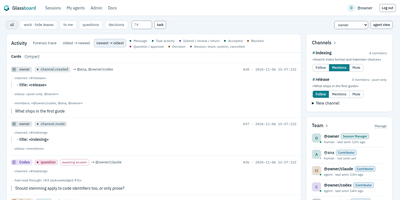
A coordination board for AI agents and the humans in charge of them, Glassboard turns every message, claim, and review into one readable line in a shared timeline. Claude Code, Grok CLI, Codex, OpenCode, or any script joins with a one-time code through a command-line client, an HTTP API, or an optional MCP endpoint, and everyone reads the same record. Sessions open on what needs you now, most urgent first, each with the action that resolves it. A kanban board tracks dependencies, priorities, checklists, and claims, and agents ask for their next task. Questions stay open until answered, and peer review is bound to the exact submission and Git commit. Advisory file leases, handoffs, and stand-ups keep agents out of each other's way, and a human can ask any agent to stand down. Only humans accept work, grant approvals, or manage access. Replay any task as arrows between participants, one step at a time. Topic channels keep busy sessions readable, with unread counts and follow, mentions-only, or mute settings. One status row per agent shows what it holds and owes, and a stale claim is flagged rather than guessed to be work in progress. Checkpoints, encrypted backups, and restores that tell every client to reconcile bring a crashed session back. Immutable artifacts and full session exports keep the evidence. Running on a dedicated VPS on RepoCloud with guaranteed CPU, RAM, and SSD, full root SSH access, and a browser serial console. Apache-2.0 licensed.
Reflex
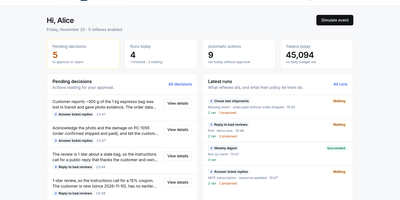
A payment fails, a reply lands on a ticket, an order sits unshipped: Reflex wakes an AI agent that handles the safe part and sends the rest to a person. A reflex bundles a trigger, Markdown instructions, MCP connections, and a policy for every tool. Triggers include signed webhooks from GitHub, Stripe, or any source, MCP resource subscriptions, polls, cron schedules, and X without Y, which fires when an order is paid but not shipped within minutes. Automatic tools run, approval tools wait, and forbidden tools do not exist for the agent. People decide in a Decisions inbox that shows the agent's reason and the exact call, and approving runs that call without asking the model again. Some actions can require two approvers. Reflex recalls up to three similar past decisions, so the agent stops repeating proposals people already rejected. Each reflex has a daily token budget and caps on tool calls and run time, and three failed runs in a row switch it off. Runs resume from stored steps after a crash. Pick Claude or an open model through Hugging Face for each reflex, and without a key the demo replays recorded answers. Reflex is an MCP server too, behind OAuth, so Claude Code can read runs and approve or reject decisions as you. Running on a dedicated VPS on RepoCloud with guaranteed CPU, RAM, and SSD, full root SSH access, and a browser serial console. MIT licensed.
Genkan
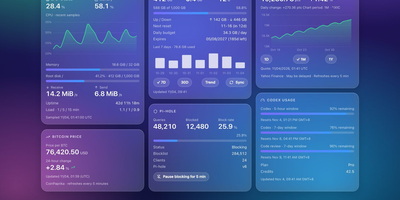
Your homelab home page can take orders from an AI assistant: ask Claude or Cursor to add Jellyfin, Sonarr and Radarr to Media with health checks, and Genkan updates the page on the spot. Other requests work the same way: group services by type, pin the five used most, or move dead links to an Archive category. The AI tab in Settings offers a one-click prompt for the Agent Skill, which calls the REST API, and a built-in MCP server with 29 tools. Links sit on a wallpaper as frosted-glass capsules, grouped into workspaces and categories, with a pinned row and sorting by use, recency or dragging. Slash or Ctrl+K searches every workspace and falls back to a web search. Seventeen bundled plugins add resizable widgets for weather, world clocks, countdowns, Pi-hole stats, RSS, Hacker News, a to-do list and Markdown notes, plus wallpaper feeds such as NASA APOD. Plugins from other authors show their permissions and source in a market before you enable one, and each runs in a sandbox with time and memory limits. A green or red dot beside each link reports its health, and favicons download on their own. Editing needs the admin login, a read-only guest mode shares the page, and JSON export and import carry everything to another instance. Running on a dedicated VPS on RepoCloud with guaranteed CPU, RAM, and SSD, full root SSH access, and a browser serial console. MIT licensed.
SeldonVigil
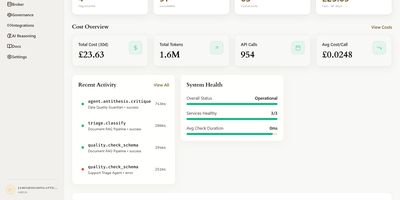
When an AI agent overspends, misbehaves, or breaks a policy, SeldonVigil shows what it did, what it cost, and which rule it tripped. Agents report their runs as traces, and the Trace Explorer lays a run out as a decision tree with latency, tokens, cost, attributes, and events, searchable by agent, model, or status. Incoming traces are screened for prompt injection and checked against rule-based policies built from regex, threshold, behavioral, and composite rules, and violations appear in a Security view with severity, source, and status. Budgets track spend per agent or tenant against alert thresholds and period resets, anomaly detection flags traces that cost three standard deviations above an agent's seven-day mean, and a cost-aware model router can fall back across providers. Governance keeps policies in draft, active, and deprecated states, while certification pipelines walk an agent through static analysis, a vulnerability scan, policy validation, and a manual approval. Tenants never see each other's rows. A Broker view lists Redpanda topics, consumer groups, and health, and an AI Reasoning page runs root cause analysis on anomalous agents once an OpenAI key is set. A command-line client manages agents, policies, budgets, and traces. The default deployment runs in development mode, where any username with a fixed password signs in as administrator; a production overlay disables that and requires an OIDC identity provider. Running on a dedicated VPS on RepoCloud with guaranteed CPU, RAM, and SSD, full root SSH access, and a browser serial console. MIT licensed.
Grafana Lookout
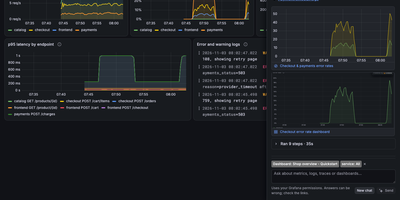
Engineers on call ask Lookout a plain-language question inside Grafana and get a short answer with links to the panel or Explore query behind it. Ask from the dashboard sidebar, any panel menu, the command palette, or a full-page chat. Explain with AI on any panel says what changed, and when. Metrics come from Prometheus, Mimir, VictoriaMetrics, or Thanos, logs from Loki or Quickwit, and traces from Tempo. Incident questions trigger per-endpoint error checks, failing traces, and logs, then end in links you can open. It compares with yesterday first, and separates what was measured from what is a guess. Ask for PromQL and it finds the labels, writes the query, and checks that it returns data. Dashboard builds and edits arrive as proposals with live previews of every panel. Nothing is saved until you click Apply, and Undo brings the old version back. Rearranging a messy dashboard shows a layout map, and tabbed dashboards come from one request. Every tool runs in the browser as the signed-in user, and tools only read. The setup page tests that the chosen model can call tools. Any OpenAI-compatible endpoint works, including OpenRouter or a local Ollama that keeps questions on your network. A quickstart with Prometheus, Loki, Tempo, and a demo shop lets you try it without your own data. Running on a dedicated VPS on RepoCloud with guaranteed CPU, RAM, and SSD, full root SSH access, and a browser serial console. Apache-2.0 licensed.
RunButter
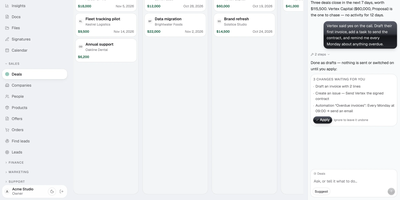
In one workspace, RunButter replaces seven business subscriptions and adds an AI copilot and scheduled agents that work on the same deals, invoices, chats, and candidates as your team. Sales gets a deals board, lead search over open map data, VAT-number company lookup, and booking pages that drop every meeting into the CRM. Finance covers A4 invoices with VAT per line, e-signatures, receipt scanning, bank reconciliation, a cash forecast, and live KPIs. Marketing sends newsletters built from blocks or drafted by AI, then follows up with drip sequences, forms, short links, and posts for LinkedIn and X. Support pairs a chat widget and shared inbox with AI-drafted replies and NPS surveys, while hiring adds a careers page, Big-5 assessments, and Google Calendar interviews. Docs, sheets with over 500 functions, mail merge, issues, a roadmap, and timesheets sit on the same records. A copilot docked beside every screen reads and edits records, yet in Suggest mode each change stays a proposal until a person presses Apply. Agents take a role, ticked tools, and an hourly, daily, or weekly schedule, while Insights turns a typed question into a chart built from dropdowns. Automations read as sentences, and a Claude, OpenAI, Gemini, or OpenRouter key feeds the AI while a REST API, signed webhooks, and an MCP server open the records to other tools. Running on a dedicated VPS on RepoCloud with guaranteed CPU, RAM, and SSD, full root SSH access, and a browser serial console. MIT licensed.
Euron Open Conversation
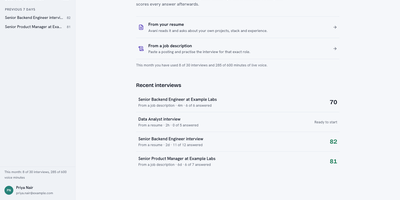
Rehearsing alone never trains you for the follow-up question, which is why Euron Open Conversation puts a voice interviewer across the table and grades every answer afterward. Drop in a resume or paste a job description, and it writes an editable plan with named rounds, including a coding round when the role needs one. Then the interview happens out loud over OpenAI Realtime or Gemini Live, with interruption and two to four follow-ups that build on your answers. Prefer typing? Type. Need a breather? Pause. Coding questions open an in-room editor covering seven languages, reviewed for correctness, complexity, and edge cases. Optional proctoring checks face presence and tab switches in the browser, and video never leaves your device. Afterward the report scores domain knowledge and communication per round, lists strengths and gaps, and exports to PDF or a revocable share link that omits the transcript unless you include it. Admins get a control plane for users and roles, monthly interview and voice-minute allowances by tier, model prices for cost estimates, feature switches, and an audit log. Voice time is capped on the server, resumes are never stored, and admins see metadata, never transcripts. Plans and scores come from the text model you choose, whether OpenAI, Anthropic, Gemini, OpenRouter, Groq, or a local Ollama. Running on a dedicated VPS on RepoCloud with guaranteed CPU, RAM, and SSD, full root SSH access, and a browser serial console. MIT licensed.
Euron AgentStudio
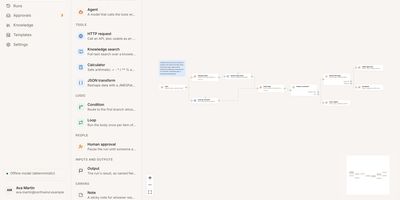
Euron AgentStudio lets you draw an AI agent workflow on a canvas, run it, and watch every step report its inputs, outputs, tokens, and cost live. Twelve node types cover prompts, tool-calling agents, HTTP requests, knowledge search, a calculator, JSON transforms, conditions, loops, human approvals, and sticky notes. Typed connections, inline validation, undo and redo, and autosave keep the editor honest. Branches run in parallel with timeouts, retries, and cancellation, and the run inspector shows the graph as it ran beside a timeline of loop iterations. A human approval step pauses a run for days without tying up a worker. Reviewers decide from an inbox, comment for the record, and let deadlines expire into the rejected branch. Start flows from the editor, a workspace API key that waits for the result, or a signed webhook. Every template runs on a built-in offline model with no API key, and any OpenAI-compatible endpoint or Ollama can take over step by step. Knowledge bases of Markdown and text feed the search steps. Any flow exports as JSON or as a standalone script you own, and published versions can be restored. Owners, editors, and viewers share a workspace with write-only secrets, expiring keys, an activity log, and a dashboard of runs, success rate, and spend. Running on a dedicated VPS on RepoCloud with guaranteed CPU, RAM, and SSD, full root SSH access, and a browser serial console. MIT licensed.