Shlink
With over 5,100 GitHub stars and eight years of active development since 2016, Shlink has become the definitive self-hosted URL shortener for teams that need unlimited links, full visitor analytics, and complete data ownership without per-link pricing or monthly caps. The PHP backend built on the Mezzio framework with Doctrine ORM serves redirects through any number of custom domains on a single instance, generating unique short codes or accepting custom slugs including multi-segment paths and emoji characters. Every click is tracked with anonymized visitor data including geolocation by country, city, and coordinates, browser and operating system identification, referrer source, and device type classification, all stored in your choice of MySQL, MariaDB, PostgreSQL, Microsoft SQL Server, or SQLite. Dynamic redirect rules route visitors to different destinations based on geolocation, device type, or browser language, enabling targeted campaigns from a single short URL. The REST API exposes every operation with OpenAPI documentation and an interactive sandbox at api-spec.shlink.io, while the CLI provides equivalent functionality for scripting and automation. The official progressive web app at app.shlink.io manages multiple Shlink instances from a single interface with URL creation, tag management, and detailed visit charts. Real-time event integration supports both Mercure and RabbitMQ for webhook-style notifications on new visits. Third-party imports migrate existing short URLs from Bitly and YOURLS with visit history preserved. Running on a dedicated VPS on RepoCloud with guaranteed CPU, RAM, and SSD, full root SSH access, and a browser serial console. MIT licensed.
Whatomate
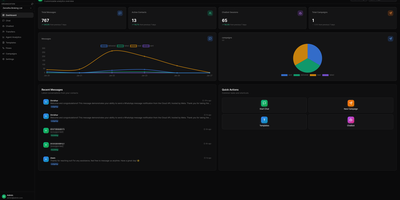
A complete WhatsApp Business Platform covering messaging, chatbot automation, and voice calling with IVR — a combination most self-hosted projects never attempt. The Fastglue/fasthttp backend processes WhatsApp Cloud API webhooks through PostgreSQL and Redis into a real-time WebSocket layer powering instant chat updates across a Vue 3 frontend built with shadcn-vue and TailwindCSS. Chatbot automation supports keyword triggers, multi-step conversation flows with branching logic, AI-powered responses from OpenAI, Anthropic, or Google models, knowledge base integration via vector stores, and seamless handoff to human agents when the bot gets stuck. The visual IVR builder uses a drag-and-drop node canvas where you wire greeting prompts, DTMF menu capture, HTTP callbacks to external APIs mid-call, business-hours routing by IANA timezone, agent team transfers with hold music, and reusable sub-flows. Every call recording streams encrypted to your S3-compatible bucket with retention you control. Multi-tenant architecture isolates organizations with separate data, roles, and API keys while a unified inbox presents both chat and call conversations to agents in a single dashboard. Meta-approved template management, bulk campaign messaging, analytics tracking, and a full REST API round out the platform. Deploy via Docker Compose with Postgres and Redis included. Running on a dedicated VPS on RepoCloud with guaranteed CPU, RAM, and SSD, full root SSH access, and a browser serial console. AGPL v3 licensed.
Bazarr
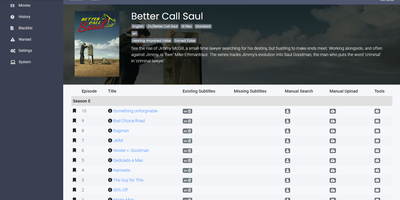
Subtitles are the one chore Sonarr and Radarr leave behind - Bazarr finishes the *arr media stack by automating them. It connects to both via their APIs and mirrors their libraries - it doesn't scan disk itself, it manages exactly what your *arr apps index. For every monitored episode and movie it checks existing internal and external subtitles against your language profiles, then hunts missing ones across dozens of providers - OpenSubtitles.com, Podnapisi, Addic7ed, Subscene, and many regional sources - covering 184 subtitle languages including forced/foreign-dialogue tracks. Matching is smarter than filename guessing: releases are compared by release group and source, some providers support exact file-hash matching, and every downloaded subtitle gets a percentage score. Set a minimum score per Sonarr/Radarr connection and Bazarr rejects weak matches; enable upgrades and it replaces previously downloaded subtitles when better ones surface. Out-of-sync files get fixed too - automatic subtitle synchronization realigns timing after download, triggered only below a configurable score threshold so good subs aren't touched. Per-show and per-movie language configuration, download history, manual on-demand search, and adaptive searching that throttles provider API calls round it out, all behind a clean Sonarr-style web UI written in Python. If your library serves multilingual viewers, this removes the last manual step.

Komga
What Jellyfin is for video, Komga is for comics, manga, BDs, magazines, and eBooks: point it at folders of CBZ, CBR, CBT, PDF, and EPUB files and it becomes a proper library with cover art, embedded metadata import, and per-user reading progress. The responsive web reader handles multiple reading modes - left-to-right for western comics, right-to-left for manga, webtoon scrolling - while collections and read lists organize crossovers and story arcs, with ComicRack .cbl read list import for existing curation. Its openness is the real differentiator: OPDS v1.2 and v2.0 feeds serve virtually every reader app (Panels, Moon+ Reader, Mihon/Tachiyomi, KyBook), with OpenSearch and page-streaming extensions so mobile apps fetch pages on demand instead of whole archives. E-ink support is built in, not bolted on - Kobo devices sync directly against Komga instead of Kobo's servers, with two-way read progress, on-the-fly KEPUB conversion via Kepubify, and optional proxying so official Kobo purchases still work; KOReader sync covers everything else. Multi-user management brings per-library access control, age restrictions, and label restrictions for family setups. Housekeeping tools detect duplicate files and duplicate pages, and a REST API feeds a healthy ecosystem of community scripts. Runs from a single Docker container with embedded SQLite.
Plunk
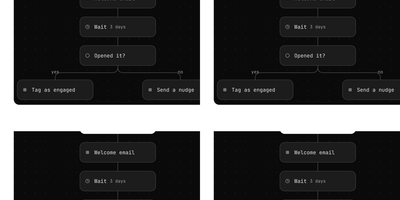
Plunk consolidates transactional emails, marketing campaigns, and drip automation into one platform riding AWS SES at roughly one-tenth of a cent per message, with zero per-contact charges regardless of list size. The Turborepo monorepo architecture separates the Express.js API server (handling REST requests with Prisma ORM against PostgreSQL) from a dedicated BullMQ worker process that consumes email, campaign, and workflow jobs independently for fault isolation and horizontal scaling. Transactional emails support HTML bodies, template variable substitution via React Email components, attachments, and custom headers with dedicated SMTP relay on ports 465 and 587 for integration with existing frameworks. The campaign system sends newsletters and product updates to full contact lists or dynamically segmented audiences based on contact properties and behavioral events, with scheduling, A/B testing, and performance tracking for opens, clicks, and bounces. The workflow automation builder creates event-triggered sequences with delays, conditional branches, and webhook steps for lifecycle campaigns like onboarding drip sequences and re-engagement flows. Contact management stores unlimited contacts with custom data fields, CSV import, full activity history, and dynamic segmentation. Custom domain verification with DKIM and SPF ensures deliverability, while inbound email processing handles incoming messages with custom routing rules. Docker Compose deployment runs five containers including PostgreSQL, Redis, MinIO for S3-compatible storage, and ntfy for notifications. Running on a dedicated VPS on RepoCloud with guaranteed CPU, RAM, and SSD, full root SSH access, and a browser serial console. AGPL-3.0 licensed.

CommaFeed
CommaFeed delivers the Google Reader experience on your own infrastructure with modern performance characteristics. The Quarkus-based Java backend compiles to native code via GraalVM, achieving sub-second cold starts and 50MB memory footprint — a fraction of traditional JVM RSS readers. Four distinct layouts (title-only, expanded, magazine, and card) with light and dark themes adapt to any reading style, while comprehensive keyboard shortcuts cover navigation, marking, starring, and feed management without touching a mouse. The Fever-compatible API and newly added Google Reader API connect native iOS and Android apps (Reeder, Unread, FeedMe, ReadKit) directly to your instance. Per-feed push notifications through ntfy, Gotify, or Pushover alert you to new articles instantly. The visual query builder for automatic read-marking rules replaces raw expression syntax with an intuitive condition editor supporting title, content, author, and URL matching. OPML import and export enable seamless migration from any RSS service. Custom CSS and JavaScript injection let power users completely restyle the interface, while the browser extension adds one-click subscription from any website. Docker images for linux/amd64 and linux/arm64 with H2 embedded database require zero configuration to start. Running on a dedicated VPS on RepoCloud with guaranteed CPU, RAM, and SSD, full root SSH access, and a browser serial console. Apache-2.0 licensed.
Prowlarr
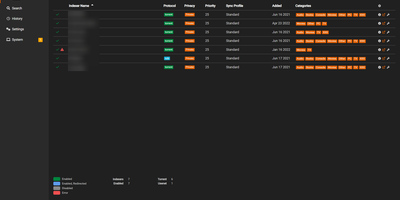
Configure each indexer once, not five times: Prowlarr is the indexer hub of the *arr stack, removing the most tedious duplication in a media automation setup. Instead of configuring the same torrent trackers and Usenet indexers separately in Sonarr, Radarr, Lidarr, Readarr, and Mylar3, you add each one once in Prowlarr and it syncs them to every connected app automatically, complete with category mappings; with Full Sync enabled, adding or removing an indexer propagates everywhere, and a tracker URL change is a one-place fix. Coverage is the deepest available: 500+ torrent trackers with definitions added constantly, 24 native Usenet indexers, generic Newznab and Torznab support for anything else, and custom Cardigann YML definitions with JSON and XML parsing for obscure sources. Built on the same .NET/React base as its siblings, it also earns a place as a search tool in its own right: unified manual search queries every indexer simultaneously at a category level, and you can push multiple releases straight to your download clients without touching Sonarr or Radarr. Health checks and status notifications flag failing indexers, per-indexer statistics track success rates and response times so you can cull unreliable sources, and per-indexer proxy support (SOCKS4/5, HTTP, FlareSolverr) handles trackers behind Cloudflare.
Dittofeed
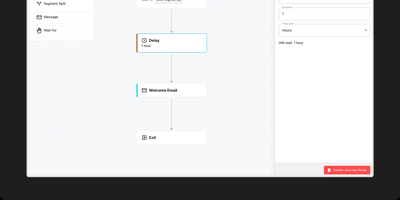
Automate transactional and marketing messages across email, SMS, mobile push, WhatsApp, Slack, and custom webhooks from a single visual journey canvas. Dittofeed provides the capabilities of Customer.io or Braze while keeping customer PII within your own infrastructure and eliminating volume-based pricing entirely. The drag-and-drop journey builder creates multi-trigger automations with branching logic, wait nodes, random cohort splits for A/B testing, and local timezone delivery without writing code. User segments combine trait conditions, event history, and array-based filtering through AND/OR operators with real-time evaluation. Template authoring supports both a low-code visual editor and direct HTML/MJML input, with templates reusable across journeys and one-off broadcasts. Data flows in through Segment integration, Reverse ETL connections, or the REST API with Web, Node.js, and React Native SDKs. Message delivery routes through SendGrid, Amazon SES, Twilio, or SignalWire with per-channel analytics tracking opens, clicks, bounces, and unsubscribes. Authentication supports Keycloak, AWS Cognito, and GCP OAuth for enterprise SSO. Embeddable iframe and headless React components let SaaS platforms white-label journey builders into their own products. Deploy on RepoCloud with a dedicated VPS for full GDPR compliance under the MIT license.
Coroot
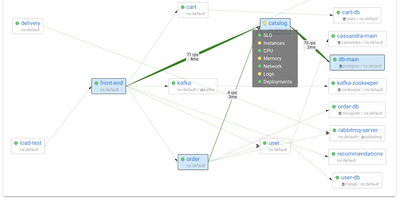
Coroot uses eBPF to capture metrics, distributed traces, logs, and continuous CPU profiles directly from the Linux kernel, delivering full observability without any application code changes, SDKs, or sidecars. From the first minute of deployment, an automatically generated service map covers every microservice, database, message queue, and external dependency with request rate, error rate, and latency measurements. When a service breaches its SLO, AI-powered inspections analyze telemetry across all dimensions to pinpoint the root cause and send a single consolidated alert with findings, replacing the flood of fragmented notifications typical of traditional monitoring. Deployment tracking automatically discovers Kubernetes rollouts and compares each release against the previous one to detect performance regressions, resource spikes, and cost impacts without CI/CD pipeline integration. Continuous profiling captures CPU flame graphs down to the line of code with negligible overhead. Integrated cost monitoring tracks cloud spending across AWS, GCP, and Azure, attributing expenses to individual services and deployments. Coroot supports Prometheus, OpenTelemetry, and ClickHouse as data sources and works identically on Kubernetes clusters, virtual machines, and bare-metal hosts. 7,700+ GitHub stars. Apache-2.0 licensed.

LibrePhotos
With over 8,000 GitHub stars and continuous development since 2020, LibrePhotos delivers the core intelligence of Google Photos — face recognition, object detection, semantic search, and automatic album generation — entirely on your own hardware without sending a single photo to a third-party server. The Django 5 backend processes uploaded media through a machine learning pipeline that runs face detection via the face_recognition library, clusters identified faces using scikit-learn and HDBSCAN, generates image captions through BLIP and Moondream 2, and classifies scenes using Places365 or Google's SigLIP 2 vision-language model with zero-shot classification against 900+ real-world tags. Semantic search lets you find photos by natural language queries like "sunset at the beach" without manual tagging, while metadata search filters by person, camera, lens, file type, and filesystem path. The React 18 frontend built with Vite presents a timeline view, fullscreen lightbox with slideshow mode, photo detail sidebar showing location and people, and a folder navigation view with breadcrumb paths. RAW files from any camera are converted via ImageMagick, videos processed through FFmpeg, and Live Photos paired with their RAW+JPEG counterparts as unified entries. Public album sharing via link provides fine-grained privacy controls, and duplicate detection uses perceptual hashing to identify near-identical images. Deployment runs as a single unified Docker container or via Docker Compose with Kubernetes manifests also available. Running on a dedicated VPS on RepoCloud with guaranteed CPU, RAM, and SSD, full root SSH access, and a browser serial console. MIT licensed.
Passbolt
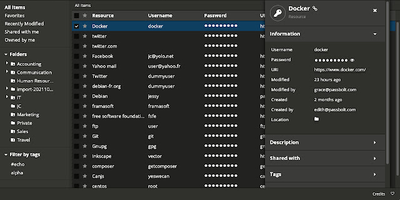
Security-conscious IT departments pick Passbolt for its cryptography: every user holds an OpenPGP key pair, and shared credentials are encrypted individually to each recipient's public key - real end-to-end encryption, not a vault password handed around. All crypto runs client-side in the mandatory browser extension (distributed and signed through the Chrome and Firefox stores, deliberately separating the crypto code from the server that stores ciphertext); private keys and passphrases never touch your instance, and the server admin cannot read a single secret. Authentication uses the challenge-based GpgAuth protocol, secrets are digitally signed to verify sender integrity, and metadata encryption extends protection to resource names and URLs. Day to day it behaves like a polished commercial manager: auto-fill and auto-save in forms, strong password generation, anti-phishing protection, TOTP storage, folder hierarchies shared per-user or per-group with fine-grained permissions and instant cryptographic revocation. Native iOS, Android, and desktop apps ship alongside a JSON API, CLI, and SDKs for CI/CD secret retrieval and rotation. The PHP server runs on MariaDB and is AGPL-licensed open source - including the paid tiers' codebase - with published security audits.
Baby Buddy
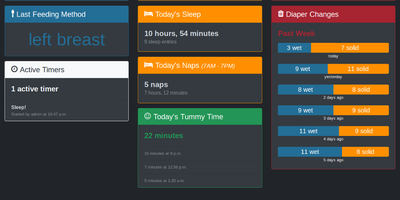
Baby Buddy is a private self-hosted child care tracker that centralizes feeding sessions, sleep cycles, diaper changes, and developmental health milestones into a collaborative dashboard for parents and caregivers. Caregivers can start quick timers on mobile devices to measure nursing intervals, bottle feedings, naps, and tummy time sessions with single-tap precision. The dashboard automatically calculates daily averages, feeding amounts, and awake windows to help families establish consistent daily sleep and feeding routines. Parents can track diaper changes by recording wetness, stool consistency, and color anomalies to spot digestive health changes early. Physical measurements including weight, height, and head circumference plot directly against World Health Organization growth curves to visualize percentile progression between pediatric visits. Multi-child profiles allow families with twins or multiple young children to switch contexts instantly and monitor individual growth timelines. Granular user permissions let parents invite nannies, babysitters, and relatives with restricted logging permissions while keeping administrative settings private. The built-in REST API and webhook system enable physical smart button clicks and home automation routines to log events instantly without opening a browser. Running on a dedicated VPS on RepoCloud with guaranteed CPU, RAM, and SSD, full root SSH access, and a browser serial console. BSD-2-Clause licensed.
Treg
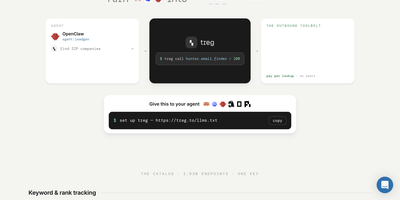
With over 330 GitHub stars and described as "OpenRouter, but for agent tools instead of models," Treg is the unified tool registry that gives your AI agent one base URL, one token, and instant access to approximately 2,800 cataloged endpoints across 56 providers — SEO and backlink analysis via Semrush and Moz, social media intelligence from TikTok and Instagram, people and company enrichment through Crunchbase and Hunter, media buying, scraping, and SERP data — all priced per call from fractions of a cent with no provider signup required. The FastAPI backend with PostgreSQL stores credential bindings and injects them server-side into every proxied request, ensuring API keys and OAuth tokens never touch the agent or local machine while every call is audit-logged. Teams register their own paid API accounts, OAuth connections, vendor CLIs like Stripe, GitHub CLI, Vercel, and gcloud, plus custom SKILL.md definitions — all callable by every teammate's agent through a single treg token with automatic credential injection. The evidence-based tool selector shows success rate, response speed, and last-seen timestamp for each provider, so agents pick tools on measured performance rather than guesswork. Bring-your-own-key routes bypass metering entirely, and the one-dollar free credit on every new team lets agents start calling immediately. The Vue.js web dashboard provides team management, audit logs, catalog browsing, and guided onboarding. Self-host with pip install tools-registry[server] on a dedicated VPS on RepoCloud with guaranteed CPU, RAM, and SSD, full root SSH access, and a browser serial console. Apache-2.0 licensed.
CPA Manager Plus
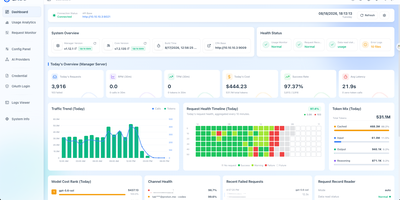
CPA Manager Plus is a self-hosted observability dashboard and management panel that tracks every AI request flowing through your CLI Proxy API gateway, breaking down failures, costs, and account health across providers like OpenAI, Anthropic, xAI, and Codex in one interface. When a request fails, drill into the persistent history to see status codes, affected models, latency, and redacted failure evidence without exposing raw response bodies. The cost analytics engine breaks down token consumption and estimated spend by model, provider, account, API key, project, channel, and time range while tracking input, output, reasoning, cache, and service-tier pricing semantics separately. Model prices sync automatically from models.dev with LiteLLM and OpenRouter fallbacks, and you can add local overrides for aliases or internal models. For teams running Codex or xAI accounts, the health inspector reads quota windows, reset evidence, credential state, and workspace status on a configurable schedule, routing credential failures into an action queue for review rather than letting them silently degrade throughput. Deploy the Lightweight Panel to replace your existing CPA management UI without adding another service, or run Full Mode as a single Docker container that adds the Manager Server with persistent SQLite storage for request history, historical analytics, and automated account inspections. Export or import request history as JSONL for external analysis, and back up the SQLite files alongside your encrypted management keys. Running on a dedicated VPS on RepoCloud with guaranteed CPU, RAM, and SSD, full root SSH access, and a browser serial console. MIT licensed.

WriteFreely
With over 5,100 GitHub stars and a proven track record powering more than 550,000 blogs on the Write.as hosted platform since 2018, WriteFreely strips blogging down to its essential purpose — writing — by removing news feeds, notifications, likes, and engagement metrics that distract from the creative process. The Go binary deploys on any platform as a single executable with SQLite for zero-dependency setups or MySQL and MariaDB for larger installations, consuming minimal system resources and running comfortably on hardware as small as a Raspberry Pi. The auto-saving Markdown editor provides a clean writing environment with instant draft preservation, while published posts render with typography-focused CSS that puts content front and center for readers. ActivityPub federation connects every blog to the fediverse, allowing Mastodon, Pleroma, and other ActivityPub platform users to follow blogs directly, receive new posts in their timelines, and boost or favorite content to their followers. Multi-blog support lets writers maintain separate blogs with distinct pen names from a single account without revealing their association, while OAuth 2.0 integration enables single sign-on onboarding from existing identity providers. Hashtag categorization organizes posts by topic, pinned posts create static pages for permanent content, and draft mode lets writers compose privately before publishing. Blog elements are localized in over 20 languages with first-class right-to-left script support for Arabic, Hebrew, and other RTL languages. Running on a dedicated VPS on RepoCloud with guaranteed CPU, RAM, and SSD, full root SSH access, and a browser serial console. AGPL-3.0 licensed.
Alf.io
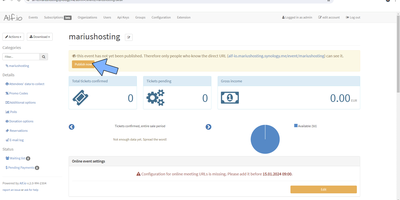
Alf.io handles the complete conference and event lifecycle from ticket distribution through check-in to financial reporting, built for organizers who refuse to surrender attendee data to third-party ticketing platforms like Eventbrite or Tito. Built on Java 17 with Spring Boot and PostgreSQL with row-level security policies, the project has earned over 1,500 GitHub stars from privacy-conscious event organizers across Europe and beyond. Payment processing supports Stripe for credit cards, Mollie for iDEAL, Bancontact, KBC/CBC, and Przelewy24, plus Revolut, PayPal, bank transfers, on-site collection, and configurable custom offline payment methods with localized instructions. Multi-tier ticket categories enable early bird, VIP, standard, and free registrations with promotional codes, group discounts, and waiting lists that automatically notify next-in-queue when cancellations occur. Customizable registration forms collect attendee data beyond standard fields, while EU VAT management validates tax IDs through the VIES web service and supports Italian e-invoicing with automatic PDF invoice generation attached to confirmation emails. The Alf.io Scan mobile app for iOS and Android performs QR code check-in at venue entrances, and the Alf.io-PI project provides Raspberry Pi-powered offline-capable check-in stations that form encrypted clusters for high-throughput badge printing at large events. Apple Wallet integration delivers digital passes via PassKit. The extensions system integrates with CRMs, accounting platforms, Slack, Telegram, and Mailjet. Multi-language support covers nine languages. Deploy via Docker with PostgreSQL. Running on a dedicated VPS on RepoCloud with guaranteed CPU, RAM, and SSD, full root SSH access, and a browser serial console. GPLv3 licensed.
Tailchat
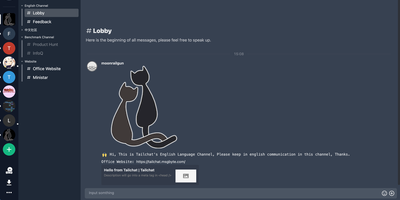
Think of it as a team messaging platform where every feature beyond core chat is a plugin you can install or remove, inspired by VS Code's extension model but applied to real-time communication. The Moleculer microservice backend scales horizontally across nodes while Socket.io delivers instant message synchronization with text, images, files, mentions, reactions, and rich Markdown formatting. Available plugins provide LiveKit video conferencing, collaborative drawing boards, task management panels, end-to-end encryption, custom themes, and third-party push notification reception without touching core code. Groups use a two-level space system with customizable panel layouts arranged through drag-and-drop, while role-based access control enforces fine-grained permissions across the organization. The Open Platform exposes OAuth for single sign-on across connected applications and a Bot API enabling bidirectional message processing between Tailchat and external services via HTTP requests. Multi-platform clients cover web, Electron desktop with screenshot capabilities, and mobile apps with native push. Docker Compose deployment bundles MongoDB for persistence, Redis for caching and transport, and MinIO for S3-compatible file storage. Deploy on RepoCloud with a dedicated VPS for persistent team infrastructure under the Apache 2.0 license.
Dawarich
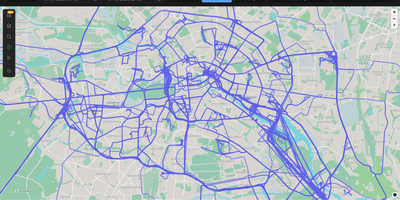
With over 9,000 GitHub stars earned since Google killed its browser-based Timeline, Dawarich fills the gap with a fully self-hosted location history platform that keeps your movement data under your control. Built on Ruby on Rails 8.0 with PostgreSQL and the PostGIS spatial extension for geometry-based queries, Dawarich imports your entire Google Takeout location archive in minutes and begins rendering interactive maps immediately. The visualization engine supports five map layers — heatmaps, points, lines, Fog of War exploration tracking, and a 3D globe view — each powered by Leaflet and spatial SQL rather than browser-side computation. Native iOS and Android apps handle background GPS tracking with offline support, automatically uploading location points when connectivity returns, while third-party integrations support OwnTracks, GPSLogger, Overland, Home Assistant, Traccar, and PhoneTrack. The trip system lets you create route visualizations between any two dates, attach notes, replay travel paths with a timeline scrubber, and share trips publicly with phrase-protected links and per-section visibility controls. Immich and PhotoPrism integrations automatically overlay geotagged photos on your maps and trips, while AirTrail integration renders flight history as arcs. Statistics dashboards break down countries visited, cities explored, total distance traveled, and active days by year and month, with visit detection suggesting places you have frequented. Running on a dedicated VPS on RepoCloud with guaranteed CPU, RAM, and SSD, full root SSH access, and a browser serial console. AGPL-3.0 licensed.