Quantum
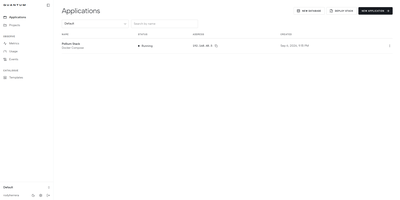
From a bare Linux server, Quantum builds and runs GitHub repositories, multi-service Docker Compose stacks, and managed databases through a self-hosted PaaS dashboard with automated webhook deployments and live container telemetry. Connect a GitHub account, pick a branch, and let the build engine compile from a Dockerfile or custom install, build, and start commands on every git push or release tag. Multi-service Compose files can be pulled from a repository or pasted into the editor, with automatic `${VAR}` placeholder detection and isolated internal networks so containers communicate by service name. Provision PostgreSQL, MySQL, MariaDB, MongoDB, and Redis instances with one-click backups, or deploy pre-configured templates for n8n, Directus, WordPress, Uptime Kuma, and Ollama. Live log streams, an interactive browser terminal, `.env` secret management, persistent volume mounts, and private registry credentials come built into every service view. Need to patch a file quickly? Clicking Open in VS Code launches a sidecar `code-server` instance mounted directly to the container filesystem. Organization and project roles enforce granular access while real-time CPU, memory, and network charts track health across 15-minute to 24-hour windows. Running on a dedicated VPS on RepoCloud with guaranteed CPU, RAM, and SSD, full root SSH access, and a browser serial console. MIT licensed.
DispatchMail
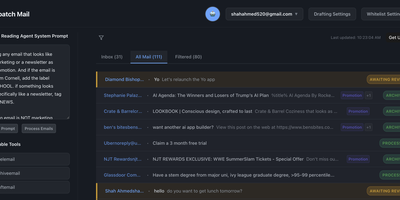
DispatchMail is an SuperHuman alternative and delivers a self-hosted AI email assistant that processes your Gmail inbox through configurable OpenAI prompts without sending data to third-party cloud services beyond the LLM API itself. The Flask backend connects to Gmail via IMAP, retrieves new messages according to your schedule, and routes them through customizable whitelist rules based on sender address, subject keywords, or natural language descriptions before AI processing begins. Two distinct prompt configurations control behavior — the Reading Prompt instructs how the AI should analyze and classify incoming messages, while the Draft Prompt defines how responses should be composed, letting you maintain consistent tone and policy across all automated replies. Whitelist filtering ensures the AI only processes messages you explicitly authorize, preventing unnecessary API costs and keeping sensitive emails out of the LLM pipeline entirely. The React web interface provides inbox management with message previews, AI-generated summaries, draft editing with human-in-the-loop approval before sending, and configuration panels for prompts and rules. Automatic labeling and archival organize processed messages into categories without manual intervention. The sender research feature uses LLM-powered deep analysis to build background profiles of email contacts. All email content, credentials, and processing results persist in a local SQLite database with zero cloud storage dependencies. Running on a dedicated VPS on RepoCloud with guaranteed CPU, RAM, and SSD, full root SSH access, and a browser serial console. Apache-2.0 licensed.
PayMe
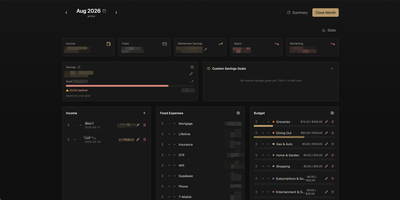
PayMe is a privacy-first personal finance dashboard that runs entirely on your own hardware with zero third-party service dependencies. The Rust backend compiled to a single binary serves a React 19 frontend built with Vite, TypeScript, and Tailwind CSS 4, storing all financial data in a local SQLite database that auto-migrates on startup. Monthly dashboards track income entries, fixed expenses like mortgage and utilities, and budget categories with real-time progress bars showing spending against configurable limits. The savings module includes goal tracking with percentage-based progress indicators, custom savings goals for targeted objectives, retirement savings projections with breakdown analysis, and projected savings calculations. Variance analysis compares actual spending against budgets across categories. Drag-and-drop reordering powered by dnd-kit lets you arrange income sources, expenses, and budget items to match your workflow. The interactive charts rendered by Recharts visualize spending trends, income patterns, and savings trajectories. Month-by-month navigation tracks financial history over time, while the Summary and Stats views aggregate data across periods. JWT-based authentication secures access, and the full OpenAPI Swagger documentation at the /swagger-ui endpoint exposes every API route for automation and integration. Docker Compose deployment creates a minimal image with the compiled Rust binary and static frontend assets, running on port 3001 behind nginx, Caddy, or Traefik reverse proxy with HTTPS. On RepoCloud, deploy PayMe on a dedicated VPS with persistent SQLite storage, root SSH access, and complete privacy over your household financial data, all under the MIT license.
LogTide
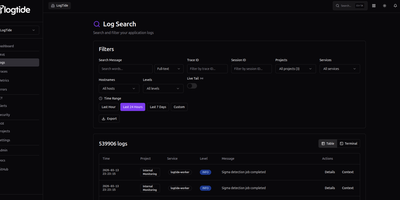
Every production incident starts the same way: someone asks "what do the logs say?" and the answer takes 45 minutes to find. LogTide collapses that search into seconds with a unified observability platform that indexes logs, traces, and metrics into a single queryable interface, backed by your choice of TimescaleDB, ClickHouse, or MongoDB. The log search interface supports full-text queries across millions of entries with filters for trace ID, session ID, project, service, hostname, and severity level, plus a live tail mode that streams new log lines as they arrive. Distributed traces render as waterfall timelines showing every span, its duration, and cross-service dependencies, while correlated logs for each trace are one click away. The metrics explorer visualizes OTLP gauge and counter data from your applications with system CPU, memory, disk, and network panels that update in near real-time. Where LogTide diverges from standard observability is its built-in SIEM engine: Sigma-compatible detection rules scan incoming logs for security threats like SQL injection, privilege escalation, lateral movement, and C2 communication, surfacing findings on a dedicated security dashboard with severity distribution, detection timelines, and affected service breakdowns. Alerting pushes notifications to Email, Slack, or Discord webhooks when thresholds trip or security rules fire. Native SDKs for Node.js, Python, Go, PHP, Kotlin, and Ruby ship logs with retry logic and circuit breakers, and the platform accepts OpenTelemetry data natively. Running on a dedicated VPS on RepoCloud with guaranteed CPU, RAM, and SSD, full root SSH access, and a browser serial console. AGPL-3.0 licensed.
Preloop
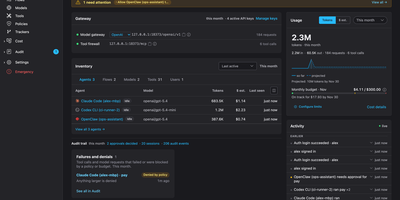
Preloop is a self-hostable control plane that governs every AI agent tool call and model call, and can run ticket-triggered agent work that returns as reviewable pull requests. An MCP firewall can allow, deny, or hold any tool call for approval, with require-justification rules written as YAML and CEL policy. Human approvals arrive on mobile, watch, Slack, Mattermost, email, webhook, or the command line, and agents can ask a person a question before continuing. The model gateway speaks OpenAI, Anthropic, and Gemini formats, applies budgets and allowed-model lists, and attributes token spend by model, agent, session, API key, flow, and user. Flows start agents from GitHub, GitLab, Bitbucket Cloud, Jira, webhooks, or CI jobs, in hosted containers or on private runners that connect over an outbound WebSocket. Twenty-one presets review pull requests, implement issues, triage tickets, scan for vulnerabilities, and collect evidence packs. Operators can steer a running agent from the console, phone, or watch with notes, then review the resulting pull request. One session timeline records tool calls, model calls, policy decisions, approvals, spend, outcomes, and synchronized recordings. Fleet Map shows people, devices, agents, models, and observed work in one view. An account kill switch blocks gateway and tool traffic and stops managed runs, with audited recovery. Running on a dedicated VPS on RepoCloud with guaranteed CPU, RAM, and SSD, full root SSH access, and a browser serial console. Apache-2.0 licensed.
1FlowBase
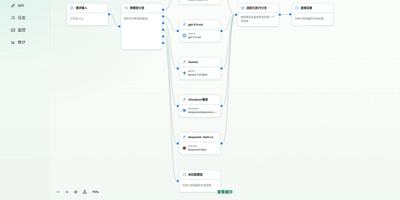
1FlowBase gives teams a single self-hosted foundation that connects model providers, retains every AI conversation, and turns that activity into working business applications. You connect OpenAI, Anthropic, Gemini, DeepSeek, Alibaba Cloud Bailian, or any OpenAI-compatible API through provider plugins and publish one stable endpoint for clients. Requests convert between Anthropic Messages, OpenAI Chat Completions, and OpenAI Responses, so applications keep working when a provider changes. You can route traffic by model name, fall back across branches when a provider fails, and combine planning, execution, and review models into a virtual model that callers use like any other model. Every gateway conversation is recorded with its model, reasoning effort, status, token totals, recorded cost, and latency, then broken down by model and by user in statistics views. You define data models and data sources, expose CRUD APIs, schedule workflows, and publish an OpenAPI 3.1 document for each application. Agents reach the same runtime through MCP with progressive list, get, and call tool discovery, and you manage MCP instances and third-party servers from the console. Pages come from native React blocks that you edit in place with a built-in AI assistant. Running on a dedicated VPS on RepoCloud with guaranteed CPU, RAM, and SSD, full root SSH access, and a browser serial console. Apache-2.0 licensed.
LangGraph GUI
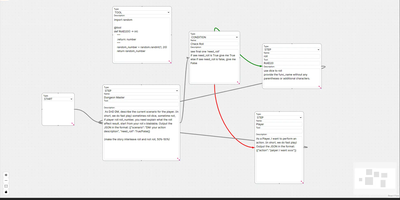
Building LangGraph agents in code means imagining the graph; LangGraph GUI turns that graph into something you draw, wire, and run from the browser instead. You place a start node, add step nodes, and drag edges between ports to define the flow, with cycles created by simply connecting nodes back toward each other. Condition nodes split execution into green true paths and red false paths, info nodes append context to stage output, and subgraph nodes run a whole named graph inside another one. Tool steps call real Python functions that you define in tool nodes with the familiar decorator style, so file saving, lookups, and custom logic sit inside the visual flow. Graphs save to JSON on your computer, load back for editing, and upload to the server as workflow files ready to execute. You configure which LLM to use and its API key in the panel, run against local models through Ollama or hosted APIs, then download every file the run produced in the workspace. Files upload to the server workspace as working environment, and a cache clean clears it between runs. Example graphs for role-playing loops, lottery branch switches, and tool-using flows show patterns you can copy and refine with your own prompts. Running on a dedicated VPS on RepoCloud with guaranteed CPU, RAM, and SSD, full root SSH access, and a browser serial console. MIT licensed.
Dim0
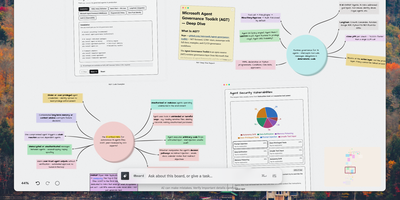
What if the whiteboard could read everything pinned to it and hand you back finished work, which is exactly the workspace Dim0 builds on your own server? One infinite board holds rich notes, hand-drawn and geometric shapes, images, documents, code sandboxes, and nested boards, all editable in place by a whole team at once with live cursors. The built-in agent sees the current board and your selected nodes, takes multi-step actions with its tools, and drops the answer back onto the canvas as a note, a mind map, or a working mini-app instead of burying it in a chat thread. Describe a tool in plain words and Dim0 generates a real interactive React app that lives on the board, reads the data sitting next to it, and can be opened, edited, and exported as code. Code nodes run in sandboxes, uploaded documents become searchable through retrieval, and presentation frames turn any board into a slideshow without exporting to a separate deck tool. You bring your own model keys for OpenAI, Anthropic, Gemini, Mistral, DeepSeek, or Qwen and switch providers whenever you like. Boards holding thousands of nodes still pan and zoom smoothly, and light, dark, and paper-and-ink themes restyle the whole surface. Running on a dedicated VPS on RepoCloud with guaranteed CPU, RAM, and SSD, full root SSH access, and a browser serial console. MIT licensed.
Jetlog
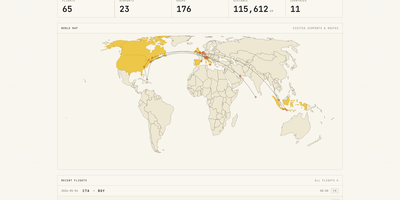
A personal flight logbook you host yourself, Jetlog draws every route you have flown on a pannable world map and turns the totals into charts. The home page opens with counts of flights, airports, hours, distance, and countries above that map, where dots mark visited airports and lines trace each trajectory. Settings let markers and lines grow with visit frequency and shade the countries where you have landed. Logging a flight takes only two airports and a date. Type a flight number and press Fetch to pre-fill the origin, destination, and airline, and a utility links connection flights automatically. Duration and distance are calculated for you and stay editable, with an option to use airport time zones. The All Flights table lists route, times, duration, distance, seat, class, and airline with filters and configurable columns, and each flight opens a detail page with airport data, a route map, tail number, and aircraft. A Statistics page charts flights per month, cumulative distance, most visited airports, most common airlines, ticket class, and seat for any time frame. History arrives through MyFlightRadar24 or custom CSV imports and leaves as CSV or iCal. Family members can share one install with separate logbooks, an admin manages the accounts, and the responsive layout works on a phone at the gate. Running on a dedicated VPS on RepoCloud with guaranteed CPU, RAM, and SSD, full root SSH access, and a browser serial console. GPL-2.0 licensed.
CaddyUI
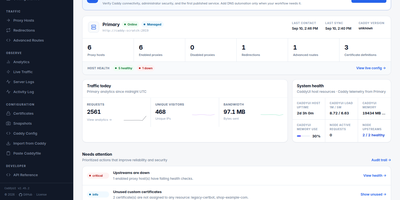
Providing an intuitive control plane for modern reverse proxy infrastructure, CaddyUI enables system administrators to manage proxy hosts, automated TLS certificates, and traffic routing without hand-editing configuration files. Operators can create and adjust reverse proxy destinations, URL path rewrites, custom headers, and redirection rules using structured forms that validate against the proxy engine before saving. The platform coordinates automatic ACME certificate requests and renewals, displaying live certificate expiration timelines, validation stages, and internal self-signed certificate authority options for local network services. Fleet management tools synchronize proxy rules across multiple distributed server instances, preventing configuration drift across staging and production clusters. Automated post-deployment health checks verify upstream endpoint availability, HTTP status codes, and latency thresholds, instantly rolling back to the previous configuration if an expectation fails. An integrated observability suite delivers real-time visitor traffic analytics, geographic maps, HTTP response code breakdowns, and single-click client IP blocking to counter malicious probing attempts. Administrators can schedule automated database backups, configure multi-user access with role permissions, and integrate CrowdSec threat intelligence to protect backends. Running on a dedicated VPS on RepoCloud with guaranteed CPU, RAM, and SSD, full root SSH access, and a browser serial console. Apache 2.0 licensed.
Codra
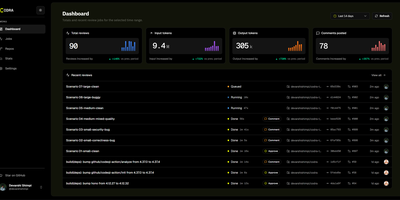
Your GitHub pull requests get reviewed by your own models, with inline findings posted in the merge flow: Codra is a self-hosted AI code review engine, so your diffs and credentials stay inside infrastructure you control. Connect a repository once and every opened, synchronized, ready-for-review, or reopened pull request starts a queued review job automatically; mention Codra for an on-demand pass instead. Findings arrive as inline GitHub comments, a summary review, and check run updates that fit the normal merge flow. Each repository gets its own review personality: triggers, skipped paths, draft handling, mention reviews, labels, custom rules, and a review budget are all tuned from the dashboard, and model routing follows global defaults, per-repository chains, fallbacks, and size-based overrides for larger pull requests. Providers from OpenAI, OpenRouter, Anthropic, Google, NVIDIA, and Cloudflare are managed behind GitHub OAuth sign-in. The operator dashboard tracks totals for reviews, input and output tokens, and comments posted, then drills into job history, webhook deliveries, failed queue runs, and model usage, so a stalled review is debuggable instead of invisible. Deploy the whole loop (GitHub App, web server, queue, database, and dashboard) on Cloudflare Workers, on Node.js 24, or with Docker on your own server. Running on a dedicated VPS on RepoCloud with guaranteed CPU, RAM, and SSD, full root SSH access, and a browser serial console. AGPL-3.0 licensed.
Vintrack
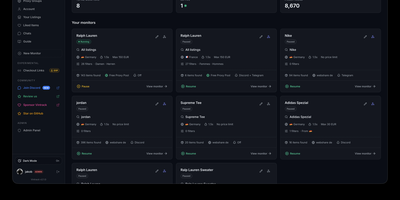
The jacket you want at the price you want sells in minutes, so Vintrack watches Vinted around the clock and pings you the moment a matching listing appears. You build monitors around the searches you actually run, choosing the regional market and narrowing by price range, category, brand, color, clothing or shoe size, condition, and seller country. Matching items stream into a live dashboard feed as they surface, and the same matches can land in Discord through per-monitor webhooks or in Telegram through a connected bot, with rich or compact alert layouts per channel. Regional proxy pools keep catalog checks running, with personal groups for dedicated capacity and health-scored shared pools showing which regions are ready before you rely on them. If you link a Vinted account you control through the browser extension, you can go further without leaving the flow: like items, send offers, message sellers, browse wardrobes, and open checkout for the finds worth acting on. Roles separate free, premium, and admin users on shared instances, sign-in runs through Discord OAuth or any standard OIDC provider, and bounded logs keep a busy instance from eating its own disk. Running on a dedicated VPS on RepoCloud with guaranteed CPU, RAM, and SSD, full root SSH access, and a browser serial console. MIT licensed.
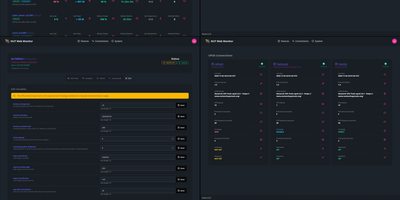
NUT WebGUI
When the power blinks at 3 a.m., NUT WebGUI is the page that tells you whether the UPS in the closet is coasting or dying, without a serial cable in sight. Point it at one or several Network UPS Tools servers and it polls charge, load, input voltage, and estimated runtime, refreshing critical status every couple of seconds while background variables update on a calmer thirty-second cadence. The dashboard renders device cards, gauges, sparklines, and a topology view of how units chain together, and it stays readable on a phone when you are standing in front of a humming rack. Authorized users can issue instant commands, set variables, or trigger a forced shutdown from the browser, while everyone else gets a strictly read-only view. A JSON API under /api serves device lists, variables, and instant commands to your own scripts, health and readiness probes fit container orchestrators, and OpenMetrics output feeds Prometheus without extra exporters. The whole thing is a single small binary that runs happily on a Raspberry Pi, an old ARM board, or a RISC-V box, reads one TOML file, and supports multi-user sign-in with scoped API keys when you share it with a team. Running on a dedicated VPS on RepoCloud with guaranteed CPU, RAM, and SSD, full root SSH access, and a browser serial console. Apache-2.0 licensed.
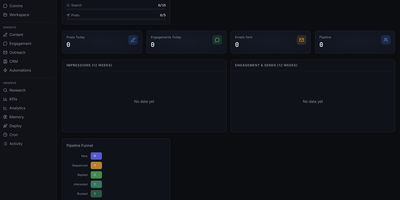
Marketing Dashboard
This is a marketing operations control center that replaces fragmented CRM, outreach, content, and analytics tools with a unified self-hosted interface designed for AI agent-assisted go-to-market teams. The CRM module manages leads through a configurable pipeline funnel with stages from New through Sequenced, Replied, Interested, and Booked, tracking source attribution, industry segments, company size, lead quality scores, and LinkedIn URLs per contact. Outreach sequencing supports email campaigns with pause controls, audit endpoints, suppression workflows, and engagement tracking. The content operations surface provides calendar views, content item management, performance metrics, and approval queues for editorial control. Analytics and KPI dashboards show impressions, engagement, and send volumes over configurable time periods, with optional connectors to Plausible, Google Analytics 4, X, and LinkedIn for cross-platform reporting. The OpenClaw-native agent runtime enables dynamic agent and squad discovery, workspace management, session monitoring, and communications surfaces. Automation scheduling uses cron job templates with OpenClaw-compatible schedule variants including cron expressions, every intervals, and at timestamps. The tech stack combines Next.js 16 App Router with React 19, Tailwind CSS 4, Recharts, and Zustand for state management. Authentication supports session cookies, API keys, and optional Google OAuth with role-based access controls. All state persists locally in SQLite via better-sqlite3 with no required external infrastructure. On RepoCloud, deploy Marketing Dashboard on a dedicated VPS with persistent SQLite storage, root SSH access, and complete control over your marketing operations data, all under the MIT license.
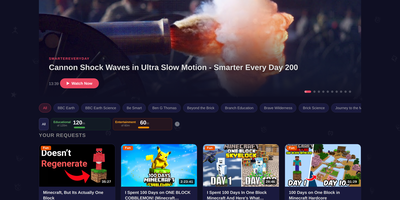
BrainrotGuard
BrainRotGuard puts a parent between YouTube's recommendation engine and your kid: children search freely, but nothing plays until you tap Approve in Telegram. The request that lands on your phone carries the thumbnail, title, channel, and duration, and one tap either starts the video on the child's tablet instantly or denies it for good. Channels you trust can be allowlisted as educational or entertainment so their new uploads arrive pre-approved, while blocked channels and title word filters stop repeat offenders automatically. Each child gets a profile with its own PIN, watch history, and time budgets, and educational and entertainment content can draw from separate daily limits. Scheduled windows keep the app closed during school hours or after bedtime, with different rules per weekday and bonus minutes grantable for today only. Approved videos stay in a library the child can rewatch without asking again, a dedicated Shorts row can be shown or switched off entirely, and a search-off mode limits younger kids to channels and videos you already approved. You see all of it from the parent side: pending queues, search history, and an activity log of what was watched and for how long. Running on a dedicated VPS on RepoCloud with guaranteed CPU, RAM, and SSD, full root SSH access, and a browser serial console. MIT licensed.
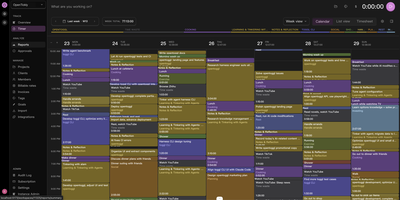
OpenTickly
OpenTickly is a self-hosted Toggl alternative that keeps your timers, projects, clients, and reports on infrastructure you control, so tracking time does not mean renting access to your own work history. Start the timer from the web app or an installable mobile PWA that works offline, then review the week in a color-coded calendar, switch to list or timesheet views, or open reports to see where hours actually went. Projects, clients, tags, billable rates, invoices, goals, and favorites organize entries the way agencies and freelancers already work, with team activity, top projects, and time-by-project panels on the admin overview. Because the public API mirrors Toggl Track v9 and Reports v3, existing scripts, integrations, and reporting jobs carry over, and coworkers can move their Toggl data in or back out without losing entries. The generous API also suits AI workflows: pair it with toggl-cli and an agent can track, organize, and review your time for you, then combine it with the Lyubishchev method to spot time waste across learning, social, rest, and work categories. Approvals, an audit log, integrations, and instance administration round out team operations, and seat limits, per-user fees, and usage caps simply do not exist here. Running on a dedicated VPS on RepoCloud with guaranteed CPU, RAM, and SSD, full root SSH access, and a browser serial console. AGPL-3.0 licensed.
AgentVerse OS
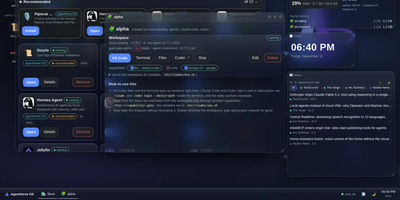
AgentVerse OS turns a single Ubuntu server into a personal cloud with a real desktop in the browser, built for a developer and their AI agents. You work in a windowed desktop with a taskbar, start menu, and widgets for system monitoring, clock, news, weather, and projects, and the same desktop opens from a laptop, tablet, or phone while everything stays on the server. Each project gets an isolated Incus container with Docker inside, its own network and gate, plus VS Code, a terminal, files, and git in the browser. The Agents app runs Claude Code, Codex, Gemini CLI, pi, and Antigravity inside the workspace, with permission prompts you approve from any device, scheduled routines, model menus, conversation search and export, and a ledger of what each session spent. When you close your laptop the agents keep working, and you pick the conversation up later exactly where it stopped. A built-in store merges the Runtipi, Coolify, and Umbrel catalogs into about 945 installable apps with guided setup, credentials shown in the app card, snapshots, and rollback. Projects request capabilities such as storage.s3, llm, or notify instead of hardcoding addresses, scheduled ZFS snapshots feed a restic backup repository, and access arrives only through your Tailscale network with real certificates. Running on a dedicated VPS on RepoCloud with guaranteed CPU, RAM, and SSD, full root SSH access, and a browser serial console. Apache-2.0 licensed.
OpenSuperBot
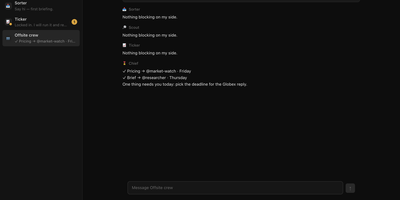
Always-on AI teammates that each get a real computer of their own, with a browser, files and a terminal, working from your hardware instead of a vendor cloud: that is OpenSuperBot. You hire a teammate from the sidebar with a name and a one-line job, and it works inside its own sealed computer with a browser, shell and persistent workspace. At a login wall the bot asks you to take over its live screen and sign in once inside its own browser profile, so passwords never pass through the gateway. Group threads let you ask the whole room at once: everyone answers in parallel, the chief of staff closes with a dispatch table, and @names pick which teammates respond. Nothing leaves the workspace without your say-so, because outward actions stop at a draft-and-hold approval chip. Standing approvals cover repeat sends to one destination for an hour or a day, and money and bookings always ask. Memory is a visible file you control: tell a bot a rule and it posts the exact change as a chip, and forget removes it the same way. Routines come from plain conversation, so a daily digest, a secret webhook trigger or a quiet status-page watch can be scheduled in chat. Each teammate runs a model you pick, with daily token budgets and live step cards for every action. Running on a dedicated VPS on RepoCloud with guaranteed CPU, RAM, and SSD, full root SSH access, and a browser serial console. MIT licensed.