Autobase
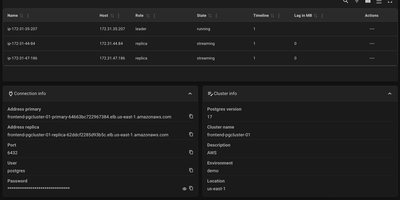
Provisioning, scaling, and maintaining production-grade PostgreSQL clusters becomes completely automated with Autobase, an internal database-as-a-service control plane. Through a unified web console, database administrators provision multi-node replication topologies, execute non-disruptive minor version updates, and orchestrate automated failovers without manual intervention. Operators can configure continuous physical backups and point-in-time recovery to S3-compatible object storage, ensuring resilient disaster recovery for mission-critical workloads. The integrated dashboard provides granular visibility into cluster topology, replication lag, connection pool saturation, and query throughput across primary and replica instances. Teams can scale read capacity on demand by provisioning dedicated read replicas and load-balanced query endpoints managed by intelligent routing layers. Comprehensive backup verification routines run scheduled restore rehearsals to confirm data integrity before emergencies occur. Automated maintenance playbooks handle index reindexing, vacuum scheduling, and parameter tuning without requiring custom shell scripts. Running on a dedicated VPS on RepoCloud with guaranteed CPU, RAM, and SSD, full root SSH access, and a browser serial console. MIT licensed.
Shaper
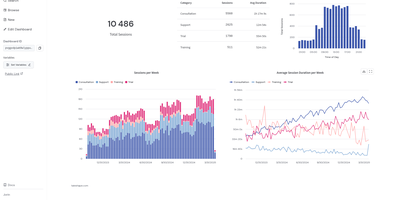
Write standard SQL queries and watch Shaper turn them into interactive dashboards, scheduled reports, and customer-facing analytics widgets without maintaining a heavy business intelligence stack. Every query maps directly to a visual component through simple type casts like BARCHART, LINECHART, GAUGE, BOXPLOT, or DROPDOWN. Analysts can attach external PostgreSQL and MySQL databases, read Parquet, CSV, JSON, and Excel files straight from S3 object storage, or stream live events into the HTTP ingest API. Interactive filter controls let viewers slice metrics by date ranges, multi-select dropdowns, and dynamic parameter variables that automatically re-evaluate downstream charts. Teams version-control their entire reporting layer as plain SQL files in Git, making dashboard updates auditable in pull requests and simple for AI coding assistants to generate. Product engineers embed white-labeled analytics directly into customer web apps without iframes, issuing per-tenant JWT tokens to enforce row-level data isolation. Need scheduled deliverables for stakeholders? Configure SQL-driven background tasks that transform datasets on a cron schedule, send threshold alerts to Slack or Microsoft Teams, and generate downloadable PDF, PNG, Excel, or CSV reports. External collaborators can also view live metrics through password-protected sharing links. Running on a dedicated VPS on RepoCloud with guaranteed CPU, RAM, and SSD, full root SSH access, and a browser serial console. MPL-2.0 licensed.
Azimutt
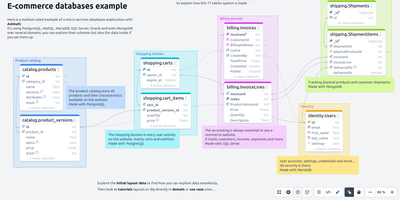
Inheriting a sprawling database with hundreds of undocumented tables usually means weeks of guesswork, unless you open it in Azimutt to visually map schemas, trace relationships, and inspect live rows in one workspace. Instead of dumping every table onto a cluttered canvas that crashes your browser, the visual explorer starts clean so you can search across entity names, column types, and SQL comments to reveal only the tables relevant to your investigation. Clicking foreign-key or primary-key indicators expands incoming and outgoing relations step by step, while the graph path-finder automatically calculates the shortest join route between any two distant entities. When debugging production issues or answering support tickets, you can query live records across PostgreSQL, MySQL, MariaDB, SQL Server, Oracle, SQLite, MongoDB, Couchbase, Snowflake, and BigQuery, then click directly through foreign keys in the result rows to follow data lineage visually. Architects and developers also design new schemas at typing speed using Azimutt Markup Language (AML), attach contextual markdown notes, tags, and memos to saved layouts for team onboarding, and run automated schema analysis that flags missing primary keys, implicit foreign keys, inconsistent column types, and oversized tables. Running on a dedicated VPS on RepoCloud with guaranteed CPU, RAM, and SSD, full root SSH access, and a browser serial console. MIT licensed.
Velld
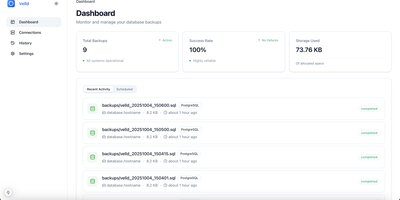
Database administrators and backend engineers managing production PostgreSQL, MySQL, MariaDB, MongoDB, and Redis instances use Velld to centralize scheduled backups, storage retention, and disaster recovery in a single self-hosted control plane. You can register multiple database connections across staging and production environments, test connectivity with one click, and route traffic through encrypted SSH bastion tunnels using password or private-key authentication to reach isolated private subnets. Flexible cron schedules and preset hourly, daily, weekly, or monthly intervals automate snapshot creation, while configurable retention policies purge expired archives from local volumes or S3-compatible object storage buckets after seven, fourteen, thirty, or ninety days. An integrated backup comparison tool renders split or unified line-by-line diffs between any two snapshots so you can inspect schema changes or data drift before triggering a guided database restore or downloading compressed dump files. The real-time monitoring dashboard tracks backup completion rates, total storage consumption, and execution histories alongside automated email and webhook alerts that notify your team immediately if a scheduled job fails. Running on a dedicated VPS on RepoCloud with guaranteed CPU, RAM, and SSD, full root SSH access, and a browser serial console. MIT licensed.