Karma
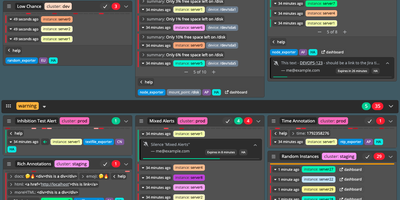
When an alert fires on any of your Prometheus Alertmanagers, Karma shows it once, on one filterable dashboard, and lets you acknowledge or silence it from there. Identical alerts from different servers merge into one entry tagged with every server that saw it, HA pairs included. Groups follow the group_by settings of your Alertmanager routes, and shared labels and annotations collapse into a footer. Multi-grid mode gives each value of a label, or each Alertmanager, cluster, or receiver, its own grid, keeping production and staging apart. Configurable label colors make hosts and severities easy to spot. Optional history draws 24 hourly blocks per group from the Prometheus servers that fired it, and an inhibited alert's muted button lists whatever is suppressing it. One click acknowledges an alert with a short-lived silence, and the separate kthxbye daemon can keep extending it until the alert resolves. The silence modal creates, edits, and expires silences, and ticket IDs in comments can become links. A Dead Man's Switch check raises a visible error when the alerting pipeline goes quiet. Basic auth or a proxy's header identifies each user, silence ACLs stop one team from silencing another's alerts, and read-only mode disables silence management. Default filters open the view your team triages first, and light and dark themes follow the browser. Running on a dedicated VPS on RepoCloud with guaranteed CPU, RAM, and SSD, full root SSH access, and a browser serial console. Apache-2.0 licensed.
Mail-Archiver
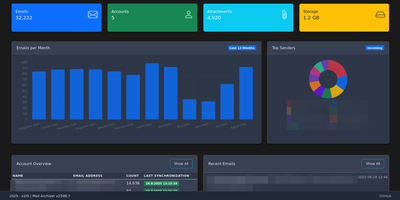
Across personal mailboxes and business domains alike, Mail-Archiver captures, indexes, and preserves every incoming and outgoing email from multiple IMAP and Microsoft 365 accounts in a tamper-resistant archive. Connect standard IMAP servers, Microsoft 365 business tenants via Microsoft Graph, or personal Outlook and Hotmail accounts using OAuth2 device code flow without creating custom cloud app registrations. Scheduled background synchronization mirrors complete folder hierarchies automatically, while bulk tenant onboarding lets administrators import every active mailbox from a Microsoft 365 organization through a single configuration screen. When an important contract, invoice, or correspondence thread goes missing, the advanced search interface filters archived messages by sender, recipient, subject, date range, folder, and body text with instant HTML preview and direct attachment downloads. Users can import legacy MBox files or zipped EML archives, export selected messages or entire accounts, and run direct mailbox-to-mailbox migrations that copy folder trees between providers. Granular retention rules optionally purge aged messages from upstream mail servers to free quota while keeping local archive copies locked against manual deletion for compliance auditing. Multi-user access controls, OpenID Connect single sign-on, detailed activity audit logs, a scoped read-only REST API, and a Model Context Protocol endpoint allow both teams and AI assistants to query historical mail safely. Running on a dedicated VPS on RepoCloud with guaranteed CPU, RAM, and SSD, full root SSH access, and a browser serial console. GPL-3.0 licensed.
Reitti
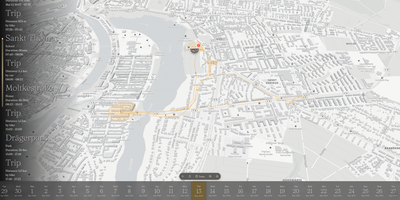
Reitti turns raw GPS coordinates from your phone and fitness trackers into an interactive daily timeline and private map that replaces Google Timeline and Life360 without sending your movement history to third-party clouds. Every coordinate you record is analyzed automatically to detect stationary visits, recognize significant places, and classify trips between walking, cycling, and driving with exact duration and distance metrics. Stream real-time updates from OwnTracks, GPSLogger, Overland, or Home Assistant, or upload historical archives from GPX files, GeoJSON, Google Takeout, and Google Timeline exports. Switching between a smartphone and a dedicated cycling computer never fragments your history. The visual workbench lets you stitch multi-device recordings across any time range, drag misplaced GPS points into position on the map, and delete signal outliers with a single click. Connect a self-hosted Immich server so geotagged photos appear directly alongside the routes and stops where you captured them. Turn memorable trips into narrative travel logs with customizable text, map, and photo blocks. Need to coordinate a meetup or share your arrival time? Share live positions with family members on the same server, federate across trusted instances, or send revocable magic links to friends without accounts. Customize your view with custom vector styles from MapTiler or Stadia Maps and explore movement statistics across top destinations. Running on a dedicated VPS on RepoCloud with guaranteed CPU, RAM, and SSD, full root SSH access, and a browser serial console. AGPL-3.0 licensed.
Krawl
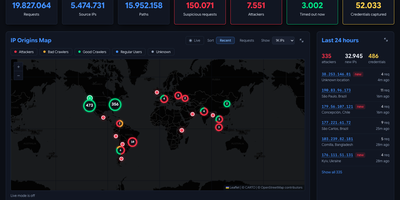
Leave a fake door unlocked and see who walks through: Krawl is a self-hosted honeypot that poses as a sloppy web server and records everything scanners and scrapers try. Fake WordPress, phpMyAdmin, and admin logins. Every attempt logged, every credential captured. A .env file leaking fake database strings, AWS keys, and Stripe secrets. SQL injection, XSS, path traversal, XXE, and command injection traps that answer with believable fake output. SQLMap gets a different database error on every request. Malicious crawlers wander an endless maze of random links. An optional tarpit adds delay and word salad that cost scrapers time, storage, and tokens. Optional AI-generated pages write a plausible decoy for any path an attacker requests. A hidden dashboard shows an attacker map, top IPs, captured credentials, and per-IP forensics. TLSH fuzzy hashing groups webshell variants into campaigns. A behavior score labels each IP attacker, bad crawler, good crawler, or regular user. Export bans as raw lists, iptables, or nftables rules, with guides for Fail2Ban, OPNsense, and RouterOS. A canary-token link in decoy pages emails you the IP and user agent of anyone who follows it. Running on a dedicated VPS on RepoCloud with guaranteed CPU, RAM, and SSD, full root SSH access, and a browser serial console. MIT licensed.
DEEIX Chat
Organizations deploying multiple large language models across departments use DEEIX Chat as their centralized AI workspace for model routing, multimodal conversations, document retrieval, MCP tool execution, and usage governance. Administrators connect upstream channels across OpenAI, Anthropic, Google Gemini, xAI, and OpenRouter protocols while configuring route priorities, traffic weights, and automatic circuit breaking from a unified control plane. Team members switch models mid-conversation, branch message threads, adjust reasoning effort, and generate images or video without managing individual API keys, or optionally bring their own provider keys under admin policy rules. Uploaded PDFs, spreadsheets, and images undergo OCR and semantic chunking so users can attach personal or shared knowledge bases directly to chat sessions with traceable retrieval evidence. Interactive responses render live HTML, SVG, Mermaid diagrams, KaTeX math, and stateful parameter sliders inside a sandboxed preview pane alongside the conversation. Built-in support for Streamable HTTP Model Context Protocol servers lets users discover and invoke external tools with per-message execution limits and full call inspection. Integrated permission groups, OIDC single sign-on, TOTP two-factor authentication, token and per-call billing ledgers, and audit logs give operators complete visibility over usage and spend. Running on a dedicated VPS on RepoCloud with guaranteed CPU, RAM, and SSD, full root SSH access, and a browser serial console. Apache-2.0 licensed.
Parca
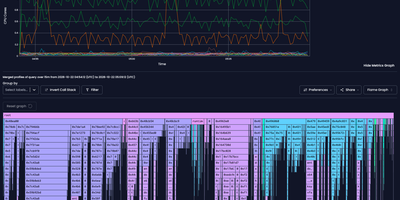
A flight recorder for production code, Parca profiles CPU and memory continuously and keeps the history to query after something breaks. A slow memory leak or a momentary CPU spike is already on record by the time anyone looks. Point it at any service that exposes pprof endpoints, or deploy the eBPF-based Parca Agent to profile every process on a Linux host or Kubernetes node without touching application code. The agent covers C, C++, Rust, Go, and more. In the web UI, pick a profile type such as on-CPU, narrow it with Prometheus-style label selectors, sum or group by any label, and click a point on the time series to open its flame graph. Switch the same query to a table, add extra panels, or try the alpha Flame Chart and Sandwich views. After a deploy, open the Compare page, set two queries side by side by label or time range, and the functions that gained or lost CPU time stand out as a diff. Native binaries are symbolized from uploaded debuginfo or upstream debuginfod servers. Recent releases add support for OpenTelemetry eBPF profiler profiles and GPU profile types. Optional persistence keeps history across restarts, and a Prometheus-style scrape configuration with service discovery decides what gets profiled. Running on a dedicated VPS on RepoCloud with guaranteed CPU, RAM, and SSD, full root SSH access, and a browser serial console. Apache-2.0 licensed.
Circuit Breaker
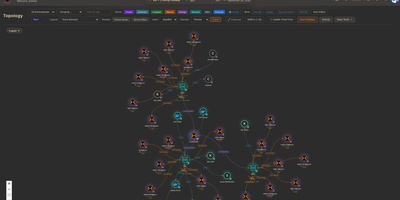
Mapping every physical server, virtual machine, container, and network link across a sprawling homelab into a live interactive canvas, Circuit Breaker gives infrastructure operators real-time topology visualization, IP address management, and rack elevation modeling on a single screen. Operators can switch between hierarchical, concentric, cortex ring, radial, and force-directed graph layouts where animated edges reflect link speeds and color-coded status rings display live hardware health. Automated discovery scans local subnets using nmap, SNMP, and ARP while querying Proxmox VE clusters, TrueNAS storage pools, and UniFi controllers, staging newly detected nodes in a review queue before adding them to the map. For multi-site labs or isolated VLANs, lightweight remote agents connect outbound over Noise-encrypted links after fingerprint approval to report host telemetry and run scoped network scans without opening inbound firewall ports. Rack diagrams let administrators drag servers into U slots with cabling overlays using a built-in catalog covering Dell, HPE, Supermicro, Ubiquiti, MikroTik, Synology, and APC gear alongside live iDRAC, iLO, and UPS metrics. Role-based access control, OIDC single sign-on, TOTP multi-factor authentication, encrypted full-state snapshots, and a SHA-256 hash-chained audit log keep multi-user operations accountable. Running on a dedicated VPS on RepoCloud with guaranteed CPU, RAM, and SSD, full root SSH access, and a browser serial console. MIT licensed.
MDCz
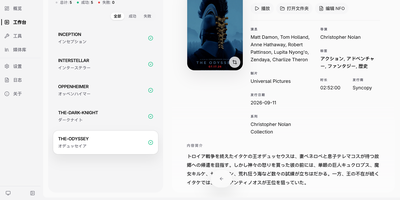
Messy video folders become a clean, browsable library with MDCz, a metadata scraper and organizer that prepares local movie files for Emby, Jellyfin, and Kodi. Point it at a folder and it recognizes titles from filenames, then pulls metadata, high-resolution covers, stills, and cast information from sources including DMM, FC2, AVBase, JavBus, JavDB, MGStage, and Prestige. Each finished title gets a standard NFO file beside the video, so your media server shows rich detail pages instead of bare filenames. The batch workbench queues folders of files, shows a diff preview of every rename before anything changes, and reports success and failure per title. Actor names arriving under different aliases from different sources merge into one canonical name with your own mapping rules. Segmented releases, STRM stream files, and external subtitle files move together with the main video during renaming. Built-in tools check for duplicate titles, apply rule-based renaming, and maintain existing library data. Run it as the Docker WebUI on your NAS at port 3838, or use the desktop builds for Windows, macOS, and Linux. Running on a dedicated VPS on RepoCloud with guaranteed CPU, RAM, and SSD, full root SSH access, and a browser serial console. GPL-3.0 licensed.
Mainsail
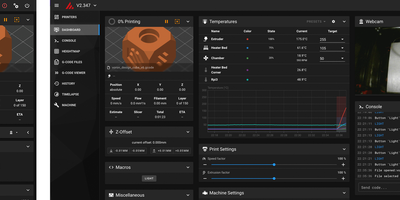
Controlling Klipper-powered 3D printers from a single browser workspace, Mainsail delivers a responsive web interface for monitoring print jobs, tuning kinematics, and managing multi-printer farms in real time. Makers and print farm operators monitor extruder and heated bed temperatures, fan speeds, and toolhead coordinates live on customizable dashboard layouts. An integrated file manager and syntax-highlighted editor let you upload G-Code directly from your slicer, organize print job queues, and modify Klipper configuration files (`printer.cfg`) without opening an SSH terminal. Interactive 3D visualizations render bed mesh heightmaps for first-layer leveling diagnostics alongside a real-time 3D G-Code toolpath viewer that tracks layer progress. Multi-webcam streaming, automated timelapse recording through `moonraker-timelapse`, Spoolman filament spool tracking, and mid-print object exclusion help salvage multi-part plates when a single model detaches. You can also organize parameterized Klipper macros, switch smart relays or Tasmota power plugs, and audit historical job success rates and filament consumption. Running on a dedicated VPS on RepoCloud with guaranteed CPU, RAM, and SSD, full root SSH access, and a browser serial console. GPL-3.0 licensed.
Quantum
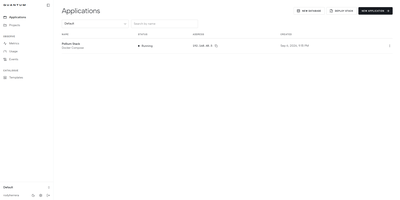
From a bare Linux server, Quantum builds and runs GitHub repositories, multi-service Docker Compose stacks, and managed databases through a self-hosted PaaS dashboard with automated webhook deployments and live container telemetry. Connect a GitHub account, pick a branch, and let the build engine compile from a Dockerfile or custom install, build, and start commands on every git push or release tag. Multi-service Compose files can be pulled from a repository or pasted into the editor, with automatic `${VAR}` placeholder detection and isolated internal networks so containers communicate by service name. Provision PostgreSQL, MySQL, MariaDB, MongoDB, and Redis instances with one-click backups, or deploy pre-configured templates for n8n, Directus, WordPress, Uptime Kuma, and Ollama. Live log streams, an interactive browser terminal, `.env` secret management, persistent volume mounts, and private registry credentials come built into every service view. Need to patch a file quickly? Clicking Open in VS Code launches a sidecar `code-server` instance mounted directly to the container filesystem. Organization and project roles enforce granular access while real-time CPU, memory, and network charts track health across 15-minute to 24-hour windows. Running on a dedicated VPS on RepoCloud with guaranteed CPU, RAM, and SSD, full root SSH access, and a browser serial console. MIT licensed.
RabiRoute
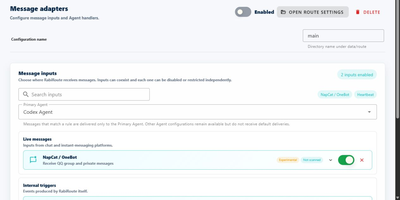
Which agent should answer a question that just arrived in your QQ group, and how much of the conversation should it see? RabiRoute is the self-hosted message gateway that answers those routing questions before your agent ever wakes up. Chat messages from QQ groups and direct chats (through NapCat and OneBot), webhooks, schedules, voice, desktop selections, and device events all arrive at one gateway, and message Routes decide which agent or local program receives each one. Every role keeps its own message history plus references to plans, memories, and skills, while each Route limits how many recent messages travel with a delivery. Roles can also fire agents on interval, time-window, daily, or one-time schedules, or run a configured local script, so recurring checks and reports happen without anyone typing a prompt. Replies to QQ, RabiLink, and other channels leave through a single sending API that validates targets, quoted messages, and sender identity, then records receipts for everything delivered. The Windows desktop side adds selected-text actions, screenshots, and annotations; speech, phone, glasses, wearable, and remote-computer clients connect as experimental integrations, and the Linux Host serves the Manager and browser WebGUI from a Node.js process. Running on a dedicated VPS on RepoCloud with guaranteed CPU, RAM, and SSD, full root SSH access, and a browser serial console. MIT licensed.
neTV
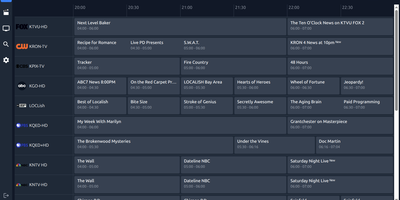
neTV turns any Xtream Codes or M3U IPTV subscription into a clean, fast player that you host yourself and open from a browser, iPhone, iPad, Apple TV, Mac, or Chromecast. The EPG grid guide shows what is on now and next, and catchup lets you browse earlier listings, replay a program from the beginning, or start over a show already airing, with timeline seeking whenever your provider keeps an archive. Intelligent Handoff lets you switch off the living room TV mid-match and resume on your phone from the exact moment you stopped, because the server keeps the stream going until the program ends. Movies and series arrive with metadata, seasons, episodes, and resume points, while search accepts regular expressions and favorites support drag-and-drop ordering alongside playlists that you build on the web and see in every app. Smart passthrough remuxes h264 and AAC streams without re-encoding, and NVENC or VAAPI hardware transcoding serves low-latency HLS to clients that need it. Owners of an NVIDIA GPU can switch on real-time 4K AI upscaling that lifts 1080p channels above 70 frames per second on an RTX 5090. A separate gateway port exposes your live sources as an Xtream-compatible endpoint for other native players, with per-user source access and stream limits. Running on a dedicated VPS on RepoCloud with guaranteed CPU, RAM, and SSD, full root SSH access, and a browser serial console. Apache 2.0 licensed.
Your Spotify
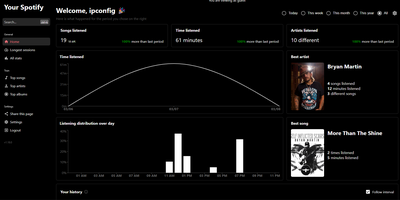
To explore years of personal music streaming habits without waiting for an annual year-end summary, Your Spotify continuously tracks your listening history and presents it inside a private analytics dashboard. Music enthusiasts use the interface to inspect daily, weekly, monthly, and custom date-range breakdowns of their most played tracks, top artists, favorite albums, and total listening duration. Listeners who want their complete historical archive from day one can upload official Spotify privacy data exports, including both past-year StreamingHistory JSON files and multi-year Extended Streaming History archives, directly through the settings panel. Friends and family sharing an instance can use the collaborative affinity view to compare overlapping listening habits across multiple accounts in intersection or union mode. From any historical table, top-tracks ranking, or multi-user affinity comparison, you can generate new playlists directly inside your Spotify account or trigger track playback on active devices. Administrators can manage user registrations, generate shareable public guest tokens for read-only dashboard access, blacklist specific artists from skewing statistics, and expose ingestion metrics to Prometheus. Running on a dedicated VPS on RepoCloud with guaranteed CPU, RAM, and SSD, full root SSH access, and a browser serial console. GPL-3.0 licensed.
MinusPod
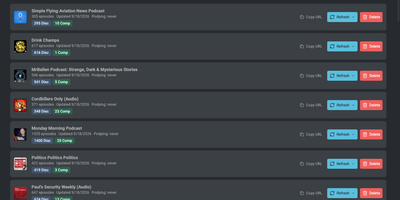
Eliminating repetitive sponsor reads and dynamic mid-roll commercials before an episode even reaches your headphones, MinusPod operates as a self-hosted podcast ad-removal server and RSS feed manager. You subscribe to shows inside the web dashboard using PodcastIndex search or OPML import, and the server generates clean replacement RSS feeds compatible with Pocket Casts, Overcast, Apple Podcasts, and Audiobookshelf. When a new episode drops via scheduled polling or instant Podping notifications, the pipeline transcribes the audio locally with faster-whisper or Parakeet, or routes it through a remote transcription API. Your choice of LLM provider, including Ollama, Anthropic Claude, OpenRouter, or any OpenAI-compatible endpoint, scans overlapping transcript windows to pinpoint sponsor reads, cross-promotions, and intros. Programmatic audio analysis reinforces AI detection by measuring EBU R128 loudness jumps, Chromaprint acoustic fingerprints, show jingles, and dynamically inserted ad transitions before FFmpeg splices the audio or marks segments as skippable Podcasting 2.0 chapters. A browser-based Ad Editor lets you audition pre-cut and post-cut audio, nudge start and end timestamps, and confirm detections that train global, network, and show-specific sponsor patterns. Running on a dedicated VPS on RepoCloud with guaranteed CPU, RAM, and SSD, full root SSH access, and a browser serial console. MIT licensed.
Cronmaster
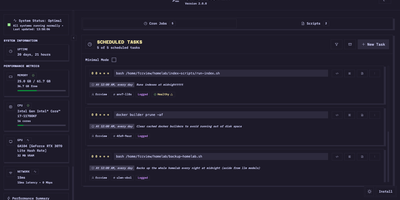
Silent background task failures and scattered crontab files across Linux hosts make routine maintenance risky, which Cronmaster solves with a visual scheduling dashboard and live execution log viewer. Five-field cron expressions translate automatically into plain English alongside one-click schedule presets. Operators can create, comment, clone, pause, or delete scheduled jobs across single or multiple Linux users in seconds. A built-in script manager lets you write, duplicate, and organize reusable Bash scripts from starter templates right inside the browser. Turning on per-job execution logging wraps commands automatically to record standard output, standard error, start and finish timestamps, duration, and exit codes. Log retention policies keep disk usage bounded automatically. Long-running tasks stream their console output live over Server-Sent Events, and any job can be triggered on demand with a single click. Across the top of the workspace, real-time hardware telemetry cards report system uptime, CPU load, memory consumption, network throughput, and GPU utilization. Administrators can protect the interface with local password authentication, OpenID Connect single sign-on with group and role rules, or Bearer API keys for the full REST API. Running on a dedicated VPS on RepoCloud with guaranteed CPU, RAM, and SSD, full root SSH access, and a browser serial console. AGPL-3.0 licensed.
Tome
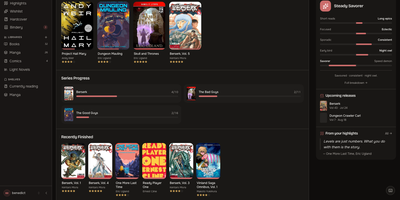
Tome is a self-hosted ebook library that knows how you read, not just what you own, syncing your place between an e-reader and the browser while turning every session into statistics. Its TomeSync plugin for KOReader records time on page, pages turned, and device, then syncs positions bidirectionally and works fully offline, queuing sessions until you reconnect. Browse and bulk-download whole series from the e-reader menu, with stable book IDs keeping history intact when files change. Reading stats grow sharper the more you read: streaks, time-of-day heatmaps, pace, completion estimates, author affinity, and per-book breakdowns fill three insight tabs. The built-in reader opens EPUBs with themes and font controls, manga in page, spread, or webtoon scroll modes with RTL support, and PDFs directly. Volumes group into series with arcs and status badges, so a forty-volume saga reads as one story. Metadata arrives from Hardcover, Google Books, and OpenLibrary with a side-by-side diff and cover picker. A Bindery inbox reviews incoming files before they join the library, and the OPDS catalog serves KOReader, Panels, or any OPDS client with per-user PINs. Admin, member, and guest roles govern per-book visibility behind API tokens. Running on a dedicated VPS on RepoCloud with guaranteed CPU, RAM, and SSD, full root SSH access, and a browser serial console. AGPL-3.0 licensed.
Norish
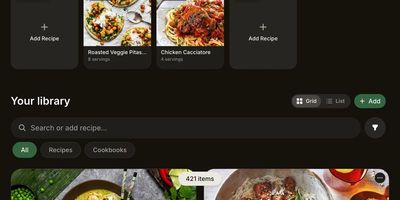
Planning weekly dinners across a busy household becomes effortless with Norish, a real-time recipe manager, meal planner, and smart grocery list platform that captures dishes from any link, video, or cookbook photo. Families and roommates can paste a food blog URL, drop in a YouTube Short, Instagram Reel, or TikTok link, or snap up to ten photos of handwritten recipe cards to generate a clean, structured dish with automatic tags, cuisines, and allergen alerts. When you drag meals onto the shared household calendar or sync your schedule over CalDAV, every ingredient flows into a live grocery list that remembers which supermarket aisle or store each item belongs to and automatically excludes staples already sitting in your pantry inventory. Splitting up in the supermarket aisles works seamlessly because checked-off items disappear on your partner's phone screen the instant you tap them, even across fifteen supported interface languages. In the kitchen, step-by-step cooking mode keeps your screen awake, embeds countdown timers directly inside preparation steps, links fractional ingredient quantities to the exact step where they are used, and scales servings or swaps between metric and US measurements with a single tap. Automatic macro calculations powered by USDA FoodData Central and CIQUAL databases break down calories, protein, carbohydrates, and fat per serving. Running on a dedicated VPS on RepoCloud with guaranteed CPU, RAM, and SSD, full root SSH access, and a browser serial console. AGPL-3.0 licensed.
slskd
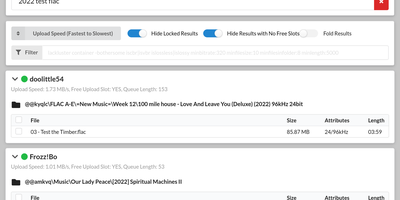
Across peer-to-peer music and file-sharing communities, slskd brings the Soulseek network into any modern web browser through a self-hosted client-server daemon that runs continuously without a desktop GUI. Users can run multiple concurrent network searches, filter results by audio bitrate, file extension, free upload slots, or transfer speed, and queue entire album folders for download in two clicks. The real-time transfer monitor groups active downloads and uploads by peer and directory, allowing you to inspect your live queue position, retry stalled files, or clear completed batches at a glance. For library contributors, the share manager indexes local directories with custom regex exclusion rules and configurable user groups that enforce per-group upload slot allocations, bandwidth caps, and automated leecher blacklists. Built-in social tools let you browse remote user directory trees, auto-join public Soulseek chat rooms on startup, and exchange private messages directly inside the web interface. Multi-server operators can even link a central controller to remote relay agents to distribute file sharing and search workloads across separate machines. When transfers finish or system state changes, event-driven integrations can fire custom HTTP webhooks, execute post-processing shell scripts, upload files via FTP, or expose Prometheus metrics and CIDR-restricted REST API endpoints for external media managers. Running on a dedicated VPS on RepoCloud with guaranteed CPU, RAM, and SSD, full root SSH access, and a browser serial console. AGPL-3.0 licensed.