Timon
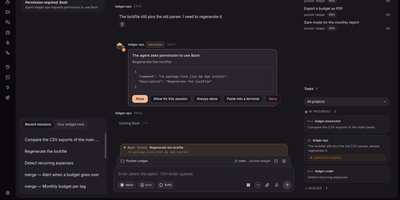
Describe a software job in plain words, and Timon's orchestrator splits it into tasks for a coder, a reviewer, and a merger working in parallel. Each coding task gets its own git worktree, a second model reviews the diff and sends it back when it falls short, and the merger runs the full test suite before landing the branch. A Kanban board tracks briefs, priorities, dependencies, and scheduled start times through pending, in progress, done, and blocked statuses. Agents ask before they push, publish, or delete anything, through clickable questions and permission cards, and secrets stay out of their sight. Work runs on the Claude Code, Codex, Copilot, Grok, opencode, Pi, and Hermes command line tools you already sign in to, and a mission moves to the next backend when one subscription runs dry. Memory carries a rule learned once into the next mission, and a crashed mission resumes from its recorded turns and tool calls. Routines, cron schedules, and webhook triggers run overnight series paced to your quotas. Each mission gets an isolated browser with annotations and recordings, voice dictation turns speech into requests, and the agents answer from a browser, a phone, Telegram, or the command line. Widgets, pages, themes, and layouts install as signed plugins without a restart, and agent roles are plain fields you can rename or extend. Running on a dedicated VPS on RepoCloud with guaranteed CPU, RAM, and SSD, full root SSH access, and a browser serial console. AGPL-3.0 licensed.
AI Maestro
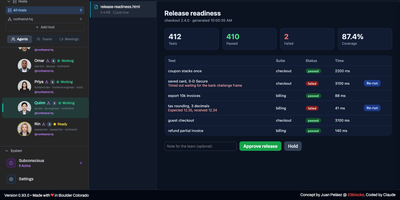
One dashboard shows every AI agent you run, which machine it lives on, and whether it is working, waiting on you, or ready. Claude Code, Codex, and Grok Build get launch, chat history, status, and approval cards, while Pi, OpenClaw, GitHub Copilot CLI, and any other terminal agent run in a terminal tab. Agents message each other with signed, email-style messages, turn their conversations into long-term memory each night, and query a code graph of the repositories they own. Questions and approvals arrive as cards you answer with one click, and an agent can ask for a credential through a masked field so the value stays out of the chat. Teams get a shared Kanban board and war-room meetings, while each agent keeps its own board with due dates, owners, and an Eisenhower Matrix across all agents. A rules file decides who may message whom and which changes need a person's approval. Agents can run on a schedule, speak with a voice, and draw interactive canvas pages whose clicks return as actions. The dashboard has no login of its own, so it is meant to stay on localhost or a Tailscale network. Running on a dedicated VPS on RepoCloud with guaranteed CPU, RAM, and SSD, full root SSH access, and a browser serial console. MIT licensed.
Myrlin Workbook
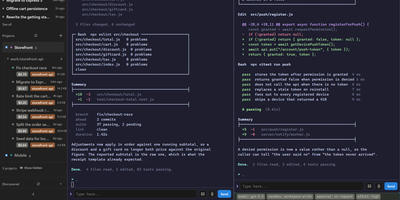
One browser sidebar lists every Claude Code and ChatGPT Codex conversation on your machine, and Myrlin Workbook opens each in a live terminal. Sessions are read, never modified, from the folders both CLIs write to, then grouped by project with a Recent list and Ctrl+K search. Panes tile two or four up and replay their history after a page refresh. Agent CLIs keep no scrollback, so wheeling past a pane's top continues into the recorded conversation, and one drag selects an hour of output. Codex projects and titles match the ChatGPT desktop app, and every Codex session shows its model, reasoning effort, approval policy, and sandbox. Token counts are priced per model where a price exists and totaled per session and project for any day, week, month, or all time. On the five-column task board, each card gets its own branch, worktree, and session, then opens a pull request through the GitHub CLI. A conflict center flags sessions editing the same files. Session templates save a working directory, model, and flags for one-click launches. Each project keeps Notes, Goals, Tasks, Rules, and Roadmap docs in a markdown editor. The phone layout has five tabs, an Attention badge, and a ring for sessions waiting on you. A random password is generated on first launch, and a LAN address or Cloudflare tunnel reaches the server. Running on a dedicated VPS on RepoCloud with guaranteed CPU, RAM, and SSD, full root SSH access, and a browser serial console. AGPL-3.0 licensed.