RankMe
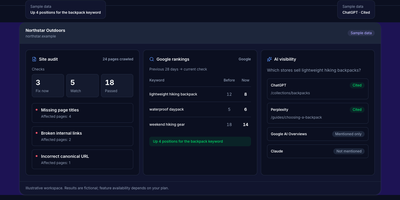
RankMe puts the whole SEO workbench on your own server: audits, rankings, keywords, backlinks, and AI visibility without a per-seat subscription deciding what you may check. Crawl a site and it runs 26 automated checks, returning a plain-language report sorted into Fix now, Watch, and Passed, where each finding names the page, explains in one sentence why it matters, and tells you how to fix it, with an optional AI summary on top. Rank tracking follows Google organic positions over time plus Bing, YouTube, and Amazon, watches SERP features, fires confirmed-drop alerts, and maps local rankings on a geogrid. Keyword research covers volume, difficulty, trends, and SERP-overlap clustering, while Search Console data feeds cannibalization reports and connects to GA4, PageSpeed Insights, and CrUX for performance context. Backlink profiles, link-gap analysis, toxic-link review, and competitor discovery show who links to rivals and which content earns it. A dedicated AI visibility module tracks prompts in AI Overviews and LLM answers and measures share of voice in a weekly digest. Agencies get PDF and CSV exports, scheduled white-label client reports, read-only share links, a REST API, and an MCP server, with alerts delivered by email, Slack, or signed webhook across seven interface languages. Running on a dedicated VPS on RepoCloud with guaranteed CPU, RAM, and SSD, full root SSH access, and a browser serial console. AGPL-3.0 licensed.
Open SEO
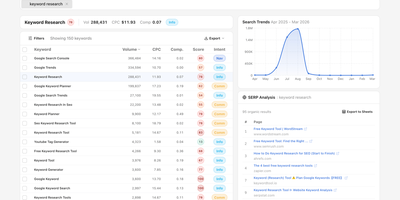
OpenSEO provides an alternative to the $100+/month SEO suite monopoly by connecting directly to DataForSEO APIs on a pay-as-you-go basis — you bring your own API key and pay only for the queries you actually make. The platform delivers focused workflows for keyword research with volume, difficulty, CPC, intent, and live SERP inspection; rank tracking with historical position monitoring; backlink analysis with referring domain quality scoring; technical site audits that crawl pages and surface issues; competitor insights comparing SERP positions across keyword sets; and AI visibility monitoring that tracks brand mentions, citations, and prompts across AI models. The integrated MCP server exposes all tools to AI coding agents including Claude Code, OpenClaw, Hermes, and Cursor, while Agent Skills provide reusable SKILL.md workflows that guide agents through complex SEO research tasks. Google Search Console integration reads first-party performance data including clicks, impressions, CTR, and position metrics with URL-level index status inspection. The Prompt Explorer compares how different AI models respond to SEO-relevant queries. Self-host via Docker for personal use or deploy to Cloudflare for team access with automatic database backups. The hosted version at openseo.so adds a 28% markup on DataForSEO requests. Running on a dedicated VPS on RepoCloud with guaranteed CPU, RAM, and SSD, full root SSH access, and a browser serial console. MIT licensed.
GEOFlow
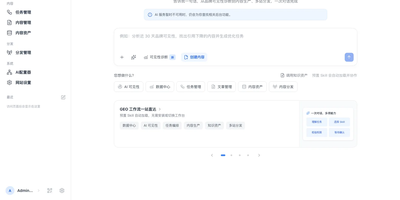
Built for brands that want AI search engines to quote them, GEOFlow is an open-source admin system that turns approved knowledge into reviewed articles and publishes them across every site you run. Load documents or import trusted web pages into knowledge bases that are chunked into evidence units, with optional semantic planning and vector retrieval. Combine them with title libraries (AI can draft up to 100,000 titles), keywords, images, authors, and prompts, then set a task's generation limits, cadence, and publishing scope. Chat and embedding models connect through OpenAI-compatible endpoints or native Gemini, with automatic fallback to the next model when a call fails. Each draft passes an AI quality gate that checks evidence, citations, advertising rules, and publishing context, records scores with source locations and revision advice, and holds risky articles for a human reviewer. Approved articles appear on the built-in site with SEO metadata, Open Graph, Schema, sitemaps, and llms.txt, or travel to hosted subdomain sites, GEOFlow Agent packages, WordPress through its REST API, or any HTTP endpoint. A manual publishing workbench and Chrome assistant cover platforms that need a person, while analytics track traffic, AI crawlers, and brand visibility in generative engines. An API, command-line tool, and agent skill support automation. Running on a dedicated VPS on RepoCloud with guaranteed CPU, RAM, and SSD, full root SSH access, and a browser serial console. AGPL-3.0 licensed.
SerpBear
Unlimited domains, unlimited keywords, daily Google position checks with stored history and trend charts: SerpBear is an open-source search engine rank tracker. Retrieval works through your choice of third-party SERP APIs - ScrapingAnt, ScrapingRobot, SerpApi, SearchApi, HasData - or your own proxy IP pool, and a flexible scrape-strategy system (Basic, Custom, or Smart, set globally or per domain) works around Google's removal of the 100-results-per-page parameter by choosing how many pages to check per keyword. Google Search Console integration adds real visit counts, impressions, and click-through rates per tracked keyword and surfaces top-performing pages and countries; Google Ads integration supplies monthly search volumes and auto-generates keyword ideas from your site's content. Email notifications report position changes daily, weekly, or monthly, a built-in REST API feeds dashboards and reporting tools, and data exports to CSV. Built with Next.js on SQLite, deployed via Docker, installable as a PWA on mobile - with no per-keyword or monthly SaaS fees.
SEOnaut
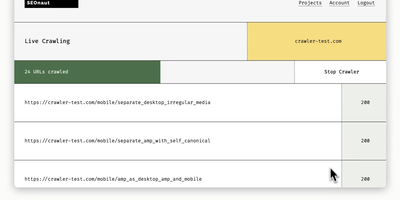
More than 70 automated checks sniff out broken links, redirect chains, and missing meta tags across your whole site, and SEOnaut, the self-hosted SEO audit crawler, sorts every finding into critical, alert, or warning so you know what to fix first. Add a website as a project, press Crawl Now, and watch URLs stream in with their status codes; a Stop button ends any run that wanders off. Reports also cover duplicate titles and descriptions, heading order, hreflang, canonicals, image alt text, thin content, orphan pages, and non-HTTPS URLs, while a passed-checks list shows what is already healthy. Dashboard charts follow crawl history, issue trends, status codes, link types, and page depth. Crawl options are set per project: ignore robots.txt, follow nofollow links, include noindex pages, read the sitemap, allow subdomains, check external links, or authenticate with HTTP Basic to audit a password-protected staging site. Page Details opens any URL with its inlinks, outgoing links, redirections, and images, and URL Explorer searches the crawled pages by term. Export sitemap.xml, CSV lists, or a replayable WACZ archive. Each person picks a light or dark theme and one of five interface languages. Running on a dedicated VPS on RepoCloud with guaranteed CPU, RAM, and SSD, full root SSH access, and a browser serial console. MIT licensed.