Guaardvark
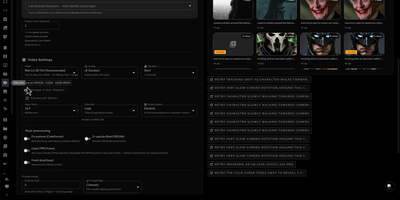
Guaardvark is a complete AI studio that lives on your own GPU, so chat, retrieval, agents and media generation happen on hardware you own instead of a metered cloud account. Upload documents and question them through local retrieval that fuses keyword and vector search, reranks candidates, and cites the passages behind each answer, with the chunks and scores visible for inspection. Plan mode turns a request into an approve-or-edit plan card before tools run, and approved steps execute one at a time with a pause on failure. Screen agents receive a desktop of their own, see it through a vision model, and operate a real browser while the operator watches from any page. Coding swarms split a task across parallel agents in separate git worktrees and merge results back in dependency order. The generator bench covers thirteen local video models, image models for generation, editing, inpainting and upscaling, full songs with vocals, sound effects and three text-to-speech engines, with consent required before any voice clone or public post. Character, environment and prop LoRAs train from a few reference photos and keep the same character consistent across images and films. A GPU orchestrator with a live VRAM budget schedules renders, chat and training so jobs stop competing for the card. Running on a dedicated VPS on RepoCloud with guaranteed CPU, RAM, and SSD, full root SSH access, and a browser serial console. MIT licensed.
NovelVids
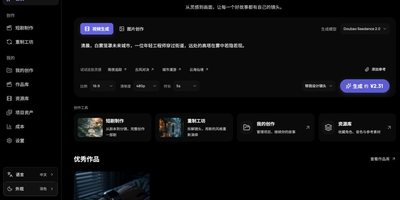
Short dramas and illustrated stories come together in NovelVids, a workbench that carries a project from manuscript import to assembled episode. Import a TXT, Markdown, DOCX, or PDF manuscript, review the chapter boundaries and story analysis, then develop the story chapter by chapter. Characters, locations, and props live in an asset library with reference images, aliases, variants, and voice bindings that stay linked to every shot. The storyboard editor holds shot descriptions, complete prompts, reference media, and generation parameters, and each generated result lands beside its inputs for inspection. An infinite canvas connects assets, videos, and enhanced results, and you can switch between storyboard and workflow views of the same project. Ask the creation assistant to revise selected objects, inspect the recorded diffs, and undo supported edits before anything regenerates. Start image or video clips from the home page by choosing a model, attaching reference images, video, or audio, and reviewing the estimate first. Remake studio analyzes reference videos you are authorized to use and converts their shots into an editable project. Track generation tasks and versions, assemble finished episodes, and optionally enhance resolution at the end. Running on a dedicated VPS on RepoCloud with guaranteed CPU, RAM, and SSD, full root SSH access, and a browser serial console. MIT licensed.
DramaClaw
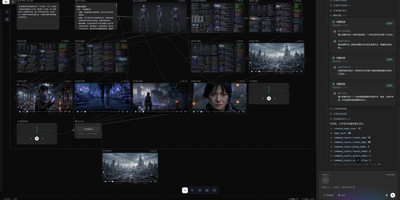
DramaClaw is a self-hosted production line that carries a manuscript or screenplay all the way to a finished AI drama, handling story structure, characters, storyboards, voices, and final cuts inside one workspace. Drop in a novel manuscript or a Fountain screenplay and it builds episodes, characters, and scenes for you, then plans multi-episode arcs and writes scripts in adaptive, literal, or staged modes with review-and-repair loops. The shared asset library keeps every character, scene, prop, and voice organized once, so faces stay consistent across episodes while portraits and per-episode variants handle costume and age changes. Storyboards and first frames are generated beat by beat, emotion-aware voice-over is synthesized per character, and episodes are assembled and exported with subtitles and the full asset pack. For finer control, the XiaHua canvas gives you 18 node types for images, video, audio, scripts, and 3D sets, with a wall of 45 short-drama styles and tools for relighting, outpainting, upscaling, and camera moves. Xia Director, the built-in agent, turns a plain-language brief into a node graph, runs it with progress tracking, and can promote winning results from the canvas back into the series. You pick the models: paste an official gateway key, or route Seedance, Kling, Hailuo, Sora, ComfyUI, and other channels through the bundled gateway, while external agents drive the same pipeline over MCP. Running on a dedicated VPS on RepoCloud with guaranteed CPU, RAM, and SSD, full root SSH access, and a browser serial console. Elastic License 2.0 licensed.
Biniou
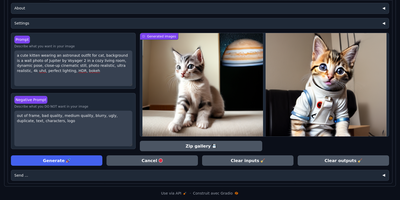
Thirty generative AI tools behind one login on your own server: that is Biniou, a self-hosted studio for making images, text, music, video, and 3D objects without sending a prompt anywhere else. The chatbot module runs GGUF language models locally, a multimodal variant sees images, Whisper transcribes speech, and a translation module covers 200 languages. Image work spans text-to-image across Stable Diffusion, SDXL, Flux, PixArt, and Kandinsky model families, plus img2img, inpainting, outpainting, ControlNet, face swapping, upscaling with Real-ESRGAN, and face restoration with GFPGAN. Music arrives from MusicGen, MusicLDM, AudioGen, and Bark voice generation, video from Modelscope, AnimateDiff, and Stable Video Diffusion, and Shap-E turns text or images into 3D shapes. Modules hand outputs to each other, so a generated caption can become a prompt and a still can become a clip. Everything runs from 8GB of RAM with no dedicated GPU, works offline once models are downloaded, and a control panel inside the interface handles updates, restart, authentication, network access, and one-click sharing. Models are managed from the same panel, generation settings are saved as metadata in every file, and CUDA acceleration is there when hardware allows. Running on a dedicated VPS on RepoCloud with guaranteed CPU, RAM, and SSD, full root SSH access, and a browser serial console. GNU General Public License v3.0 licensed.
OpenMontage
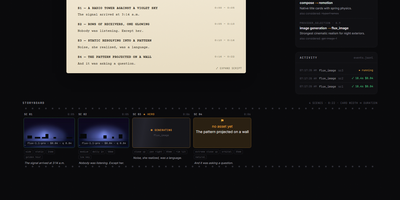
Reaching #1 on GitHub Trending with over 48,000 stars, OpenMontage is the first open-source agentic video production system — transforming AI coding assistants like Claude Code, Cursor, Copilot, Windsurf, and Codex into complete video studios that handle research, scripting, scene planning, asset generation, editing, and final rendering through natural language prompts. Twelve production pipelines cover animated explainers, cinematic trailers, documentary montages, talking heads, screen demos, podcast repurposing, character animation, localization and dubbing, avatar spokesperson videos, hybrid productions, clip factory batch processing, and animation workflows. Over 100 registered Python tools connect to 60+ providers including Kling, Runway Gen-4, Google Veo 3.1, FLUX, Google Imagen 4, ElevenLabs, and Suno AI for cloud generation, plus Piper TTS, WAN 2.1, Hunyuan, and CogVideo for fully local GPU rendering — while free footage from Archive.org, NASA, Wikimedia Commons, Pexels, and Unsplash powers the documentary montage pipeline's CLIP-indexed retrieval system for real-motion video without paid generation APIs. Two composition engines — Remotion for React-based programmatic video and HyperFrames for HTML/GSAP motion graphics — render final output with spring animations, word-level captions, kinetic typography, and SVG character rigs. A seven-dimension scored provider selector, pre-compose validation gates, post-render ffprobe self-review, slideshow risk scoring, configurable budget caps with per-action approval thresholds, and the Backlot live web dashboard for visual production monitoring enforce production-grade quality at every stage. Running on a dedicated VPS on RepoCloud with guaranteed CPU, RAM, and SSD, full root SSH access, and a browser serial console. AGPL-3.0 licensed.
Mix Studio
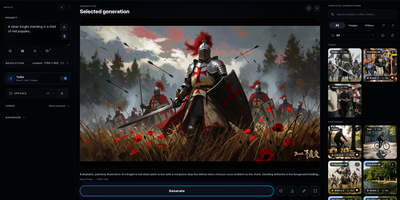
Mix Studio gives ComfyUI a calm, touch-friendly workspace where image and video generation happens through focused controls instead of a fresh node graph for every job. The Create view runs curated families including Krea 2, Flux 2 Klein, and Qwen Image with exact resolution, seed, batching, LoRA, and prompt enhancement controls. Region mode places aspect-correct boxes on the canvas, each carrying an independent prompt, LoRA stack, and reference image, then resolves them into one coherent generation. Edit mode combines whole-image editing, identity editing, and multi-reference Remix flows with masks, inpainting, outpainting, and source preservation. Video workspaces cover text-to-video, first and last frame control, reference-to-video, character animation, face lipsync, and motion transfer driven by a trimmed performance clip. An experimental photo-to-3D path turns a picture into an orbit video and a Gaussian splat you can view interactively and export. Upscaling pairs synchronized pan and zoom with a movable before-and-after divider for detail inspection. The Library keeps generations and uploads searchable with folders, groups, metadata, reusable settings, recoverable trash, and ZIP export, and separate profiles can carry PIN access. Live queue progress, cancellation, guided setup with dependency checks, and automatic backups keep daily operation orderly. Running on a dedicated VPS on RepoCloud with guaranteed CPU, RAM, and SSD, full root SSH access, and a browser serial console. GPL-3.0 licensed.
ComfyUI
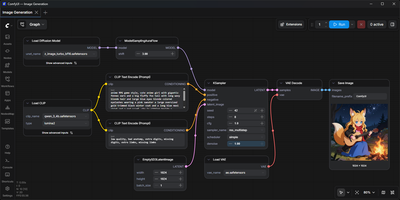
With over 126,000 GitHub stars and adoption across professional studios, research labs, and independent creators, ComfyUI has become the most widely used node-based interface for generative AI workflows — supporting image, video, audio, and 3D content creation through a single visual canvas. The graph editor natively supports Stable Diffusion 1.5, SDXL, SD3.5, Flux.1, Flux.2, HunyuanDiT, Lumina Image 2.0, HiDream, Qwen Image, and Pixart for image generation, plus Wan 2.1 and 2.2, LTX-Video, HunyuanVideo 1.5, CogVideoX, and Mochi for video, ACE-Step and Stable Audio for audio, and Hunyuan3D 2.0 for 3D models. Built-in tools handle inpainting, outpainting, ControlNet conditioning, LoRA and Hypernetwork loading, ESRGAN upscaling, area composition, model merging, and GLIGEN spatial control without writing code. The execution engine implements asynchronous queue processing with partial graph re-execution, running only changed nodes between iterations, and smart VRAM management that offloads models on GPUs with as little as 1 GB of memory. API nodes optionally connect to closed-source models through Comfy API while the core runs fully offline. Reusable subgraphs and App Mode expose complex workflows as simplified interfaces for non-technical users. The V3 custom node schema enables stateless execution with async support and process isolation. The TypeScript and Vue frontend ships as a PyPI package with stable releases every two weeks. Workflows save as JSON and embed in generated PNG, WebP, and FLAC files for reproducibility. Running on a dedicated VPS on RepoCloud with guaranteed CPU, RAM, and SSD, full root SSH access, and a browser serial console. GPL v3.0 licensed.