
Viseron
Homeowners and facility operators deploy Viseron to turn standard RTSP and ONVIF security cameras into a self-hosted network video recorder with local AI object detection, face recognition, and license plate reading. Instead of uploading private camera feeds to subscription cloud services, you monitor low-latency WebRTC live streams, scrub through an interactive event timeline, and review 24/7 continuous recordings directly from a responsive web dashboard. You can draw custom detection zones and privacy masks in the visual camera tuning editor to filter out street traffic, while lookback buffering captures footage several seconds before motion or an object triggers an event. Pluggable computer vision pipelines connect your cameras to YOLOv7 Darknet, Google Coral EdgeTPU, CompreFace, dlib, and CodeProject.AI to classify people, vehicles, known faces, and license plates in real time. Tiered storage policies automatically migrate older video segments from fast NVMe drives to high-capacity archival disks based on age and quota rules. Bidirectional MQTT integration and Home Assistant auto-discovery let you toggle cameras on demand, ingest external motion sensors, and dispatch instant snapshot alerts to Telegram or Discord. Running on a dedicated VPS on RepoCloud with guaranteed CPU, RAM, and SSD, full root SSH access, and a browser serial console. MIT licensed.
Flexisip
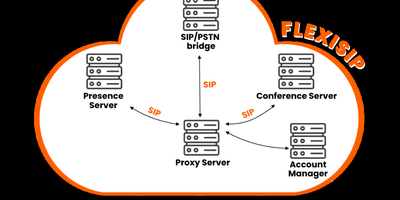
A SIP phone system lives or dies on the unglamorous middle. Something has to route every call, know who is registered, wake phones that are asleep, and translate between networks that disagree. Flexisip is that middle, built as a modular server suite where you deploy only the pieces your service needs. The proxy routes calls and messages, relays media with ICE, STUN, and TURN support, and authenticates users by digest, TLS certificates, or OpenID Connect. Its push gateway speaks RFC 8599 to Apple and Google, so incoming calls ring phones whose app is closed, and it can lend that gift to an existing Asterisk or FreeSWITCH platform that lacks push of its own. The presence server tracks who is reachable and shares contact lists, the back-to-back user agent bridges SIP networks to PSTN gateways and trunks with codec transcoding and caller identity translation, and a registration event server notifies peer domains when users register. Instances cluster with load balancing for services that outgrow one box, the same suite shrinks onto a Raspberry Pi class intercom, and it has quietly powered the public linphone.org SIP service for over a decade. Running on a dedicated VPS on RepoCloud with guaranteed CPU, RAM, and SSD, full root SSH access, and a browser serial console. AGPL-3.0 licensed.
LightNVR
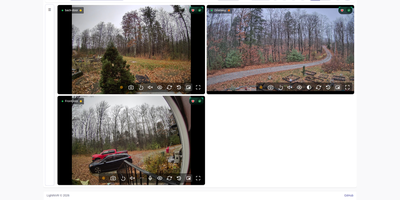
At 3 a.m., your driveway camera is the only witness that matters, and LightNVR makes sure the footage lives on a drive in your house, not a subscription cloud. ONVIF discovery finds cameras on the network; an RTSP address adds the rest. Recording runs continuously, on a schedule, or only when something happens: draw a polygon over the gate, pick the object classes worth alerting on, set a confidence threshold, and clips keep a pre-event buffer so the lead-up survives too. Plate recognition turns passing traffic into a searchable log. Playback splits two ways. The live grid streams over WebRTC at sub-second latency, overlays detection boxes on the picture, and the Investigation workspace lines sixteen cameras onto one shared clock after an incident. Storage obeys retention policies, protected recordings stay put, and full disks archive out to S3, NFS or SAN volumes. Access comes with database users, roles, TOTP two-factor codes and API keys. Prometheus metrics report the recorder's own health, MQTT events feed Home Assistant, and a REST API carries detections into the rest of the house. The binary idles within 256 MB on supported boards and speaks nineteen languages. Running on a dedicated VPS on RepoCloud with guaranteed CPU, RAM, and SSD, full root SSH access, and a browser serial console. GPL-3.0 licensed.
AiPBX
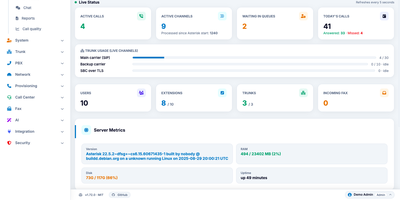
One server replaces the phone system, the meeting link, and the fax line: AiPBX turns a Linux machine into a business phone system with extensions, video meetings, chat, and call queues. Every employee gets one extension that rings a desk phone, the browser softphone, and the mobile app, while ring groups, multi-level IVRs, and time conditions route callers without anyone editing dialplan files. Queues staff your support line with dynamic agent sign-in, hold music, and position announcements, and a live wallboard lets supervisors watch waiting callers and agent states, then listen, whisper, or barge into a call. Meetings run in the browser: schedule conferences with PINs, send guests a magic link into a WebRTC room with screen sharing, and let streams forward without transcoding. Chat lives in the same portal: photos, files, presence, read receipts, and fax is composed in a rich-text editor or uploaded as PDF and delivered over T.38. Desk phones provision themselves: a discovery daemon spots new Yealink, Fanvil, Grandstream, Snom, and Cisco handsets and writes their configuration files. An AI assistant plans dialplan changes in plain language with dry-run preview and one-click undo, cloud voices from Google, Polly, Azure, ElevenLabs, or OpenAI read announcements aloud, and GDPR, KVKK, HIPAA, and PCI-DSS presets govern recording consent and retention purges. A 100-plus-endpoint REST API with scoped keys and HMAC-signed webhooks makes everything scriptable. Running on a dedicated VPS on RepoCloud with guaranteed CPU, RAM, and SSD, full root SSH access, and a browser serial console. MIT licensed.
MikoPBX
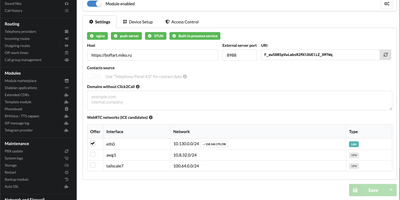
MikoPBX gives a small business a complete phone system on a server it controls, with extensions, call queues, IVR menus, and call recording instead of per-seat hosted PBX fees. Follow a call through it: incoming rules per provider match exact numbers or patterns, fall through by priority when nobody answers, and end at a default route. Each employee gets an extension with SIP credentials, forwarding for no-answer, busy, and unavailable states, and an optional recording switch. Queues offer seven distribution strategies, including Ring All, Least Recent, Fewest Calls, and Memory Hunt, and can announce each caller's position and estimated wait. IVR menus play a recorded greeting, route keypad choices to departments or extensions, and fall back to a default number after a set number of retries. Call history filters by caller, destination, or DID, flags missed calls in red, and plays or downloads recordings as WebM, MP3, WAV, or OGG. Voicemail, call transfer, call pickup, and a holiday and night-time switcher serve daily needs, while free and paid marketplace modules, among them a softphone, auto dialer, and LDAP/AD sync, handle the rest. A firewall, Fail2Ban, passkey sign-in, and CrowdSec integration protect the system, and a REST API with more than 250 endpoints lets other tools manage it. The interface speaks 26 languages. Running on a dedicated VPS on RepoCloud with guaranteed CPU, RAM, and SSD, full root SSH access, and a browser serial console. GPL-3.0 licensed.