BugTraceAI
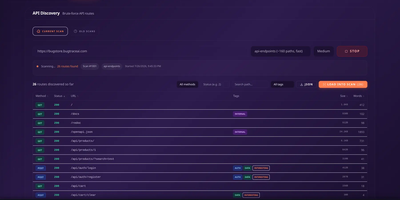
Point an AI pentesting crew at a web app you own and watch it hunt: BugTraceAI plans the checks, sends specialist agents after each weakness class, and brings back evidence you can inspect. A scan moves through six visible phases, from crawling and endpoint discovery through strategy, exploitation and validation, and ends in a findings table where every result carries a severity, a CVSS score and a confirmed status. The web dashboard follows the hunt live as a graph of specialists branching from a coordinating agent, and its API discovery workspace brute-forces routes and loads the interesting ones straight into a scan. Analysts get their own toolbox of more than twenty utilities for poking HTTP traffic by hand, an AI repeater for replaying requests, and ModelLab for comparing models on cost and results. Findings download as a ZIP with the full report, and a terminal workspace with pipeline, findings, agents, timeline and logs views suits keyboard-driven work. Bring your own model through OpenRouter, Anthropic, Z.ai or a local endpoint, and aim the whole suite at the bundled BugStore practice shop when you want to rehearse safely. Running on a dedicated VPS on RepoCloud with guaranteed CPU, RAM, and SSD, full root SSH access, and a browser serial console. Apache-2.0 licensed.
PentaGI
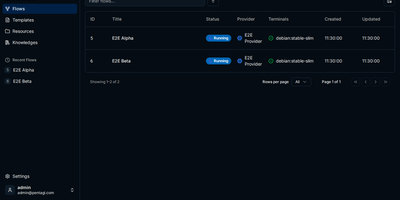
Autonomous red team execution without manual script coordination is what PentaGI delivers through a multi-agent penetration testing platform engineered for automated security assessments. Security engineers configure testing scopes, target IP ranges, domain lists, and rules of engagement through an interactive web console with real-time execution graphs. Autonomous agent personas break down high-level assessment goals into discrete tactical phases, orchestrating network port discovery, service banner fingerprinting, web application crawling, and CVE verification. Specialized agents query integrated Graphiti knowledge graphs and local vulnerability repositories to synthesize attack paths, validate exploitability, and confirm finding veracity before issuing alerts. Operators monitor live agent terminal streams, inspect sandboxed tool executions, and adjust active LLM provider routes across OpenAI, Anthropic, or local Ollama endpoints. The template editor allows red teams to compose reusable testing playbooks with customizable security prompt chains, safety constraints, and automated remediation reporting. Audit logs capture full command histories, raw tool outputs, and LLM reasoning steps to generate compliance-ready technical documentation. Running on a dedicated VPS on RepoCloud with guaranteed CPU, RAM, and SSD, full root SSH access, and a browser serial console. MIT licensed.
Sirius Scan
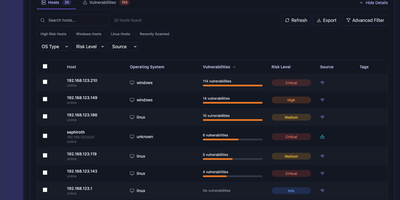
Point Sirius Scan at a network range and it finds live hosts, fingerprints their services, and lists every matching CVE with its CVSS score in a live web dashboard. The Vulnerability Navigator groups findings by severity, filters on CVSS, and exports results for remediation tracking. Scans run on Nmap with NSE scripts kept in sync with upstream, alongside Naabu port scanning. Lightweight remote agents connect back over gRPC from other networks, so segments the central scanner cannot reach still get assessed, and the same agents can run YAML detection templates locally in CLI mode with no server connection at all. An operator console runs PowerShell commands against connected agents and keeps command history beside the scan results. Real-time progress, severity trend charts, host detail pages, and an environment overview show what changed between scans. A REST API on port 9001 with API key authentication feeds results into existing security workflows, while service health monitoring and centralized logging confirm the platform itself is behaving. An installer generates fresh secrets and an initial admin password, and production overlays tighten the deployment further. Running on a dedicated VPS on RepoCloud with guaranteed CPU, RAM, and SSD, full root SSH access, and a browser serial console. MIT licensed.