Buzz
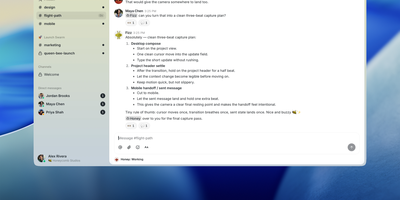
Buzz delivers the first production workspace where humans and AI agents operate as cryptographically equal team members on a self-hosted Nostr relay. The Rust-based backend stores every message, code patch, CI result, review comment, and workflow step as a signed Nostr event in a unified PostgreSQL-backed event log with Redis pub/sub for real-time presence and S3/MinIO for media storage. The integrated Git forge implements NIP-34, turning feature branches into dedicated channels where patches, reviews, and merge decisions live alongside the discussion that produced them — eliminating the split between chat tools and code hosts. Through the open Agent Client Protocol, Buzz natively supports Goose, Anthropic Claude Code, and OpenAI Codex as first-class channel members with scoped permissions, their own audit trails, and the ability to create patches, run workflows, and orchestrate multi-step automations via YAML-defined triggers including message events, reactions, schedules, and webhooks. The Tauri-based desktop client runs on macOS, Windows, and Linux, while buzz-cli provides agent-first JSON I/O for headless automation. Deploy via Docker Compose with the production bundle in deploy/compose/, Railway one-click, or build from source requiring Rust 1.88+, Node 24+, and pnpm. Multi-community mode scopes tenant data by domain with NIP-42 Schnorr authentication, rate limiting, and hash-chain audit logging. Running on a dedicated VPS on RepoCloud with guaranteed CPU, RAM, and SSD, full root SSH access, and a browser serial console. Apache 2.0 licensed.
Erxes
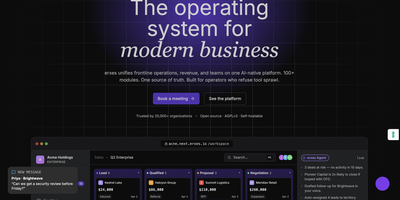
Replacing HubSpot, Zendesk, Intercom, and Linear with a single self-hosted platform, erxes delivers an Experience Operating System trusted by over 4,000 GitHub stars and built on a modern Nx-powered monorepo architecture. The core ships with six foundational modules — My Inbox for omnichannel conversations across email, web chat, voice, and Discord; Contacts for unified customer profiles; Products for catalog management; Segments for behavioral targeting; Automation for visual workflow builders; and Documents for template generation. Beyond the core, a plugin marketplace activates Frontline for ticket management and omnichannel support queues, Sales for deal pipelines and lead scoring, Operations for project boards with cycle management, Content for headless CMS and knowledge bases, and Team for employee directories, time clocks, and internal chat. The technical stack combines GraphQL Federation with Apollo Server v4 and tRPC v11 microservices on Node.js, React 18 micro-frontends via Rspack Module Federation with TailwindCSS 4, MongoDB with Mongoose for persistence, Redis for caching, BullMQ for job queues, and Elasticsearch for full-text search. Deployment supports Docker Compose orchestration with automatic service discovery across all plugin containers. The Global Profile architecture enables agencies to manage multiple client brands under a single login with separated data stores. iOS and Android SDKs embed the messenger widget directly into mobile applications. Running on a dedicated VPS on RepoCloud with guaranteed CPU, RAM, and SSD, full root SSH access, and a browser serial console. AGPLv3 licensed.
Macro
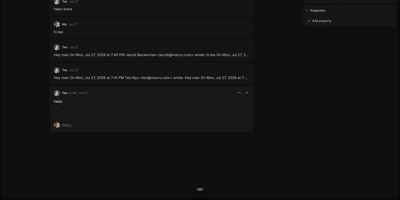
Macro merges email, team chat, collaborative documents, task management, CRM, and video calls into one keyboard-driven application where AI agents operate across the entire workspace with shared team memory, replacing the Slack plus Notion plus Linear plus Superhuman plus HubSpot stack with a single deployment. The email module provides a multi-account unified inbox with keyboard shortcuts, shared team inboxes, and Gmail integration. Team messaging offers channels and direct messages designed for technical discussions with threaded conversations. The task system draws from Linear with board and list views tightly integrated with channels, email threads, and AI agents. Real-time collaborative documents use CRDT synchronization via Loro for conflict-free editing with Markdown-native formatting and @mention linking. A 2D canvas board embeds @links to tasks, files, and emails for visual project planning. AI agents access unified team-level memory spanning all workspace modules, taking autonomous actions across email, chat, tasks, and documents through MCP-compatible tool interfaces. Video calls include recording, transcription, and automatic logging to team memory. The CRM module tracks customers and contacts with custom properties, email synchronization, and data enrichment. Eighty-plus Rust microservices on the Axum framework handle backend operations while a SolidJS static SPA delivers the frontend with instant search and real-time collaboration. Docker Compose deployment provisions the complete service stack with PostgreSQL, Redis, OpenSearch, and FusionAuth authentication. Running on a dedicated VPS on RepoCloud with guaranteed CPU, RAM, and SSD, full root SSH access, and a browser serial console. AGPL-3.0 licensed.
Kandev
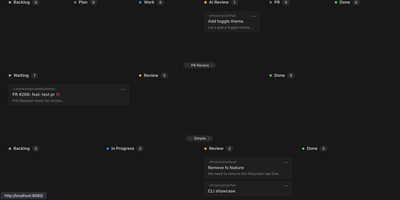
Kandev provides a command center for orchestrating AI coding agents across parallel workstreams. The Go backend paired with a Next.js frontend delivers kanban boards with drag-and-drop columns, pipeline workflow definitions with per-step agent handoffs, and an IDE-like review workspace combining file editor, file tree, terminal, browser preview, and unified git diffs. Multi-provider support connects Claude Code, GitHub Copilot, Codex, Qoder, Grok, and custom agents through configurable profiles with per-agent prompts, runtimes, and review gates. Tasks execute in isolated git worktrees with multi-repository support, letting agents work on separate branches simultaneously while changes surface in a consolidated review interface. Native integrations with GitHub, GitLab, Jira, Linear, Sentry, and Slack pull external issues into the kanban and link tasks to pull requests. Kandev exposes streamable HTTP and SSE MCP endpoints, enabling external clients — Cursor, Claude Desktop, Augment — to create tasks and read workspace context programmatically. Workflow definitions export as portable YAML for sharing across installations. Agentic workflows chain multi-step pipelines mixing different models per step — Opus for architecture, Sonnet for implementation, with human review gates between stages. Running on a dedicated VPS on RepoCloud with guaranteed CPU, RAM, and SSD, full root SSH access, and a browser serial console. AGPL-3.0 licensed.
Paca
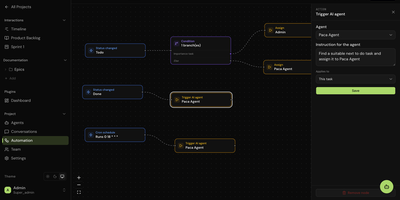
Paca is a self-hosted project management platform and Scrumban workspace where autonomous artificial intelligence agents collaborate with human software engineers as first-class Scrum teammates instead of external chat assistants. Engineering teams manage sprints, backlogs, and task lifecycles through a shared real-time board powered by Socket.IO where both humans and agents pick up assignments and post progress updates. A native Model Context Protocol server connects external coding assistants such as Claude Desktop and Claude Code directly into projects, tasks, and sprint data without custom scraping scripts. Distributed agents execute in isolated runtime sandboxes powered by the OpenHands software development kit, co-authoring behavior-driven development Gherkin scenarios with product owners and maintaining living system design documents. Visual event-driven automation builders compose multi-branch trigger, condition, and action pipelines that evaluate task dependency gates and cron schedules. A sandboxed WebAssembly plugin runtime allows developers to write custom backend logic and custom board views using Go or Rust. Running on a dedicated VPS on RepoCloud with guaranteed CPU, RAM, and SSD, full root SSH access, and a browser serial console. Apache 2.0 licensed.
Scrumboy
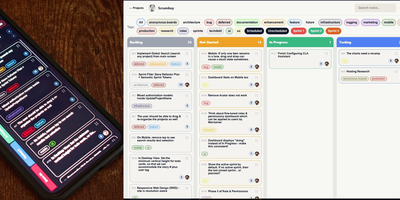
Scrumboy is a Kanban and sprint management tool that ships as a single Go binary backed by SQLite, deploys in under ten seconds via Docker, and uniquely integrates with AI coding agents through a standards-compliant MCP JSON-RPC endpoint. The dual-mode architecture supports Full mode with bootstrapped authentication, TOTP two-factor auth, OIDC/SSO integration through Keycloak, Authentik, Auth0, or Entra ID, role-based access control across Owner, Admin, User system tiers plus per-project Maintainer, Contributor, and Viewer roles, and Anonymous mode that generates instant shareable boards accessible via unique URLs with zero signup requirement. Custom workflows allow user-defined lane configurations per project including designated "Done" lanes, while sprints with configurable one or two-week cycles include board-level sprint filtering and the ability to disable and re-enable sprint tracking without losing history. Real-time Server-Sent Events power instant multi-user board updates, and outbound webhooks deliver JSON payloads to registered URLs when domain events fire with HMAC signature verification. The MCP endpoint at /mcp/rpc enables native integration with Cursor, Claude Code, and other AI agents through OAuth 2.1 with PKCE authorization, while API access tokens support CLI automation and CI/CD pipelines. Additional capabilities include VoiceFlow voice commands, per-project sticky-note walls, Markdown and Mermaid diagram support in task notes, append-only audit trails, VAPID Web Push notifications, SMTP password reset, Trello import, JSON backup with merge/replace/copy strategies, and 22-language internationalization. Running on a dedicated VPS on RepoCloud with guaranteed CPU, RAM, and SSD, full root SSH access, and a browser serial console. AGPL v3.0 licensed.
Plane
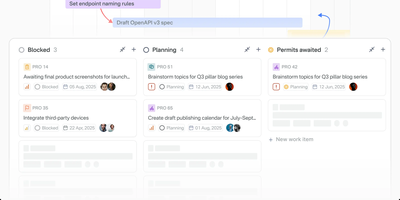
The most-starred open-source project management platform on GitHub with over 55,000 stars, Plane delivers what Jira, Linear, Monday, and ClickUp charge thousands per year for — issue tracking, sprint planning, documentation, and AI-powered workflows in one unified workspace that you own and control entirely. Work items feature a rich text editor with file uploads, sub-properties, custom states, priorities, labels, assignees, and cross-referencing, organized across five customizable layout views (list, board, table, spreadsheet, Gantt) with Command-K navigation for instant access to anything. Time-boxed Cycles provide sprint planning with automatic burn-down charts, velocity tracking, and scope change detection, while Modules break complex projects into manageable deliverables with progress aggregation. Built-in Pages combine AI-powered documentation with rich formatting, image embedding, and one-click conversion of notes into actionable work items. The AI layer reads across every project, cycle, document, and thread in the workspace — agents take real assignments, triage incoming requests, assign owners, track blockers, and ship status updates automatically. Native integrations connect GitHub, GitLab, Slack, Sentry, Figma, and 50+ tools with bidirectional issue sync and PR tracking, while import pipelines migrate entire workspaces from Jira, Linear, Asana, ClickUp, or Monday in minutes. The REST API with OAuth 2.0, HMAC-signed webhooks, typed SDKs in Node.js and Python, and a native MCP server enable custom automations. Running on a dedicated VPS on RepoCloud with guaranteed CPU, RAM, and SSD, full root SSH access, and a browser serial console. AGPL-3.0 licensed.
Multica
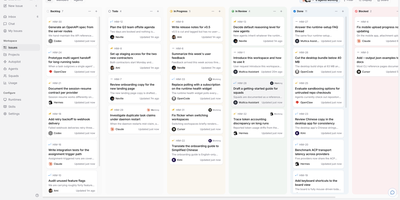
Reaching 45,000 GitHub stars within seven months of launch, Multica is the fastest-growing open-source platform for managing AI coding agents as first-class teammates — assign an issue to Claude Code, Codex, Cursor, Copilot, Kimi, or any of 21 supported agent CLIs and it picks up the work, comments progress in real time via WebSocket, raises blockers, and hands the result back for human review before anything merges. The Go backend (Chi router, sqlc-generated type-safe queries, gorilla/websocket) connects to PostgreSQL 17 with pgvector for semantic search across workspace history, while the Next.js 16 App Router frontend delivers workspace dashboards showing per-agent token spend, execution time, daily cost charts, and runtime status across unlimited connected machines. Agent Skills provide reusable methods, reference material, and supporting files that compound across runs — a persistent knowledge layer that makes each subsequent task faster and more accurate. Squads let a leader agent select the right specialist for subtasks, creating multi-agent workflows without manual orchestration. Review gates ensure no AI-generated code ships to main without explicit human approval. Self-host via Docker Compose or Kubernetes with full Git integration across GitHub, GitLab, Gitea, and Forgejo including self-hosted instances. The CLI and REST API make every surface scriptable, and Autopilot automations trigger agent runs from events. Running on a dedicated VPS on RepoCloud with guaranteed CPU, RAM, and SSD, full root SSH access, and a browser serial console. Apache 2.0 licensed with additional conditions.
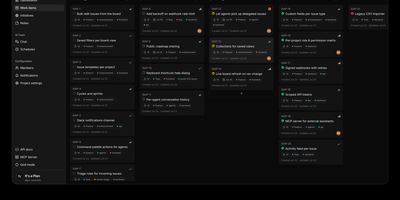
Its a Plan
Autonomous AI coding agents work side-by-side with software engineers inside Its a Plan, a keyboard-driven project tracking and sprint planning workspace designed for rapid software delivery. Product teams organize development cycles through customizable Kanban boards, prioritized backlogs, nested sub-issues, and interactive roadmap timelines designed for rapid keyboard navigation. Engineers can assign work directly to AI agents or mention them inside discussion threads to trigger automated code fixes, documentation updates, and test suite generation. Integrated runners connect to popular coding models via standard protocol interfaces, executing assigned tasks in isolated environments before reporting pull requests and results back to the issue thread. Administrators manage team permissions through role-based access controls, authenticate users with passwordless passkeys or identity providers, and broadcast instant notifications via Telegram and transactional email. The platform dispatches configurable webhooks across development tools, enabling seamless bi-directional status synchronization with external version control platforms and continuous integration pipelines. Custom labels, milestone estimates, and progress metrics provide engineering managers with immediate visibility into sprint velocity and delivery bottlenecks. Running on a dedicated VPS on RepoCloud with guaranteed CPU, RAM, and SSD, full root SSH access, and a browser serial console. AGPL-3.0 licensed.
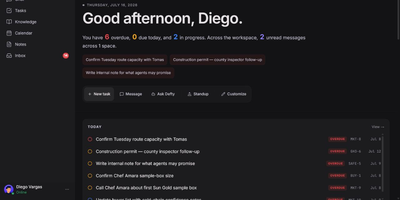
Deft
One self-hosted workspace holds your team's chat, tasks, notes, and calendar, and Deft lets AI agents work in it beside your people. People get real-time chat with spaces, direct messages, threads, mentions, reactions, files, and presence. Tasks open as Board, Table, Timeline, or Calendar views, with dependencies, subtasks, recurrence, and bulk actions. Notes, decisions, and channel memory become durable knowledge, with graph views and links back to the source conversation. Native calendar events sit beside read-only ICS subscriptions. Agent employees can join channels and receive task assignments. Tag the built-in assistant Defty to draft a task, answer a workspace question, or take a governed action, then review the proposal in an approval card before anything changes. Personal connections let Codex, Claude, ChatGPT, and other streamable HTTP MCP clients act as the signed-in user within revocable scopes. Approval tiers, trust levels, token scopes, revocation, activity history, and action receipts record who or what acted and what changed. OpenAI, Anthropic, OpenRouter, OpenAI-compatible endpoints, and local Ollama-style models are supported providers. Chat, tasks, notes, and calendars keep working with no AI key. Modules add company-specific records, relationships, and views, with a bundled Contacts module as the first example. Running on a dedicated VPS on RepoCloud with guaranteed CPU, RAM, and SSD, full root SSH access, and a browser serial console. AGPL-3.0-only licensed.

Kaneo
With nearly 8,000 GitHub stars since its December 2024 launch, Kaneo has rapidly gained traction as the minimalist alternative to bloated project management platforms like Jira and Linear. Built on TypeScript with React and Hono, the interface strips away complexity to focus on execution — plan in list view, track in kanban board, and schedule on interactive Gantt chart timelines where dragging bar handles adjusts start and due dates with optimistic UI updates. Native GitHub integration synchronizes issues bidirectionally, links pull requests to tasks, and keeps product planning aligned with development execution without context switching. The built-in Model Context Protocol server at /api/mcp enables AI tools like Claude and Cursor to manage tasks, projects, and labels directly, while the official @kaneo/mcp npm package provides stdio access for local MCP clients. Authentication supports password, magic link, GitHub OAuth, and Google sign-in with organization-level access management. Rich text editing for task descriptions and comments, label-based initiative grouping, priority levels, assignee management, and due date tracking provide focused planning without ceremony. Deploy with the drim CLI for automatic HTTPS and database setup, Docker Compose for custom configurations, or Helm charts for Kubernetes clusters — all requiring just 2GB RAM and PostgreSQL. Running on a dedicated VPS on RepoCloud with guaranteed CPU, RAM, and SSD, full root SSH access, and a browser serial console. MIT licensed.
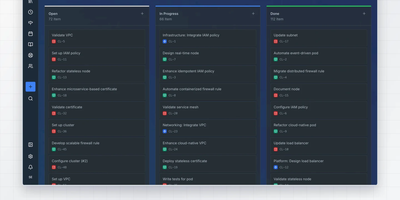
Windshift
Windshift packs boards, sprints, roadmaps, test runs, time tracking, and a customer portal into one open-source tracker that replaces Jira on a server you control. Epics, stories, and sub-tasks form a hierarchy you can view as a board, list, tree, or map, and backlog items drag into dated sprints. The roadmap stretches across weeks, months, or quarters, and milestone pages show completion percentage with a status breakdown. Each workspace defines its own item types, custom fields, screens, statuses, priorities, workflows with conditions and approvals, and permissions, while JQL-style queries save as shared views. Event-driven rules update fields, notify people, and create work. Customers file requests through a public portal, and your team works them through queues with SLAs and approvals. Reusable test cases roll into test runs with success rates, and timers log billable and internal hours against projects and customers. GitHub, GitLab, Gitea, and Forgejo connections put branches and pull requests on the work item, and the importer brings over Jira projects, comments, attachments, and worklogs. A knowledge base and an asset register keep documentation and inventory next to the work. The interface speaks nine languages, including right-to-left Arabic, and sign-in supports OIDC single sign-on and passkeys. Running on a dedicated VPS on RepoCloud with guaranteed CPU, RAM, and SSD, full root SSH access, and a browser serial console. AGPL-3.0 licensed.
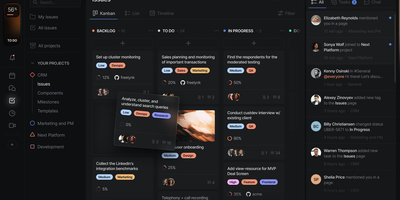
Huly
With 27,000 GitHub stars and 349 releases shipping multiple times per week, Huly replaces four separate SaaS subscriptions — Linear for issue tracking, Notion for documents, Slack for team chat, and Motion for time-blocking — with a single self-hosted platform that charges nothing per seat. The issue tracker provides projects, sprints, roadmaps, custom workflows, and Kanban views with bi-directional GitHub and GitLab synchronization that keeps issues and pull requests in lockstep across both systems. Collaborative documents use CRDT-based real-time editing for wikis, meeting notes, and technical specs with nested page hierarchies and rich embedding. Team messaging delivers channels, direct messages, threaded conversations, reactions, and pinned messages in a Slack-equivalent interface that lives alongside your project context. The time-blocking planner schedules tasks into calendar slots with drag-and-drop, integrating directly with your issue backlog so nothing falls through cracks. A virtual office module provides audio and video rooms for standups and pair programming with external guest access. HR features handle team management, office hours, and PTO tracking. The architecture runs 30+ microservices on CockroachDB for ACID-compliant storage, Elasticsearch for full-text search, MinIO for file attachments, and Redpanda for event streaming. Desktop apps ship for macOS, Windows, and Linux alongside mobile apps for iOS and Android. Running on a dedicated VPS on RepoCloud with guaranteed CPU, RAM, and SSD, full root SSH access, and a browser serial console. EPL-2.0 licensed.
Veritas Kanban
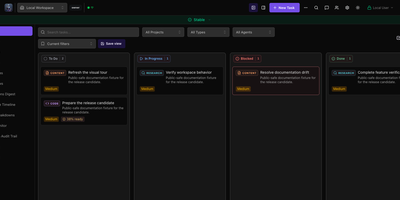
A drag-and-drop task board that works fine on its own and can also hand cards to AI coding agents, Veritas Kanban shows what each agent is doing, what it changed, and what is waiting for your approval. Start with no agents at all. Cards move through To Do, In Progress, Blocked, and Done, and each one carries subtasks, dependencies, time tracking, comments, and an activity log. When you are ready, connect Codex, Claude Code, Copilot CLI, Hermes, or OpenClaw, give every agent an Intern, Specialist, or Lead permission level, and follow each agent's status and model on a live dashboard. Let a task run in its own Git worktree, read the diff, leave inline comments, approve or request changes, and open a GitHub pull request from the task panel. Squad Chat gives agents one shared channel that posts spawned, completed, and failed events. Workflows chain steps with parallel branches, loops, and human approval gates. Policy rules allow, deny, or hold agent actions for review. Assistants reach the board through an MCP server, a command-line client, or a REST API. Running on a dedicated VPS on RepoCloud with guaranteed CPU, RAM, and SSD, full root SSH access, and a browser serial console. MIT licensed.
Mission Control
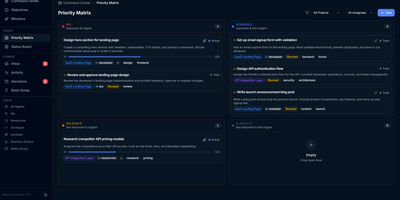
With over 600 GitHub stars and a featured Show HN launch, Mission Control is the agent-first command center that replaces the chaos of manually shepherding AI agents with structured delegation, approval workflows, and autonomous execution. The Next.js 15 web UI delivers an Eisenhower priority matrix with drag-and-drop quadrants, a Kanban board tracking tasks through Not Started, In Progress, and Done columns, and a goal hierarchy with milestone progress bars — powered by shadcn/ui, Radix UI, and @dnd-kit. Six built-in agent roles — Researcher, Developer, Marketer, Business Analyst, Tester, and You — receive tasks through a token-optimized API compressing context by 92 percent to approximately 50 tokens versus 5,400 unfiltered. The autonomous daemon polls task queues on cron schedules, spawns Claude Code sessions via the official CLI, enforces concurrency limits, and auto-retries with loop detection that escalates to human decisions after three failures. Field Ops extends execution to 64 external services across 16 categories with working X, Ethereum with MetaMask signing, and Reddit adapters, protected by AES-256-GCM encrypted vault with scrypt key derivation, per-service and global spend limits, a circuit breaker, and three autonomy levels. All data lives in local JSON files with Zod validation and async-mutex locking ensuring safe concurrent writes, backed by 193 automated Vitest tests. Running on a dedicated VPS on RepoCloud with guaranteed CPU, RAM, and SSD, full root SSH access, and a browser serial console. AGPL-3.0 licensed.