Statewave
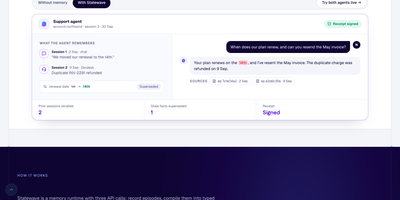
Statewave is the memory runtime that compiles what your AI agents experience into typed, provenance-tagged memories, so the same subject asked the same question receives the same context every time. Recording is append-only: your application writes events as episodes (chat, ticket, commit), and a compiler distills them into structured memories with confidence scores, each traceable to its source episodes. When an agent needs context, Statewave assembles a ranked bundle inside the token budget you set; the same request at the same moment returns identical bytes, so retrieval sampling noise never leaks into an answer. Every bundle leaves an HMAC-signed receipt that a replay endpoint can re-evaluate under the same rules. Memories carry sensitivity labels for personal data, financial details, and secrets, and YAML policies deny or redact them per tenant. One instance serves many products: tenants are isolated by header, pinned to a region for residency with cross-region requests refused, and erasable by subject on request. The default compiler runs fully local on regex heuristics with no API key, or point extraction at any of 100+ LiteLLM providers. Reach it over REST from any language, through typed Python and TypeScript SDKs, LangChain, CrewAI, and AutoGen integrations, or the built-in MCP server that lets Copilot, Claude, and Cursor share one memory. Support agents recognize returning customers across sessions, and coding agents keep project decisions between conversations. Running on a dedicated VPS on RepoCloud with guaranteed CPU, RAM, and SSD, full root SSH access, and a browser serial console. Apache 2.0 licensed.
Hindsight
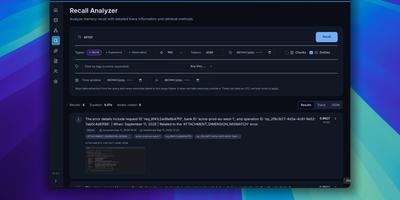
Memory that survives the session: Hindsight extracts facts, entities, and timestamps from everything an AI agent retains, then lets the agent search or reason over it later. Adding it to an existing LLM client takes a two-line wrapper, and more than 60 integrations cover Claude Code, Cursor, LangGraph, CrewAI, and n8n. Every bank also exposes its own MCP endpoint. Retain sends text, images, or files through an LLM that extracts facts, timestamps, entities, and relationships. Recall runs semantic, keyword, graph, and temporal searches in parallel, merges them with reciprocal rank fusion, reranks with a cross-encoder, and trims to a token budget. Reflect reasons across memories for questions that need synthesis, shaped by per-bank skepticism, literalism, and empathy traits. In the background, related facts consolidate into observations that keep exact quotes and proof counts and are refined, never silently overwritten. Mental models and wiki-style knowledge pages hold standing answers that rewrite themselves as the bank learns. Each user, agent, or project gets an isolated bank with no cross-bank leakage, and Memory Defense redacts or blocks secrets and PII against 45 patterns. The Control Plane adds a Recall Analyzer with traces, a memory constellation graph, and a knowledge page editor. Extraction and reasoning can run on 25+ LLM providers, including local Ollama and llama.cpp. Running on a dedicated VPS on RepoCloud with guaranteed CPU, RAM, and SSD, full root SSH access, and a browser serial console. MIT licensed.
Memory OS
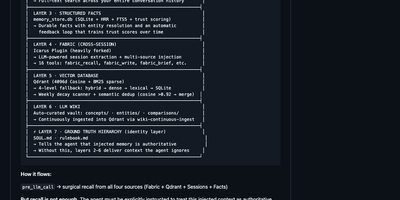
Memory OS gives Hermes Agent a permanent memory, so a new session opens with your projects, decisions, and working style already in context instead of introductions. Seven layers divide the job: workspace files carry your standing instructions into every turn, and a full-text index makes every past conversation searchable in place. Durable facts about your stack, your projects, and your patterns live in a structured store that resolves entities and scores how much each fact can be trusted, promoting what proves itself and demoting what does not. Cross-session recall pulls relevant moments from older threads, while a vector store with hybrid dense and keyword search finds the right memory even when the wording has changed. A self-curating wiki turns raw material into concept, entity, and comparison pages that are re-ingested automatically, and a Ground Truth hierarchy tells the agent to treat injected memories as authoritative instead of re-checking them. Scheduled jobs keep the system honest: hourly ingestion, weekly curation and decay scans, dead-letter reporting, and health heartbeats. It all runs beside the agent on your own machine with whichever provider you already use, from OpenRouter and Anthropic to a local Ollama. Running on a dedicated VPS on RepoCloud with guaranteed CPU, RAM, and SSD, full root SSH access, and a browser serial console. MIT licensed.
Euron MemoryVault
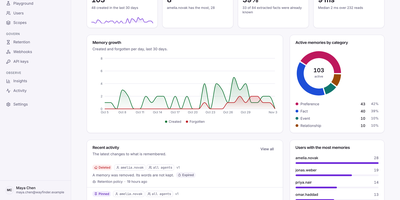
Long-term memory for AI assistants lives in Euron MemoryVault, which stores conversations as atomic facts like "Lives in Lisbon" and hands back the ones that fit the next prompt. Repeated facts reinforce the old memory. Changed facts supersede it and keep the history. A "forget that" message deletes it. Extraction runs on a rule engine with no key, and an OpenAI-compatible API or Ollama can replace it. Scopes cover organization, project, user, agent and session. Keys tied to one agent never see another project. Retention policies set half-lives, time to live per category and a per-user cap. Live previews show what would be forgotten before anything is saved. Hybrid search blends vectors with full text. The context endpoint packs the strongest memories into a token budget. Playground runs preview what a conversation would create, merge, ignore or supersede. Dry runs store nothing. The dashboard shows decay curves, version history and source conversations for each memory. Users, API keys, insights and an activity feed sit beside it. Signed webhooks announce created, updated and deleted memories, with retries, a dead-letter queue and a delivery log. Erasing a user removes memories, history, messages and queued deliveries in one transaction and returns a receipt. A client SDK offers blocking and asyncio versions. Running on a dedicated VPS on RepoCloud with guaranteed CPU, RAM, and SSD, full root SSH access, and a browser serial console. MIT licensed.
Spector
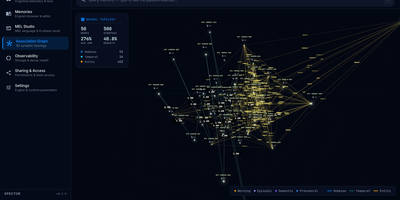
Spector is a cognitive memory engine for AI agents that remembers, forgets, consolidates, and links related memories rather than just storing vectors. Memories live in four tiers, working, episodic, semantic, and procedural, and sleep consolidation distills repeated events into lasting facts. Unused traces fade along a power-law forgetting curve, while reused ones stay reachable. Co-activation, temporal, and entity links join memories, so a query surfaces related context and not only close matches. Recall fuses dense, sparse, and keyword scores with importance and age, then reranks the candidates. Claude Desktop, Cursor, Windsurf, and Claude Code attach through Model Context Protocol tools for remembering, recalling, reinforcing, and forgetting, while apps use REST, gRPC, or client libraries. Each user, agent, or tenant gets its own encrypted on-disk namespace, and sharing runs through owner, admin, writer, and reader grants. The Cortex dashboard draws the association graph in 3D, browses and edits memories, and charts storage, index health, consolidation, and decay. A content-free admin console manages tenants, quotas, keys, and break-glass access without ever exposing memory text. Embeddings come from Ollama, OpenAI, Google, Mistral, Azure, Bedrock, or an ONNX model, and the project ships container images for amd64 and arm64 plus a Helm chart. Running on a dedicated VPS on RepoCloud with guaranteed CPU, RAM, and SSD, full root SSH access, and a browser serial console. Apache-2.0 licensed.