OpenReplay
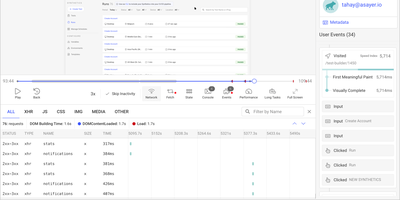
Backed by 12,400+ GitHub stars and positioned as the self-hosted alternative to FullStory and Hotjar, OpenReplay delivers the open-source session replay platform that keeps every byte of user behavior data on your own infrastructure. The JavaScript tracker captures pixel-perfect recordings of clicks, scrolls, form inputs, and navigation with automatic sensitive data masking, while simultaneously logging network requests, console errors, JavaScript exceptions, and Redux, VueX, MobX, NgRx, Pinia, and Zustand store state changes for complete technical context. DevTools mode reconstructs each session with full stack traces, GraphQL queries from Apollo and Relay, Fetch and Axios request payloads, CPU and memory metrics, and page speed waterfall charts — effectively giving developers a browser inspector tied to any user session. Product analytics surfaces conversion funnels, user journeys, click heatmaps, web vitals trends, and retention cohorts without requiring custom instrumentation. Co-browsing connects support agents to live user sessions with cursor control and WebRTC audio, enabling real-time assistance without third-party screen-sharing software. Integrations push session context into Sentry, Datadog, CloudWatch, Stackdriver, and Elastic for front-to-back debugging. Feature flags enable gradual rollouts with session-level targeting. The platform deploys to any cloud via Docker and Kubernetes with auto-scaling ingestion handling up to 50,000 sessions per month on the open-source edition. Running on a dedicated VPS on RepoCloud with guaranteed CPU, RAM, and SSD, full root SSH access, and a browser serial console. AGPLv3 licensed.
Formbricks
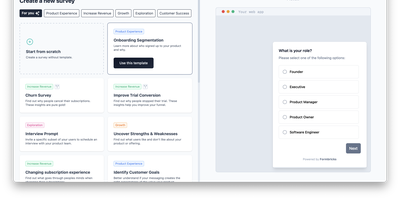
In-app, website, link, and email surveys feed one open-source experience management platform: Formbricks. Its distinguishing strength is targeted in-app research: a JavaScript SDK triggers surveys on user events and attributes, with segmentation rules like "power users who have not seen a survey in 10 days," so questions reach the right cohort at the right moment instead of a mass email blast. The no-code editor offers 20+ question types including NPS, CSAT, CES, matrix, ranking, and file upload, with skip logic, conditional branching, best-practice templates, and full brand theming. Responses feed built-in analytics with summaries and CSV/JSON export, and integrations push data to Slack, Notion, Google Sheets, Airtable, Zapier, and n8n, with webhooks and an open API on every tier. Because self-hosted surveys load from your own domain rather than a blacklisted third-party script host, ad blockers do not suppress them - in-app surveys reach users that Hotjar-style tools silently miss, which measurably raises response rates. Self-hosting also removes the third-party sub-processor from your privacy policy entirely: survey responses often contain PII, and keeping them on your own server matters for GDPR-sensitive and regulated industries. The Community Edition has no response caps or tier-gated features, so core functionality and your data stay accessible regardless of any subscription. Next.js on PostgreSQL, AGPLv3.
Rybbit
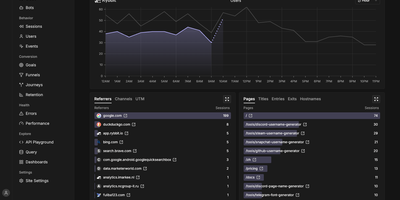
Google Analytics without the cookie banner or the maze of menus: Rybbit puts web and product analytics for every site you run on one readable dashboard, hosted on your own server. Pageviews, sessions, unique users, bounce rate, session duration, traffic sources, campaigns, devices, and countries update in real time beside a live visitor count. Session replay lets you watch the visits behind the numbers, and user profiles tie identified visitors to their sessions and events. Funnels pinpoint where conversions leak, journeys chart the paths people take through a site, retention reports show who comes back, and goals track conversions from page visits, custom events, and autocaptured clicks. Custom events carry JSON properties, filters slice every report across more than 15 dimensions, saved segments reapply them in one click, and location tracking drills from country to region to city on interactive maps, with optional 3D globe views through a Mapbox token. Error tracking connects JavaScript failures to the affected sessions, so a spike in errors leads straight to the visits that explain it. One install serves unlimited sites and organizations with role-based access, public dashboards share a site's stats through a link, and a tracking script of about 11 KB compressed collects data with no cookies and no consent banner. Running on a dedicated VPS on RepoCloud with guaranteed CPU, RAM, and SSD, full root SSH access, and a browser serial console. AGPL-3.0 licensed.
Matomo
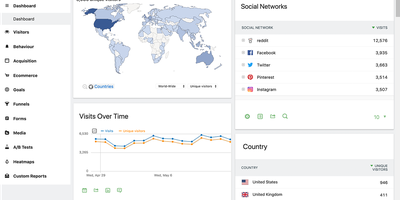
Several EU data protection authorities have ruled Google Analytics deployments unlawful; Matomo (formerly Piwik) is the most complete open-source replacement - a full analytics platform with 30+ report types across visitors, actions, referrers, goals, and ecommerce. The self-hosted PHP/MySQL edition is free and keeps every byte of visitor data on your infrastructure, which matters more each year: several EU data protection authorities have ruled Google Analytics deployments unlawful, while Matomo configured for cookieless tracking is approved by France's CNIL for use without a consent banner. All reporting runs on 100% unsampled data - no extrapolation at high traffic volumes. The GDPR Manager handles data subject requests and deletion, with IP anonymization, retention controls, and Do Not Track support built in. A dedicated importer pulls your historical Google Analytics data so years of trends survive the migration. Core analytics cover campaigns, custom variables and dimensions, entry/exit pages, downloads, site search, and full ecommerce tracking with a comprehensive HTTP API for reporting and ingestion. Premium plugins extend the platform into Hotjar-class behavioral tooling - click and scroll heatmaps, session recordings, conversion funnels, form analytics, A/B testing - plus a tag manager and SAML SSO. For teams that need GA-equivalent depth with actual data ownership, Matomo is the realistic drop-in replacement.
PostHog
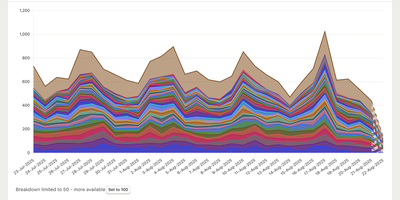
With over 37,000 GitHub stars and used by teams at Y Combinator, Airbus, and Phantom, PostHog replaces an entire stack of paid analytics tools — Mixpanel, Amplitude, Heap, LaunchDarkly, Hotjar, and Google Analytics — with a single open-source platform where every tool shares a common event layer and user context. Product analytics captures events automatically or via manual instrumentation with HogQL (SQL) access for custom queries, while web analytics provides GA-like dashboards for traffic, conversions, and Core Web Vitals. Session replay records user interactions with DOM snapshots and network waterfall analysis, linking directly to errors and feature flag exposures. Feature flags safely roll out changes to specific cohorts with multivariate support and instant rollback, while experiments run A/B tests with automatic Bayesian significance calculations and revenue attribution. Error tracking captures stack traces linked to session replays and user properties for immediate reproduction context. AI observability monitors LLM generations, traces, token usage, latency, and costs across model versions. The managed data warehouse syncs 120+ external sources including Stripe, Postgres, Salesforce, and HubSpot alongside product events, queryable through a unified SQL editor. An MCP server enables AI agents in Cursor, Claude Code, or VS Code to query analytics and execute SQL directly. Running on a dedicated VPS on RepoCloud with guaranteed CPU, RAM, and SSD, full root SSH access, and a browser serial console. MIT licensed.
Ackee
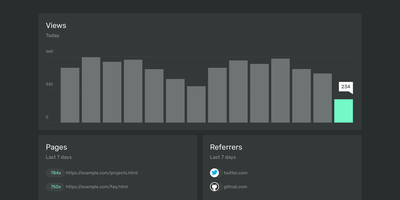
Page views, referrers, browsers, and screen sizes - Ackee delivers the analytics developers actually check, from a deliberately minimal Node.js and MongoDB stack that skips both Matomo's weight and Google Analytics' cloud dependency. Its defining constraint is anonymization: no cookies, no unique user tracking, and a multi-step anonymization process that keeps visitors unidentifiable while the aggregate numbers stay useful. In its default anonymous mode Ackee collects no personally identifiable information at all, which means GDPR and CCPA compliance out of the box and no cookie consent banner on your sites. A detailed mode adds screen size, language, and per-visit referrers - still without cookies or fingerprinting. Integration mirrors the Google Analytics pattern: create a domain in settings, drop the generated ackee-tracker snippet into your pages, and data appears in a clean single-page dashboard. One instance tracks multiple domains, and custom events capture button clicks, signups, and conversions. The distinctive engineering choice is the fully documented GraphQL API: everything the dashboard shows comes from that API, so you can query active visitors, average duration, and view statistics programmatically, feed data in from apps and services beyond websites, or build an entirely custom interface on top. If you want bare-minimum analytics with a real API and zero privacy anxiety, this is the tool.
Swetrix
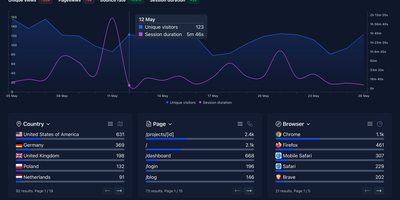
Traffic analytics, real-user performance monitoring, and client-side error tracking - normally three tools - in one cookieless, privacy-first dashboard: Swetrix. The Community Edition ships the same core engine as the cloud product - a NestJS API with ClickHouse for high-volume event storage, MySQL for relational data, and Redis for caching, fronted by a React dashboard and a ~5 KB tracking script with official packages for 20+ frameworks including Next.js, WordPress, and Shopify. Traffic analytics cover pageviews, referrers, UTM campaigns, geolocation, sessions with page flows, funnels, and custom events - all anonymized server-side with no cookies, no cross-device tracking, and no consent banner required for GDPR compliance. Performance monitoring records real-user metrics per pageview: TTFB, DNS and TLS timing, and render times, so regressions surface in the same place as traffic. Error tracking captures unhandled JavaScript exceptions automatically with formatted stack traces, filename/line metadata, affected browsers and pages, first/last-seen timestamps, and a resolve workflow - replacing a separate error monitoring subscription for many teams. Alerts fire to email, Slack, Telegram, Discord, or webhooks on traffic spikes, new errors, and custom events. If Plausible covers your traffic questions but you also want to know why the site broke, Swetrix answers both.
Quant-UX
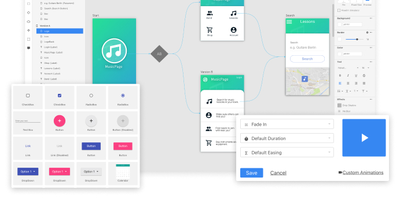
Most design tools stop at prototyping; Quant-UX also measures how real users actually perform with the prototype. The visual editor creates prototypes that behave like real apps - functional input widgets, animations, form validation, data binding across screens, and business logic modeled with REST requests and decision elements. Design systems are first-class, with components, design tokens, and master screens; if you design elsewhere, drop in image files or import from Figma. Testing is a shared link or QR code - no installs on the tester's side. Define user tasks up front, and Quant-UX records every session: click heatmaps show where users found (or missed) actionable elements, user journey graphs expose lost users, drop-off charts reveal where tasks stall, and success rates and task KPIs are extracted automatically into a dashboard. An A/B test operator wires two design variants into one prototype and compares task duration, success rate, and interaction counts. In-prototype surveys collect qualitative feedback alongside the numbers, and an AI assistant generates prototype fragments like styled forms on request. The RepoCloud deployment runs the full stack - frontend, backend, and WebSocket server containers over MongoDB - so all test recordings and research data stay on your infrastructure.