Apache Solr
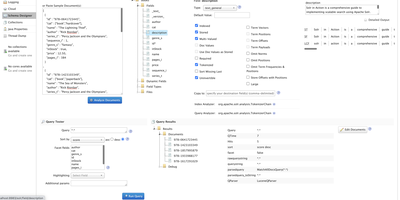
Product catalogs, help centers, and document archives all fail the same way: visitors type a few words, get the wrong results, and leave. Apache Solr is the search platform behind fast, relevant answers, returning ranked matches with faceted filters, highlighted snippets, spell suggestions, and geospatial distance in a single query. Index documents through HTTP updates or data import handlers, shape fields in the schema, and watch changes appear through near-real-time indexing without rebuilding the corpus. SolrCloud turns one index into a distributed collection: shards split large corpora across nodes, replicas copy each shard for failover and query load, and ZooKeeper coordinates configuration so every node serves the same schema. Dense vector fields store embeddings beside your text, and the KNN parser retrieves nearest neighbors through HNSW graphs, so semantic search runs in the same engine as keyword search instead of a second system. A combined query handler merges keyword and vector rankings with reciprocal rank fusion, and an enrichment processor can call language models at index time to tag or summarize documents as they arrive. Streaming expressions add analytics over results, from rollups and percentiles to joins across collections, while JWT authentication and authorization rules protect the admin console and APIs. Running on a dedicated VPS on RepoCloud with guaranteed CPU, RAM, and SSD, full root SSH access, and a browser serial console. Apache-2.0 licensed.
RAGFlow
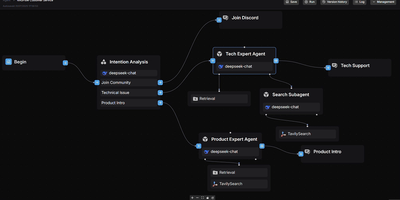
RAGFlow has established itself as one of the most widely adopted open-source RAG engines available, powering production AI systems that demand traceable, hallucination-free answers from complex enterprise data. The platform processes PDF, DOCX, Excel, and PPT files through vision-based deep document understanding with layout analysis and OCR, extracting structured knowledge from tables, charts, and images that simpler parsers miss entirely. RAGFlow's hybrid retrieval pipeline combines vector search with BM25 keyword matching and multi-stage reranking across configurable document stores including Elasticsearch, InfiniFlow's Infinity engine, OpenSearch, and OceanBase. Developers connect any combination of LLM providers — OpenAI, DeepSeek, Anthropic Claude, Google Gemini, and locally-hosted models via Ollama — through a unified configuration layer. The visual agent workflow system enables multi-step reasoning chains with persistent memory, tool calling, and pre-built templates for common enterprise scenarios. RAGFlow synchronizes data from Confluence, S3, Notion, and Google Drive, and delivers answers through chat integrations with Feishu, Discord, Telegram, and Line. The Python SDK and RESTful API on port 9380 provide programmatic access to knowledge base management, document parsing, and conversational retrieval. The full stack deploys via Docker Compose with MySQL for metadata, Redis for task orchestration, and MinIO for object storage. Running on a dedicated VPS on RepoCloud with guaranteed CPU, RAM, and SSD, full root SSH access, and a browser serial console. Apache 2.0 licensed.
LightRAG
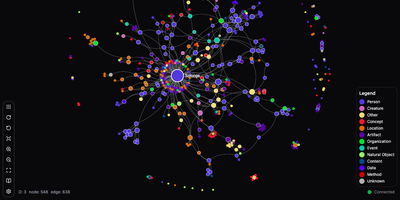
Plain chunk retrieval hands an LLM disconnected excerpts; LightRAG builds a knowledge graph from your documents so answers can join facts spread across many files. Ask about one named person, product, or clause and local mode pulls its details. Ask for themes across the whole library and global mode follows the links between entities. Hybrid blends the two, naive falls back to plain chunk search, and mix combines all three. Mix is the default. Upload text, Markdown, PDF, Word, PowerPoint, and Excel files; MinerU, Docling, or the native parser can extract images, tables, and formulas. The admin console manages documents, explores the graph visually, and debugs queries, while a query-only workspace page gives everyday colleagues a clean chat screen that works on phones. A REST API covers indexing and queries, and an Ollama-compatible endpoint lets chat front ends such as Open WebUI use the knowledge base as a model. New files merge into the existing graph without a full reindex, and deleting a document rebuilds only the entities and relationships it touched from cached results. Separate model roles let an inexpensive model extract entities while a stronger one writes answers. An API key or accounts protect the server, and named workspaces keep several knowledge bases apart. Pair it with local Ollama models and no document text leaves the server. Running on a dedicated VPS on RepoCloud with guaranteed CPU, RAM, and SSD, full root SSH access, and a browser serial console. MIT licensed.