Mitra
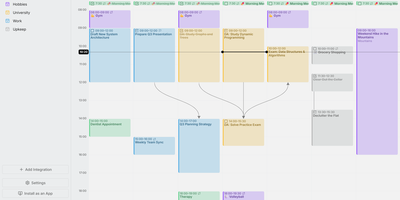
Mitra is a self-hosted calendar that puts your tasks on the same timeline as your events, so planning a week finally happens in one place instead of two. Drag across empty grid space to make an entry, drag it to move it, and stretch its edges to resize it. Tasks without a date sit in the Planning tab with a due date and an estimate until you drag them into the week. Subtasks and dependencies draw as lines between entries. Availability shading lays your working hours under the grid so double-booking becomes obvious before it happens. Keep calendars inside Mitra with no account behind them, or connect the ones you already use: CalDAV, Google Calendar, Apple Calendar, Notion, Todoist, and Tempo all sync both ways, and published feeds arrive as read-only subscriptions. Lists sort, filter, and change many entries at once. Files attach to entries, guests reply, reminders land as push notifications, and a command palette drives everything from the keyboard. Claude, Cursor, and other AI tools can read and plan your calendars over MCP. Eight languages, right-to-left layouts, light and dark themes, phone install, and OIDC sign-in for several people round it out. Running on a dedicated VPS on RepoCloud with guaranteed CPU, RAM, and SSD, full root SSH access, and a browser serial console. AGPL-3.0 licensed.
Rackula
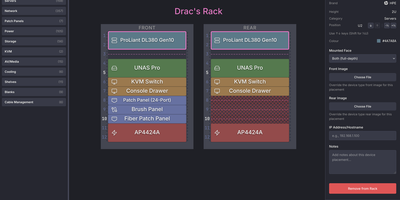
Before lifting a heavy four-unit storage server or rewiring a cramped network closet, you can map every unit of cabinet space in Rackula, an interactive drag-and-drop rack layout designer and capacity planner. Instead of staring at generic grey rectangles in a spreadsheet, you pull switches, routers, patch panels, UPS battery banks, and rackmount chassis from a hardware catalog populated with authentic front and rear faceplates from the NetBox device library. Equipment snaps cleanly to standard EIA-310 rack unit boundaries, while half-width gear and mini PCs nest inside one-unit carrier shelves and mounting brackets. Audiovisual technicians can group bayed cabinets side by side to plan amplifier racks, signal processor chains, and patch bays across multi-rack installations. Network engineers and data center operators can rearrange hardware with full undo and redo history, attach custom device graphics, and export crisp diagrams as PNG, SVG, or PDF files for runbooks and change control tickets. Sharing a proposed cabinet topology with a colleague in the field takes seconds using an encoded URL or a scannable QR code that opens on mobile browsers. Server-side persistence stores your rack definitions as portable YAML files and supports optional local accounts or OpenID Connect single sign-on for shared infrastructure teams. Running on a dedicated VPS on RepoCloud with guaranteed CPU, RAM, and SSD, full root SSH access, and a browser serial console. MIT licensed.
Craftplan
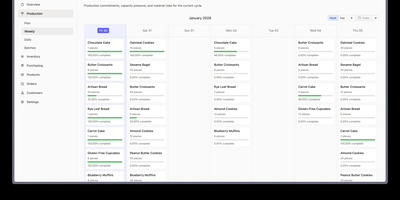
Every batch a craft business ships carries a recipe version, a cost, and a trail of ingredient lots, and Craftplan, an open-source ERP, keeps all three connected. Receiving stock against a purchase order records each supplier lot code and optional expiry date, and partial deliveries keep the order open. Customer orders appear on a delivery calendar and can generate invoices. Scheduled items wait on the production board as unbatched cards until Batch All creates one batch with a frozen copy of the recipe. Capacity warnings flag products over their daily limit, and a forecast highlights materials that will run short. Finishing a batch consumes ingredient lots earliest-expiry first, skips any lot on hold or rejected, and snapshots material, labor, and overhead costs. Recipes are versioned, so past costs never change. A blend made in-house can be stocked as its own material, with its actual yield, lot costs, and source lots intact. Allergens and nutrition facts roll up from each material through every recipe, and completed batches print A5 or compact labels with a scannable barcode. The Trace Center follows a supplier lot forward to every customer who received it, or a finished batch back to its sources. Recall mode can place the lot on hold, and the trace exports as CSV or prints for the recall file. Running on a dedicated VPS on RepoCloud with guaranteed CPU, RAM, and SSD, full root SSH access, and a browser serial console. AGPL-3.0 licensed.
Vanilla Cookbook
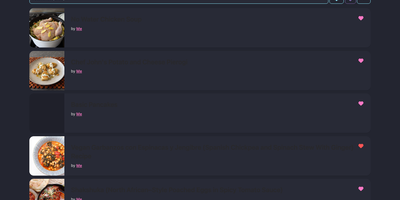
Every family recipe, bookmarked food blog post, and meal-prep formula stays organized inside Vanilla Cookbook, a self-hosted culinary library that converts volumetric measurements into precise gram weights and scales servings on the fly. Paste a URL or click the browser bookmarklet to scrape recipes from hundreds of cooking websites. Plain-text ingredient strings split automatically into structured quantities, units, preparation notes, and optional or to-serve badges. Home bakers switch effortlessly between US cups, imperial ounces, and metric grams across thousands of ingredient density profiles. Inline oven temperatures, fractions, and numeric ranges adjust automatically as serving counts change. Nutritional text parses into a structured per-serving breakdown, while integrated shopping lists, cooking logs, and equipment lists keep weekly grocery planning synchronized across desktop browsers and Progressive Web App mobile devices. Connecting an optional OpenAI, Anthropic, Google Gemini, Ollama, or LiteLLM endpoint unlocks AI fallback scraping for pages lacking Schema.org markup, automatic recipe translation, verbose direction summarization, photo-to-recipe extraction, and vector-based semantic search. Multi-user accounts, OAuth authentication, public recipe sharing links, and bulk import or export tools give households full control over their cookbook data. Running on a dedicated VPS on RepoCloud with guaranteed CPU, RAM, and SSD, full root SSH access, and a browser serial console. GPL-3.0 licensed.