Univer Workspace
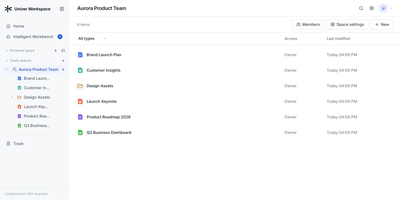
A budget model, the launch document that explains it, and the slides that present it can live side by side in one self-hosted office workspace that people and AI agents edit together. Personal and Team Spaces organize Sheets, Docs, Slides, relational Bases, and Boards, with Recent, Trash, file import, and export views keeping everyday housekeeping close at hand. Sharing follows role and node aware access control, including anonymous viewing, so a single table or document can be opened to a reader without exposing the whole space. Data and references stay connected across artifacts as the workspace changes, which keeps a figure corrected in a sheet consistent with the document that quotes it. The Workspace Agent drafts and revises content in isolated Worktrees, verifies its own changes, and hands the result to a person for review before anything reaches the trunk. Several review rounds can happen while humans keep editing in the Browser, and nothing merges until someone approves it. The Workspace CLI connects existing agents to your deployment, so automation can create content, inspect data, render screenshots and PDFs, and run layout checks before review. Sign-in accepts passwords, GitHub, Discord, or application OAuth, and files move in and out as XLSX, DOCX, PPTX, and CSV without a separate conversion project. Running on a dedicated VPS on RepoCloud with guaranteed CPU, RAM, and SSD, full root SSH access, and a browser serial console. Apache-2.0 licensed.
Codeg
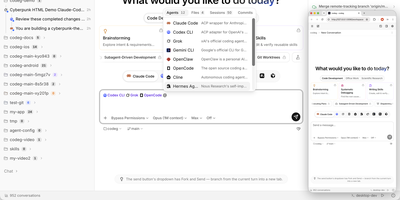
Run Claude Code, Codex, Gemini CLI, OpenCode, and sixteen other AI coding agents from one workspace instead of juggling twenty terminals. Every agent connects through the Agent Client Protocol, so conversations render as structured chats with tool cards, live diffs, and interactive replies rather than raw terminal scrollback. Codeg imports the session history each agent already keeps on disk, making every past conversation searchable and resumable, even when you hand the thread to a different agent. Mention one agent with an @ to delegate work to another, or run several side by side and watch their progress stream into the same conversation. Queued to-dos execute unattended in isolated git worktrees, leaving finished changes ready for your review and approval instead of touching your working tree. An infinite canvas arranges chats, files, terminals, and notes on one board, while git tooling, token usage tracking, and MCP server support stay one panel away. Deployed as a headless server, Codeg answers in any browser and through Telegram, Lark, and WeChat channels, so agent work continues while you are away from your desk. Running on a dedicated VPS on RepoCloud with guaranteed CPU, RAM, and SSD, full root SSH access, and a browser serial console. Apache-2.0 licensed.
UseAgent
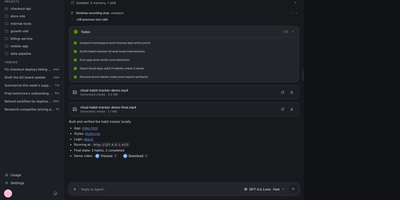
Hand a task to an AI teammate the way you would hand it to a person: describe the work, then follow along and step in when it matters. UseAgent runs Claude Code, Codex, OpenCode, and Pi inside isolated Linux workspaces, each with your repositories, a terminal, a real browser, and a desktop you can open and take over. Start work from the web app, by mentioning an agent in Slack, or through the API, and get pull requests, documents, spreadsheets, presentations, and research back as usable files. Four engines share one thread and one event format, so you can compare how Claude Code and Codex each handled the same bug, then switch engines on the next reply without losing history, files, or memory. Risky operations pause at approval gates, and a decision resumes the run with a one-shot, argument-bound capability instead of blanket trust. Every step, tool call, and approval is stored as an append-only event log in your Postgres, replayable after the fact and durable across restarts mid-task. Teach the workspace your procedures by importing versioned skills from GitHub and pinning playbooks to tasks, while knowledge pages and optional team memory stay beside the work, inspectable and correctable. Recurring tasks run on schedules with full history. Provider keys stay on your server and never enter an agent sandbox. Running on a dedicated VPS on RepoCloud with guaranteed CPU, RAM, and SSD, full root SSH access, and a browser serial console. AGPL-3.0 licensed.
Seatsurfing
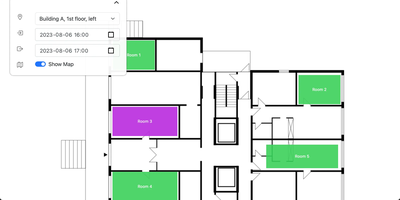
Seatsurfing brings desk booking, room reservations, and parking management to interactive floor plans across multiple office locations, solving the coordination headache of hybrid work. The Go backend serves two React/TypeScript frontends through a single Docker container on port 8080: a Booking UI built as an installable Progressive Web App for mobile and desktop reservations, and an Admin UI for floor plan configuration, capacity enforcement, and analytics. Interactive floor plans accept uploaded office layouts where administrators visually place bookable spaces with per-space metadata and availability rules. Multi-location support handles organizations with distributed offices across multiple buildings and cities. The buddy system displays which colleagues have bookings on a given day, enabling team coordination without manual communication. Capacity management enforces occupancy limits per area with automatic denial when thresholds are reached. SSO integration supports OIDC and OAuth2 providers including Microsoft Azure AD, Keycloak, and Authentik for enterprise identity federation. Microsoft Teams and Confluence integrations embed booking directly into collaboration tools employees already use daily. The REST API enables automation and custom integrations, while the analytics dashboard tracks utilization rates, peak hours, and booking patterns. Docker Compose deployment requires only a PostgreSQL database with multi-architecture images supporting amd64 and arm64. Running on a dedicated VPS on RepoCloud with guaranteed CPU, RAM, and SSD, full root SSH access, and a browser serial console. GPL-3.0 licensed.
Cloudflare OS
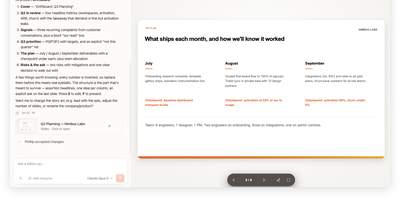
With over 7,700 GitHub stars and thousands of Cloudflare employees using it daily across every function, Cloudflare OS delivers an open-source AI workspace where every employee gets a personal agent grounded in company context, systems, and skills — not a generic chatbot but a programmable workspace that builds real applications, automates workflows, and connects to internal tools through governed access. The Code Mode agent writes and immediately executes code snippets to perform arbitrary tasks, build full-stack Gadgets with client code, server code, APIs, and durable SQLite state, debug errors, and test results within isolated sandboxes. Gadgets are private application instances running in separate sandboxes — each document, spreadsheet, or tool is its own secure runtime that cannot leak data even to attackers with access to other Gadgets. Blueprints enable sharing application code as templates that others instantiate with independent state, credentials, and resources. Gatekeepers provide security governance giving system owners precise control over what agents can see, change, and when human approval is required before actions execute. Built on Cloudflare Workers using Durable Objects for workspace persistence, Dynamic Workers for Gadget execution, and Facets for access management. Zero Trust security via Cloudflare Access verifies every user and request before granting access. Real-time collaboration lets colleagues use shared Gadgets. Deploy to your own Cloudflare account or self-host on workerd, the open-source Workers runtime, on your own servers. Running on a dedicated VPS on RepoCloud with guaranteed CPU, RAM, and SSD, full root SSH access, and a browser serial console. Apache-2.0 licensed.
AgentBox
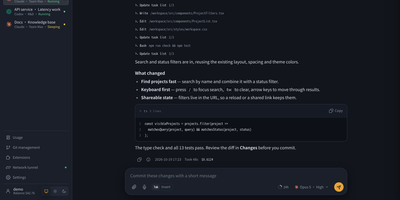
AgentBox is a self-hosted browser workspace that runs Claude Code and Codex CLI on a server you control, so a task goes from chat to reviewed code without leaving one place. Open a workspace from an empty project, an uploaded archive, or a Git clone, then talk to the agent in streaming web chat or drop into its original interactive terminal when you want the CLI itself. Files persist between sessions along with your home configuration and chat history, so a project picked up on a laptop continues on a phone exactly where it stopped. Review per-file diffs line by line before committing, pushing, or opening a pull request, and download the result when no Git connection is configured. Shared files, layered home templates, Claude skills, and MCP configuration carry your setup into every new workspace, with per-workspace overrides when a project differs. A trusted team shares central account pools with per-user scopes, while every model request is recorded with tokens, cache hit rate, cost, and latency, exportable to CSV and optionally capped by credits. An optional tunnel reaches allowlisted repositories and databases on private networks, and six interface styles with light and dark modes keep long sessions comfortable. Running on a dedicated VPS on RepoCloud with guaranteed CPU, RAM, and SSD, full root SSH access, and a browser serial console. Apache-2.0 licensed.
Thesys
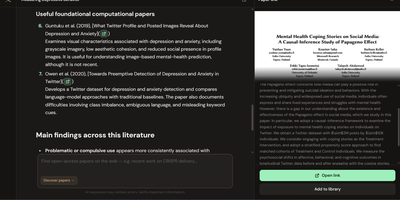
Thesys is a research workspace where you search academic papers, build your own library, and ask questions that answer with citations you can click straight onto the highlighted passage of the PDF. Discovery searches OpenAlex and arXiv in one pool, so a paper you find can be previewed and added to your library without leaving the workspace. Uploaded PDFs are ingested locally, and when you ask a question the answer cites its sources in the document, jumping the preview to the retrieved passage with either a full-passage or a tighter focused highlight. Reader mode opens a paper full-width so you can select any span of text and ask about that exact passage. Document summaries follow a consistent structure of problem statement, methodology, key findings, limitations, and metrics, with citations that still land on the source text. Figures and flowcharts are described during ingest, so questions and summaries can reference them too. When two papers disagree, Compare mode takes one claim and classifies each retrieved pair as corroboratory, contradictory, or neutral, with confidence shown in a side panel. Your bibliography exports as BibTeX, RIS, EndNote, or CSV for whatever reference manager you already use. Papers, embeddings, and chat history stay on your own disk the whole time. Running on a dedicated VPS on RepoCloud with guaranteed CPU, RAM, and SSD, full root SSH access, and a browser serial console. AGPL-3.0 licensed.
AtomicServer
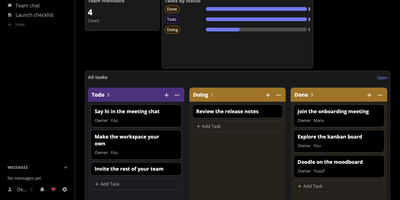
Documents, tables, files, chat, and video meetings share one workspace in atomic.place, and AtomicServer is the part you host yourself so a team can edit together while the data stays on a machine it controls. Documents are collaborative rich text with comments, icons, and cover images, tables enforce a strict schema with keyboard navigation and copy and paste, and any table can switch to a kanban, calendar, dashboard, or timer view. Templates start an issue tracker, a CRM, a project task list, or a time tracker. Live cursors, typing indicators, and presence avatars show who is working where, group channels carry attachments, replies, and search, and an infinite canvas can be drawn on together. Every write is a signed commit, so a full history is kept. Read and write rights follow the resource hierarchy, and invite links bring people in. Websites are designed in the browser, published in one click, and rolled back to any earlier version. Custom classes and properties come from the Ontology Editor, small apps are plain JavaScript screens over the same data, and AI features work with any model through OpenRouter or a local Ollama and support MCP. Typeahead search suggests results as you type. A REST API answers in JSON-AD, Turtle, or JSON-LD for automation, and export and import commands write and read JSON-AD backups. Running on a dedicated VPS on RepoCloud with guaranteed CPU, RAM, and SSD, full root SSH access, and a browser serial console. MIT licensed.
Litpage
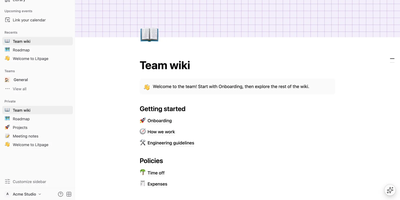
A project brief and the task board tracking it belong together, and Litpage keeps pages, databases, and team discussion in one self-hosted workspace instead of scattering them across subscriptions. Write in a block editor with 41 block types, a slash menu, markdown shortcuts, drag and drop, mentions, equations, and highlighted code blocks. The same data becomes a table, board, list, gallery, calendar, timeline, chart, dashboard, feed, form, or map, with typed fields, formulas, relations, and rollups underneath. Automations and buttons turn those databases into working tools, while templates keep repeated projects consistent. Teammates edit together live, comment, suggest edits, and revisit version history, with page-level and field-level permissions deciding who sees what. Pages can be shared publicly or published as sites, and Markdown, CSV, HTML, Word, and PDF files import into the tree. Optional AI runs on the provider and key you configure: chat that searches your workspace, custom agents on schedules or triggers, writing help, database autofill, and meeting-note summaries. Administrators get member and guest management, security policies, an audit log, analytics, passkeys, and two-step verification. A REST API with personal tokens, webhooks, and an MCP endpoint open everything to your other tools. Running on a dedicated VPS on RepoCloud with guaranteed CPU, RAM, and SSD, full root SSH access, and a browser serial console. MIT licensed.
Busabase
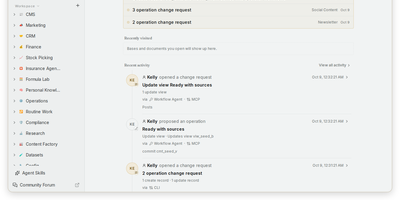
Every AI agent session starts from zero, and Busabase fixes that: it is an open-source workspace where agents and people share records, docs, skills, and apps, and every agent write arrives as a reviewable change. Bases hold typed records with relations, views, and forms, while Docs, Files, Whiteboards, and Workflows live in the same tree, so a project's data and context stay together. Skills are SKILL.md playbooks that any connected agent can look up before it acts. Each write becomes a Change Request carrying a message, a field-level diff, an author, and history; your permissions decide whether it merges at once or waits in the Inbox for approval, and any change can be reversed. Ask an agent to turn a Base into a dashboard, CRM, or content desk and it runs as an AirApp on live workspace data. Claude Code, Codex, Cursor, Gemini CLI, n8n, or your own process can connect through MCP, OpenAPI, the CLI, TypeScript and Python SDKs, or an in-app chat session. Templates install a complete setup, with sample data and an agent manual, in one command. Start it with one command and no accounts, because the open-source edition is a single-user workspace with no sign-in screen. Running on a dedicated VPS on RepoCloud with guaranteed CPU, RAM, and SSD, full root SSH access, and a browser serial console. MIT licensed.
AgentVerse OS
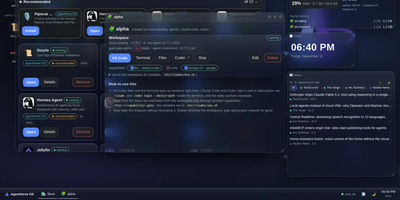
AgentVerse OS turns a single Ubuntu server into a personal cloud with a real desktop in the browser, built for a developer and their AI agents. You work in a windowed desktop with a taskbar, start menu, and widgets for system monitoring, clock, news, weather, and projects, and the same desktop opens from a laptop, tablet, or phone while everything stays on the server. Each project gets an isolated Incus container with Docker inside, its own network and gate, plus VS Code, a terminal, files, and git in the browser. The Agents app runs Claude Code, Codex, Gemini CLI, pi, and Antigravity inside the workspace, with permission prompts you approve from any device, scheduled routines, model menus, conversation search and export, and a ledger of what each session spent. When you close your laptop the agents keep working, and you pick the conversation up later exactly where it stopped. A built-in store merges the Runtipi, Coolify, and Umbrel catalogs into about 945 installable apps with guided setup, credentials shown in the app card, snapshots, and rollback. Projects request capabilities such as storage.s3, llm, or notify instead of hardcoding addresses, scheduled ZFS snapshots feed a restic backup repository, and access arrives only through your Tailscale network with real certificates. Running on a dedicated VPS on RepoCloud with guaranteed CPU, RAM, and SSD, full root SSH access, and a browser serial console. Apache-2.0 licensed.