CLIProxyAPI Dashboard
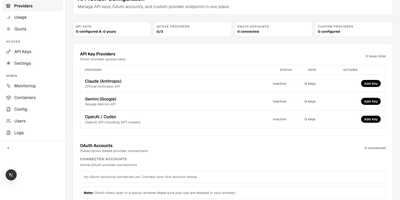
CLIProxyAPI Dashboard puts a web console in front of CLIProxyAPI so you manage AI providers, keys, quotas, and containers through forms instead of YAML files. Connect Claude Code, Codex, xAI, Antigravity, Kimi, and Devin accounts with OAuth, then add Gemini CLI, GitHub Copilot, Kiro, and Cursor through plugins you install and configure from the settings store. Any OpenAI-compatible endpoint can join as a custom provider with model mappings, and admins can mark a provider as shared so the whole team uses it. You create, revoke, and track API keys with per-user ownership, manage dashboard users and admin rights, and stream live logs beside container health. Quota views track rate limits per provider and per model, and Telegram alerts fire when remaining quota drops below your threshold. Usage analytics break down request counts, provider share, model statistics, error rates, and estimated cost. Configuration syncs to OpenCode automatically, model configurations travel as share codes, and backups can be created, scheduled, previewed, and restored from settings. One-click updates refresh the dashboard and proxy images, containers start and stop from the panel, and automatic TLS keeps the console reachable under your domain. Running on a dedicated VPS on RepoCloud with guaranteed CPU, RAM, and SSD, full root SSH access, and a browser serial console. MIT licensed.
Coder
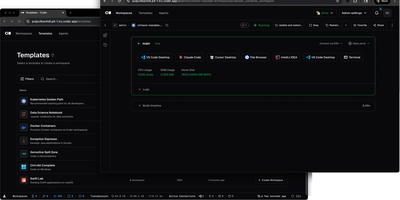
With over 14,000 GitHub stars and enterprise adoption by security-conscious organizations, Coder transforms how development teams provision, manage, and secure their coding environments. Every workspace is defined as a Terraform template, meaning infrastructure engineers can standardize development environments across EC2 instances, Kubernetes pods, Docker containers, or any combination, while developers get self-service provisioning that launches in seconds rather than days of manual setup. The WireGuard-based networking layer establishes encrypted tunnels between developer machines and remote workspaces, providing low-latency access without exposing ports or configuring VPN concentrators. Automatic idle detection shuts down unused workspaces after configurable periods, directly reducing cloud compute costs for organizations running hundreds of developer environments. The Coder Agents feature introduces native AI coding capabilities where the agent loop executes entirely within the control plane on self-hosted infrastructure, keeping LLM API credentials out of individual workspaces and eliminating credential exfiltration risks. Centralized model governance allows platform teams to approve specific AI providers and models, set per-user spend limits, and maintain complete audit logs of all prompts, tool calls, and agent activity. IDE integration supports VS Code through a dedicated extension, JetBrains IDEs via Gateway and Toolbox plugins, and browser-based code-server for web access. The template registry provides pre-built configurations for common development stacks. DevContainer support builds environments from standard devcontainer.json specifications. Deploy on a dedicated VPS on RepoCloud with guaranteed CPU, RAM, and SSD, full root SSH access, and a browser serial console. AGPL-3.0 licensed.
Hollama
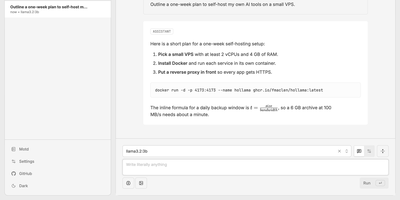
A tidy, account-free chat client for every language model server you run. Ollama, the OpenAI API, and OpenAI-compatible servers like llama.cpp plug in side by side, and each of their models appears in one picker. Prompts accept images for vision models, and answers render Markdown, highlighted code, and KaTeX formulas. Reasoning models keep their thinking in a separate panel from the final answer. Messages can be edited, retried, or copied, and the session panel holds a system prompt plus Ollama options for temperature, Top K, Top P, and seed. Knowledge notes, written in a built-in code editor, attach to a session as reusable context. The Settings page pulls new Ollama models by tag, labels each connection, and filters model names by prefix. Tabs stay in sync, themes switch between light and dark, and the interface is translated into many languages. Servers, preferences, sessions, and knowledge export and import as files. Nothing sits in a cloud database, because history lives in the browser of whoever opens it. A single Docker container on port 4173 serves a whole team. Running on a dedicated VPS on RepoCloud with guaranteed CPU, RAM, and SSD, full root SSH access, and a browser serial console. MIT licensed.
Paperclip
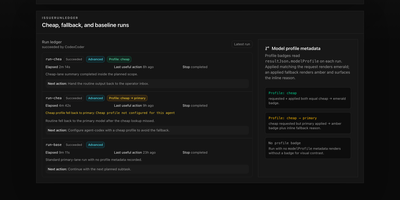
With over 77,000 GitHub stars accumulated in under five months since its March 2026 launch, Paperclip has become the default control plane for teams running multiple AI agents in production. Rather than juggling dozens of terminal tabs with Claude Code sessions, Codex instances, and Gemini CLI workers, Paperclip organizes all agents into a company structure with org charts, reporting lines, role-based permissions, and per-agent monthly budgets that trigger hard-stops when exceeded. The platform supports any runtime through its adapter system — Process adapters manage local CLI agents like Claude Code, Codex, Cursor, Pi, and OpenCode as child processes, while HTTP adapters trigger remote agents via webhooks to OpenClaw, serverless platforms, or custom endpoints. Heartbeat-based execution wakes agents on configurable schedules, injecting goal context, budget state, and workspace paths directly into the invocation payload. The Work and Task System provides atomic checkout with execution locks, first-class blocker dependencies, and structured work products to eliminate duplicate effort. Governance features include approval workflows, decision tracking, emergency stops, and full audit trails tracing every mutation to an actor. Deployment runs as a single Node.js process with embedded PostgreSQL locally or scales to external Postgres for production, installable in one command via npx paperclipai onboard. Running on a dedicated VPS on RepoCloud with guaranteed CPU, RAM, and SSD, full root SSH access, and a browser serial console. MIT licensed.
9Drive
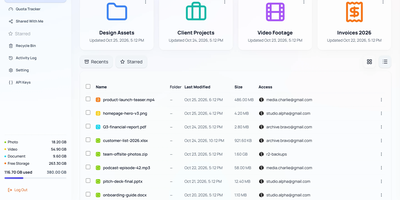
Four half-full cloud accounts become one big drive with a single search bar. Connect Google Drive accounts and S3-compatible buckets like Cloudflare R2, MinIO, Wasabi, or Backblaze B2, and the Quota Tracker shows total, used, and available space across all of them. Upload routing picks the destination by most free space, round-robin, or a custom priority order, and files stream straight through to storage without touching the server disk. The file manager offers nested virtual folders with custom colors and icons, list and grid views, filters for type, account, size, and date, previews for images, videos, PDFs, and Office files, a recycle bin, and a starred list. Public links open a built-in viewer with an embed mode, and invitations give other people viewer or editor access to a file or folder, tracked on a Shared page. An activity log records uploads, shares, and changes, and API keys with upload-only scope let scripts and CI jobs push files through a documented endpoint. Dark mode and a phone-friendly layout that installs as a PWA come built in. Running on a dedicated VPS on RepoCloud with guaranteed CPU, RAM, and SSD, full root SSH access, and a browser serial console. Apache-2.0 licensed.
Traffic Source
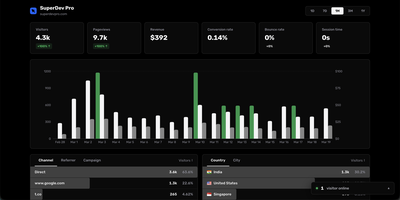
Traffic Source answers the three questions every site owner actually asks: who showed up, where did they come from, and did they pay. The live dashboard counts visitors in real time alongside pageviews, sessions, bounce rate, and session duration, with no cookie banner required because tracking uses no cookies at all. Referrer and UTM breakdowns show exactly which campaigns, newsletters, and posts earn their traffic, while country and city data arrives through proxy headers. Visitor journeys replay every page a person viewed before converting, so you can see the path from first click to checkout instead of guessing. Connect Stripe once and payments are matched to the sessions that produced them automatically, with no webhook plumbing to maintain. The affiliate system lets you create partners with custom commission rates and shareable referral links, and each affiliate gets a public dashboard showing their own clicks and earnings. Search Console data is pulled into the same screen, where a keyword explorer shows the pages, countries, and devices behind any query. One tiny tracking script covers all your sites, including single-page apps. Running on a dedicated VPS on RepoCloud with guaranteed CPU, RAM, and SSD, full root SSH access, and a browser serial console. MIT licensed.
AI Video Transcriber
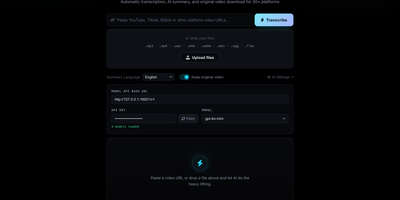
A two-hour podcast becomes a page of takeaways with AI Video Transcriber, a self-hosted web app that turns links and uploads into clean transcripts and short summaries. Paste a URL from YouTube, TikTok, Bilibili, Apple Podcasts, SoundCloud, or any of 30+ other platforms, or drag in an mp3, mp4, wav, or plain text file. When a video already carries subtitles, the transcript arrives in seconds with no audio download at all, and Whisper takes over only when captions are missing. A badge shows which path each job took, and live progress streams to the page as the job runs. Summaries come out in 11 languages, and a Translation tab appears whenever the transcript language differs from the one you picked. The original video or audio stays beside the results with an inline player and a one-click download, and every tab has its own download icon. Models are your choice: enter any OpenAI-compatible base URL and key in the interface, press Fetch to list what is available, and pick one. Agents get a command line tool, an MCP server, a Claude Code skill, and a Codex plugin. Running on a dedicated VPS on RepoCloud with guaranteed CPU, RAM, and SSD, full root SSH access, and a browser serial console. Apache-2.0 licensed.
Webclaw
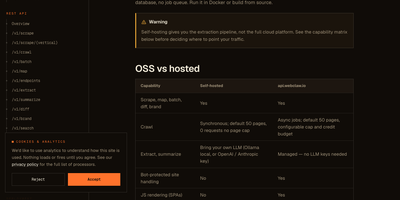
Webclaw turns messy web pages into clean content your AI tools can actually use, extracting the meaningful text and leaving the navigation, ads, and boilerplate behind. You point it at a URL and get back Markdown, plain text, structured JSON, raw HTML, or a format trimmed for language model input, with images stripped, links deduplicated, and whitespace cleaned. Crawl a whole site by following same-origin links page after page, map a domain first to discover every URL from its sitemap before deciding what to fetch, or batch many URLs at once and stream the results as they finish. CSS selectors let you include only the part of a page you care about or exclude the parts you never want, and main-content filtering keeps the article while dropping the chrome around it. Compare today's page against an earlier snapshot to see exactly what changed, or pull a site's colors, fonts, and logo into a brand profile. With your own language model connected, extraction follows a JSON schema or a plain prompt, and summaries come back at the length you ask for. Agents reach the same engine through an MCP server, scripts through the command line, and applications through the REST API. Running on a dedicated VPS on RepoCloud with guaranteed CPU, RAM, and SSD, full root SSH access, and a browser serial console. AGPL-3.0 licensed.
Shelve
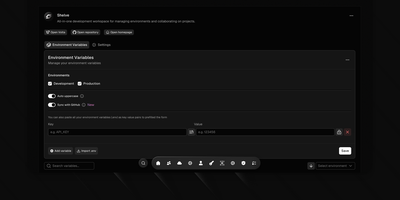
Eliminate scattered configuration files and leaked credentials across development teams with Shelve, an open-source secrets management platform that secures environment variables across development, staging, and production tiers. Engineering teams can organize sensitive database passwords and third-party API credentials within a centralized vault protected by AES-256 encryption and SHA-256 integrity verification. The platform synchronizes configurations directly to GitHub Actions and repository secret stores through an official GitHub App integration. Developers can inject encrypted variables directly into local processes using the dedicated CLI without saving plain-text secrets to disk. The built-in sharing vault creates self-destructing, password-protected links to exchange sensitive credentials securely with external contractors. Administrators can define custom workspace teams with granular role-based access controls, track change audit logs across configuration histories, and navigate management views using a keyboard-driven command palette. Automated schema validation engines detect missing parameters and enforce uniform uppercase naming standards across application tiers. Running on a dedicated VPS on RepoCloud with guaranteed CPU, RAM, and SSD, full root SSH access, and a browser serial console. Apache 2.0 licensed.
ZenNotes
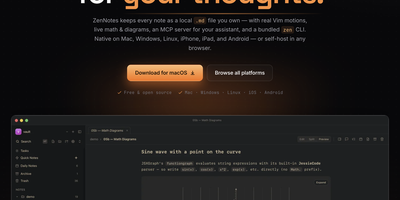
With over 2,200 GitHub stars and a philosophy that your notes should be files you own rather than rows in a database, ZenNotes is the keyboard-first Markdown editor that runs as a self-hosted web app backed by a Go server accessible from any browser on your network. Every note is a plain .md file in a vault directory you mount, with zero proprietary lock-in. Modal editing with real Vim motions, leader-key flows, and a command palette keeps your hands on the keyboard through edit, split, and preview modes. The rendering engine handles KaTeX math, Mermaid diagrams, TikZ graphics, and JSXGraph plots directly from Markdown syntax alongside wiki links and callout blocks. A first-party MCP server ships in the box with one-click integration for Claude Desktop and Cursor, letting AI assistants read and write the same Markdown files on disk without sync layers or duplicate copies. The bundled zen CLI provides note creation, search, tagging, task toggling, and piped capture with JSON output for shell scripting. Board views render plain CSV files as Kanban columns. Daily notes, quick capture, archive, and trash round out the vault workflow. The Go backend serves the browser frontend on port 7878 with token-based authentication, configurable browse roots, TLS proxy support, and file permission hardening at 0600/0700 defaults. Deploy via the multi-arch Docker image for linux/amd64 and linux/arm64. Running on a dedicated VPS on RepoCloud with guaranteed CPU, RAM, and SSD, full root SSH access, and a browser serial console. MIT licensed.
Open Intelligent UI
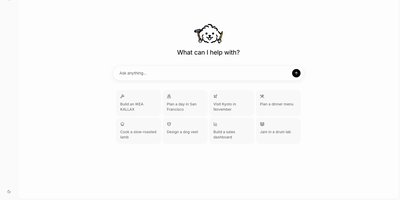
Ask for a day in San Francisco and get a routed map, photographs, and an editable itinerary instead of a wall of text. Open Intelligent UI recreates the interactive answers introduced in ChatGPT, with the model streaming a layout that the app renders live from a library of 55 components. A request for a phone comparison returns product cards and a side-by-side table, a money question returns sliders that recalculate loans and savings as they move, and a language question returns flip cards followed by a scored quiz. Dashboards offer date-range switches, KPI cards, area charts, ranked source bars, and sortable page tables, and maps add category filters, pins, expandable stops, and street routes. Fifty-nine built-in functions let each answer compute with its own state, so splits, schedules, and unit conversions update without another model call. Chat history keeps earlier answers, light and dark themes are one click away, and suggestion tiles start common requests. A development gallery shows worked examples, including a bike assembly guide, a retirement calculator, and a small arcade game, all without calling a model. Models connect through OpenUI Cloud, any OpenAI-compatible endpoint, or local Ollama, so keys and data stay in your control. Product teams, designers, and developers get a working reference for generative interfaces. Running on a dedicated VPS on RepoCloud with guaranteed CPU, RAM, and SSD, full root SSH access, and a browser serial console. MIT licensed.
Carbone
Document-generation code is the worst kind of code in your backlog - Carbone kills it. Its insight is separating design from data - templates are ordinary office documents (DOCX, ODT, XLSX, PPTX, HTML, even custom XML) built in LibreOffice, Microsoft Office, or Google Docs, with mustache-like markers such as {d.companyName} typed directly into the text. Send a template plus JSON from your existing APIs to the HTTP API, and Carbone returns the finished document - exported as-is or converted to PDF, XLSX, CSV, HTML, PNG, EPUB, and more via its integrated LibreOffice converter (Chromium and OnlyOffice engines are also supported for HTML-fidelity and office-format conversions). The template language goes well beyond substitution: loops over arrays render dynamic table rows, filters and aggregations run inside the document, and built-in formatters handle dates, numbers, currencies, timezones, and locales, with custom JavaScript formatters when needed. One template serves multiple languages through translation markers with auto-maintained translation files. The XML-agnostic engine means anything your document editor can design - pagination, headers, footers, nested tables, charts - survives generation intact, and Carbone guarantees no breaking changes in template syntax. Node.js-based, fast via multi-threaded LibreOffice conversion. The invoices, contracts, and reports your product owes its users become template edits, not sprints.
magpie
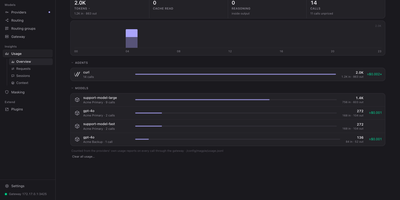
Point every coding agent and chat client at one self-hosted gateway, then choose which model answers from a single browser console. Add providers by preset or custom OpenAI-compatible URL, or sign in with the subscriptions you already pay for. Routing groups bundle several models into one name and move to the next member when a quota runs out, so the calling agent never sees the error. Create a gateway key per client, cap each with daily token or cost budgets, restrict its models, and watch usage counted separately. The Usage pages chart tokens, cost, request counts, cache hit rate, and a yearly heatmap, split by model, provider, or agent, with CSV export. A Routing view replays how each request was routed, with timing for masking, connecting, and the vendor. Masking swaps passwords, API keys, and tokens for placeholders before a prompt leaves your server and restores them in the answer. The browser page is protected by a key you set at launch. Running on a dedicated VPS on RepoCloud with guaranteed CPU, RAM, and SSD, full root SSH access, and a browser serial console. MIT licensed.
Pad
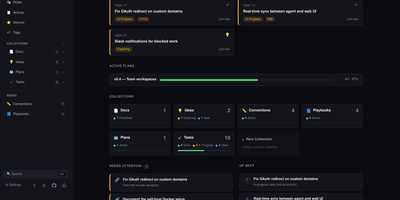
Your coding agents finish a session, close the laptop, and forget everything; Pad is where the project remembers. It holds the tasks, plans, bugs, ideas, and decisions in one workspace that you drive from a browser while your agents drive it from the terminal, so the next session, human or machine, picks up exactly where the last one stopped. You plan on boards, lists, and tables with drag-and-drop status columns, rich item pages, comment threads, and a dashboard that answers what needs attention and what to do next. Your agents read the queue, claim items, leave checkpoints, link their pull requests, and mark work fixed with the fixing PR attached. Conventions teach them the house rules once, like running tests before calling a task done, and playbooks hand them repeatable multi-step workflows they can invoke by name. Every change is versioned with its author, a person or a named agent, and new items appear in the browser the moment an agent creates them in the terminal. The same workspace is reachable three ways: the web interface, the pad CLI, and a bundled MCP server with a natural-language skill that plugs into Claude Code, Cursor, Codex, Windsurf, OpenCode, Copilot, Amazon Q, and Junie. Running on a dedicated VPS on RepoCloud with guaranteed CPU, RAM, and SSD, full root SSH access, and a browser serial console. Apache-2.0 licensed.
AI-Git-Bot
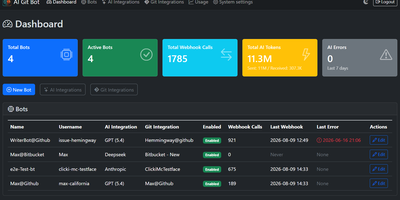
Inside your Git platform, AI-Git-Bot works as a self-hosted teammate that quietly handles the engineering chores everyone agrees matter and nobody has time for. Open a pull request and it reviews the diff with inline findings, re-reviews after a force-push, and answers questions when you mention it in the discussion, keeping the conversation context across updates. Assign it an issue and it can rewrite that issue with structure and acceptance criteria, route it to the right assignee with a stated reason, or implement it and open a pull request for you. It generates unit tests for new code, builds Playwright end-to-end suites and runs them against a preview environment, then posts the results back to the pull request. Documentation and locale files stop drifting, because README sync and translation coverage workflows update them as the code changes. Every run is observable through built-in metrics and signed outgoing webhooks, and you choose the brain behind it, from cloud models to a local model on your own hardware, so source code never has to leave your network. Running on a dedicated VPS on RepoCloud with guaranteed CPU, RAM, and SSD, full root SSH access, and a browser serial console. MIT licensed.
Ziit
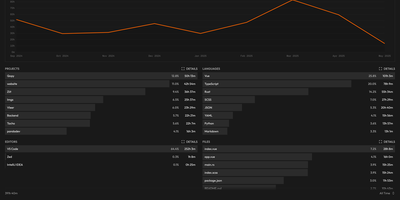
Ziit tracks where your coding hours actually go and shows the answer in a dashboard you host yourself. Install the extension in VS Code, any of its forks, or a JetBrains IDE, and every editing session streams to your instance with its project, language, editor, file, branch, and operating system attached. The dashboard filters by time range and breaks your work down by project and language, so a week of effort becomes a readable chart instead of a vague memory. You sign in with GitHub or email and password, import existing history from WakaTime or a WakAPI instance, and keep building on years of data instead of starting over. README badges embed live coding time for a project into any repository page, turning your profile into a quiet proof of work. A public stats page summarizes the whole instance, and a public leaderboard ranks who logged the most coding hours, which makes self-hosted instances double as community scoreboards. Because the server, the database, and the extensions are all yours, no third-party service sees which files you opened or how long a private project took. Teams can run one instance for everyone and compare effort across projects with the same filters. Running on a dedicated VPS on RepoCloud with guaranteed CPU, RAM, and SSD, full root SSH access, and a browser serial console. AGPL-3.0 licensed.
Svix
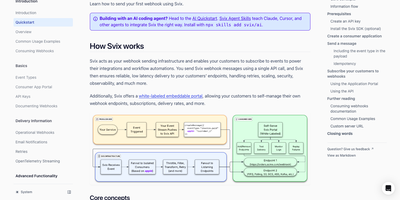
Development teams hand their outgoing webhooks to Svix, which delivers each event to customer endpoints with retries, signed payloads, and a delivery record for every attempt. Your app makes one API call when something happens, a user signs up, an invoice is paid, a build finishes, and Svix delivers the event to every subscribed endpoint your customers registered. Endpoints that fail get automatic retries on a schedule, deliveries are logged attempt by attempt, and failed messages can be resent instead of vanishing. Customers organize their integrations as applications, subscribe endpoints to the event types they care about, filter by channels, and verify signed payloads so forged requests get rejected. You define the event catalog once, and fanout, throttling, and endpoint bookkeeping stop being code you maintain. Official libraries for nine languages and a CLI make the first integration an afternoon task, and the whole service runs from a Docker Compose stack with Postgres and Redis when you want it on your own infrastructure. Your product gains the webhook system customers expect, without your team becoming a deliverability department. Running on a dedicated VPS on RepoCloud with guaranteed CPU, RAM, and SSD, full root SSH access, and a browser serial console. MIT licensed.
Websurfx
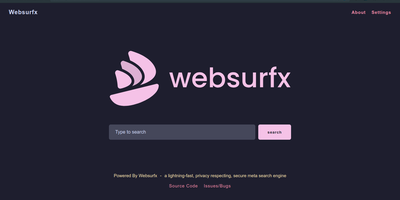
Websurfx aggregates results from multiple search engines into one private, ad-free interface that never tracks your queries. Written in Rust, the backend provides memory safety against buffer overflows and data races at the language level while handling concurrent requests across upstream providers like DuckDuckGo and Searx. A built-in re-ranking algorithm scores and merges results by relevance, producing a unified page that draws from many sources while appearing as one coherent search. Safe-search filtering operates across four levels from unrestricted to complete content blocking, with regex-based filter lists for parental controls in schools and organizations. Upstream requests route through configurable proxy chains or Tor, preventing search providers from correlating your queries with a specific IP address. Four Docker image variants target different caching strategies: hybrid Redis plus in-memory for maximum throughput, Redis-only, in-memory-only, or zero-persistence for environments where cached queries must never touch disk. The Lua configuration file controls engine selection, request timeouts, rate limiting thresholds, and production-mode delays that throttle upstream traffic to prevent abuse. Quick-result widgets handle calculations, currency conversions, and unit transformations inline without external redirects. Image search capabilities serve visual discovery for designers and researchers who need media results without surveillance. Runs on a RepoCloud VPS with dedicated resources and full root access. AGPL-3.0 licensed.