Chief-Onboarding
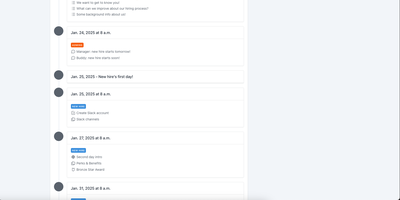
ChiefOnboarding is an open-source employee onboarding platform that turns a new hire's first weeks into a guided sequence of tasks, reading, introductions, and small wins delivered through a web portal and a Slack bot. Onboarding starts before day one: send pre-boarding pages that welcome people, collect their details, and build excitement ahead of the first morning. Inside, to-do items carry the forms and information each hire must complete, and the portal tracks every item until it is done. Sequences drip-feed content over time or unlock the next step when a to-do is completed, so nobody opens thirty tasks on Monday morning. Resources build a searchable knowledge base with courses that bring hires up to speed on tools, processes, and team lore. Introductions put names and faces to the people a hire will work with, and badges reward finished milestones to keep momentum high. Behind the scenes, integrations provision user accounts automatically and fire webhooks into the rest of your stack when milestones land. Admins get their own to-do lists for laptops, access, and paperwork, coordinated with colleagues in the same timeline. The portal speaks eight languages, adjusts message timing to each hire's timezone, and wears your logo, colors, and email templates so the whole journey feels like your company, not a vendor tool. Running on a dedicated VPS on RepoCloud with guaranteed CPU, RAM, and SSD, full root SSH access, and a browser serial console. AGPL-3.0 licensed.
Gideon
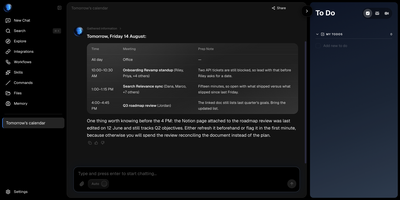
Connected to Gmail, Slack, Calendar, Notion, Linear, and GitHub, Gideon is an AI coworker that drafts replies in your voice, preps you for meetings, and runs workflows while you are away. A chat window plans a task, calls the tools it needs, and answers from what it found, with extended thinking, file understanding, and streaming replies. Workflows are plain-English instructions on a schedule from every few minutes to weekly, and a Slack mention, a CC'd email, or a WhatsApp message can start a run too. Memory builds a graph of the people, projects, preferences, and topics it learns, and a Hub gathers the day's meetings, todos, and suggested follow-ups from Slack, email, Linear, and GitHub. Todos can be delegated to a teammate over a Slack group message with recurring nudges until the work is marked done. Skills teach Gideon your email and Slack tone, custom slash commands save prompts you reuse, and per-model token and dollar accounting shows what each model costs. Every AI feature routes on its own to Anthropic, OpenAI, or any OpenAI-compatible endpoint, so the chat model and the cheaper background agent can differ. Other connectors reach Drive, Sheets, Docs, Figma, PostHog, Grafana, Freshdesk, and Exa web search, and a ClickHouse option answers questions with SELECT-only SQL. Running on a dedicated VPS on RepoCloud with guaranteed CPU, RAM, and SSD, full root SSH access, and a browser serial console. Apache-2.0 licensed.
Octo Server
Most team chat keeps people in one app and AI agents in another; Octo Server is the backend that puts both in the same conversation. It powers the OCTO workplace, where Lobsters, the platform's OpenClaw-powered AI agents, sit in channels as first-class participants that read context, run tool calls, and report back alongside their human teammates. Every request flows through one pipeline: token and cookie authentication, organisation-aware role checks and per-channel permissions, business logic that can start or resume an agent session, then fan-out through WuKongIM for real-time delivery. Channels support threaded subspaces, shared files, and a GROUP.md document that stores the group's standing context where the whole team can edit it. The smart summary service reads busy channels and produces structured digests, so catching up means reading one brief instead of hundreds of messages. External bridges connect conversations to GitHub, WeCom, Feishu, and Loop through adapters, and webhooks push group events to your own systems. The official one-command deployment runs the server with the web client, admin console, task service, WuKongIM, MySQL, Redis, and MinIO behind nginx, scaling as one backend that every client speaks to. Running on a dedicated VPS on RepoCloud with guaranteed CPU, RAM, and SSD, full root SSH access, and a browser serial console. Apache-2.0 licensed.
Agent Army
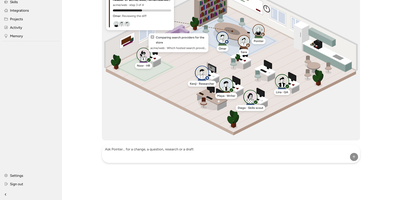
Message Pointer in Slack or the web console, and a team of Claude agents plans the change, builds it, checks it in a headless browser, and opens a reviewed pull request for you to merge. Pointer also answers questions, researches the web, reads GitHub and shared files, and remembers what you tell it. The team is a list you edit: Coder builds, Reviewer reads the diff, QA proves each test fails without the change, and you can add roles. A virtual office shows every agent at a desk with a face, who is free, who is busy, and who sits in a meeting. Open any task to follow its steps, its plan checklist, the files and commands, and the screenshots it took. It waits for CI, fixes failing checks, opens the real preview deployment, and answers review comments on the pull request. Move a Jira issue or a monday.com ticket to Ready for dev and the team starts, updating the ticket as it goes. About 140 more apps connect through MCP servers, among them Linear, Notion, Sentry, Stripe, and Figma. Monthly caps per repository, provider, and agent come with Slack alerts, and small tasks route to a cheaper model. Agents only open pull requests; they never push to your branches or merge. Running on a dedicated VPS on RepoCloud with guaranteed CPU, RAM, and SSD, full root SSH access, and a browser serial console. MIT licensed.