FileSync
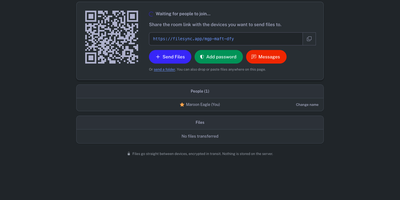
Moving a 40 GB video from your laptop to three colleagues takes a shared link instead of a cloud upload when FileSync sends it from one device to many in real time, straight between browsers, from a server you host yourself. Open a room, share its link or QR code, and everyone inside can send, receive, and download everything as a zip. The files travel directly between browsers over encrypted connections while the server only introduces the devices to each other, so your documents never sit on someone else's disk. A verification key rides inside the link itself and is never sent to the server, proving the person who joined is the person you invited. Transfers stream to disk as they arrive, so file size is limited by storage rather than memory, and every file is checked with SHA-256 the moment it lands. Close a tab mid-transfer and the download resumes from the last saved byte instead of starting over. You can send whole folders, paste straight from your clipboard, and coordinate through the built-in room chat while the files move. When two devices cannot connect directly, the included relay carries the traffic automatically, and rooms can ask for a password before anyone joins. Recipients need no account and install nothing; they open the link in any modern browser and start receiving. Running on a dedicated VPS on RepoCloud with guaranteed CPU, RAM, and SSD, full root SSH access, and a browser serial console. MIT licensed.
PsiTransfer
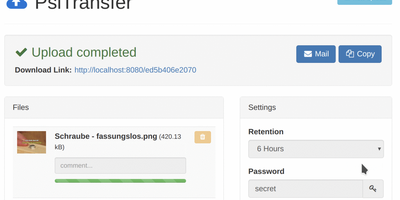
Upload files, get a share link, let it expire: PsiTransfer is a self-hosted WeTransfer with no accounts, no logins, and no third-party cloud with size caps and metadata harvesting. The engineering focus is large files over imperfect networks. Uploads use the tus.io resumable protocol, so a dropped connection on a multi-gigabyte video resumes exactly where it stopped once you're back online; downloads support HTTP range headers for the same resilience, and everything streams, so file size is bounded by your disk rather than memory. Files organize into upload buckets with retention you control: expire after a set time (up to weeks) or after a one-time download, with automatic cleanup when links lapse. Recipients need nothing installed - they open the link, preview files in modal views, and grab everything as a zip or tar.gz archive with one click. Buckets can be password-protected (AES-encrypted download lists), and security-through-obscurity is done properly: bucket URLs use hashed UUID tokens and stored filenames are replaced with UUIDs. An optional admin page (enabled by setting an admin password) lists bucket information and storage. The Vue.js frontend ships under 100 KB gzipped and is fully responsive. Honest caveat from the author: no end-to-end payload encryption yet. BSD-licensed, Docker-ready.
MISP
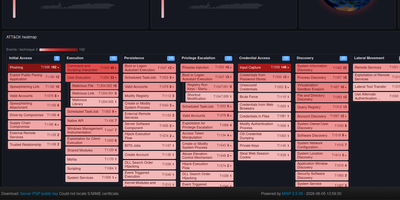
MISP is an open source threat intelligence platform where analysts log indicators and incidents, see how they connect, and share them with trusted organizations. Each case is an event holding attributes and structured objects such as files, network connections, and email messages, with Markdown reports beside the machine-readable data. A correlation engine links events that share values, including fuzzy-hash and CIDR matches, and warning lists flag benign values before they cause false positives. Taxonomies and galaxies tag events with TLP levels, threat actors, malware families, and MITRE ATT&CK techniques. Analysts explore relationships in an event graph and a correlation graph with a timeline, and build drag-and-drop dashboards with maps and ATT&CK heatmaps. Sharing groups control who sees which event, and instances synchronize with partner organizations with distribution settings down to a single attribute. Free-text, URL, bulk, and STIX imports fill the database, and exports reach Suricata, Snort, Zeek, OpenIOC, CSV, STIX 1 and 2, and RPZ zones. A REST API, the PyMISP library, expansion modules, and workflows enrich data and automate publishing. ZeroMQ and Kafka streams announce every change to connected tools. Running on a dedicated VPS on RepoCloud with guaranteed CPU, RAM, and SSD, full root SSH access, and a browser serial console. AGPL-3.0 licensed.
PrivateBin
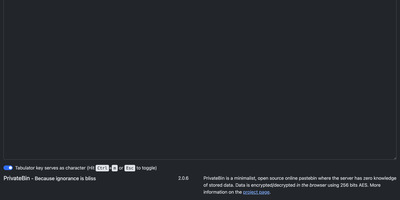
PrivateBin shares text and files with true zero-knowledge encryption: the server stores only ciphertext it cannot decrypt because the key exists exclusively in the URL fragment that never reaches the server. With over 8,400 GitHub stars and 500,000+ Docker pulls, it has become the standard for privacy-respecting paste sharing where not even the hosting operator can read stored content. All encryption uses 256-bit AES in Galois Counter mode performed entirely client-side in the browser. Burn-after-reading mode destroys pastes on first view, while configurable expiration timers automatically purge content after periods ranging from five minutes to forever. Optional password protection adds a second encryption layer requiring recipients to enter a passphrase before decryption occurs. Discussion threads enable anonymous or nickname-based commenting on pastes with IP-based identicon avatars for visual identity. Markdown rendering with live preview formats pastes as styled HTML, and syntax highlighting through prettify.js supports dozens of programming languages across four color themes. File upload support enables sharing images, PDFs, and media files with in-browser preview. QR code generation converts paste URLs for mobile device transfer. Customizable templates include Bootstrap 5, classic Bootstrap CSS, and Darkstrap themes. Storage backends support filesystem, MySQL, PostgreSQL, SQLite, Amazon S3, and Google Cloud Storage. Deploy via Docker with the privatebin/nginx-fpm-alpine image on port 8080. Running on a dedicated VPS on RepoCloud with guaranteed CPU, RAM, and SSD, full root SSH access, and a browser serial console. zlib licensed.
Rustypaste
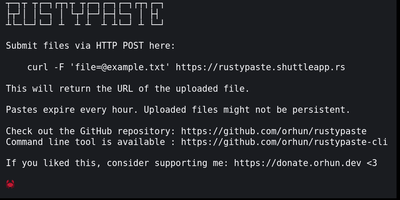
Sharing a file with one command is the whole idea: pipe a file to Rustypaste with curl and get back a short URL with a memorable random name like square-fish.txt. Links can expire after a set time, vanish after a single view, or require a password hashed with Argon2id before the file opens. The service also shortens long URLs, fetches files from remote addresses for you, and removes duplicate uploads so the same file is not stored twice. Everything lives on the local filesystem, which means no database to provision, back up, or tune; configuration reloads while the server keeps running. An upload form is available for browser users, HTTP authentication guards private instances, and file listing and deletion endpoints keep housekeeping scriptable. It ships as a single binary and an official Docker image, so a personal file-sharing endpoint can be running on a server in minutes and stay out of the way afterward. Running on a dedicated VPS on RepoCloud with guaranteed CPU, RAM, and SSD, full root SSH access, and a browser serial console. MIT licensed.
Webtor
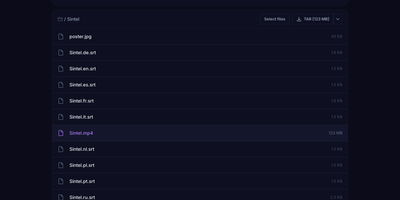
Webtor turns any magnet link or .torrent file into instant in-browser streaming and direct downloads on your own server, with no desktop torrent client and nothing to install for viewers. Drop in a magnet, an infohash, or a torrent file and the file list appears in seconds; pick a video and it plays in the built-in player while the pieces are still arriving, or take a plain HTTP download link for any single file instead. Whole torrents come down as ZIP or TAR archives generated on the fly with the folder structure preserved, and formats from MKV and MP4 to FLAC and MP3 stream without a separate transcoding step in most cases. Torrents you keep go into a personal library that recognizes movies and series automatically and enriches them with posters and descriptions, and the same library can mount as a network drive over WebDAV or S3 and play on a TV through the Stremio addon. Subtitles are matched from OpenSubtitles inside the player, uploaded tracks are supported, and optional AI translation renders them in your language; a master password locks the instance, the player embeds into other sites through the JavaScript SDK, and a REST API drives everything from your own code. Running on a dedicated VPS on RepoCloud with guaranteed CPU, RAM, and SSD, full root SSH access, and a browser serial console. MIT licensed.
Papermark
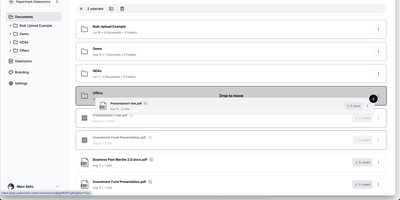
With nearly 9,000 GitHub stars and adoption by over 60,000 companies across 100 countries, Papermark is the open-source DocSend alternative that turns document sharing into a data-rich conversation between you and your viewers. Every shared document generates page-by-page analytics showing exactly which pages capture attention, how long viewers spend on each section, where they drop off, and whether they return for a second look, with real-time notifications the moment a document is opened. Virtual data rooms support unlimited folders with drag-and-drop organization, bulk uploads, granular per-viewer permissions, dynamic watermarking that stamps each page with the viewer's identity, and NDA gating that requires agreement before access. Custom branding applies your logo, colors, and custom domain to every shared link and download page, while email verification and password protection add authentication layers. The AI Data Room Copilot lets viewers chat with uploaded documents, ask questions, and receive contextual summaries directly within the data room interface. The developer platform exposes 43 REST API operations covering data rooms, documents, folders, links, visitors, and analytics, with an MCP server for AI agent integration and a CLI for automation. Built on Next.js with TypeScript, Prisma ORM, PostgreSQL, NextAuth.js authentication, and shadcn/ui components. Running on a dedicated VPS on RepoCloud with guaranteed CPU, RAM, and SSD, full root SSH access, and a browser serial console. AGPLv3 licensed.
Tiny File Manager
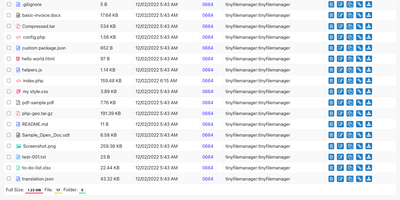
Browse, upload, edit, preview, and archive the files on your server from any web browser, with no FTP client, no shell session, and no database to set up. Tiny File Manager lists every folder in a sortable table showing size, modified date, permissions, and owner, with a search box that filters as you type. Drag files into the upload zone, send several at once, or paste a URL for the server to fetch. Rename items, select several to copy, move, delete, or pack into a zip or tar archive, and extract uploaded archives on the server. Click any text file to open the built-in editor, which offers syntax highlighting for 150+ languages and 35+ color themes, so quick fixes to configs and scripts happen where the files live. Images, audio, video, and text open in a preview without downloading, and every file has a copyable direct link. Give teammates or clients their own accounts, each locked to a root folder you choose, mark accounts read-only, and limit uploads to approved file extensions. Hide folders you never want listed, restrict access with IP allow and block lists, switch between light and dark themes, pick from 35+ interface languages, and use the responsive layout on a phone. Setup is one file copied to a web server, or one Docker container. Running on a dedicated VPS on RepoCloud with guaranteed CPU, RAM, and SSD, full root SSH access, and a browser serial console. GPL-3.0 licensed.

ownCloud Infinite Scale
Files belong to the project, not to whoever uploaded them: ownCloud Infinite Scale is a self-hosted file sharing and collaboration platform where teams work in Spaces, data rooms that stay intact when people join, leave, or change roles. Inside a Space, members browse, upload, version, and share files from the web interface or synced clients, with full control over links, permissions, and expiry. Documents open for real-time editing through the web office integration of your choice, favorites and recent files keep daily work one click away, and full-text search with tags finds content across every Space you can access. Personal files live alongside team Spaces, a recycle bin catches mistakes, and administrators manage users, groups, roles, and storage from the same deployment. One service runs the whole platform for a home server, and the same system scales out for schools, companies, and public institutions that must keep data on their own infrastructure. Running on a dedicated VPS on RepoCloud with guaranteed CPU, RAM, and SSD, full root SSH access, and a browser serial console. Apache-2.0 licensed.

Chevereto
Build your own image and video sharing site, with public galleries, private albums, and embeddable links, on a server you control. Uploads arrive by drag and drop, clipboard paste, image URL, camera, ShareX, or API, in AVIF, JPEG, PNG, GIF, WebP, BMP, MOV, MP4, and WebM, and chunked transfers handle large files. Lossless JPEG handling fixes orientation and can strip EXIF data. Duplicate detection catches repeat uploads. Tags are created on the fly with autocomplete, camera models become tags automatically, and albums nest into sub-albums with covers, privacy levels, and passwords. Categories, search, and explore views help visitors find things; a bulk importer brings in folders of existing media. Each file gets viewer, direct, thumbnail, and medium links plus HTML, Markdown, and BBCode snippets with one-click copy, and oEmbed lets other sites preview a link. Roles split admin, manager, and user duties, profiles can be private, and two-factor authentication protects accounts. Files sit on local disk or S3-compatible storage, optionally served through a CDN URL. A dashboard tracks usage, color palettes and custom CSS and JavaScript restyle the site, and a single-profile mode suits a personal portfolio. Running on a dedicated VPS on RepoCloud with guaranteed CPU, RAM, and SSD, full root SSH access, and a browser serial console. AGPL-3.0 licensed.
Plik
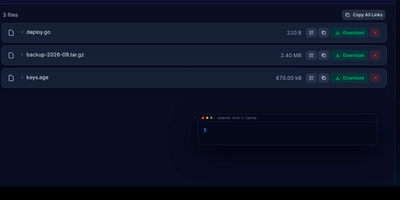
Plik lets you send big files the way WeTransfer does, except the server is yours: upload from the browser or one CLI command and get an expiring link to share. Files can delete themselves after the first download, stream straight from uploader to downloader without touching disk, or sit behind a password until their TTL runs out and cleanup removes them. End-to-end encryption with Age works between the CLI and the web interface, so the server only ever holds ciphertext. Recipients preview code with syntax highlighting, read rendered Markdown and Mermaid diagrams, and play media in the browser without downloading first. Storage lands on local disk, S3, OpenStack Swift, or Google Cloud Storage, with metadata in SQLite, PostgreSQL, or MySQL, and sign-in through local accounts, Google, GitHub, or OIDC. The web interface speaks twelve languages with light, dark, and custom themes, and Prometheus metrics plus an MCP server connect Plik to monitoring and AI assistants. Running on a dedicated VPS on RepoCloud with guaranteed CPU, RAM, and SSD, full root SSH access, and a browser serial console. MIT licensed.
ivfi
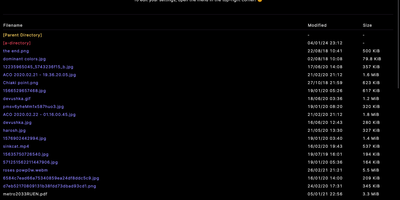
IVFi-PHP turns folders on your server into browsable media galleries: drop one PHP file into a web root and every directory of photos, videos, and audio becomes a polished, searchable index page. Hovering a filename previews the image or video inline, and clicking opens the gallery view where you can move through a whole directory's media, download originals, or reverse-search an image. Audio files play in place with a live visualiser, seeking, and their own volume control. Finding things is instant: filter filenames or file types with plain text, wildcards, or full regular expressions, sort by name, date, or size with settings that persist between visits, and dates automatically match the visitor's timezone. Select any set of files and download them as a single ZIP archive, or share direct download links file by file. Directories can render their README files as documentation pages, listings can hide sensitive entries through server-side filters, and optional Digest authentication keeps a listing private without any account database. Themes and per-visitor display preferences restyle the index, basic listings work even with JavaScript disabled, and the whole application also ships as a Docker image for a one-container deployment. Running on a dedicated VPS on RepoCloud with guaranteed CPU, RAM, and SSD, full root SSH access, and a browser serial console. GPL-3.0 licensed.
PicPeak
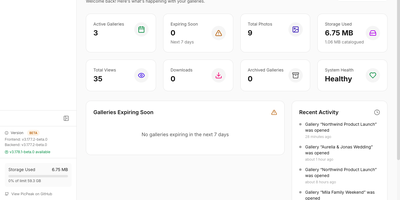
PicPeak is a self-hosted gallery platform where photographers deliver event photos to clients through private, branded links that expire on their own schedule. Every gallery gets a share link, an optional password, and a QR code that exports as PNG, SVG, an A6 table card, or an A4 poster, so a reception can put the gallery on every table. Guests browse in one of seven layouts, from grid and masonry to carousel and timeline, and react with likes, favorites, star ratings, comments, emoji reactions, or color labels. For a party, open the gallery to guest uploads, hold the finished edit back with Reveal Mode until a scheduled moment, and put the optional Live Slideshow link on a projector so new photos appear as they arrive. Theme presets, custom colors, logos, fonts, CSS, and CMS pages keep the studio's brand in front, while bulk ZIP downloads, capped download sizes, watermarking, and right-click blocking control what guests take home. An analytics dashboard tracks views, unique visitors, and downloads. Beta modules add face grouping that runs in a separate container on your own server, plus quotes, contracts, invoices, and customer accounts for studios. Media sits on local disk or any S3-compatible bucket, OIDC single sign-on lets a team log in through an identity provider, and API tokens and webhooks connect PicPeak to automations. Running on a dedicated VPS on RepoCloud with guaranteed CPU, RAM, and SSD, full root SSH access, and a browser serial console. MIT licensed.
Enclosed
Private text, encrypted before it leaves the browser: Enclosed turns passwords, keys, and other secrets into a link that only its holder can open, with no third-party service in between. Can the server read the note? No. It stores only ciphertext and settings, because the decryption key rides in the part of the link after the # sign, which browsers never send. Want a second lock? Add a password, or generate a random one with a click, and share it by another route. Worried about links lingering in chat history? Pick one hour, one day, one week, or one month, and tick Delete after reading so the first view removes the note, with a warning shown to the recipient beforehand. Need more than text? Attach files by button or drag and drop, and recipients download them one by one or all at once. Sending to a phone? Every finished note offers a QR code, downloadable as SVG or PNG. Setting it up for a team? Restrict note creation to signed-in users, create notes from the command line, and let people read the interface in 17 languages with light, dark, or system themes. Running on a dedicated VPS on RepoCloud with guaranteed CPU, RAM, and SSD, full root SSH access, and a browser serial console. Apache-2.0 licensed.
Fireshare
FireShare turns a folder of game captures on your server into a browsable library where every clip gets its own permanent link, ready to paste into Discord the moment something worth bragging about happens. Point it at the directories you already record to and it scans what is there: the file people watch is always your untouched original, in MP4, WebM, or MOV, never a recompressed stand-in. Privacy is set per file, public for the feed, link-only for friends, or behind a password, and whole folders can be shared as a single link. It also sorts the chaos for you, detecting the game in each capture and shelving hundreds of timestamped filenames under proper cover art you can search and browse. Trim the dead air off a clip before posting it, add a title, description, tags, and a custom thumbnail, and watch the view count climb. For screens that struggle with huge originals, optional transcoding adds adaptive lower qualities on CPU or an NVIDIA GPU, and HDR captures get tone-mapped to SDR instead of looking washed out. Friends can upload through the browser or by token from scripts, new public clips can announce themselves to Discord or an RSS reader, and accounts come with permissions, profiles, and two-factor sign-in. Running on a dedicated VPS on RepoCloud with guaranteed CPU, RAM, and SSD, full root SSH access, and a browser serial console. GPL-3.0 licensed.
Reloops
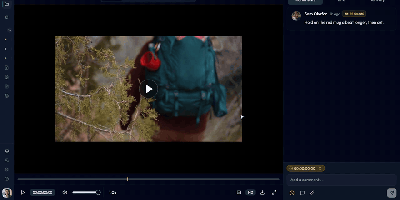
Reloops is a self-hosted creative asset workspace where teams keep every video, design, PDF, audio file, and live website in one library and collect feedback on the files themselves instead of in scattered email threads. Reviewers click anywhere on an image to pin a note to that exact spot, and on video the comments attach to the precise frame, so "fix this bit" always points at the bit in question. Every upload becomes a new version on the same asset, older cuts stay available for side-by-side comparison, and approvals are recorded on the file so nobody ships the wrong export by accident. Clients never need an account: send them a share link or a branded collection and they can watch, comment, and sign off as guests. The library searches the way people remember work, because each asset carries generated descriptions, tags, and metadata filters, so "the approved homepage with the blue button" actually finds something. Day to day, assignments and review queues keep feedback moving, while scoped API keys let agents such as Claude, OpenClaw, Zapier, and n8n upload new versions, post comments, update statuses, and manage share links inside the same workspace. Running on a dedicated VPS on RepoCloud with guaranteed CPU, RAM, and SSD, full root SSH access, and a browser serial console. AGPL-3.0 licensed.
Snowshare
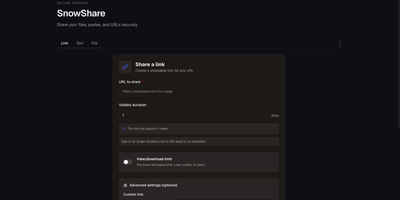
A dropped connection should not restart a 20 GB upload: SnowShare is a self-hosted app for sharing files, links, and pastes, with resumable transfers and an expiry date, a view limit, a password, and a QR code available on every share. Put several files into one share and let recipients preview common formats right in the browser, shorten a long address with an optional custom slug, or publish text and code with syntax highlighting. People you send a link to can open it with or without an account, depending on how you configure the instance. Give your users email and password accounts or OAuth sign-in, turn on email verification and CAPTCHA, and set separate storage quotas for anonymous visitors and registered users. Keep uploads on local disk or move them to S3-compatible storage, apply your own branding, and change quotas, sharing rules, SMTP, and storage from the admin panel without restarting. Automate sharing through the REST API with keys created from your profile, drop the generated ShareX uploader files into your capture tool, and receive signed webhook events when shares are created, opened, or deleted. Read the interface in English, French, Spanish, German, Dutch, or Polish, and let expired shares clean themselves up every hour. Running on a dedicated VPS on RepoCloud with guaranteed CPU, RAM, and SSD, full root SSH access, and a browser serial console. CC0 1.0 licensed.
FolderHost
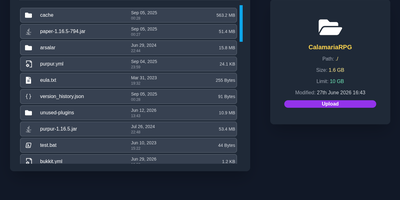
FolderHost turns a folder on your server into a private cloud that you and your team reach from any browser, with the whole platform shipping as one executable of about 19MB and zero dependencies to install. Upload, download, move, copy, rename, archive, and extract files through a familiar explorer interface, with chunked uploads that survive big transfers and a recovery bin that keeps accidental deletions restorable within limits you set. Code files open in a real editor where several people can type at once, which makes it a surprisingly handy way to tweak server configs or a game server's files together live. Long-running programs can be registered as services and started, stopped, and driven from a built-in terminal that shows live uptime and memory use. Accounts come with granular permissions for every action, optional folder scopes that confine a user to one directory tree, and per-instance storage quotas. Every activity lands in audit logs you can review and auto-expire, sessions use short-lived tokens tied to the login device, and TLS can be self-signed for a LAN or issued through Let's Encrypt for a public domain. Running on a dedicated VPS on RepoCloud with guaranteed CPU, RAM, and SSD, full root SSH access, and a browser serial console. GPL-3.0 licensed.