Aegis
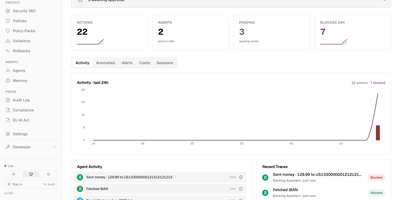
Put a checkpoint in front of every tool call your AI agents make, so a poisoned web page or file cannot quietly move money or send private data. Each call is classified and policy-checked before it executes, then allowed, blocked, or held for a person. Held calls land in an approvals queue that shows what the user asked, which passage the agent read, and the exact recipient or amount in question, with one-click block or allow. Instruction provenance flags destinations that appeared only in untrusted content, like an IBAN hidden in a file. The cockpit lists every run as a timeline of steps with verdicts, groups violations by the protection that caught them, and scores ten attack surfaces on a Security 360 page. An agent registry tracks owners, scope, and call counts. Budgets, anomaly alerts, and a kill switch cap runaway behavior. Sensitive values are redacted from traces, signed receipts prove a call was allowed, and exports produce PDF and CSV audit evidence. Python and TypeScript SDKs plug in with one line, or an LLM proxy catches calls with an environment variable. Running on a dedicated VPS on RepoCloud with guaranteed CPU, RAM, and SSD, full root SSH access, and a browser serial console. MIT licensed.

Glean
Information overload is the default state of the modern internet, and Glean exists to tame it by pulling every blog, newsletter, and news source you follow into a single, organized reading experience with an interface that prioritizes clarity over clutter. Subscribe to RSS and Atom feeds, import your existing subscriptions via OPML, and organize everything into multi-level folders with a flexible tagging system that lets you slice your reading list by topic, priority, or mood. A three-pane layout presents your feed list, article summaries, and full content side by side, with one-click actions for marking articles as read, saving them for later, bookmarking favorites, or archiving what you have already processed. Background workers fetch new articles every 15 minutes so your feeds stay current without manual refreshes. The preference learning engine (backed by Milvus vector embeddings) scores incoming articles against your reading history and surfaces a personalized Smart Feed of content you are most likely to care about, reducing the time spent scrolling past irrelevant posts. A built-in MCP server lets AI assistants like Claude Desktop search and interact with your feed library directly. The admin dashboard on a separate port provides user management, system monitoring, and configuration controls for multi-user deployments. Bookmark external URLs from any browser with the Chrome extension, or access your feeds on mobile through the Progressive Web App. Running on a dedicated VPS on RepoCloud with guaranteed CPU, RAM, and SSD, full root SSH access, and a browser serial console. AGPL-3.0 licensed.
FlyBudget
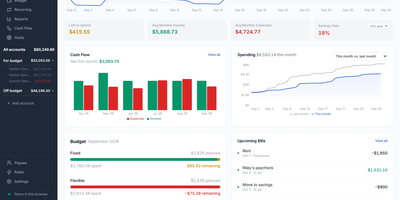
FlyBudget gives every dollar a job and keeps your financial data on a server you control, with no subscription, no account, and no tracking. Plan each month by category with carry-over, and watch bars turn amber near the plan and red when you overspend. Write a rule in plain words, preview the past transactions it matches, and let it rename, categorize, or split everything that arrives next. Track checking, credit cards, loans, investments, and property in their own currencies, then reconcile when the numbers need proof. Import CSV files from any bank with duplicate detection, or connect SimpleFIN or Plaid for automatic sync. Bills, subscriptions, and paychecks appear as a list or calendar, and FlyBudget can find them in your history. Dashboards of net worth, spending, trends, and cash flow can be rearranged, and a custom report builder covers the rest. Savings goals, payees with logos, and one-step backups sit alongside light and dark themes. Every page has a phone layout, and transactions entered offline sync when the connection returns. Running on a dedicated VPS on RepoCloud with guaranteed CPU, RAM, and SSD, full root SSH access, and a browser serial console. AGPL-3.0 licensed.
Papermerge
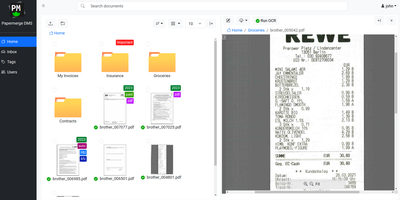
Receipts, contracts, and letters that arrive as pixels rather than text: Papermerge is a document management system built specifically for scanned documents. Upload a PDF, TIFF, JPEG, or PNG and OCR runs automatically, with a real-time status indicator beside the document title; under the hood it drives OCRmyPDF and Tesseract, supporting 130+ languages and producing a new document version with a selectable, searchable text layer you can download. Full-text search runs across everything, with multiple search-engine backends (Xapian by default). The interface deliberately mimics a modern desktop file browser: dual-panel commander, drag and drop, hierarchical folders, and colored tags on documents and folders. Page management fixes what scanners get wrong - delete blank pages, rotate, reorder, merge, extract, and move strayed pages between documents, powered by PikePDF. Document types act as categories, each with its own custom metadata fields, so invoices carry vendor and amount while contracts carry parties and dates. Versioning preserves every state of a document. Multi-user support includes groups, group ownership, permission management, and document/folder sharing between users and groups, and an OpenAPI-compliant REST API automates ingestion from scanners or scripts. Apache-licensed, ideal for long-term digital archives.
Narratarr
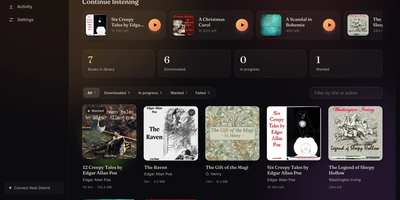
Narratarr finds free audiobooks, fetches them through your download stack, and plays them back in the browser, so a book goes from curiosity to chapter one in a single click. Discovery starts with more than 30,000 legal titles from LibriVox and Old-Time Radio, browsable by genre, popularity, language, and format. Search forgives your spelling: type a mangled author name and the right books still surface, ranked by how well they match. Every title shows its runtime, format, size, and description before you commit, and one click queues the download, files it under Author and Title with cover art attached, and tracks progress live on the Activity page. Playback needs no second app. The built-in player handles chapters, including markers buried inside m4b files, plays from three-quarter speed to triple speed, and offers a sleep timer that can stop at the chapter boundary. Your place is kept per listener, so a household can share one library without losing anyone's bookmark. Follow authors and series on the Wanted list and new releases arrive on their own; notifications land in ntfy, Gotify, Discord, or any webhook when downloads start and finish. Ebooks ride along too, readable as EPUBs in the same interface. Running on a dedicated VPS on RepoCloud with guaranteed CPU, RAM, and SSD, full root SSH access, and a browser serial console. MIT licensed.
MediaServer
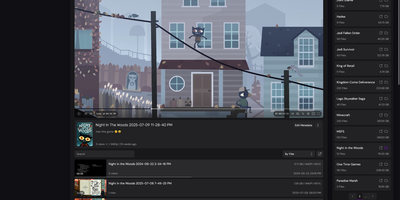
Your folders are the library with MediaServer, a self-hosted player that scans the directories you already keep and serves their video and audio through a tidy web interface. Browsing feels like a personal YouTube: folders open as shelves of content, and the custom player keeps the video going as you explore what to watch next. Keyboard shortcuts drive playback, speed controls and player statistics sit a click away, and an ambient background glows behind the video. Every view is remembered: full watch history with timestamps, re-watch counts, per-user totals, and playback heatmaps replace the single watched tick other servers stop at. Metadata belongs to you: edit titles, thumbnails, tags, seasons, and release dates for videos, folders, and albums, and the edits survive files being moved or renamed. Music gets its own treatment with embedded cover art, a lyrics viewer and editor fed by LrcLib, and auto-scrolling lines that follow the song. Subtitles extract themselves from embedded and external files, folders and single videos share as readable links, and each share renders a rich preview card for Discord or chat. Behind the scenes, a dashboard manages libraries, scanning jobs, users, and server performance. Running on a dedicated VPS on RepoCloud with guaranteed CPU, RAM, and SSD, full root SSH access, and a browser serial console. AGPL-3.0 licensed.
LocalCA
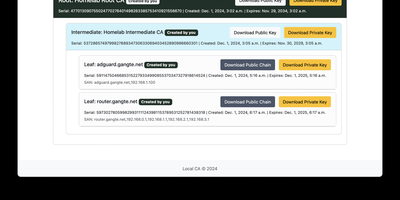
Your internal services deserve padlocks that browsers actually trust, and LocalCA is a small certificate authority you run yourself to issue them. From the web interface you create a self-signed root, install it once on your browsers and client devices, and then mint intermediate and leaf certificates underneath it for each service you host. Proxmox, Pi-hole, Jellyfin, Grafana, and the rest of a homelab stop showing insecure warnings and start presenting certificates your devices accept. The root can carry your own name, so the trust store shows your branding rather than a generic authority. Issued certificates also serve mutual TLS setups, where clients present certificates of their own before a service lets them in. Deployment stays deliberately small: a Docker Compose file brings the application up, ARM images cover Raspberry Pi class hardware, and a configurable time zone keeps expiry timestamps readable for your region. A reverse proxy path prefix is supported for placing the interface behind Traefik or Nginx at an address like /localca. Treat the instance as internal infrastructure, because issued private keys live in its database: keep it on a private network, change the default administrator password immediately, and restrict access to the host. Running on a dedicated VPS on RepoCloud with guaranteed CPU, RAM, and SSD, full root SSH access, and a browser serial console. AGPL-3.0 licensed.
Dawarich Atlas
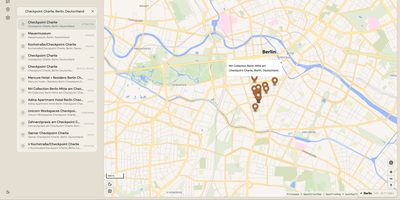
Atlas turns OpenStreetMap data for a city, a country, or the whole planet into a maps backend your applications can search, route with, and query for nearby places, all on hardware you control: pick a region and it downloads and indexes that territory's data locally. Search behaves the way users expect, with autocomplete matches grouped into clusters across the installed dataset, numbered so dense areas stay readable, and a show-all action that frames the full result set. Routing returns directions for driving, cycling, and walking, and a map-matching endpoint snaps noisy recorded GPS tracks onto the real road network. Ask what is here at any coordinate and category pickers surface restaurants, stations, parking, and hundreds of other place types around it, while transit planning threads timetables into door-to-door journeys. The settings panel is the control room: toggle search, routing, points of interest, and transit independently, switch the active region, and watch live progress as new territory is ingested and merged in the background. Developers plug in through one consistent JSON API covering geocoding, reverse geocoding in batches, coverage checks, and every map capability, documented as a public OpenAPI reference. Because every dataset lives on the box, the map keeps answering during outages and inside private networks. Running on a dedicated VPS on RepoCloud with guaranteed CPU, RAM, and SSD, full root SSH access, and a browser serial console. AGPL-3.0 licensed.
Engraphis
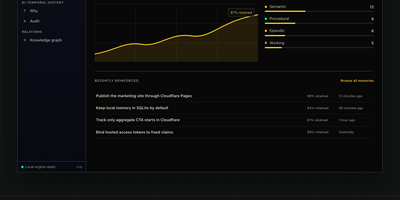
Engraphis is a durable memory layer for coding agents that answers questions like what did we decide about the auth layer three weeks ago, and why, with inspectable project memory that survives across sessions and repositories instead of evaporating when a chat ends. Store a decision once and recall it later in a new session, scoped by workspace, repository, and session so one project's facts never leak into another's context. Recall blends vector, lexical, graph, and code-aware retrieval, then packs the strongest evidence into a hard context budget your agent can actually use. Every returned fact keeps its provenance attached, and the engine cites its support or abstains when the evidence is too weak to trust. Facts are never silently overwritten: bi-temporal history preserves earlier versions, and a timeline view surfaces superseded knowledge when you need to know what used to be true. Index a repository into a code-symbol graph and ask what calls a function before you change it. Conflicting or quarantined memories wait in a review queue for a human decision. Running on a dedicated VPS on RepoCloud with guaranteed CPU, RAM, and SSD, full root SSH access, and a browser serial console. Apache 2.0 licensed.
Xibo
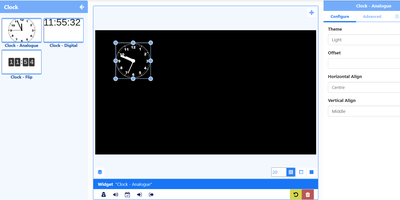
A lobby television stuck on a printed poster, a cafe menu board nobody remembers to update, a corridor screen looping last month's notices: Xibo replaces that drift with one web dashboard where every display on the network gets designed content, a schedule, and fresh media from a central library. Layouts are composed on a canvas of regions holding video, images, text and live widgets, then sequenced into playlists and grouped into campaigns spanning hundreds of screens. Scheduling works down to dayparts and dates, so breakfast menus stop at eleven, event signage appears only on event days, and each group of displays keeps its own programming. Proof-of-play reports record exactly what aired on every screen for advertiser billing and compliance audits. Windows, Android, LG webOS and Samsung Tizen players check in automatically, pull changed content and report their status back to the CMS. Running on a dedicated VPS on RepoCloud with guaranteed CPU, RAM, and SSD, full root SSH access, and a browser serial console. AGPL-3.0 licensed.

Light-Interview
Light-Interview is a practice room for job interviews where you answer out loud and get a scored report afterwards. Fill in a target role, company, job description, and resume, and the app writes a question set to match. A digital interviewer reads each question, listens, and asks a follow-up when an answer is thin, and the browser records every answer on its own. Reports show relevance, completeness, professionalism, STAR structure, logic, speaking pace, pauses, and filler words, with the transcript beside the recording so you can jump to the moment that cost points. Rewrite a weak answer, record it again, and compare the two takes. Answers below the pass line land in a mistake book for retries, and each job goal gets a daily three question plan and a weekly review. Coding assessments run in a web editor with Java, Python, C++, JavaScript, and Go, judged in disposable containers with no network access. A resume library, spoken English and Japanese practice, and study groups with peer review round out the toolkit. Running on a dedicated VPS on RepoCloud with guaranteed CPU, RAM, and SSD, full root SSH access, and a browser serial console. Apache-2.0 licensed.
Issued
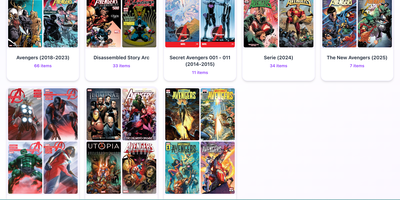
Issued is a self-hosted comic library server: point it at the folder of CBZ, CBR, CB7, and PDF comics already sitting on your server and the whole collection becomes browsable and readable from any device. Point it at your existing folders and it keeps your folder structure exactly as it is, scanning automatically when new issues appear and generating cover thumbnails so you can see what a file is before opening it. Read in the browser with the built-in web reader on desktop or mobile, with light and dark themes, or connect reader apps such as Panels, Chunky, KyBook, and Moon+ Reader through the standard OPDS catalog at /opds/. OPDS-PSE 1.2 page streaming lets compatible apps read individual pages as JPEGs without downloading whole archives, and OpenSearch discovery lets clients find library search automatically. Edit metadata in place using ComicInfo.xml data, mark series as ongoing to spot new issues, totals, and possible gaps, and use Continue Reading and Last Added views to resume the latest issue in progress or start the next unread one. An optional reader password protects browser access, and one Docker command on port 8181, with unrar included for CBR files, gets the whole library online. Running on a dedicated VPS on RepoCloud with guaranteed CPU, RAM, and SSD, full root SSH access, and a browser serial console. MIT licensed.
LightPost
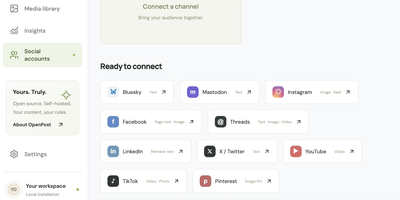
Write a post once in LightPost and it goes out to Bluesky, Mastodon, X, Instagram, Threads, Discord, LinkedIn, Telegram, and Facebook Pages on your schedule, with YouTube video uploads handled in the same workspace, from a dashboard running on your own server. The composer fans one message out to every connected account, including several accounts on the same platform, and each destination can receive text, images, or both within that network's limits. Drafts can be saved, edited, and duplicated, and scheduled times follow your browser's timezone so a week of announcements can be queued in one sitting. Images come in from public JPEG links or a saved library, with alt text and a preview before anything ships. Every delivery is tracked per account with links to the published posts, and when one network fails you retry just that destination instead of blasting the successful ones twice. The queue persists across restarts and overdue posts resume on their own, so an overnight reboot never eats a scheduled campaign. Built-in setup guides walk you through eligibility, credentials, and permissions for each platform, account connections can be verified or reconnected from the same panel, and your credentials stay encrypted on your disk with optional password protection and exportable post history. Running on a dedicated VPS on RepoCloud with guaranteed CPU, RAM, and SSD, full root SSH access, and a browser serial console. MIT licensed.
GuideAnts
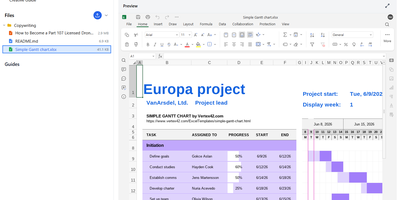
GuideAnts is an AI workspace where files, conversations, and generated documents stay together in project notebooks, so good work gets reused instead of vanishing into chat history. Projects own folders, notebooks, guides, assistants, and usage records, and each notebook keeps its conversation, file context, artifacts, and version history side by side. Word, PowerPoint, Excel, and OpenDocument files open and co-edit in place through an optional document server, Markdown has a live-preview editor, and extracted Markdown copies feed retrieval. A Guide Builder packages instructions, tools, files, starter prompts, and model choices into reusable guides and assistants, and portable SKILL.md packages can be imported or authored there. Published guides get friendly URLs, a web component for embedding in other sites, public APIs, and MCP access to their skills, with anonymous, key-protected, or webhook-validated entry plus daily and billing-period charge limits. Telemetry attributes each message, tool call, and charge to a model and assistant, so you can see which steps truly need a frontier model; the maintainers report one public workload falling from hundreds of dollars a day to about ten. Chat, embeddings, document intelligence, image generation, and speech can each route to a different cloud or local provider, with slim, CPU, NVIDIA, AMD, and Vulkan runtimes to choose from. Running on a dedicated VPS on RepoCloud with guaranteed CPU, RAM, and SSD, full root SSH access, and a browser serial console. Apache-2.0 licensed.
Meridian
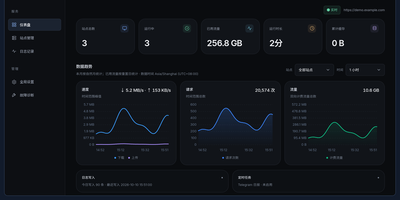
Meridian puts all of your Emby reverse proxy sites, playback routes, and day to day operations into one clean management panel instead of a pile of hand-written proxy configs. Each Emby site gets its own entry through a path, a dedicated port, or a subdomain, with primary and backup routes that switch automatically when one goes down. Three playback modes let video stream directly to clients while logins, posters, and API calls continue through the proxy, so bandwidth lands where it should. Accounts for each site are stored with passwords and expiry dates, renewal reminders arrive ahead of time, and account details can be imported or exported as JSON and CSV. Traffic trends, per-site quotas, rate limits, and static resource caching keep busy sites under control, while log filtering and connection diagnostics show exactly where a request went wrong. Certificates are handled through Cloudflare wildcard issuance and renewal, or by uploading your own, and encrypted backups protect the whole configuration. Routine administration can even happen from Telegram, checking daily reports, adding or pausing sites, and renewing accounts from chat. The whole panel runs as one small program with a built-in database and works comfortably from a phone. Running on a dedicated VPS on RepoCloud with guaranteed CPU, RAM, and SSD, full root SSH access, and a browser serial console. MIT licensed.
QuickStack
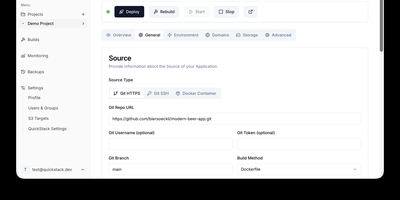
QuickStack transforms your standalone Linux server or cluster into a self-hosted platform-as-a-service that automatically compiles, deploys, and monitors full-stack applications and relational databases without vendor lock-in. Developers can trigger instant deployments directly from public or private Git repositories, upload custom Dockerfiles, or pull container images straight from private registries with automated webhook synchronization. The built-in application catalog enables one-click provisioning of production databases including PostgreSQL, MySQL, MariaDB, MongoDB, and Redis with preconfigured internal network isolation. Administrators can route traffic across custom domains with automated Let's Encrypt SSL certificate issuance, inspect real-time CPU and memory telemetry, stream container runtime logs, and launch in-browser web terminals. Teams can configure granular role-based access controls with single sign-on authentication, establish zero-trust ingress and egress network security policies, and orchestrate automated volume snapshots directly to S3 object storage. When infrastructure requirements expand, operators can attach additional worker nodes using lightweight join tokens to distribute workloads seamlessly across high-availability compute pools. Running on a dedicated VPS on RepoCloud with guaranteed CPU, RAM, and SSD, full root SSH access, and a browser serial console. GNU GPL v3.0 licensed.
MuckScraper
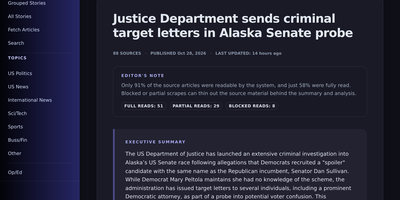
Reading the news should not mean opening twelve tabs about the same event, so MuckScraper folds every outlet's version into one story and shows you how the coverage differs. A scheduler fetches RSS feeds several times a day, with optional NewsAPI and GNews keys adding more sources, and each article is embedded and matched against recent stories so wire copies and follow-ups land together instead of flooding your feed. Every story carries a bias balance: how many left, center, and right outlets covered it, with each outlet rated from AllSides data or scored by the model where no rating exists. Local language models write the story summary and a deeper report comparing how each side frames the event, what is contested, and what nobody is mentioning, while guardrails reject cut-off summaries and figures that never appeared in the sources. Opinion columns stay in their own lane, linked to the stories they argue about and rounded up separately, never counted as news coverage. Twice a day the system publishes a balanced edition of twenty stories, and every past edition stays readable alongside full-text search across your whole archive. Reader, scraper, and admin roles decide who can simply read, who can trigger fetches, and who manages feeds, prompts, and users. Running on a dedicated VPS on RepoCloud with guaranteed CPU, RAM, and SSD, full root SSH access, and a browser serial console. MIT licensed.
DopplerTask
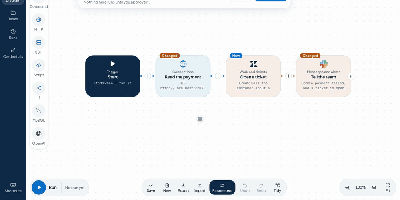
DopplerTask is the control layer where AI agents build your automations and you decide what goes live. You describe the outcome in plain language, and your agent assembles a task from a library of eighty-one ready-made steps spanning messaging, ticketing, sales, operations, documents, databases, queues, and AI models. The proposal lands in a visual editor that people and agents share, with new and changed steps marked and the old value of each field beside the new one. Nothing goes live until you approve it, and the previously approved version keeps running untouched in the meantime. Once a task is live it can start from a webhook, a schedule, a message queue, a manual click, or the agent itself, and every run is recorded with the output of each step, the person who started it, and the person who approved the version. Failed runs resume from the step that failed, with retries and continue-on-failure where you want them. Agents reference your credentials by name only; the values stay encrypted on your server, beyond the agent's reach, and separate tokens for people and agents plus single sign-on keep access tidy. Running on a dedicated VPS on RepoCloud with guaranteed CPU, RAM, and SSD, full root SSH access, and a browser serial console. MIT licensed.