OpenVoiceUI
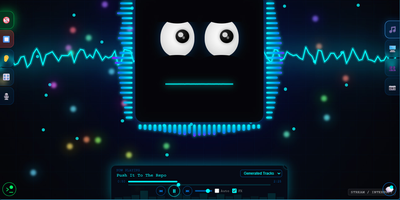
OpenVoiceUI is the voice-first front end for a self-hosted AI agent that lives entirely on your own hardware; you talk, it answers out loud, and it builds live pages on screen while the conversation runs. Hold a hands-free conversation with wake word, push-to-talk, and the ability to interrupt, or switch to text when the room is quiet. Speech recognition runs in the browser for free or through Deepgram, Groq Whisper, or your own Whisper server, while nine speech providers from local Supertonic to ElevenLabs give the agent its voice, cloned voices included. As it talks, the agent opens live canvas pages, dashboards, galleries, reports, and tools, and files them on an OS-style desktop you can reopen from the start menu. Ask for music and it generates songs with a built-in player and playlists; ask for images and it creates those too, alongside an audio clip maker and a soundboard. Profiles swap the agent's persona, voice, and model provider, animated faces react while it speaks, and sub-agents and workspace files stay visible in the admin dashboard. The agent itself runs in the OpenClaw gateway with your choice of model provider, so your keys, conversations, and files never leave your server. Running on a dedicated VPS on RepoCloud with guaranteed CPU, RAM, and SSD, full root SSH access, and a browser serial console. MIT licensed.
Open Agent Email
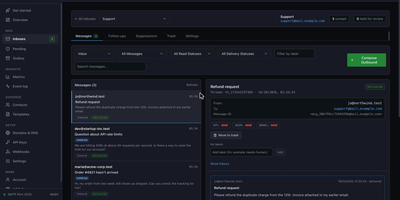
Every AI agent that deals with people eventually needs an email address, and Open Agent Email gives each one a real inbox on your own domain. Agents receive mail in proper threads, reply in place, send new messages, schedule sends up to 90 days ahead, and handle attachments, labels, search, trash and restore from one mailbox. A human approval gate can hold any outgoing message until a person clicks approve or reject, with an expiry and a full history, so a risky reply never reaches a customer unchecked. Incoming mail is screened for prompt-injection tricks and hidden text, checked against SPF, DKIM, and DMARC, and can be scanned for viruses before an agent reads it. Agents connect through a REST API with an OpenAPI file, dependency-free Python and TypeScript SDKs, the oae command line, signed webhooks, a live WebSocket stream, or 96 MCP tools for coding agents. The browser dashboard covers guided setup, inboxes, pending approvals, the outbox queue with retries, delivery metrics with bounce and complaint tracking, contacts, templates, domains with DNS verification, and API keys. Sending runs through your own relay, SES events feed suppression lists automatically, and scoped per-inbox keys limit what each agent may do. Running on a dedicated VPS on RepoCloud with guaranteed CPU, RAM, and SSD, full root SSH access, and a browser serial console. Apache-2.0 licensed.
Local Content Share
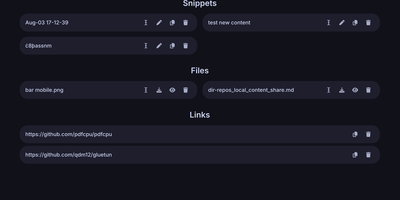
The file is on your laptop, the laptop is downstairs, and cloud drives are still syncing yesterday; Local Content Share ends that dance by giving every device on your network one shared page on port 8080. Type or paste a snippet and it appears instantly on your phone, tablet, and work machine, because Server-Sent Events push every upload, edit, and deletion to all open browsers without a refresh. Files ride along three ways: pick them, drag several at once onto the text area, or paste straight from the clipboard, screenshots included. A separate notepad holds Markdown with edit and preview modes, auto-saving as you type so a thought started on the couch continues at the desk. Links get their own newest-first section, everything can be renamed or edited in place, and each item carries an expiration clock you can set to an hour, a day, or a custom span like 34m or 2w, after which it quietly deletes itself. The interface follows your system light or dark theme, installs as a phone PWA, and needs no accounts and no internet, which is also the honest catch: there is no login, so keep it on trusted networks or behind an authenticated proxy. Running on a dedicated VPS on RepoCloud with guaranteed CPU, RAM, and SSD, full root SSH access, and a browser serial console. MIT licensed.
JumpServer
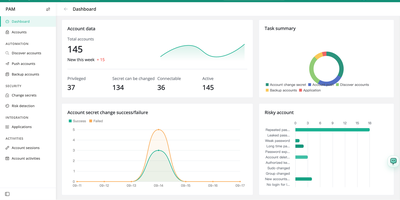
Every server login, database query, and remote desktop session passes through one audited front door instead of scattered SSH keys and shared passwords. Administrators register assets like Linux hosts, Windows machines, databases, clouds, and websites, store the accounts for each, and grant people access through authorization rules. Users open a web terminal or connect with a native client to reach SSH, SFTP, RDP, VNC, database, and Kubernetes targets, with an AI assistant that can describe tasks and run commands in the terminal. Every session is recorded for replay, commands are logged, file transfers are tracked, and auditors can watch live sessions or cut them off. Access control lists filter commands, limit source addresses, and restrict time windows, and multi-factor authentication and LDAP or Active Directory sign-in protect the front door. Automation jobs discover accounts on assets, push new ones, rotate secrets on a schedule, and back up credentials, with a risk dashboard that flags weak, repeated, or stale passwords. Community Edition covers up to 5,000 assets. Running on a dedicated VPS on RepoCloud with guaranteed CPU, RAM, and SSD, full root SSH access, and a browser serial console. GPL-3.0 licensed.
Manage My Damn Life
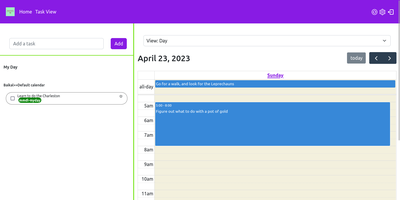
Manage My Damn Life is a personal productivity platform and CalDAV task manager that gives individuals and teams a full-featured web workspace for coordinating todos, calendar agendas, and project schedules without relying on proprietary productivity software. Users can connect multiple CalDAV server backends including Nextcloud, Radicale, and Baikal to synchronize tasks, events, and subtasks across their self-hosted infrastructure. The interface offers multiple interactive perspectives, letting planners switch between nested task checklists, full monthly calendar grids, and dynamic Gantt chart roadmaps with customizable timeline scales. Keyboard-driven operators can rapidly log action items via intuitive Quick Add syntax that parses due dates, priority tiers, and category labels from inline text triggers. A versatile filter manager allows users to save custom query views matching due dates, completion statuses, parent task hierarchies, and color-coded labels. Team members can establish reusable task templates for recurring administrative workflows, assign multi-level checklist items, and manage individual calendar visibility across shared workspaces. System administrators can configure user authentication through native accounts or integrate enterprise Single Sign-On using OpenID Connect providers like Keycloak, Authentik, and Google. Client-side state caching accelerates navigation while background sync preserves CalDAV compliance. Running on a dedicated VPS on RepoCloud with guaranteed CPU, RAM, and SSD, full root SSH access, and a browser serial console. GPL v3 licensed.
Latent Scope
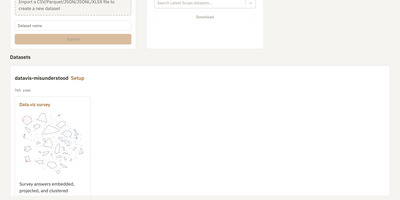
Survey answers, support tickets, and documents become an interactive map where similar rows sit together, so patterns show up before anyone reads a single row. Latent Scope imports a CSV, Parquet, JSON, JSONL, or XLSX file in the browser, then walks through five setup steps: embed the text with a local or hosted model, project the vectors to two dimensions, cluster the points, label every cluster, and publish the result as a scope. The Explore view pairs a searchable table with the map, so you can type a phrase to run a nearest-neighbor search, browse cluster lists, and open any row's full text. Setup keeps every experiment in a gallery with thumbnails and quality scores, which makes comparing parameters painless. Image collections get a zoomable image map, and ColBERT multi-vector embeddings support late-interaction search. Export tables, or render publication-ready plots with dark mode, glow, and custom fonts. A read-only mode and a Hugging Face downloader help you share finished scopes. Running on a dedicated VPS on RepoCloud with guaranteed CPU, RAM, and SSD, full root SSH access, and a browser serial console. MIT licensed.

Lunarr
Lunarr turns the movie and TV folders you already store into a private streaming service with posters, progress tracking, and play-anywhere convenience. Point it at local disks or at libraries living on SFTP and WebDAV servers, and it scans, identifies, and decorates everything with TMDb artwork, cast pages, similar titles, and because-you-watched recommendations. Press play and the file either streams directly or is transcoded on the fly into seekable HLS, generating only the segments around the moment you are watching instead of converting whole films up front. Continue watching follows you between sessions, sidecar subtitles are picked up automatically, and known intros and credits can be skipped. Send the picture to the big screen with Chromecast or AirPlay, pair new devices without typing passwords, and hand a guest a share link instead of your account. Underneath, an admin console manages users, roles, and which libraries each person may see, watches background jobs, and holds API keys and registration settings. Rescans run on schedules you set from minutes to a month, local folders can be watched live for new arrivals, and metadata refreshes itself on a timer. Running on a dedicated VPS on RepoCloud with guaranteed CPU, RAM, and SSD, full root SSH access, and a browser serial console. Apache-2.0 licensed.
ChainForge
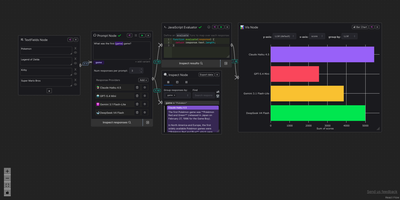
Comparing prompts and models by eye stops working fast, so ChainForge lays every experiment out on one visual canvas. Drop a table of inputs into a Prompt Node, add a handful of models, and the app sends every combination of template variable and model, then collects the answers in an Inspect Node that groups responses by any variable. Evaluator nodes score outputs with a few lines of code, and visualization nodes plot pass rates and numeric scores as histograms or box plots. Chat Turn nodes test follow-up questions, to see if a model caves when a user pushes back. Sparkle buttons draft synthetic table rows, test questions, and starter evaluator code with a model of your choice, and an LLM scorer can judge answers against a rubric you write. Example Flows open ready-made experiments, from a no-key starter with tiny in-browser models to prompt template comparisons, sycophancy checks, gender bias audits, red-teaming runs, and 188 flows converted from OpenAI Evals. Documents, Chunking, Retrieval, and Rerank nodes cover retrieval experiments. Finished flows export as cforge files, and results export to spreadsheets or JSON for the rest of the team. Running on a dedicated VPS on RepoCloud with guaranteed CPU, RAM, and SSD, full root SSH access, and a browser serial console. MIT licensed.
Chatpad
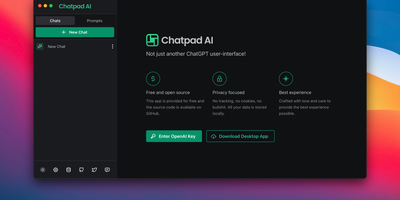
Why should your chat history live on someone else's servers? Chatpad AI - a React/TypeScript front end for the OpenAI API, built on the Mantine component library - is designed around that question. Enter your own OpenAI API key and start chatting with GPT models; every conversation, prompt, and setting is stored locally in your browser via DexieJS over IndexedDB, with no tracking, no cookies, and no backend database at all. That architecture is the point - the Docker image is just Nginx serving static files, making it one of the lightest AI deployments in the catalog, and pay-per-token API pricing typically undercuts a ChatGPT Plus subscription for moderate use. The interface earns its "premium quality" tagline with the details: a persona selector that switches communication styles per conversation, a saved-prompts library for messages you reuse constantly, organized chat history, and full data export/import so conversations move between browsers or into backups as files you control. A JSON config file customizes defaults - models, API endpoints, UI options - without rebuilding the image. AGPL-licensed, with desktop builds available upstream. For teams that want ChatGPT's utility with a self-hosted, zero-telemetry footprint, Chatpad is the minimal, sane answer.
ChatChat
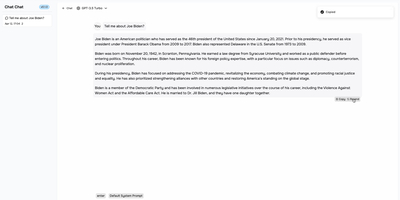
One clean interface in front of Anthropic, OpenAI, Google Gemini, Cohere, and more: Chat Chat is a Next.js front door to the major AI providers, ending the juggling of separate subscriptions, tabs, and UIs per model. Bring your own API keys, pick a provider and model per conversation, and switch between them as the task demands: Claude for long-form reasoning, GPT for code, Gemini for multimodal work - the interface stays identical. Beyond configured presets, custom providers plug in with their own API endpoints and keys, which covers OpenAI-compatible gateways and local inference servers. The design splits into two dedicated modes: a chat interface for conversational work with customizable system prompts, and a search interface that pairs AI processing with query handling for research-style questions. The stack is modern and hackable - Next.js 14, Tailwind CSS, shadcn/ui on Radix primitives, Jotai for state - with full internationalization including English, Chinese, and Japanese. Self-hosting means your conversation history and API keys live on your instance rather than a third-party wrapper service, and pay-per-token API pricing typically beats stacking multiple monthly chat subscriptions. AGPL-licensed and deliberately simple to deploy: one container, environment variables for keys, done.
PodFetch
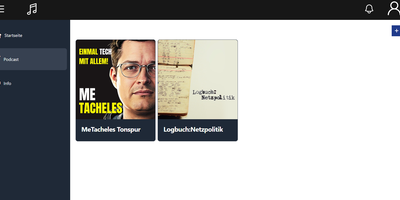
Podcast enthusiasts and homelab archivers automate digital episode preservation and stream personal audio feeds using PodFetch, an open-source self-hosted podcast manager that combines scheduled RSS downloads, Podcasting 2.0 transcript indexing, and browser playback into a modern listening platform. Listeners can subscribe to international podcast channels through direct feed URLs, Apple Podcasts directory searches, or bulk OPML subscription imports, configuring background polling timers to download new releases automatically upon publication. The integrated audio player supports variable speed playback, episode bookmarks, listening histories, and fullscreen visualization modes directly inside responsive desktop and mobile browser sessions. Advanced search capabilities leverage Podcasting 2.0 synchronized transcripts and automated speech-to-text generation via OpenAI-compatible Whisper APIs, allowing collectors to run full-text keyword searches across every spoken phrase in their audio archive. Built-in GPodder API synchronization maintains subscription lists and playback positions across popular smartphone apps like AntennaPod and native companion clients without relying on commercial cloud accounts. Server operators can assign multi-user accounts with private favorites lists, export customized RSS aggregation streams, and route storage paths between fast solid-state drives and large secondary mechanical hard disks. Running on a dedicated VPS on RepoCloud with guaranteed CPU, RAM, and SSD, full root SSH access, and a browser serial console. Apache-2.0 licensed.
Shelf
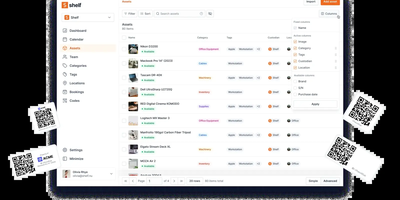
Shelf answers the three questions every equipment manager dreads — who has it, where is it, and when is it coming back — using QR-code-first tracking where every asset gets a unique scannable label, every handover is logged with timestamps and e-signed custody agreements, and every scan captures GPS coordinates displayed on a map. Built on React Router 7 with React 19, TypeScript 5, Prisma 6 ORM, and Tailwind CSS 3 with Radix UI components, the platform generates QR codes and barcodes (Code128, Code39, Datamatrix) printable on DYMO, Brother, and Zebra label printers. The custody system records every handover with user details and generates PDF custody agreements with e-signatures for high-value items, while a complete audit trail tracks responsibility from check-out to return. The visual booking calendar prevents double-bookings automatically, supports partial check-outs and returns with segmented lifecycle bars, and handles quantity-tracked consumables alongside individually serialized equipment. Asset Models enable bulk creation of identical items with shared defaults while maintaining individual QR codes and custody histories. Location tracking displays last-scanned GPS coordinates on MapTiler maps. Supabase Auth provides email and SSO authentication, pg-boss handles background job queuing, and Nodemailer delivers SMTP email. The Shelf Companion app on iOS and Android enables field scanning and bookings. Export Asset Inventory, Asset Distribution, and Custody Snapshot reports for compliance. Deploy via Docker with PostgreSQL and Supabase. Running on a dedicated VPS on RepoCloud with guaranteed CPU, RAM, and SSD, full root SSH access, and a browser serial console. AGPL v3.0 licensed.
Raven
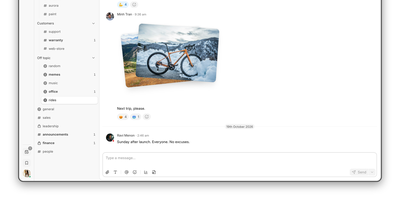
Raven is a team chat app you host yourself, with the channels, threads, and file sharing of the big hosted tools and none of the per-seat bills. Public and private channels group into workspaces, and direct messages cover everything else. A side discussion can move into a thread so the main channel stays readable. Messages support formatting, mentions, code blocks, polls, emoji, and custom reactions, and dropped-in photos, videos, and documents get previews plus a per-channel list of every file. One search box finds messages, files, links, and people across all your channels. Notifications reach the browser and phones with quiet hours and per-channel settings, reminders bring a message back later, and scheduled messages go out at a set time. Paste a link to any document on the site and Raven shows a card with its status and key fields, post to a channel when a document is created or submitted, or approve and reject straight from the conversation. Bots, incoming webhooks, and agents backed by your own OpenAI-compatible provider extend the chat, and iOS and Android apps connect to the same site. Running on a dedicated VPS on RepoCloud with guaranteed CPU, RAM, and SSD, full root SSH access, and a browser serial console. AGPL-3.0 licensed.
Atom
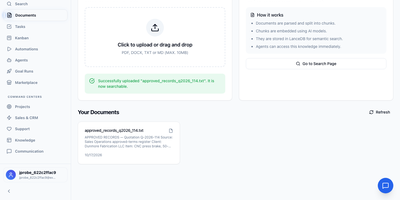
Give an AI agent a price list and it drafts the quote; hand it an invoice and it checks the numbers against purchase and receiving records before anyone pays. Atom is a self-hosted AI agent platform for business automation that wraps every agent action in governance: permissions, ordered policies authored in a canvas editor, human approval checkpoints, and durable audit records. Work starts from your files and instructions, with demonstrated workflows that map unfamiliar spreadsheet columns, calculate against source records, and produce cited Word or PowerPoint documents you can inspect line by line. Corrections become reusable teaching: saved field mappings, commercial terms, and contextual lessons carry into new work, and each job keeps the accepted snapshot it started with. Questions, approvals, and waits survive restarts, completed operations are retained, and uncertain effects must be reconciled before anything retries, so long-running business processes do not silently double-act. Results keep provenance back to the source records and operations that produced them, and unresolved requirements block completion instead of being invented away. You bring the model: configure a hosted provider or a local OpenAI-compatible endpoint, route by capability and cost, and run everything in a single-tenant workspace with user, role, and workspace boundaries. A starter sample runs with no model or cloud key at all. Running on a dedicated VPS on RepoCloud with guaranteed CPU, RAM, and SSD, full root SSH access, and a browser serial console. AGPL-3.0 licensed.
Bracket
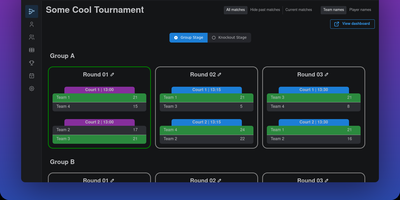
Organizers running sports leagues, gaming tournaments, and community athletics can deploy Bracket as an open-source competition control hub that coordinates multi-stage events without recurring SaaS subscription fees. Competition directors can configure multi-tier tournament topologies combining single elimination, double elimination, round-robin pools, and dynamic Swiss format brackets within a unified event schedule. An interactive calendar grid enables operators to drag and drop fixtures between designated courts, assign start times, and balance player recovery intervals across multiple playing areas. Public dashboard displays generate real-time match outcomes, court assignments, and standings boards that spectators can monitor on mobile devices or overhead venue monitors with customized team logos. Club administrators can manage multiple regional athletic organizations, register rosters through bulk CSV spreadsheet imports, and coordinate simultaneous divisions spanning amateur and championship flights. Integrated OpenAPI REST endpoints allow external scoring overlays, live stream graphic generators, and automated result bots to query match statuses or submit verified referee scorecards programmatically. Running on a dedicated VPS on RepoCloud with guaranteed CPU, RAM, and SSD, full root SSH access, and a browser serial console. AGPL-3.0 licensed.
Undb
Undb turns a browser tab into a full-featured database with spreadsheet-style editing, auto-generated REST APIs, and five configurable views for every table. The platform organizes data through Spaces, Bases, and Tables, offering grid view for traditional editing, Kanban boards for workflow tracking, calendar for date-based planning, gallery for image-rich records, and pivot tables for analytical summaries, each with independent filtering, sorting, color coding, and field selection. An ANTLR4-powered formula engine provides Airtable-style calculated fields with proper syntax validation, variadic argument handling, and type-checked function signatures that go beyond simple string interpolation. Every table automatically generates a fully documented OpenAPI REST endpoint with Swagger UI, letting developers integrate Undb data into external applications through standard HTTP methods without additional configuration. The Drizzle ORM abstraction layer supports four database backends (SQLite, PostgreSQL, MySQL, and Turso edge-distributed SQLite) with separate migration configurations for each adapter. Authentication uses Lucia with OAuth2 via Arctic for GitHub login and Oslo for TOTP two-factor authentication. The SvelteKit 5 frontend renders through Houdini's compile-time GraphQL client and TanStack Svelte Query, while the Elysia.js backend compiles into a single executable via Bun's --compile flag, embedding all assets into one portable binary. File attachments store in any S3-compatible backend including MinIO. Running on a dedicated VPS on RepoCloud with guaranteed CPU, RAM, and SSD, full root SSH access, and a browser serial console. AGPL-3.0 licensed.
Music Player
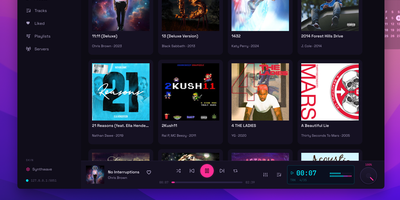
One binary scans your music folder and turns it into a server you can browse, search, and play from anywhere on your network. Start it and the daemon serves gRPC on port 5051, WebSocket events on 5052, and the web UI plus GraphQL on 5053. Later invocations detect the running daemon and act as clients, so the same command drives playback from a second terminal. Search lands instantly because tracks, albums, and artists sit in SQLite FTS5 tables kept current by database triggers. Playback handles more than 40 formats, from FLAC and Opus to WavPack, APE, and chiptunes, with EQ presets, crossfade, and ReplayGain. Browse and stream libraries hosted on Subsonic, Navidrome, and Jellyfin servers beside your own files. Cast to Chromecast and UPnP or DLNA renderers, or control another Music Player daemon as the output. Internet radio search covers Radio Browser and TuneIn stations, with bookmarks and a fullscreen now-playing view. Chromaprint fingerprints name badly tagged files from AcoustID and MusicBrainz data. Import Spotify, Last.fm, and Rocksky history into DuckDB analytics and ask about sessions, skips, and taste drift. Scrobble plays to Rocksky, sync radio bookmarks through the AT Protocol, and pick skins in the browser, desktop, or terminal interface. Running on a dedicated VPS on RepoCloud with guaranteed CPU, RAM, and SSD, full root SSH access, and a browser serial console. MIT licensed.
SQLPage
If you can write a SELECT statement, you can publish a working web app with SQLPage, where each query's results appear on the page as tables, charts, maps, or forms. A .sql file is a page. Name a component in the first row, and the rows after it become lists, cards, data grids, timelines, or step trackers. Tables offer searching, sorting, frozen headers, and per-row edit and delete buttons. Charts cover line, area, bar, pie, scatter, bubble, and heatmap views with a one-click CSV export. Forms feed INSERT and UPDATE statements directly, with validation and file uploads. A complete CRUD tool takes a handful of queries. The map component plots markers and GeoJSON shapes, and the JSON component lets the same data serve other systems as an API. Protect private pages with password logins or single sign-on through Google, Microsoft, or your own identity provider. Connect to SQLite, PostgreSQL, MySQL, SQL Server, or ODBC sources such as DuckDB, Oracle, Snowflake, and BigQuery. Tabs, modals, alerts, breadcrumbs, and carousels shape multi-page sites, and custom templates, CSS, and JavaScript fill any gap. Running on a dedicated VPS on RepoCloud with guaranteed CPU, RAM, and SSD, full root SSH access, and a browser serial console. MIT licensed.