Higress
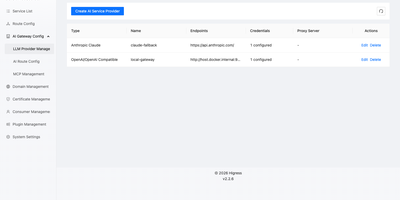
Send every AI request through one gateway that holds your model providers, API keys, and access rules. The web console starts with a first-run admin setup, then an LLM Provider page where OpenAI-compatible endpoints, Anthropic Claude, Azure OpenAI, Tongyi Qianwen, Moonshot, Zhipu, and other services are added with their tokens. AI Route Config maps path prefixes and model match rules to weighted target services, with token failover and first-packet timeouts to keep traffic moving when a key fails. Consumer Management issues key, OAuth2, and JWT credentials, and each route can limit access to named consumers. Plugin Management lists ready-made AI plugins for caching, context limits, data masking, prompt templates, prompt decorators, load balancing, and intent checks, plus traffic and security plugins that can be configured per route. MCP Management hosts MCP servers behind the same authentication and rate limits so agents call tools through one governed address. Service Sources import backends from Nacos, Zookeeper, Consul, Eureka, static addresses, or domains, and domain and certificate pages handle HTTPS, including free automatic certificates from Let's Encrypt. An LLM proxy for a product team, a shared model endpoint for several agents, or a replacement for an ingress controller all fit this console. Running on a dedicated VPS on RepoCloud with guaranteed CPU, RAM, and SSD, full root SSH access, and a browser serial console. Apache-2.0 licensed.
Campfire Rust
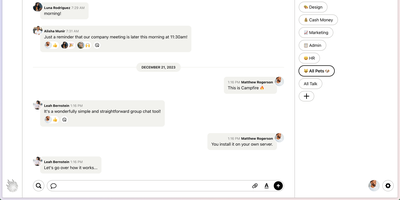
Your team chat can be one executable on your own server: Campfire Rust runs rooms, direct messages, attachments, and search as a single binary that replaces the whole Ruby, Puma, Redis, Resque, and Thruster stack. Create rooms with access controls for projects, departments, or a private board discussion, and keep direct messages beside them for quick questions. File attachments arrive with previews, mentions pull the right person into a thread, and search finds the decision someone made months ago. Web Push notifications reach browsers and phones, so a quiet room still finds its people when it matters. Chatbots connect through a simple HTTP API for sending and receiving messages and attachments, which makes Campfire a home for build alerts, deploy notices, and support pings. Existing Campfire installs upgrade in place because the Rust binary reads the same SQLite database, storage layout, and signed cookies, with no data migration and no mass sign-out. Automatic TLS with Let's Encrypt certificates, HTTP/2, and Action Cable-compatible WebSockets are built in, and the whole system works on air-gapped networks that never touch the internet. Run it as your primary chat, as a backup for the day a hosted service goes down, or as a walled garden for executives and events. Running on a dedicated VPS on RepoCloud with guaranteed CPU, RAM, and SSD, full root SSH access, and a browser serial console. MIT licensed.
JupyterHub
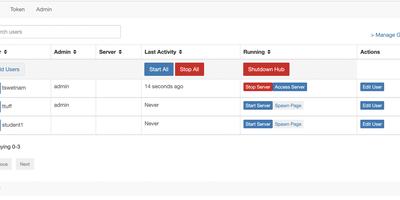
One server, a login for everyone, and a private JupyterLab in every browser tab: that is the whole pitch, and for classrooms and research teams it is transformative. JupyterHub authenticates each user against your existing identity system (campus OAuth, GitHub, Google, LDAP, or local accounts), then spawns a dedicated single-user server just for them, with their files, their kernels, and their compute allocation. Users open notebooks, terminals, and extensions in JupyterLab without installing anything, and their environment is identical whether they log in from a lab workstation or a laptop at home. The Spawner decides where those servers live: plain processes on one machine for a small class, Docker containers for isolation, or Kubernetes pods that scale across a cluster for a whole university. Administrators manage users, groups, and named servers from the admin panel, grant precise permissions through roles and scopes, and watch start times and profiles for every running server. External services plug into the Hub API, so dashboards, autograders, and portals can authenticate through the same OAuth machinery. When a user disappears for the semester break, culling stops their idle server and frees the resources. Running on a dedicated VPS on RepoCloud with guaranteed CPU, RAM, and SSD, full root SSH access, and a browser serial console. BSD-3-Clause licensed.

Calibre-Web
With over 17,700 GitHub stars and continuous development since 2015, Calibre-Web has become the definitive self-hosted digital library solution for book enthusiasts who want beautiful web access to their Calibre collections. The responsive Bootstrap 3 interface delivers instant browsing, searching, and filtering across titles, authors, tags, series, book formats, and languages, with custom shelves for organizing personal reading collections. In-browser reading supports EPUB, PDF, TXT, CBR, CBT, CBZ, and DJVU formats with a configurable EPUB reader featuring multiple themes and page location tracking, while one-click email delivery sends books directly to Kindle, Kobo, and other E-Readers without leaving the interface. Native Kobo sync lets Kobo device owners synchronize their entire Calibre library wirelessly, maintaining reading progress and bookmarks across devices. Metadata management includes editing capabilities with automatic metadata downloading from Google Books, Amazon, and other configurable sources, plus eBook format conversion through Calibre binaries for on-the-fly EPUB, MOBI, AZW3, and PDF conversion. User management provides fine-grained per-user permissions controlling download access, upload rights, editing capabilities, and content visibility based on categories or Custom Column values. Authentication supports local accounts, LDAP directory integration, Google and GitHub OAuth, proxy authentication, and Magic Link login for easy E-Reader access. The OPDS catalog feed enables any compliant E-Reader app to browse and download from the library. Running on a dedicated VPS on RepoCloud with guaranteed CPU, RAM, and SSD, full root SSH access, and a browser serial console. GPL-3.0 licensed.

Flagsmith
With over 6,400 GitHub stars, 130 contributors, and 512 releases, Flagsmith is the open-source feature flag and remote configuration platform that gives development teams granular control over feature releases, remote configuration values, user segmentation, and A/B testing from a single self-hosted dashboard. Feature flags support boolean toggles and remote config values simultaneously — every flag carries both an enabled state and a configurable value, letting teams deploy functional and visual changes without code modifications or app store approvals. User segments target audiences by attributes, percentage rollouts, and custom rules, enabling beta testing, canary releases, and gradual feature rollouts with real-time toggle control. Multivariate flags split traffic across multiple variations with configurable percentage weights for A/B and multivariate testing with analytics integration. The flag evaluation engine runs server-side with local evaluation mode in SDKs for sub-millisecond performance without network calls, supporting 15+ languages including TypeScript, Python, Java, C#/.NET, Go, Ruby, PHP, Swift, Kotlin, Flutter, React, and Next.js. The REST API and webhooks enable integration with CI/CD pipelines, and pre-built connectors exist for Datadog, New Relic, Amplitude, Mixpanel, Segment, Heap, Rudderstack, and Slack. Built on Django with a React frontend, self-hosting deploys via Docker Compose with PostgreSQL, or via Helm charts and the OpenShift Operator for Kubernetes environments. Change history provides a complete audit trail of flag modifications. Running on a dedicated VPS on RepoCloud with guaranteed CPU, RAM, and SSD, full root SSH access, and a browser serial console. BSD-3-Clause licensed.
Collabora Office
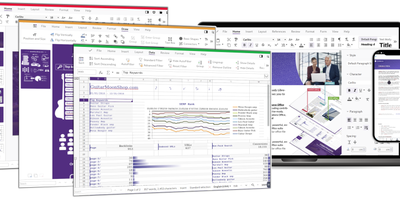
Real LibreOffice document engineering in the browser: Collabora Online is built by the company employing much of the former SUSE LibreOffice team - not a reimplementation. This deployment runs CODE (Collabora Online Development Edition), the collabora/code server that renders and edits documents entirely server-side while browsers get high-fidelity WYSIWYG output, so layout and formatting survive round-trips that break lesser converters. Four editors ship in one container: Writer for text documents (comments, track changes with comparison and restoration, form handling), Calc for spreadsheets (advanced formulas, macros, pivot tables, per-user sheet views, server-enforced cell protection), Impress for presentations, and Draw for Visio-class diagrams. Format compatibility spans DOCX, XLSX, PPTX, the ODF family, PDF, and dozens more - including Visio and Publisher import. Real-time collaborative editing supports multiple simultaneous editors with visible cursors and commenting. The architectural point: documents are processed on your server and never leave it, which is why Collabora is the engine behind Nextcloud Office and integrates with ownCloud, Seafile, and any WOPI-speaking host - or embeds in your own application via the SDK. An admin console monitors sessions and memory. For organizations that need Google Docs-style collaboration with actual data sovereignty, this is the reference open-source answer.
Homarr
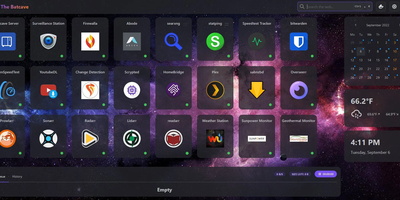
A single pane of glass for every service you run, arranged by drag-and-drop with no YAML or JSON files: Homarr is the modern dashboard for self-hosted infrastructure. Its grid system arranges apps, widgets, and bookmarks on desktop or touch, backed by an icon picker with over 11,000 icons. What separates Homarr from static launchers is 50+ live integrations: Plex, Jellyfin, and Emby media stats, the *arr suite (Sonarr, Radarr) with a unified release calendar, download clients, Pi-hole and AdGuard Home controls, Proxmox, Home Assistant, OPNsense, and Unifi monitoring. Widgets update in real time over WebSockets (tRPC and Redis under the hood), and a built-in search queries thousands of data points across connected services. Custom widgets extend the reach to any HTTP API without code: define endpoint, auth, and refresh interval in the management UI, then render responses as stat grids, tables, progress bars, status indicators, action buttons, or full custom JSX layouts - with an AI-prompt helper for generating templates. Multi-user support is first-class: credentials, OIDC, or LDAP sign-on, groups with granular permissions, and secrets encrypted with AES-256-CBC. A robust background-job system scales it from a Raspberry Pi homelab to deployments serving hundreds of users.
Amplication
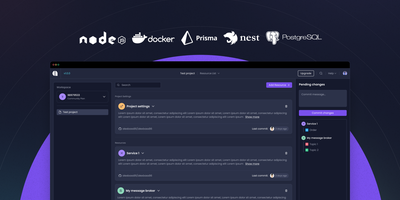
Amplication turns entity definitions into production-ready backend services, generating NestJS with Prisma and Apollo GraphQL for Node.js or ASP.NET Core for .NET, eliminating months of boilerplate. The plugin-driven Data Service Generator hooks into code generation lifecycle events, enabling teams to inject CI/CD manifests, proprietary authentication schemes, testing configurations, and cloud-specific deployment targets for AWS, Azure, and GCP without forking the core generator. Blueprint templates encode organizational architecture standards, security policies, and coding conventions into reusable foundations that keep every generated service consistent across the engineering organization. Jovu AI translates natural language requests into entities, relationships, fields, modules, DTOs, and custom API actions, automatically aligning each resource with predefined standards. Generated services include full CRUD operations with input validation, Swagger/OpenAPI documentation, authentication middleware, database-agnostic ORM via Prisma, optional React Admin interfaces, and Jest test scaffolding. Code output syncs to Git repositories as pull requests, preserving standard review workflows while letting developers edit every generated line and add custom business logic. Supports PostgreSQL, MySQL, and MongoDB as database targets. Over 16,000 GitHub stars with enterprise adoption. Apache 2.0 licensed.
OpenVPM
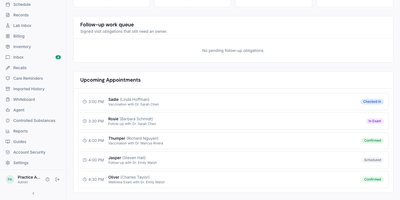
A clinic day starts before the first patient arrives, and OpenVPM has the whole of it on one screen: the schedule, the charts, the invoices, and the shelves. The calendar gives every doctor a column across day and week views, color-codes appointment types, flags doctor and room conflicts, and walks each visit from Scheduled to Checked In, In Exam, and Checked Out. Any chart opens in seconds through fuzzy search, carrying species, breed, weight trend charts, microchip numbers, photos, and allergy alerts that surface before anyone prescribes. SOAP notes sit beside problem lists, vaccination records with reminders and downloadable certificates, lab results against reference ranges, and prescriptions with a dosing calculator and refill tracking. Checkout ties the medicine to the money: treatment templates draft itemized invoices with tax, estimates convert to invoices, payments post to the account balance, and stock deducts itself when products are dispensed. Owners get their own portal for health records, appointment requests, vaccination certificates, invoices, and active prescriptions. The practice whiteboard refreshes itself as animals move between rooms, so the whole team always knows who is waiting, who is in exam, and who is done. Running on a dedicated VPS on RepoCloud with guaranteed CPU, RAM, and SSD, full root SSH access, and a browser serial console. AGPL-3.0 licensed.
ShibaClaw
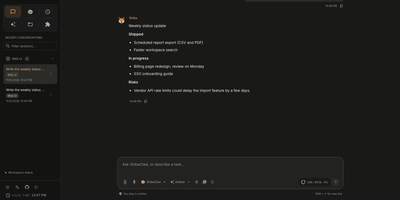
Meet an AI assistant that lives on your own server, remembers who you are, and keeps working after you close the tab. ShibaClaw opens with a four-step onboarding wizard for provider, credentials, and model, then drops you into a chat workspace with agent profiles for building, planning, reviewing, administering, and security work. Long-term memory lives in editable files, a dream diary records what the agent learned, and a Library view maps how profiles relate to each other. Agents call file, shell, and web tools, plug into external MCP servers, and hand work to isolated or forked sub-agents. The Automations page schedules one-shot, interval, or cron jobs like a weekday morning support brief, and a plugin catalog adds services like GitHub, Notion, PostgreSQL, and Google Workspace in one click. An optional knowledge base searches your own documents, and channel integrations reach the agent from Discord, Telegram, Slack, and Matrix. Provider choices span OpenRouter, Anthropic, OpenAI, Gemini, DeepSeek, Groq, Ollama, and any OpenAI-compatible endpoint. A credential vault encrypts keys, and file tools stay inside a restricted workspace. Anyone who wants research, drafting, and recurring chores handled by an assistant they host themselves will feel at home. Running on a dedicated VPS on RepoCloud with guaranteed CPU, RAM, and SSD, full root SSH access, and a browser serial console. Apache-2.0 licensed.
SocialCoach
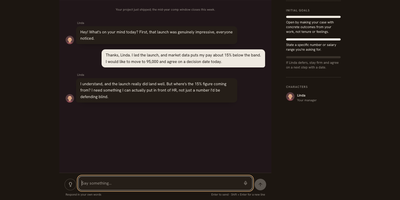
Asking for a raise, declining extra hours, or setting a boundary with a friend can all be rehearsed first in SocialCoach, an AI coach built for the conversations people dread. Pick one of 63 scenarios across seven areas of life, or describe your own situation, and talk to a character who has real goals, doubts, and limits, so politeness alone does not win the argument. A stance meter shows how firmly the other person holds their position as you speak, and optional timed replies add pressure for readiness practice. The debrief quotes what you actually said before judging it, separates communication quality from the outcome, and suggests one thing to change on the next attempt. A Today page recommends a daily scene from your goals, Growth tracks practice history against five competencies, and a Learn library offers short videos, theories, and cases with sources. Step into 3D dinners, elevator lobbies, and offices to answer by typing or speaking. Practice history stays in the browser and can be exported, with no sign-up needed, and the mobile-first layout installs as an app on a phone. Settings accept your own Anthropic or OpenAI-compatible model, or a server key, so a self-hosted copy runs on any gateway. English and Simplified Chinese are both built in. Rehearse a hard conversation three times here and the real one feels smaller. Running on a dedicated VPS on RepoCloud with guaranteed CPU, RAM, and SSD, full root SSH access, and a browser serial console. Apache-2.0 licensed.
Home Screens
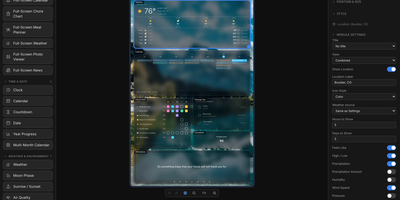
The family calendar is split across phones, the meal plan lives in someone's head, and the chore chart fell off the fridge: Home Screens turns a spare screen into a self-hosted family command center that puts calendars, weather, chores, meal plans, and photos on one shared display. You compose each screen in a drag and drop editor, placing any of 46 built in modules on a configurable canvas: clocks in 18 styles, weather in 14 views, calendars, to do lists, news, stock and crypto tickers, sports scores and standings for 15 leagues, traffic, air quality, and moon phases. Screens rotate through seven transitions, and a hub and spoke setup lets one server drive several physical displays, each with its own layout, dimensions, rotation, and scheduled profile. The phone remote wakes or sleeps displays, adjusts brightness, starts visual timers and morning routines, and runs the family organizer: chore charts with rewards, a meal planner with grocery list, shared to do lists, school timetables, and a notes board. Calendars arrive from Google, iCloud, or any iCal feed, weather from nine providers, and backgrounds from your uploads, Unsplash, NASA, Immich, Google Photos, iCloud, or OneDrive. Modules can appear or hide based on live conditions, plugins add new module types from a directory or a URL, and everything is stored locally with no cloud account. Running on a dedicated VPS on RepoCloud with guaranteed CPU, RAM, and SSD, full root SSH access, and a browser serial console. MIT licensed.
Fusion
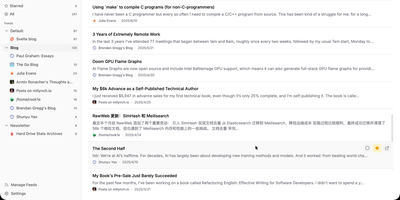
Follow every blog, newsletter, and news site you like from one distraction-free inbox with the self-hosted Fusion RSS reader, which has no AI features by design. A left sidebar lists feed groups with unread counts and jumps between Unread, Starred, and All, while the center list shows articles under filter tabs with read and star buttons on every card. Click a card and a right-hand drawer opens with the full sanitized article, a link to the original, and Previous and Next buttons. Press Cmd or Ctrl+K, or the slash key, to search feeds and articles from anywhere. Stay on the keyboard with Google Reader-style keys such as j and k to move, m to mark read, s to star, and g then u to jump to Unread; the question mark lists them all. Add a feed by entering a site address and letting auto-discovery find it, then pick its group, refresh frequency, and HTTP proxy, or suspend it to pause updates. OPML import and export bring subscriptions in or out. Starred articles are saved as snapshots that outlive their source feed. Fever API compatibility lets Reeder, Unread, and FeedMe read the same library. Sign in with a password or OIDC single sign-on, and install the interface as a PWA with Light, Dark, and System themes in eight languages. Running on a dedicated VPS on RepoCloud with guaranteed CPU, RAM, and SSD, full root SSH access, and a browser serial console. MIT licensed.
Keila
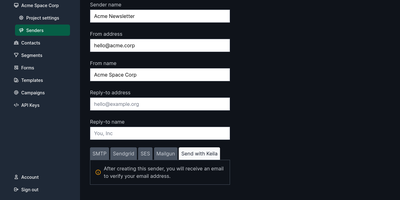
Among open-source Mailchimp alternatives, Keila has the most modern UI - built in Germany on Elixir and Phoenix (the PETAL stack), with GDPR-conscious defaults including an optional no-tracking mode, and 100% open source with no proprietary premium tier. Campaign authoring is flexible three ways: a visual block editor with multi-column layouts, Markdown with or without WYSIWYG for hybrid HTML-plus-plain- text sends, and raw MJML for hand-coded designs. The personalization system is unusually clean - every contact carries custom data as a single JSON object (populated from sign-up form fields or pushed from your CMS/CRM), and Shopify's Liquid template language renders it into fully dynamic emails. Targeting uses a visual segment editor backed by a powerful segment language for complex logic over tags, language preferences, and any custom field. Sign-up forms with custom fields grow your lists; open and click tracking measures campaigns; scheduled sending handles timing. Delivery pipes through your own SMTP or first-class integrations with AWS SES (including automated bounce handling), SendGrid, Mailgun, and Postmark. A full REST API manages contacts, campaigns, and segments, with Erlang/OTP reliability underneath. Comfortable at 100K+ subscribers. AGPL-licensed, EU-hosted project, actively developed.
OnGrid
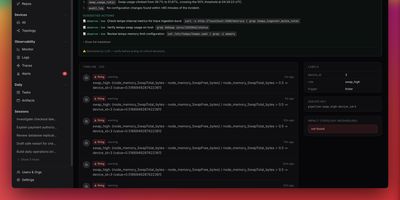
When an alert fires, OnGrid investigates it for you: an AI operations agent that correlates metrics, logs, traces, and topology, then names the root cause in plain language. A coordinator agent hands each question to specialist SRE, network, or database sub-agents, and the incident investigator walks the service graph for blast radius, queries Prometheus, Loki, and Tempo, and pins the cause to a line of source code before posting its report back to chat. Lightweight edge agents on every host dial out over a single tunnel, so no inbound ports are opened, and operators can reach any machine through an audited browser shell. The agent works through more than 26 read-only inspection tools in a sandbox, while anything that changes production waits behind an approval gate. Ask questions or receive reports in Slack, Telegram, Larksuite, DingTalk, or WeCom, and run it on Anthropic, OpenAI, GLM, DeepSeek, Gemini, Kimi, or any OpenAI-compatible endpoint. A workflow builder turns triggers, agents, tools, and notifications into repeatable automations, and a knowledge vault indexes runbooks, incident history, and repositories for search. Enroll Kubernetes clusters to inspect workloads and manage upgrades, or discover network neighbors, verify them over SNMP, and map them into the topology. Role-based access separates admins, users, and viewers. Running on a dedicated VPS on RepoCloud with guaranteed CPU, RAM, and SSD, full root SSH access, and a browser serial console. AGPL-3.0 licensed.
asciinema Server
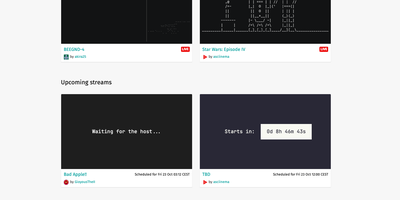
asciinema server gives terminal recordings and live streams a home on your own domain, stored as lightweight, searchable text instead of heavy video files. Demos, tutorials, and incident replays recorded with the asciinema CLI upload in the asciicast format and play back in an integrated web player with configurable terminal themes and font families. Live streams broadcast a running session to viewers in their browsers, which suits workshops, pair debugging, and open office hours. Search spans titles, descriptions, and the terminal output itself, so a command typed months ago is easy to find. Every recording or stream is private, unlisted, or public, secret links make sharing simple, and titles and Markdown descriptions stay editable after upload. Players embed in documentation pages, an SVG preview image links back to the recording, and transcripts download as plain .txt files. No tracking, no advertising. Sign-in uses emailed login links, which a single-user instance can read straight from the server log. An HTTP API creates, updates, and deletes recordings and streams, and an optional audio track can accompany either one. Running on a dedicated VPS on RepoCloud with guaranteed CPU, RAM, and SSD, full root SSH access, and a browser serial console. Apache-2.0 licensed.
Zammad
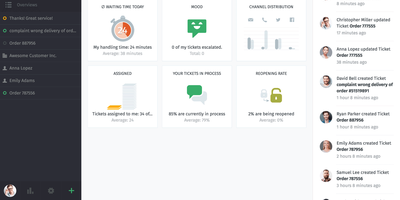
With 5,700+ GitHub stars and over a decade of active development since 2012, Zammad is the open-source helpdesk platform that unifies every customer communication channel — email, live chat, telephone, WhatsApp, Telegram, Facebook, SMS, and web forms — into a single ticket management interface backed by PostgreSQL, Elasticsearch, and Redis. Version 7.0 introduced native AI features including automated ticket categorization, priority assignment, and title rewriting via AI agents that plug into triggers, macros, and scheduler jobs, plus one-click AI ticket summaries and a writing assistant — all configurable with your choice of LLM provider: OpenAI, Anthropic, Mistral AI, Azure AI, Ollama for local models, or any custom OpenAI-compatible endpoint with full audit logging of every AI action. Define service level agreements with first response, update, and solution time tracking tied to business hours calendars, with automatic escalation notifications. The knowledge base provides multilingual FAQ management with internal and public visibility. Core workflows enable dynamic ticket masks with conditional field dependencies per group. Text modules let agents insert predefined responses via the double-colon shortcut, while macros execute multi-step actions with one click. Security includes two-factor authentication, S/MIME and PGP email encryption, and single sign-on via SAML or OpenID Connect. Integrations connect to GitHub, GitLab, Microsoft 365, LDAP with nested group support, and Exchange. Deploy via Docker Compose, Kubernetes with the official Helm chart, or DEB/RPM packages. Running on a dedicated VPS on RepoCloud with guaranteed CPU, RAM, and SSD, full root SSH access, and a browser serial console. AGPLv3 licensed.
pgAdmin
pgAdmin 4 is the reference administration GUI for PostgreSQL, bundled by virtually every Linux distribution and supporting versions 14 through 18 including EDB Advanced Server — browse schemas in a hierarchical tree, write and optimize queries with AI assistance, design entity-relationship diagrams visually, monitor live sessions, and run backup/restore operations entirely from the browser. Built on Python Flask with a ReactJS frontend, version 9.17 delivers a comprehensive web-based platform accessible from any device. The Query Tool provides syntax highlighting, auto-completion, query history, an EXPLAIN plan visualizer with graphical node representation, AI-powered SQL generation from natural language prompts, and AI Insights for execution plan analysis that identifies performance bottlenecks. The Graph Visualiser renders query results as line charts, bar charts, stacked charts, and pie charts directly in the interface. The ERD Tool auto-generates entity-relationship diagrams from existing schemas for visual database design. The Schema Browser presents databases, schemas, tables, views, functions, sequences, roles, and extensions in a navigable hierarchy. Server monitoring dashboards display real-time active sessions, locks, transaction throughput, and vacuum status. GUI-driven backup and restore wraps pg_dump and pg_restore with format and compression options. Authentication supports internal, LDAP, Kerberos, OAuth2/OIDC, and webserver modes. The Helm chart includes an HTTPRoute template for Kubernetes Gateway API deployments. Bundled pg_dump, pg_restore, and psql utilities version 18.4. Deploy via Docker with the official dpage/pgadmin4 image. Running on a dedicated VPS on RepoCloud with guaranteed CPU, RAM, and SSD, full root SSH access, and a browser serial console. PostgreSQL License.