
Omni
Omni is an open-source workplace AI agent and enterprise search platform that unites your company's scattered tools into a single context-aware workspace where team members can find answers and automate cross-application workflows. Employees can query connected knowledge sources including Google Drive, Gmail, Slack, Jira, GitHub, Confluence, and HubSpot to locate project specifications, customer records, and operational documents without jumping across tabs. The integrated AI assistant answers complex multi-step inquiries, summarizes lengthy email threads, and cites exact source passages so workers can verify factual accuracy before making business decisions. Granular permission inheritance mirrors existing access controls across every connected service, guaranteeing that sensitive personnel files, financial statements, and confidential repositories remain hidden from unauthorized staff. Engineers can construct bespoke data connectors and define automated agent skills through the extensible Python and TypeScript software development kits, triggering multi-service actions directly from interactive chat dialogues. Administrators can monitor background synchronization jobs, inspect audit trails, manage single sign-on access, and configure custom extraction pipelines using centralized operational dashboards. Running on a dedicated VPS on RepoCloud with guaranteed CPU, RAM, and SSD, full root SSH access, and a browser serial console. Apache 2.0 licensed.
Draw a UI
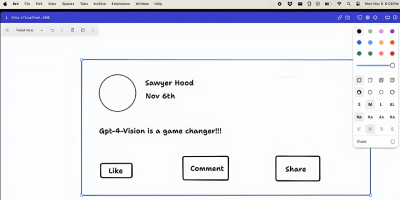
Sketch a wireframe, get working code: Draw a UI turns hand-drawn layouts into web interfaces. It pairs the open-source tldraw canvas with an OpenAI vision model: you sketch a layout - boxes, labels, buttons, arrows, whatever communicates the idea - select the drawing, and click Make Real. The app snapshots your selection as a PNG, sends it to the vision API with instructions to return a single HTML file styled with Tailwind CSS, and renders the result in an iframe directly on the canvas next to your sketch. The loop is iterative: annotate the generated prototype or redraw parts of it, select both the sketch and the previous result, and generate again - the model receives the earlier HTML as context and produces an updated version. Built by Figma engineer Sawyer Hood as one of the first viral GPT-4 Vision demos and the basis for tldraw's "Make Real", it is a Next.js app that runs against your own OpenAI API key. Self-hosting matters here: the upstream demo ships without authentication, so a private deployment keeps your API key from being drained by strangers. MIT-licensed.

OpenSquilla
Claiming 60-80% token cost reduction compared to flat single-model deployments and backed by 6,500+ GitHub stars, OpenSquilla delivers an intelligent AI agent runtime where a local ML classifier evaluates every turn on message length, code blocks, keyword patterns, and semantic embeddings before routing it to the optimal model tier from C0 through C3. The pluggable provider layer connects natively to TokenRhythm, OpenRouter, OpenAI, Anthropic, Ollama, DeepSeek, Gemini, DashScope, Moonshot, Mistral, Groq, Zhipu, SiliconFlow, vLLM, LM Studio, and additional compatible backends with primary-plus-fallback selection. The four-tier cognitive memory architecture spans working, episodic, semantic, and raw layers with vector-semantic and BM25 retrieval powered by on-device ONNX embeddings that never leave your infrastructure. Security isolation operates at the syscall level via Bubblewrap on Linux and Seatbelt on macOS, complemented by policy-based execution controls and prompt injection protections. The unified TurnRunner executes identically across the Vue-based control console Web UI, terminal CLI, and chat channel integrations including Slack and Discord, ensuring consistent tool dispatch, retry logic, and decision logging regardless of entry point. Built-in skills cover deep research, multi-search-engine queries, document generation for DOCX, PPTX, XLSX, and PDF formats, GitHub integration, cron scheduling, and bounded subagent delegation. Per-agent workspaces with durable session storage provide transcript replay, context state management, and per-call cost tracking with automatic quota enforcement. Running on a dedicated VPS on RepoCloud with guaranteed CPU, RAM, and SSD, full root SSH access, and a browser serial console. Apache-2.0 licensed.
Muse
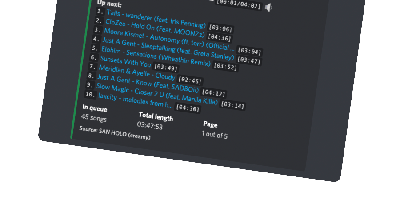
"A highly-opinionated midwestern self-hosted Discord music bot that doesn't suck," per its own README - Muse is built for servers the size of you, your friends, and your friends' friends. It exists because the big public music bots kept getting shut down or paywalled, and self-hosting yours means nobody can take it away. Written in TypeScript on discord.js, it joins voice channels and plays audio resolved from YouTube via yt-dlp, and given optional Spotify API credentials it auto-converts Spotify tracks, albums, artists, and entire playlists to playable equivalents. The playback details show real care: seeking within songs and videos, livestream support, local caching so repeated plays start instantly, volume normalization across tracks, and configurable volume controls including optional ducking that lowers music when people speak. SponsorBlock integration can skip non-music segments automatically. Users save favorite queries as reusable shortcuts, and one Muse instance serves multiple guilds simultaneously - one deployment for all your communities. Configuration is three environment variables (Discord token, YouTube API key, optional Spotify pair) and the personality is free: there is no vote-to-skip, because "this is anarchy, not a democracy," and the bot remains a loyal Green Bay Packers fan. MIT-licensed and easily extendable.
SigNoz
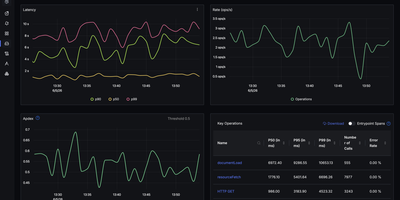
With over 31,000 GitHub stars and native OpenTelemetry support that eliminates vendor lock-in from day one, SigNoz delivers full-stack observability covering metrics, traces, and logs in a single pane of glass without the per-host pricing model of commercial APM platforms. The platform ingests telemetry data through the OpenTelemetry Collector, supporting auto-instrumentation for Java, Python, Node.js, Go, Ruby, PHP, and .NET applications with zero code changes required for basic tracing. ClickHouse serves as the columnar storage backend, providing fast aggregation queries over billions of spans and log lines with configurable retention policies and tiered storage. The distributed tracing view renders flame graphs and Gantt charts showing request flow across microservices with latency breakdowns, error rates, and p99 percentile calculations. Custom dashboards support PromQL and ClickHouse SQL queries with time-series charts, bar graphs, tables, and value widgets. The log management pipeline supports structured and unstructured logs with full-text search, log pipelines for parsing and enrichment, and correlation with traces via trace IDs. Alert rules can be configured on any metric or log query with notification channels including Slack, PagerDuty, OpsGenie, webhooks, and email. The exceptions monitoring module automatically groups and tracks application errors with stack traces, occurrence counts, and first-seen timestamps. Service maps visualize inter-service dependencies with real-time latency and error rate overlays. Running on a dedicated VPS on RepoCloud with guaranteed CPU, RAM, and SSD, full root SSH access, and a browser serial console. MIT licensed with an enterprise edition available.
2FAuth
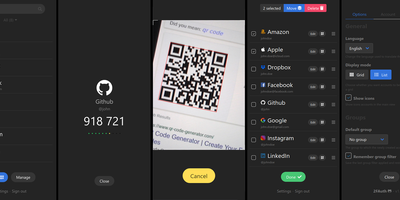
2FAuth generates TOTP, HOTP, and Steam Guard codes from any web browser, freeing your two-factor authentication from dependence on a single smartphone or app. Lose your phone, switch devices, or sit at a desktop computer, and your 2FA codes remain accessible through the web interface. The Laravel and Vue.js application stores account secrets in an encrypted SQLite database that backs up as a single file. Adding accounts works through camera-based QR scanning or manual secret key entry for services that only provide text codes. Group organization with drag-and-drop sorting keeps large collections navigable, categorized however you prefer. WebAuthn authentication with FIDO2 hardware keys protects vault access with phishing-resistant passwordless login, meaning the tool that secures your accounts is itself secured by the strongest available method. Automatic screen lock triggers after configurable idle time, and OTP obfuscation dots out generated codes until you tap to reveal them, preventing shoulder surfing in shared spaces. The REST API enables browser extensions and external applications to request codes programmatically. Import compatibility with Google Authenticator, Aegis, and 2FAS ensures painless migration without re-enrolling every account from scratch. PWA installation places 2FAuth on your device home screen for native-app-like instant access. Runs on a dedicated RepoCloud VPS with guaranteed resources and full root SSH access. AGPL-3.0 licensed.
ezBookkeeping
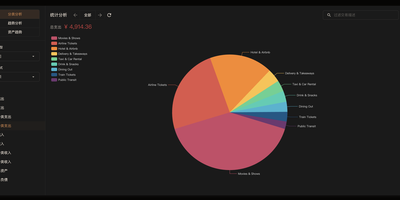
Managing household finances and personal investments becomes completely private with ezBookkeeping, a self-hosted accounting platform that combines multi-currency ledger tracking, automated bank imports, and AI-assisted receipt analysis into a responsive financial dashboard. Users can record daily income, expenses, and asset transfers using hierarchical two-level accounts and customizable tags, attaching photographic receipts and geographic location coordinates to individual entries. The automated data ingestion engine processes bank statements across standardized CSV, OFX, QIF, CAMT, and MT940 files, applying user-defined column mappings and custom conversion scripts to eliminate manual bookkeeping. Financial planners can schedule recurring bills, configure monthly category spending limits, and track asset distribution with interactive charts, trend graphs, and activity heatmaps in the Insight Explorer. Integrated artificial intelligence tools scan uploaded invoice photos to extract line items automatically while a native Model Context Protocol server lets external desktop assistants query balances and audit budgets safely. Security features include time-based two-factor authentication, single sign-on via standard identity providers, and biometric passkey screen locks that secure private monetary ledgers on shared computers. Account owners can export full audit histories to portable spreadsheets, manage multi-currency exchange rate tables, and access clean web interfaces on both desktop monitors and mobile devices. Running on a dedicated VPS on RepoCloud with guaranteed CPU, RAM, and SSD, full root SSH access, and a browser serial console. MIT licensed.
EspoCRM
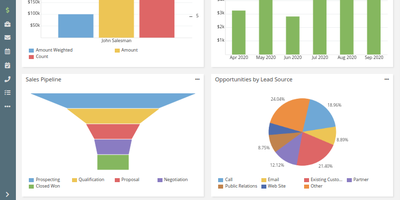
Teams tired of paying Salesforce or HubSpot per seat run EspoCRM: an AGPL-licensed PHP application with a fast single-page frontend over a REST API, covering sales, support, and marketing in one uncluttered interface. The sales core is complete - leads, contacts, accounts, opportunities with customizable pipeline stages, kanban views, calendars, meetings, and calls. Email is deeply integrated rather than bolted on: IMAP sync links messages to CRM records automatically, and mass email campaigns run with reusable templates, tracking, and Web-to-Lead forms feeding the funnel. Support teams get case management and a customer portal where clients track their own tickets and access a knowledge base. The real differentiator is the Entity Manager: create custom entities, fields, relationships, and layouts from the admin UI without code, with dynamic logic showing or hiding fields conditionally - EspoCRM is as much a business-application platform as a CRM. Formula scripting handles calculated fields and record automation in the free core; the optional Advanced Pack adds visual BPM process design and workflow rules. Role-based permissions with team and territory scoping, full-text search, reports, and a straightforward REST API for n8n or custom integrations round it out. Runs on PHP 8.3+ with MySQL, MariaDB, or PostgreSQL - unlimited users, zero per-seat fees.
Wallos
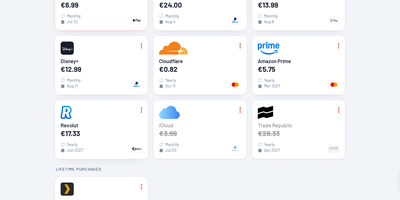
Track every recurring payment you have, from streaming services to SaaS tools, and get AI-powered recommendations on where to cut costs. Wallos manages subscriptions with automatic due date reminders delivered through email, Discord, Telegram, Pushover, Gotify, or custom webhooks so renewal charges never catch you off guard. Multi-currency support handles international subscriptions while the Fixer API converts everything to your primary currency for unified budget visibility. The statistics dashboard breaks down monthly and yearly spending by customizable categories, revealing consumption patterns and highlighting savings opportunities. AI analysis via ChatGPT, Gemini, or a locally-hosted Ollama instance reviews your subscription portfolio and suggests alternatives or consolidation strategies. Logo search automatically fetches brand imagery so your subscription list stays visually organized without manual uploads. Authentication supports OIDC with OAuth for enterprise environments, and the mobile-responsive interface works on any device with customizable themes and multi-language support. The PHP 8.3 application with SQLite backend runs from a single Docker container (bellamy/wallos image) with two persistent volumes for database and logos on port 8282. Deploy on RepoCloud with a dedicated VPS, keeping all financial data private under the GPL-3.0 license.
Zipline
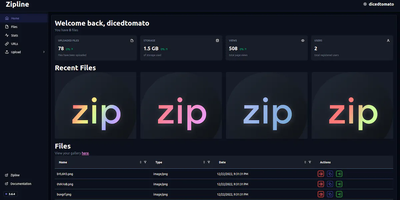
ShareX and file uploads, next generation: Zipline is a Node.js/React/PostgreSQL server that turns screenshot sharing and file hosting into something you run yourself instead of renting from Imgur or a paid image host. The core workflow is built around ShareX: generate an .sxcu config from your account settings, import it, and every screenshot or clipboard capture uploads to your domain with a short link copied automatically. Uploads accept any file type, organized with folders and tags, with token-protected uploading, optional password protection, view-limited auto-deletion, image compression, metadata stripping, automatic video thumbnails, and chunked/partial uploads for large files. File URLs come in configurable formats - UUIDs, dates, random alphanumerics, original names, even zero-width spaces. A built-in URL shortener adds vanity slugs, passwords, view caps, and custom domains. Discord embeds are first-class: customize OG metadata titles, descriptions, and colors so links unfurl exactly how you want, and fire fully customizable Discord or HTTP webhooks on each upload. Authentication is serious: OAuth2 (Discord, GitHub, Google, OIDC), TOTP two-factor, and passkeys, with invite-based registration and per-user quotas for shared instances. Storage targets local disk or any S3-compatible backend, a full REST API automates everything, and custom themes plus a PWA round out the experience.
BillionMail
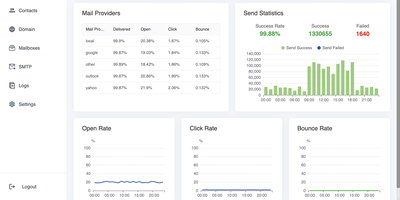
With over 15,000 GitHub stars accumulated since its February 2025 launch, BillionMail delivers the rare combination of a production mail transfer agent and a full email marketing suite in a single self-hosted package — eliminating the monthly per-subscriber fees charged by Mailchimp, SendGrid, and similar platforms. The Go-based architecture bundles Postfix for SMTP transmission, Dovecot for IMAP and POP3 mailbox access, Rspamd for intelligent spam filtering and greylisting, and RoundCube for browser-based webmail, all orchestrated through Docker Compose with PostgreSQL for persistent storage and Redis for queue management and caching. The marketing engine supports unlimited subscriber lists with tag-based segmentation, scheduled campaign sends, A/B subject line testing, and both HTML and drag-and-drop visual template editors for crafting responsive emails without coding. Real-time analytics dashboards track sent volume, deliverability rate, open rate, click-through rate, and bounce reasons, while the platform provides step-by-step DNS record configuration wizards for SPF, DKIM, and DMARC to maximize inbox placement. A transactional email API exposes REST endpoints for single and batch sending, enabling integration with CRM systems, e-commerce platforms, and custom applications. Auto-provisioned free SSL certificates, Fail2ban brute-force protection, and privacy-first architecture with zero third-party tracking ensure secure operation. The platform installs in under eight minutes via a single shell script and supports SMTP on port 25, SMTPS on 465, submission on 587, IMAP on 143/993, and POP3 on 110/995. Running on a dedicated VPS on RepoCloud with guaranteed CPU, RAM, and SSD, full root SSH access, and a browser serial console. AGPLv3 licensed.
Scrumboy
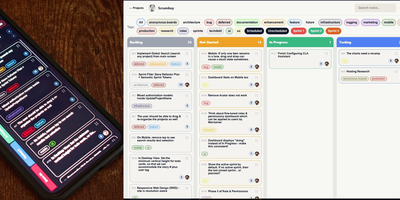
Scrumboy is a Kanban and sprint management tool that ships as a single Go binary backed by SQLite, deploys in under ten seconds via Docker, and uniquely integrates with AI coding agents through a standards-compliant MCP JSON-RPC endpoint. The dual-mode architecture supports Full mode with bootstrapped authentication, TOTP two-factor auth, OIDC/SSO integration through Keycloak, Authentik, Auth0, or Entra ID, role-based access control across Owner, Admin, User system tiers plus per-project Maintainer, Contributor, and Viewer roles, and Anonymous mode that generates instant shareable boards accessible via unique URLs with zero signup requirement. Custom workflows allow user-defined lane configurations per project including designated "Done" lanes, while sprints with configurable one or two-week cycles include board-level sprint filtering and the ability to disable and re-enable sprint tracking without losing history. Real-time Server-Sent Events power instant multi-user board updates, and outbound webhooks deliver JSON payloads to registered URLs when domain events fire with HMAC signature verification. The MCP endpoint at /mcp/rpc enables native integration with Cursor, Claude Code, and other AI agents through OAuth 2.1 with PKCE authorization, while API access tokens support CLI automation and CI/CD pipelines. Additional capabilities include VoiceFlow voice commands, per-project sticky-note walls, Markdown and Mermaid diagram support in task notes, append-only audit trails, VAPID Web Push notifications, SMTP password reset, Trello import, JSON backup with merge/replace/copy strategies, and 22-language internationalization. Running on a dedicated VPS on RepoCloud with guaranteed CPU, RAM, and SSD, full root SSH access, and a browser serial console. AGPL v3.0 licensed.
Letta
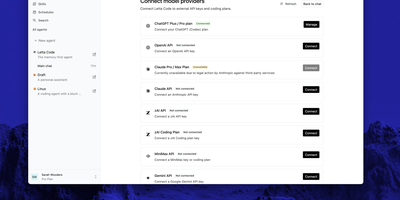
With over 24,000 GitHub stars and origins in the MemGPT research paper on virtual context management, Letta has evolved into the leading open-source platform for building AI agents that maintain persistent memory, identity, and continuity across sessions rather than operating as stateless prompt-response loops. The core architecture uses memory blocks — structured, labeled text chunks that reside permanently in the agent's context window — allowing agents to programmatically rewrite their own memory, learn new skills, and improve through a sleeptime dreaming process that runs reflection and memory organization during idle periods. The self-hosted App Server deploys via Docker and exposes a WebSocket API on port 4500, letting the TypeScript Agent SDK connect from any application using local, remote, or cloud backends. Agents support git-versioned memory through MemFS where every memory change is tracked and auditable, multi-agent communication via subagents, scheduled tasks, and integration with messaging platforms including Slack, Discord, Telegram, WhatsApp, and Signal. The platform is fully model-agnostic, routing to OpenAI, Anthropic, xAI, or self-hosted open-weight models through Ollama depending on cost, performance, and data residency requirements. The Agent File format serializes complete agent state — memory, skills, prompts, and conversation history — into portable snapshots. Desktop applications for macOS, Windows, and Linux provide native interfaces alongside the terminal CLI and web chat at chat.letta.com. Running on a dedicated VPS on RepoCloud with guaranteed CPU, RAM, and SSD, full root SSH access, and a browser serial console. Apache-2.0 licensed.
Kokoro FastAPI
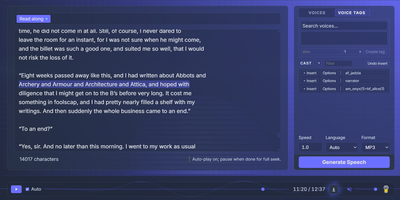
Kokoro-FastAPI turns text into natural-sounding speech across eight languages by serving the 82-million-parameter Kokoro-82M model through an OpenAI-compatible REST API, so any existing OpenAI SDK client can generate audio by just changing the base URL. With over 5,300 GitHub stars since December 2024, the fully Dockerized FastAPI server covers American English, British English, Spanish, French, Hindi, Italian, Japanese, Brazilian Portuguese, and Mandarin Chinese with language-specific phoneme processing. Inline voice mixing blends multiple profiles using weighted ratios like af_bella(2)+af_heart(1), automatically normalizing weights and caching combined voicepacks as PyTorch tensor files for reuse. Audio streams in real time over HTTP with configurable chunk sizes, or generates complete files in MP3, WAV, OPUS, FLAC, AAC, or PCM formats with speed control from 0.25x to 4.0x. Per-word timestamped captions with speaker-tagged voice labels enable subtitle generation for podcasts, audiobooks, and accessibility workflows. Pre-built Docker images support NVIDIA GPU acceleration via CUDA, experimental AMD GPU inference via ROCm, and CPU-only deployment on linux/amd64 and linux/arm64 architectures, with Apple Silicon MPS support available through direct UV execution. The integrated web interface at port 8880 provides browser-based speech generation, while the Swagger UI at /docs exposes the full API reference. Debug endpoints report system statistics for monitoring inference load. Running on a dedicated VPS on RepoCloud with guaranteed CPU, RAM, and SSD, full root SSH access, and a browser serial console. Apache 2.0 licensed.
OpenDeepWiki
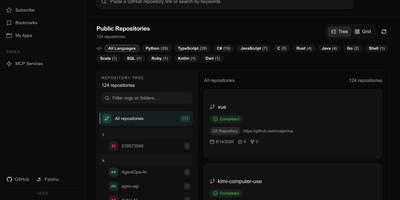
OpenDeepWiki transforms code repositories from GitHub, GitLab, Gitee, Gitea, and AtomGit into structured, searchable knowledge bases by leveraging Microsoft's Semantic Kernel for AI orchestration across OpenAI, Azure OpenAI, Anthropic, and DeepSeek providers. The three-phase Gather-Think-Write pipeline analyzes repository tree structures, generates README summaries, project overviews, wiki catalogs, and document content while producing Mermaid mind maps and optional Graphify visualization artifacts. Repository-scoped MCP endpoints at /api/mcp/{owner}/{repo} expose indexed knowledge to external AI tools, while the built-in chat assistant, embedded chat APIs, and share links provide conversational access to repository understanding. The Next.js 16 frontend serves public documentation on SEO-friendly routes with multi-language translation support, and the admin console manages repositories, users, roles, API keys, AI provider and model configuration, skills, and GitHub App imports. Background workers handle incremental updates using LibGit2Sharp to keep documentation synchronized with evolving codebases, while Polly integration provides transient failure retry handling for LLM requests. The platform supports SQLite, PostgreSQL, and MySQL database backends with Entity Framework Core providers. Running on a dedicated VPS on RepoCloud with guaranteed CPU, RAM, and SSD, full root SSH access, and a browser serial console. MIT licensed.
SnappyMail
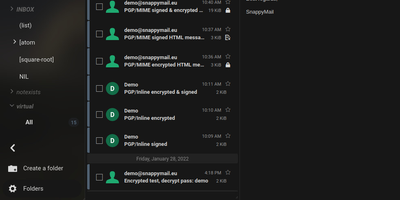
SnappyMail is a fast, privacy-respecting webmail client that connects to any existing IMAP and SMTP server, booting in under a second with a JavaScript payload of just 138 KB under Brotli compression (down from RainLoop's 8 MB fork origin). No database is required: all configuration and user data persists as flat files in a single volume, making Docker deployment trivially simple with the roughly 30 MB image consuming approximately 50 MB of RAM. Built-in PGP encryption supports three backends: OpenPGP.js v5 with ECDSA and EDDSA key generation, GnuPG integration, and Mailvelope browser extension compatibility, eliminating the need for separate encryption plugins. The integrated Sieve script editor enables users to create mail filtering rules, vacation auto-responders, and forwarding conditions directly within the web interface when connected to ManageSieve-capable servers on port 4190. Multi-domain administration allows a single instance to serve users across multiple IMAP servers with per-domain authentication routing. The admin panel manages extensions, security settings, branding customization, and domain configuration. GDPR-friendly by design, it removes all social media integrations, Gravatar lookups, and external tracking present in RainLoop. Dark mode strips background and font colors from email messages. The modified Squire HTML editor replaces CKEditor for composing rich-text messages. Scores 99% on Lighthouse performance. Running on a dedicated VPS on RepoCloud with guaranteed CPU, RAM, and SSD, full root SSH access, and a browser serial console. AGPL-3.0 licensed.

New API
New API is a Go-powered LLM gateway that funnels over 40 AI providers, from OpenAI and Anthropic to Google Gemini, Azure, AWS Bedrock, DeepSeek, and Mistral, through a single OpenAI-compatible endpoint with intelligent routing and enterprise cost controls. Bidirectional format conversion translates between OpenAI Chat Completions, Claude Messages, and Gemini GenerateContent APIs transparently, so clients call any provider using their preferred format while the gateway handles the rest. Routing logic supports weighted random channel selection, priority-based failover, and automatic retry on provider errors to maximize uptime. The React admin dashboard shows usage charts, token consumption tracking, per-model cost breakdowns, and real-time request monitoring. Multi-tenant architecture includes three role levels, token-based authentication, per-user quota management, and a three-phase billing system with tiered pricing via a custom expression language. Multimodal support covers text completion, vision, embeddings, text-to-speech, speech-to-text, image generation, and creative task providers like Midjourney-Proxy and Suno-API. The interface ships in five languages including English, Chinese, Japanese, and French. Docker deployment runs with SQLite or MySQL for persistence. 45,000+ GitHub stars. AGPL-3.0 licensed.
Mstream
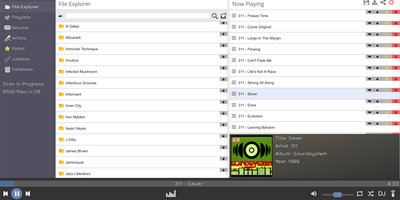
"The easiest music streaming server available" is mStream's own billing, and the claim holds up: a lightweight Node.js app that turns a folder of audio files into a private streaming service in minutes, no external database required. Its filesystem-based design is the clever part - the API mirrors your folder structure, so you can browse and play music immediately, before any library scan finishes, and your organization on disk is your organization in the app. It streams flac, mp3, wav, ogg, opus, aac, and m4a, which matters to the audiophile crowd: FLAC plays uncompressed, bit-perfect, with gapless playback for live albums and continuous mixes. The web player runs anywhere a browser does and packs personality - a Milkdrop-style visualizer (Butterchurn), playlist sharing via links, and drag-and-drop uploads straight through the file explorer. Native iOS and Android apps add the feature streaming subscriptions can't match: sync your collection to your phone for true offline playback of music you own. Multi-user support assigns separate directories and permissions per account. Resource usage is famously light - mStream is tested on multi-terabyte libraries and runs happily on a Raspberry Pi, so a small RepoCloud instance serves a lifetime's collection. GPL-licensed, with zero listening-habit telemetry.