Livebook
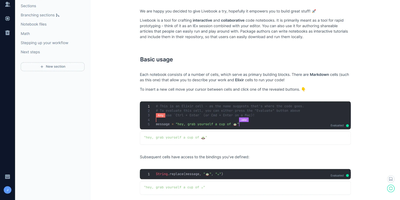
Livebook is an interactive notebook for Elixir where you write code alongside rich Markdown prose, execute it cell by cell with reactive dependency tracking, and deploy finished notebooks as standalone web applications with a single click. Nearly 6,000 GitHub stars reflect the Elixir core team's investment in a platform where code cells run on demand alongside Mermaid diagrams and KaTeX mathematical formulas. The Kino visualization library renders Vega-Lite charts, interactive data tables with sorting and pagination, Leaflet maps, and Mermaid diagrams directly within notebook output cells, while custom Kino components enable building interactive controls with sliders, text inputs, and buttons that feed values back into running code. Smart cells abstract high-level tasks into configurable UI widgets: query PostgreSQL, MySQL, SQLite, and BigQuery databases, train machine learning models with Axon, plot charts, and build map visualizations without writing boilerplate code. Real-time collaboration lets multiple users edit the same notebook simultaneously with cursor presence indicators and synchronized cell evaluation. Notebooks are stored as .livemd files, a Markdown-compatible format that renders cleanly on GitHub and integrates with standard version control workflows. Custom runtimes connect Livebook to existing Elixir applications for live introspection and documentation of running systems. The Docker image at ghcr.io/livebook-dev/livebook exposes ports 8080 and 8081 with password or token authentication. Running on a dedicated VPS on RepoCloud with guaranteed CPU, RAM, and SSD, full root SSH access, and a browser serial console. Apache 2.0 licensed.
PsiTransfer
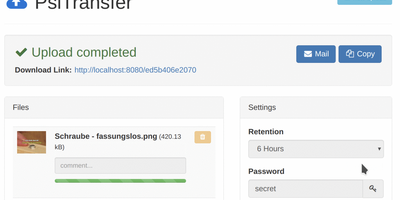
Upload files, get a share link, let it expire: PsiTransfer is a self-hosted WeTransfer with no accounts, no logins, and no third-party cloud with size caps and metadata harvesting. The engineering focus is large files over imperfect networks. Uploads use the tus.io resumable protocol, so a dropped connection on a multi-gigabyte video resumes exactly where it stopped once you're back online; downloads support HTTP range headers for the same resilience, and everything streams, so file size is bounded by your disk rather than memory. Files organize into upload buckets with retention you control: expire after a set time (up to weeks) or after a one-time download, with automatic cleanup when links lapse. Recipients need nothing installed - they open the link, preview files in modal views, and grab everything as a zip or tar.gz archive with one click. Buckets can be password-protected (AES-encrypted download lists), and security-through-obscurity is done properly: bucket URLs use hashed UUID tokens and stored filenames are replaced with UUIDs. An optional admin page (enabled by setting an admin password) lists bucket information and storage. The Vue.js frontend ships under 100 KB gzipped and is fully responsive. Honest caveat from the author: no end-to-end payload encryption yet. BSD-licensed, Docker-ready.
Glance
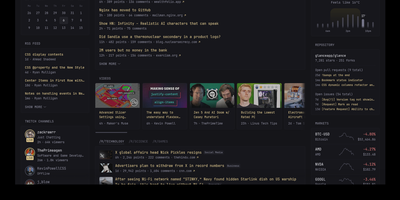
With over 35,000 GitHub stars in just two years, Glance has become the most popular self-hosted dashboard project on GitHub, outpacing established alternatives like Homarr and Homepage. Built as a single Go binary under 20MB with minimal JavaScript and zero external dependencies, Glance delivers a blazing-fast personal information dashboard that consolidates your entire digital morning routine into one beautiful page. Configure everything through clean YAML files that support modular includes and environment variable interpolation, with automatic hot-reload that applies changes without restarting the server. The widget ecosystem covers RSS and Atom feeds, Reddit and Hacker News frontpages, YouTube channel subscriptions, GitHub release timelines, weather forecasts from Open-Meteo, stock market quotes, Docker container status, Twitch live streams, calendar events via iCal, site monitor uptime checks, and custom HTML or iframe embeds. A community widgets repository extends functionality even further with user-contributed integrations. The theming system provides light, dark, and custom color schemes with multiple layout options including slim and wide column configurations. Authentication support added in 2025 secures access with username and password protection. Preconfigured page templates let you get started in seconds with curated layouts for development, homelab monitoring, news reading, and entertainment tracking. Deploy via Docker Compose or as a standalone binary on Linux, macOS, or Windows across AMD64 and ARM64 architectures. Running on a dedicated VPS on RepoCloud with guaranteed CPU, RAM, and SSD, full root SSH access, and a browser serial console. AGPL-3.0 licensed.
Dokku
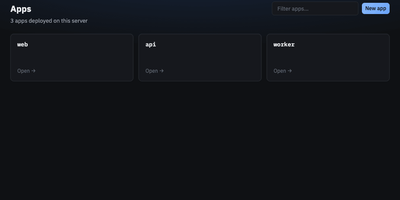
With over 32,000 GitHub stars and a decade of production use since 2013, Dokku is the original self-hosted Heroku alternative — a Docker-powered PaaS that turns any single Ubuntu server into a full application platform with a simple git push. Deploy applications written in Node.js, Python, Ruby, Go, Java, PHP, Scala, and Clojure using Heroku-compatible buildpacks, Cloud Native Buildpacks via pack-cli, standard Dockerfiles, or pre-built Docker images, with automatic language and framework detection handling the rest. Every deployment runs through zero-downtime checks that health-test new containers before routing traffic via the built-in Nginx reverse proxy, which handles virtual host configuration, WebSocket proxying, and HTTP/2 support automatically. The official plugin ecosystem provides managed datastores including PostgreSQL, MySQL, MariaDB, MongoDB, Redis, RabbitMQ, and Elasticsearch, each provisioned with a single CLI command and linked to apps via environment variables. Automated TLS certificates arrive through the Let's Encrypt plugin with auto-renewal, while persistent storage volumes, cron job scheduling, user ACL management, and process scaling round out the platform capabilities. The entire system is CLI-driven — no web dashboard — keeping resource overhead minimal enough to run multiple applications on a $5/month VPS. Dokku also supports Lambda function builds, custom builder plugins, and app.json-based healthcheck configuration for advanced deployment workflows. Running on a dedicated VPS on RepoCloud with guaranteed CPU, RAM, and SSD, full root SSH access, and a browser serial console. MIT licensed.
FreeLLMAPI
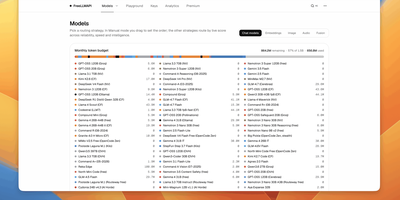
FreeLLMAPI collapses the chaos of 29 free LLM providers — Google AI, Cerebras, Groq, Mistral, OpenRouter, GitHub Models, Cohere, Cloudflare Workers AI, NVIDIA NIM, HuggingFace, SiliconFlow, Reka, Z.ai, and more — into a single /v1 endpoint that speaks both OpenAI and Anthropic protocols. The smart router selects the best available model for each request, automatically fails over to the next provider when rate limits hit, and tracks per-key token consumption so you never exceed a free-tier cap. Keys are stored with AES-256-GCM encryption and clients authenticate using a single unified bearer token, never exposing upstream provider credentials to downstream applications. The catalog tracks 251 model families across 358 provider/model endpoints with approximately 4 billion tokens per month of aggregate free-tier capacity, auto-refreshing from a signed manifest at freellmapi.co twice daily without requiring git pulls. Beyond chat completions, the proxy handles embedding, image generation, and audio/TTS endpoints, plus structured outputs with JSON schema forwarding, JSON healing, and format-ignore failover. An integrated MCP server at /mcp provides gateway introspection for coding agents, while the self-hosted OpenAPI reference at /v1/docs documents every route. Compatible with OpenAI SDKs, LangChain, LlamaIndex, Continue, Claude Code, and Hermes — just change base_url. Deploy via Docker, npm, or build from source. Running on a dedicated VPS on RepoCloud with guaranteed CPU, RAM, and SSD, full root SSH access, and a browser serial console. MIT licensed.
It Tools
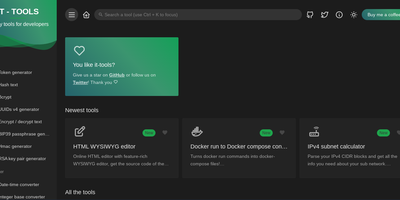
The utilities engineers otherwise scatter across a dozen ad-laden websites - 80+ of them - live together in IT-Tools, one fast, polished web app. Crypto covers JWT decoding, MD5 through SHA-512 hashing, HMAC and bcrypt generation, RSA key pairs, and password strength analysis. Converters handle JSON to CSV, YAML, and TOML, Base64 files, URL encoding, HTML entities, color formats, and Docker run commands to Compose files. Generators produce UUIDv4, ULID, BIP39 mnemonics, QR codes (including Wi-Fi QR), and tokens; text tools include a regex tester, diff viewer, slug and case converters; web utilities parse URLs and user agents, look up HTTP status codes and MIME types, and inspect Open Graph metadata; plus a cron parser, chmod calculator, and more. The privacy argument is the point: JWTs contain user IDs, hashes derive from passwords, JSON dumps hold PII - exactly the inputs you least want a third-party utility site to log. IT-Tools is a frontend-only static bundle (Vue/TypeScript, GPL-3.0, 39k+ GitHub stars) served by Nginx in one container, so everything runs client-side on your infrastructure with nothing transmitted anywhere. New tools ship roughly monthly, and a scaffolding script makes adding custom ones straightforward.
Personal Management System
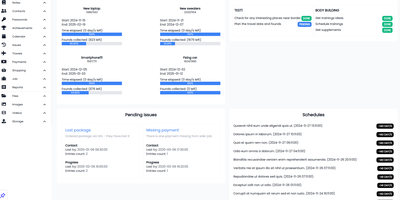
Consolidate daily to-do lists, encrypted passwords, household spending, contacts, and family photo galleries into Personal Management System, a self-hosted private command center for everyday life. Individuals can organize recurring schedules and calendar milestones with proactive notification alerts so important appointments, vehicle servicing dates, and recurring bill renewals are never overlooked. Users can balance household budgets and track expenditure across custom spending categories, calculating monthly cash flow balances while monitoring debts owed to friends or family members. Privacy-conscious users can safeguard account credentials inside an encrypted password vault featuring quick-copy buttons and secondary lock protection for sensitive personal entries. Goal setters can track multi-step personal targets and link financial milestones directly to dedicated savings pools. Home organizers can catalog contacts, log travel destinations with mapped imagery, and maintain categorized notes containing voice memos, bookmarks, and reference materials. Collectors can sort family photos and video recordings into interactive masonry galleries with built-in lightbox previews and file download tools. Running on a dedicated VPS on RepoCloud with guaranteed CPU, RAM, and SSD, full root SSH access, and a browser serial console. MIT licensed.
CubeJS
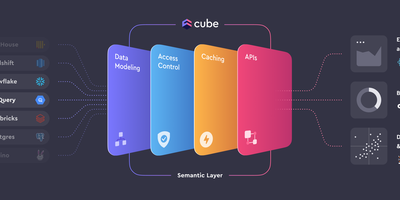
Between your databases and everything that consumes data - BI tools, embedded analytics, AI agents - sits Cube (formerly Cube.js), an open-source semantic layer. Metrics, dimensions, joins, and access rules are defined once as code in YAML, JavaScript, or Python, forming a governed data model that every downstream consumer shares, so "revenue" means the same thing in every dashboard. Caching is two-level: an in-memory cache absorbs bursts of identical queries, and declared pre-aggregations - rollup tables built in the warehouse or in Cube Store, Cube's distributed columnar engine, and refreshed in the background - deliver sub-second latency while cutting warehouse compute costs. The query planner routes each request to cache, rollup, or source automatically. Consumers connect through a Postgres-compatible SQL API (any tool that speaks Postgres works), plus REST, GraphQL, and a Meta API for model introspection. Row-level security and multi-tenancy are enforced in the layer itself, upstream of every client. Sources include Snowflake, BigQuery, Databricks, Postgres, MySQL, Presto, and Athena. Headless by design - bring your own UI.
Paperless-ngx
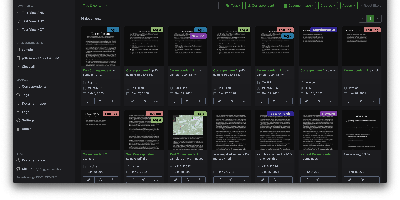
A pile of paper becomes a searchable digital archive under Paperless-ngx, the community-maintained document management system. The pipeline is what makes it work: drop a file into the consumption folder (or let it poll an email inbox), and a worker hashes it for duplicate detection, routes it by type, runs OCRmyPDF with Tesseract (100+ languages) on anything without a text layer, and produces an archivable PDF/A with invisible selectable text embedded - so Ctrl+F works on your scans. Then the smart part: a scikit-learn classifier (TF-IDF plus multi-label prediction) trained on your own tagged documents automatically assigns tags, correspondents, and document types to new arrivals, alongside rule-based exact, keyword, and regex matching for deterministic cases. Full-text search includes relevance ranking, match highlighting, autocomplete, and "more like this" similarity search. Apache Tika integration extends consumption to Word, Excel, PowerPoint, and LibreOffice formats. The Django/Angular app adds custom fields, saved views on a customizable dashboard, bulk editing, workflow automation triggered on upload or matching, shareable public links with expiration, and a robust permissions system with per-document access control. Metadata lives in PostgreSQL with Redis-queued Celery workers processing documents in parallel. Your tax records, invoices, and contracts stay on your server - searchable in seconds, never in someone else's cloud.
Plandex
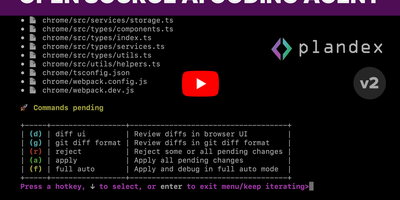
With 15,500 GitHub stars and over 1,100 forks, Plandex delivers a terminal-based AI coding agent purpose-built for the complex, multi-file tasks that overwhelm single-file AI assistants. The Go-powered server maintains a cumulative diff review sandbox that quarantines all AI-generated changes from your project files until you explicitly approve them — enabling 20-file refactors where you cherry-pick good changes and reject bad ones without touching git. A 2M token effective context window loads only what each step requires, while tree-sitter project maps index repositories exceeding 20M tokens across 30+ programming languages, providing structural awareness of class hierarchies, function signatures, and import graphs without burning tokens on full file content. The configurable model pack system assigns different models to different roles — Claude for planning, GPT for coding, Gemini for summarization — supporting Anthropic, OpenAI, Google, OpenRouter, Azure OpenAI, AWS Bedrock, DeepSeek, Perplexity, and Ollama for local models. Full auto mode handles end-to-end autonomous workflows including high-level planning, context loading, implementation, terminal command execution, and automated debugging of both terminal and browser applications. The interactive REPL provides fuzzy auto-complete, version-controlled sandbox branching, rewind to any previous point, and Git integration for commit message generation. The Plandex Server exposes 60+ REST API endpoints for programmatic orchestration across organizations, projects, plans, and branches. Deploy via Docker Compose for self-hosted operation with your own API keys. Running on a dedicated VPS on RepoCloud with guaranteed CPU, RAM, and SSD, full root SSH access, and a browser serial console. MIT licensed.
Hatchet
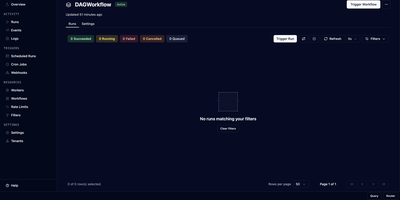
Processing over one billion tasks per month on Hatchet Cloud and holding 7,600+ GitHub stars, Hatchet is the open-source orchestration engine that replaces fragile legacy queues with durable, fault-tolerant task execution built entirely on PostgreSQL — no Redis, RabbitMQ, or Kafka required. Born from the creators' experience scaling Uber's Cadence-inspired patterns, the v1 engine achieves 10,000 tasks per second sustained throughput with 20ms average queue latency through dynamic buffer flushing and batch insert optimization. Define tasks, durable workflows, and DAG pipelines as code using native SDKs for Python, TypeScript, Go, and Ruby — every function gets automatic retries with configurable backoff, concurrency control with group round robin or cancellation policies, priority queuing, and dynamic rate limiting for third-party API protection. Durable execution persists the complete history of every task and state transition, enabling replay from failure, debugging via full event timelines, and complex pause/resume conditions using durable sleep and event waits. The real-time web dashboard provides workflow run visualization with DAG timeline rendering, worker health monitoring with slot utilization, queue depth metrics, task throughput charts, and error rate tracking — all filterable by status, workflow, or time window. OpenTelemetry integration and Prometheus metrics export enable advanced observability. Multi-tenant by default with users, roles, and namespace isolation. Self-host via Docker Compose with PostgreSQL and optional RabbitMQ, or use the single-container Hatchet Lite image for development. Running on a dedicated VPS on RepoCloud with guaranteed CPU, RAM, and SSD, full root SSH access, and a browser serial console. MIT licensed.
Kavita
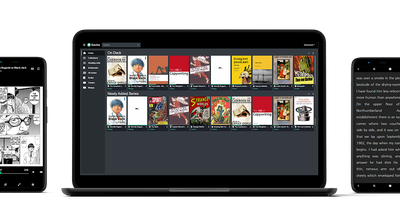
Manga, comics, ebooks, and light novels get a streaming-service-style home in Kavita - a fast, cross-platform reading server for the DRM-free collection you share with family and friends. It natively serves CBZ, CBR, CB7, ZIP/RAR/7z archives, raw images, EPUB, and PDF, with hand-crafted web readers per format: webtoon scrolling, single and dual-page spreads with advanced caching for the comic reader, and a book reader with adjustable fonts, spacing, margins, color themes, and column modes. Reading progress tracks per user, so everyone resumes exactly where they stopped on any device. Metadata parses from filenames, ComicInfo.xml, and EPUB fields, feeding index-backed search, smart filters, collections, reading lists with CBL import, and Want to Read queues. Role-based user management covers age restrictions, per-library access, and OIDC authentication. An OPDS feed connects third-party clients - Panels on iOS, Librera on Android, KOReader on e-ink devices - and a comprehensive REST API supports custom integrations. EPUB annotation and highlight support, custom theming, and full localization round it out. Built with .NET and Angular, it handles 50,000+ file libraries without strain; optional Kavita+ adds AniList scrobbling, recommendations, and external metadata.
Tolgee
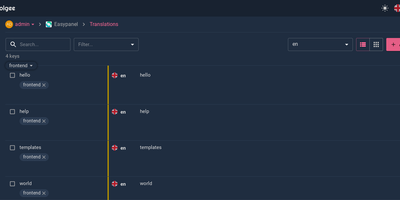
Hold Alt/Option, click any string in your running app, and edit the translation in place: Tolgee is an open-source localization platform built the way developers wish translation worked - changes save straight to the platform with no hunting through JSON or PO files. In-context editing works even in production via the Tolgee Tools browser extension, which injects credentials without touching source code, so a client or colleague with zero coding skills can translate the product inside the product. The SDKs (React, Angular, Vue, Svelte, plus iOS and Android) extract context from each UI element and capture one-click screenshots, giving both human translators and machines the surrounding meaning that raw string files lose. Autonomous translation uses that context: new keys are instantly filled from translation memory or machine translation (DeepL, Google Translate, AWS Translate), with optional human review afterward - shipping no longer waits on a translation agency. A CLI handles import/export, a REST API covers automation, a Figma plugin bridges design, and an MCP server lets AI coding assistants search keys, create translations, and trigger machine translation without leaving the editor. Self-hosting this Crowdin/Phrase/Lokalise alternative keeps every string, screenshot, and API key on your infrastructure.
LinkWarden
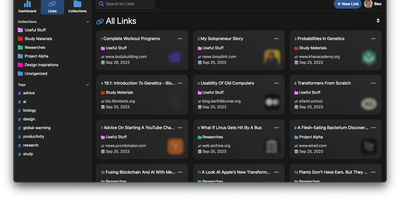
Links rot - the hard truth Linkwarden is built around, as a collaborative bookmark manager that preserves what it saves. Every page you save is fully preserved - a screenshot, a PDF, a self-contained single-file HTML archive (generated by the Monolith Rust binary), and a clean reader view - so the content survives even after the original site disappears. Think of it as a private Wayback Machine you own, with an optional one-click snapshot to archive.org on top. The reading experience matches the archival rigor: a distraction- free reader view supports text highlighting and annotation, and full-text search across everything you have saved is powered by Meilisearch. Optional AI tagging analyzes page content and auto-assigns tags - generate new ones, pick from your existing set, or constrain to predefined tags - with providers ranging from local Ollama models (fully private) to OpenAI, Anthropic, and OpenRouter. Organization is collections, sub-collections, and multiple tags per link; teams collaborate on shared collections with per-member permissions, and public collections share curated link sets (with preserved copies) to anyone. The stack is Next.js/React on TypeScript with PostgreSQL via Prisma, NextAuth supporting credentials, OAuth2, and SAML SSO, and a Playwright-driven headless Chromium worker doing the capture. Native iOS and Android apps and browser extensions feed it from anywhere.
Agent Zero
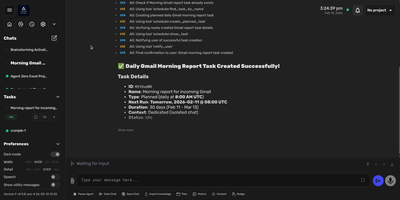
Agent Zero equips large language models with a persistent virtual Linux desktop, letting autonomous AI agents write code, research the web, and execute multistep tasks without supervision. Operating within an isolated container, the system opens an interactive XFCE graphical desktop in your browser canvas where the agent interacts with GUI applications like Blender and terminal sessions directly. Its embedded browser features interactive annotation tools, letting you click web elements to inspect stylesheet hierarchies, extract component markup, or submit automated testing instructions. You can cowork on spreadsheets, presentations, and Markdown specifications in real time alongside the agent, preserving document revisions through snapshot time travel. A multi-tier memory architecture backed by FAISS vector indexing and SearXNG web discovery retains problem-solving context across projects, while hierarchical delegation spins up specialized subordinate agents to parallelize complex engineering audits. The platform connects seamlessly to commercial LLMs via OpenAI, Anthropic, or OpenRouter, runs private local models through Ollama, and integrates custom toolkits via the Model Context Protocol and community Plugin Hub. Running on a dedicated VPS on RepoCloud with guaranteed CPU, RAM, and SSD, full root SSH access, and a browser serial console. MIT licensed.
Zitadel
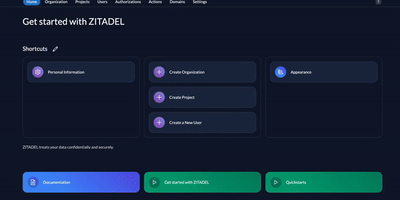
Securing a SaaS product, running B2B onboarding, or replacing Auth0 and Keycloak with a stack they own - teams needing more than basic auth reach for ZITADEL, an open-source identity and access management platform built in Go. Its multi-tenancy model is the differentiator: a strict Instance, Organization, Project hierarchy isolates data and scopes policy at each level, with identity brokering (pre-built templates for Google, GitHub, Microsoft, Apple, plus generic OIDC, OAuth, SAML, and LDAP), domain discovery that routes users to the right organization by email domain, and delegated management so customers administer their own users and roles. Authentication covers OpenID Connect (certified, including device authorization and token exchange), SAML 2.0 as both IdP and SP, SCIM, FIDO2 passkeys for phishing-resistant passwordless login, and MFA via OTP, email, SMS, and U2F; machine-to-machine flows support JWT profile, PATs, and client credentials. The architecture is event-sourced - every mutation is an immutable event, yielding a complete audit trail - with relational projections for queries and no external session store, so it scales horizontally. API-first with gRPC and REST, extensible via Actions webhooks, and the same codebase self-hosted (Docker Compose or Helm on PostgreSQL) as in the cloud.
Puter
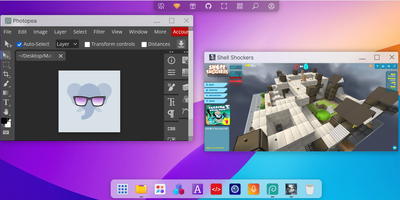
Puter delivers a complete cloud operating system that runs entirely in the browser — turning any device with internet access into a full-featured personal computer with desktop environment, file management, application hosting, and developer platform. The familiar desktop interface presents windows, taskbar, right-click menus, drag-and-drop, and multi-window management indistinguishable from native operating systems. The hierarchical filesystem supports file creation, uploads, sharing, permissions, and trash recovery with storage backends ranging from local SQLite for self-hosting to S3 and DynamoDB for production scale. Built-in AI integration provides access to GPT-4, Claude, and other models directly from the desktop for text generation, code assistance, and image creation. The developer platform offers a JavaScript SDK, REST APIs, cloud storage, key-value database, and serverless workers for building and hosting web applications without managing infrastructure. Sandboxed applications run in iframes with IPC communication and permission-based access to filesystem, AI, and system services. The app store enables publishing, discovering, and monetizing applications built on the Puter platform. Website hosting publishes static sites with custom domains directly from the file manager. Multi-user support provides individual accounts with authentication, resource isolation, and sharing capabilities. Deploy via Docker with a single command, Docker Compose for production, or npm for development — the one-line install script handles everything automatically on Linux, macOS, and Windows. Running on a dedicated VPS on RepoCloud with guaranteed CPU, RAM, and SSD, full root SSH access, and a browser serial console. AGPL-3.0 licensed.
Passbolt
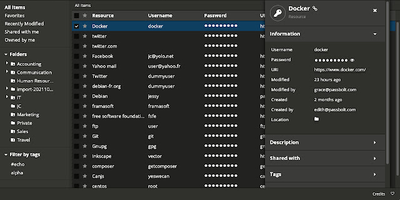
Security-conscious IT departments pick Passbolt for its cryptography: every user holds an OpenPGP key pair, and shared credentials are encrypted individually to each recipient's public key - real end-to-end encryption, not a vault password handed around. All crypto runs client-side in the mandatory browser extension (distributed and signed through the Chrome and Firefox stores, deliberately separating the crypto code from the server that stores ciphertext); private keys and passphrases never touch your instance, and the server admin cannot read a single secret. Authentication uses the challenge-based GpgAuth protocol, secrets are digitally signed to verify sender integrity, and metadata encryption extends protection to resource names and URLs. Day to day it behaves like a polished commercial manager: auto-fill and auto-save in forms, strong password generation, anti-phishing protection, TOTP storage, folder hierarchies shared per-user or per-group with fine-grained permissions and instant cryptographic revocation. Native iOS, Android, and desktop apps ship alongside a JSON API, CLI, and SDKs for CI/CD secret retrieval and rotation. The PHP server runs on MariaDB and is AGPL-licensed open source - including the paid tiers' codebase - with published security audits.