eLabFTW
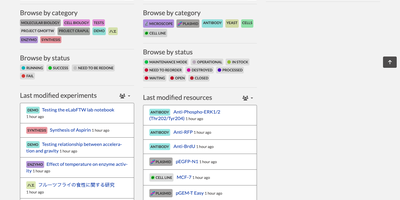
For research teams that need to show what was recorded and when, eLabFTW® is an electronic lab notebook that keeps experiments, lab inventory, and equipment bookings in one shared, searchable system. Each experiment holds rich-text notes, tables, images, checkable steps, custom metadata fields, tags, statuses, and attached files. Templates turn a protocol you repeat into a one-click starting point. A separate resource database catalogs antibodies, plasmids, cell lines, chemicals, and instruments, and typing # in an experiment links straight to any of them. Compounds import from PubChem by CID or CAS number, arriving with formulas, identifiers, and hazard data. The inventory tree maps buildings and their sub-locations, records where each container is stored, and tracks quantity and unit. Book a microscope by dragging a slot on the scheduler, and permissions decide who may reserve what. Entries can be signed with Ed25519 keys and timestamped through RFC 3161 authorities such as DFN, Digicert, and GlobalSign, or anchored on the Bloxberg blockchain; a timestamp archive can never be edited or deleted. Export to PDF, ZIP, CSV, JSON, or .eln archives, and import .eln or CSV files when moving from spreadsheets or another notebook. Users sign in locally or through SAML2 or LDAP, and an API with per-user keys lets instruments and scripts read and write entries. Running on a dedicated VPS on RepoCloud with guaranteed CPU, RAM, and SSD, full root SSH access, and a browser serial console. AGPL-3.0 licensed.
Dataverse
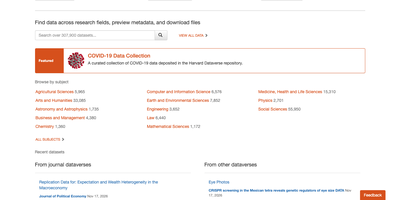
A shared drive full of spreadsheets is not a research data archive; Dataverse is repository software that gives each dataset a citable page, metadata, versions, and a permanent identifier. Universities, libraries, and research groups arrange holdings in nested collections, each with its own branding, featured subcollections, and search facets. Metadata comes from citation, geospatial, social science, astronomy, and life sciences blocks, and administrators add custom fields and controlled vocabularies without writing code. Publishing assigns a DOI through DataCite or Crossref, or a Handle or PermaLink, and each dataset shows a formatted citation with download counts and Make Data Count statistics. Tabular files in CSV, Excel, SPSS, Stata, R, and SAS formats are ingested with variable-level metadata. Previewers show images, text, spreadsheets, maps, and notebooks on the page. Every published change creates a new version, and a versions table lets readers move between them. Roles reach down to individual files, with restricted files and access requests, embargoes, guestbooks, terms of use, and anonymous preview links for peer reviewers. Records export as DDI, Dublin Core, DataCite, schema.org JSON-LD, and Croissant, and OAI-PMH lets installations harvest one another. Deposits can be automated through a REST API, SWORD, and client libraries for Python, R, and Java. Integrations reach Jupyter, Globus, DataLad, and OJS. Running on a dedicated VPS on RepoCloud with guaranteed CPU, RAM, and SSD, full root SSH access, and a browser serial console. Apache-2.0 licensed.
InvenioRDM
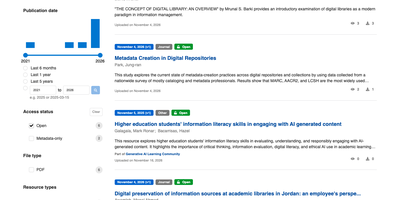
InvenioRDM is an open-source repository platform where researchers deposit datasets, papers, software, and other outputs, and institutions curate and publish them with persistent identifiers. The upload form collects files and descriptive metadata, lets depositors pick a community, and sets access to open, restricted, or embargoed with an automatic release date. Records can be restricted entirely or only their files, shared with reviewers through secret links, or published as metadata-only entries that point to files hosted elsewhere. Communities give groups their own space with a logo, custom pages, and member roles such as managers and curators, while submitted drafts open a review request that curators accept or decline. Requests also cover access to restricted files, membership invitations, and record deletion, each with comment conversations that render LaTeX equations. DOIs are registered through DataCite, authors and institutions are identified by ORCID and ROR, and metadata can be exported as DataCite JSON or XML, Dublin Core, or CSL JSON. An OAI-PMH server supports harvesting, and a versioned REST API covers every repository operation. Visitors get faceted search, advanced query syntax, search-as-you-type, previews for PDF, image, CSV, Markdown, XML, and JSON files, and citation strings in more than 800 styles. Administrators can change the theme, menus, and vocabularies, add custom fields, connect single sign-on, and store files locally or on S3-compatible storage with per-user quotas. Running on a dedicated VPS on RepoCloud with guaranteed CPU, RAM, and SSD, full root SSH access, and a browser serial console. MIT licensed.

DSpace
With DSpace, a library or research office can give every thesis, journal article, and dataset its own permanent web address, a searchable metadata record, and files visitors download from the archive. Content sits in a tree of communities and collections, and each collection decides who may deposit and how many review steps follow; reviewers accept a submission or reject it with a note that sends it back to the author. Embargoes hold files back until a set date, access policies limit other files to chosen groups, and sign-in works through LDAP, Shibboleth, SAML, OpenID Connect, or ORCID. Search covers metadata and the extracted full text of uploaded files, facets narrow the results, and browse pages sort by title, issue date, author, or subject. Editors can correct a published item through the submission form. Administrators inspect an audit trail and rewrite homepage news from an admin form. Entity types for people, organizations, projects, journals, and datasets link each publication to the work behind it, and DOIs can be registered through Crossref. Optional settings let authors keep an email address private on their researcher profile and download their own restricted files. Usage reports count visits, downloads, and top countries per item. REST, OAI-PMH, SWORD, and Google Scholar metadata connect the archive to harvesters, deposit tools, and search engines. Running on a dedicated VPS on RepoCloud with guaranteed CPU, RAM, and SSD, full root SSH access, and a browser serial console. BSD-3-Clause licensed.