
Shlink
With over 5,100 GitHub stars and eight years of active development since 2016, Shlink has become the definitive self-hosted URL shortener for teams that need unlimited links, full visitor analytics, and complete data ownership without per-link pricing or monthly caps. The PHP backend built on the Mezzio framework with Doctrine ORM serves redirects through any number of custom domains on a single instance, generating unique short codes or accepting custom slugs including multi-segment paths and emoji characters. Every click is tracked with anonymized visitor data including geolocation by country, city, and coordinates, browser and operating system identification, referrer source, and device type classification, all stored in your choice of MySQL, MariaDB, PostgreSQL, Microsoft SQL Server, or SQLite. Dynamic redirect rules route visitors to different destinations based on geolocation, device type, or browser language, enabling targeted campaigns from a single short URL. The REST API exposes every operation with OpenAPI documentation and an interactive sandbox at api-spec.shlink.io, while the CLI provides equivalent functionality for scripting and automation. The official progressive web app at app.shlink.io manages multiple Shlink instances from a single interface with URL creation, tag management, and detailed visit charts. Real-time event integration supports both Mercure and RabbitMQ for webhook-style notifications on new visits. Third-party imports migrate existing short URLs from Bitly and YOURLS with visit history preserved. Running on a dedicated VPS on RepoCloud with guaranteed CPU, RAM, and SSD, full root SSH access, and a browser serial console. MIT licensed.
Poweradmin
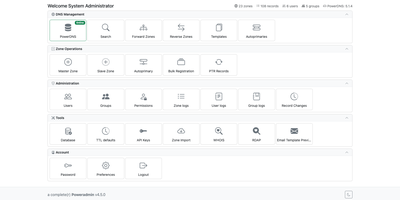
PowerDNS answers the queries; Poweradmin gives you a browser-based control panel for its zones, records, DNSSEC keys, and users, with a REST API for automation. Create master, native, and slave zones, and let zone templates stamp predefined record sets onto new ones. Edit records inline with filters, or open the optional Record Wizard for DMARC, SPF, DKIM, CAA, TLSA, and SRV. Reverse zones link to their forward zones. The batch PTR tool fills whole network ranges, bulk add takes one CSV line per record, and secondary zones can be imported over AXFR. For DNSSEC, manage keys and copy DS and DNSKEY records for your registrar; changes are applied or rectified through the PowerDNS API so signed zones stay consistent. Every record and zone edit is logged with before and after snapshots, and the logs can be filtered and exported. The panel is translated into 43 languages, including right-to-left ones. Permission templates, users, and groups control who touches which zones, sign-in works through LDAP, OIDC, or SAML, and administrators can switch on authenticator-app or email two-factor codes. API keys can be read-only, limited to chosen operations, or restricted to specific zones, and companion projects link Terraform, ExternalDNS, cert-manager, and Certbot. Dynamic DNS clients such as ddclient and inadyn update records through a dyndns2-compatible endpoint. Running on a dedicated VPS on RepoCloud with guaranteed CPU, RAM, and SSD, full root SSH access, and a browser serial console. GPL-3.0 licensed.
Fusio
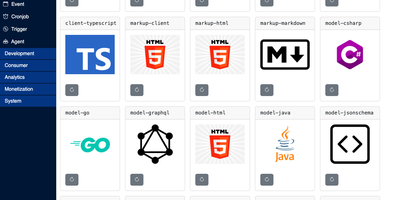
Fusio turns the data and services you already run into a managed API that partners, apps, and AI agents can actually use. The workflow starts small: add a database connection and a table becomes a REST endpoint, or proxy a remote service and route traffic between internal microservices. Each operation pairs an HTTP path with an action and a schema, so requests are validated and an OpenAPI specification plus client SDKs for major languages come out without extra effort. Custom behavior lives in reusable actions, and an AI assistant can draft actions and schemas from a plain-language prompt. Native Model Context Protocol support then offers those actions to autonomous agents as tools. Third-party developers get a self-service portal with documentation, testing tools, and their own keys. Every endpoint can be protected with scopes and rate limits. Asynchronous work runs through events, webhooks, cronjobs, and triggers. When the API becomes a product, plans, quotas, and transactions handle billing, and analytics follow usage, performance, and errors. A marketplace installs ready-made actions and apps, and the generator and test panels speed up development. Running on a dedicated VPS on RepoCloud with guaranteed CPU, RAM, and SSD, full root SSH access, and a browser serial console. Apache-2.0 licensed.

Spree
Spree Commerce provides a complete headless ecommerce backend where products, orders, payments, and promotions are managed through typed REST APIs with OpenAPI 3.0 specs and TypeScript SDKs providing autocomplete and type safety. Fifteen years of production history and 15,600+ GitHub stars back a mature ecosystem that ships a production-ready Next.js 16 storefront built with React 19 and Tailwind CSS 4, including multi-region URL routing and Stripe payments supporting Apple Pay, Google Pay, Klarna, and Affirm. Sales Channels model distinct contexts from a single instance: DTC storefronts, wholesale portals, mobile apps, and point-of-sale terminals, each with its own catalog, pricing, and checkout flow. The rules-based promotion engine supports coupon codes, multi-condition discounts, gift cards, and digital product fulfillment. Multi-warehouse inventory tracks stock across locations in real time with reservations and advanced order routing that splits shipments across fulfillment centers. B2B capabilities include customer-specific price lists, storefront access gating, wholesale portals with approval workflows, and quick order forms. The admin dashboard built with Tailwind CSS provides role-based permissions, product management, order processing with refunds, and scaffold generators for custom pages. BSD 3-Clause licensed with zero platform or transaction fees. Running on a dedicated VPS on RepoCloud with guaranteed CPU, RAM, and SSD, full root SSH access, and a browser serial console.
Traduora
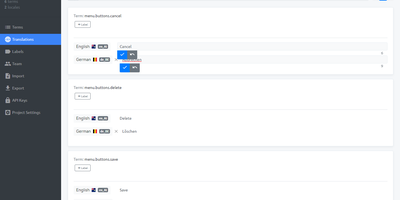
Teams that ship one app in many languages keep every string, translator, and reviewer in a single workspace by hosting their own Traduora translation management platform. Developers import the files they already have: JSON, YAML, PO, XLIFF, CSV, Android XML, iOS Strings, Java properties, PHP array, or RESX. Each string becomes a term that can carry a context note and colored labels. A search bar and a label filter narrow long lists in seconds. Translators open a locale and type inline beside a reference language, with per-locale progress showing how much is finished and a toggle that hides what is already done. Colleagues join by email invitation as admins, editors, or viewers, with optional Google sign-in. Build pipelines get their own API clients, each with a role, to fetch and push translations over a REST API. Exports go back out in whichever format each platform wants, with fallback-locale and untranslated-key options. Mobile and web teams can keep iOS, Android, and website copy in sync from a single source of truth. Running on a dedicated VPS on RepoCloud with guaranteed CPU, RAM, and SSD, full root SSH access, and a browser serial console. AGPL-3.0 licensed.
Sylius
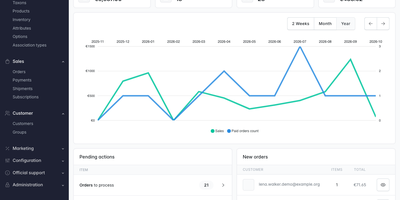
One install, many shops: Sylius runs separate storefronts with their own languages, currencies, and countries from a single admin panel. Products are simple or configurable. Define a size option, generate variants from S through XXL, and track stock per variant. Attributes, translations, and a nested taxon tree keep the catalog organized. Prices are set per channel. Catalog promotions add sale badges and struck-through prices. Cart promotions pair rules, like a minimum item total, with actions, like a fixed order discount, optionally behind coupon codes. Shipping methods carry delivery windows, zone eligibility, and shipping and tax categories. Order pages show items, shipping, taxes, promotions, payment state, and customer details. The dashboard charts sales and paid orders over time and lists pending work. A ready-made storefront covers product pages, a cart, checkout with address, shipping, payment, and review steps, customer accounts with order history, and product reviews. Custom frontends talk to separate shop and admin REST APIs, documented in OpenAPI. Every enabled locale adds a translation section to products, taxons, shipping methods, and promotions. Running on a dedicated VPS on RepoCloud with guaranteed CPU, RAM, and SSD, full root SSH access, and a browser serial console. MIT licensed.