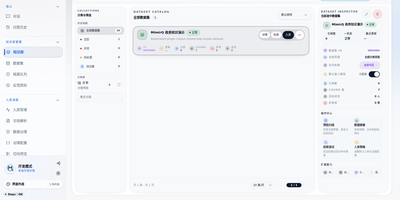
MimirQ
When a knowledge base gives a wrong answer, MimirQ shows which stage let it down. Documents move through a pipeline that teams can open at every step: parsing, cleaning, chunking, indexing, retrieval, reranking, and cited answers. A dataset catalog tracks documents, chunks, and ingestion status, and an execution monitor charts throughput, retries, parser queues, and run logs. The governance workbench previews each file, scores quality, and supports cleaning and labeling before chunks are cut by headings, records, or parent-child structure. Retrieval blends keyword and vector search with reranking, and every reply lists its source evidence with feedback scoring. A graph view maps entities, events, and relationships on one canvas for exploration. Golden-set evaluation stores standard questions and answers, runs them against the current pipeline, and reports recall and ranking metrics, so a release can be blocked when quality slips. Settings pages manage model providers, parsers, and retrieval options, and a Dify-compatible external knowledge API lets existing workflows call it. Role-based access and document permissions keep restricted material hidden from the wrong users. Running on a dedicated VPS on RepoCloud with guaranteed CPU, RAM, and SSD, full root SSH access, and a browser serial console. Apache-2.0 licensed.
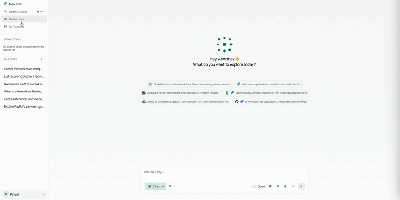
PipesHub
Unify fragmented corporate knowledge across chat channels, documents, and cloud drives with PipesHub, an open-source workplace context platform providing permission-aware search and verifiable answers for teams and autonomous agents. Employees can query enterprise knowledge bases through a conversational interface that retrieves relevant information across Google Workspace, Microsoft 365, Slack, Confluence, Jira, and GitHub while strictly respecting individual user access permissions. Knowledge workers can verify every answer through clickable citation blocks that trace claims directly back to source documents, spreadsheet rows, or chat messages. Teams can assemble custom AI agents visually using a drag-and-drop builder, combining retrieval collections with interactive toolsets to automate multi-step operations like drafting customer responses or creating issue tickets. Autonomous agents connect via Model Context Protocol to inspect shared company knowledge and perform external actions across connected SaaS tools. Organizations can index scanned PDFs, slide decks, markdown pages, and spreadsheets with OCR and document parsing, maintaining synchronized records through automated schedules. Administrators can inspect synchronized records, monitor query history, and manage connector credentials across all integrated business applications. Running on a dedicated VPS on RepoCloud with guaranteed CPU, RAM, and SSD, full root SSH access, and a browser serial console. Apache License 2.0 licensed.
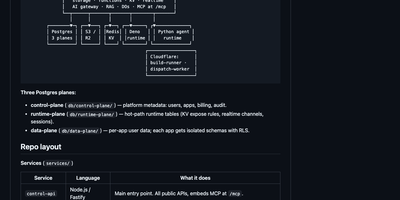
Butterbase
Butterbase gives AI applications a complete backend they can run themselves, from a dedicated PostgreSQL database for every app to an MCP server that lets agents operate that backend directly. Define schemas declaratively, apply migrations, protect rows with Row-Level Security policies, and call the generated REST endpoints without building a separate data API. Add email and OAuth sign-in with Google, GitHub, Apple, X, and other providers, then tune JWT behavior, post-login hooks, service keys, and API keys for each application. Store files in S3 or R2 compatible object storage with presigned URLs and access controls, and keep regional key-value data with TTLs and an audit trail. Run TypeScript functions on Deno, coordinate chat rooms or rate limiters as durable per-key objects, and stream table changes to live interfaces over WebSocket subscriptions. Route chat and embedding calls through one AI gateway, ingest documents into RAG collections, and build checkpointed agent workflows that can pause for human approval before continuing. Host static frontends and edge handlers, expose webhooks for application events, and manage schemas, storage, functions, realtime channels, and integrations through more than forty MCP tools. Running on a dedicated VPS on RepoCloud with guaranteed CPU, RAM, and SSD, full root SSH access, and a browser serial console. Apache-2.0 licensed.
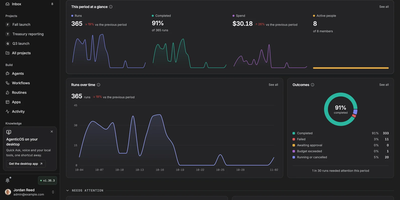
Agenticos
Give each team an AI teammate that works where the team already works: AgenticOS lets colleagues and agents share one live chat and the same project files, so an agent can answer in the thread, apply a correction from a reply, and show its work as it writes. You build an agent in the browser by writing its instructions, picking a model, and switching on tools, then publish it to web chat, Slack, Teams, Discord, Mattermost, Telegram, a website widget, or an API. Agents analyze spreadsheets, run code in a sandbox, browse the web in a browser you can watch and take over, and hand programming work to Claude Code or Codex. Company knowledge comes from uploaded documents and synced drives, searched with cited answers, while reusable skills teach agents how your team writes reports, reviews code, or researches a market. Agents can draw charts and diagrams in chat and publish dashboards as apps with stable links your team opens anywhere. Administrators set roles and department groups, cap each agent's monthly budget, require approval for sensitive tools, and read a recorded run history with costs. Running on a dedicated VPS on RepoCloud with guaranteed CPU, RAM, and SSD, full root SSH access, and a browser serial console. Apache-2.0 licensed.
Utopia
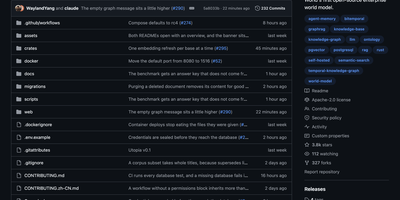
The first open-source substrate for enterprise knowledge engineering that learns passively and governs itself. The Rust-built backend paired with PostgreSQL and pgvector delivers a bitemporal knowledge graph where every fact carries two timelines: when it held in the real world and when the system came to believe it — enabling full audit trail replay of how understanding evolved. Document ingestion handles PDF, DOCX, PPTX, XLSX, CSV, Markdown, HTML, and plain text with legacy encoding detection, while scheduled syncing pulls from web pages, RSS feeds, GitHub, Jira, Notion, WebDAV, and S3-compatible buckets. Search fuses Tantivy full-text indexing with pgvector semantic vectors using Reciprocal Rank Fusion, streaming answers with inline citations that link directly to source passages. The built-in agent harness drives agentic RAG through conversation — searching documents, walking the knowledge graph at any historical date, and querying mounted databases via Ontology2SQL which achieves state-of-the-art results on BIRD Mini-Dev benchmarks. Five ontology packs ship inside the binary (schema.org, W3C Org, PROV-O, FOAF, IOF Core) with forward-chaining reasoning for transitivity, symmetry, inverses, and relation hierarchy. Entity resolution operates in three stages: exact name matching, embedding similarity, then model-based judgment with every merge reversible. Any OpenAI-compatible endpoint works including DeepSeek, Qwen, Ollama, and vLLM for fully air-gapped deployment. Running on a dedicated VPS on RepoCloud with guaranteed CPU, RAM, and SSD, full root SSH access, and a browser serial console. Apache-2.0 licensed.
OpenViking
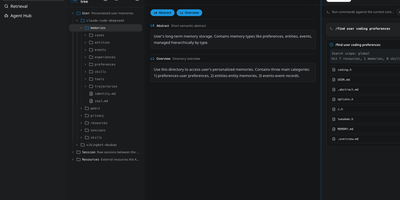
OpenViking is a self-hosted context database that gives AI agents persistent, structured memory by organizing knowledge, skills, and session history into a hierarchical virtual filesystem accessible through the viking:// URI protocol. Instead of dumping everything into a flat vector store and hoping semantic search finds the right chunks, agents navigate their context with familiar commands like ls, tree, and find, locating exactly the information they need through deterministic paths combined with semantic search. Every resource is automatically processed into three layers: a 100-token L0 abstract for quick filtering, a 2,000-token L1 overview for content navigation, and the full L2 detail loaded only when confirmed necessary. This tiered approach cuts token consumption by 83 to 96 percent compared to conventional RAG while improving task completion rates by 15 to 49 percent on benchmark tests. The built-in memory self-iteration loop automatically analyzes task execution and user feedback, updating agent memory directories so the system continuously learns and improves. You can connect to any LLM provider, including Ollama for fully local inference, OpenAI, or compatible gateways. The Web Studio UI at the /studio endpoint provides visual browsing of the entire context filesystem, and the REST API on port 1933 supports programmatic access. Deploy via Docker, Kubernetes with the included Helm chart, or as a standalone service. Running on a dedicated VPS on RepoCloud with guaranteed CPU, RAM, and SSD, full root SSH access, and a browser serial console. AGPL-3.0 licensed.
Yuxi
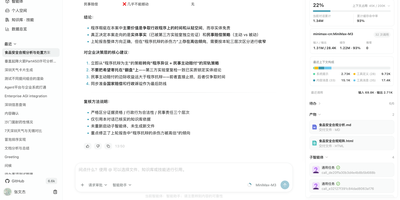
Navigating organizational knowledge, visualizing concept graphs, and orchestrating cooperative AI agents converge inside Yuxi, an open-source multi-tenant workspace built for enterprise research and deep archive exploration. Users can upload diverse business documents including scanned PDFs, spreadsheets, and slide presentations to automatically extract structured text blocks, tables, and entity relationships for semantic querying. Knowledge teams can inspect interactive topological graph views to explore connections between company entities, cross-referencing subgraphs against original file sources. Practitioners can configure autonomous agents with specialized subagents, assigning dedicated roles for concurrent research, deep data synthesis, and code execution. Human reviewers can inspect agent thought chains in real time and evaluate interactive confirmation cards before agents execute irreversible external actions or modify shared workspace files. Operators can execute sandboxed tasks that produce downloadable reports, interactive data charts, and rendered HTML pages stored within isolated workspace file systems. Administrators can govern model endpoints, set granular permission boundaries across departments, and monitor token consumption through live system analytics. Running on a dedicated VPS on RepoCloud with guaranteed CPU, RAM, and SSD, full root SSH access, and a browser serial console. MIT licensed.
Atomic
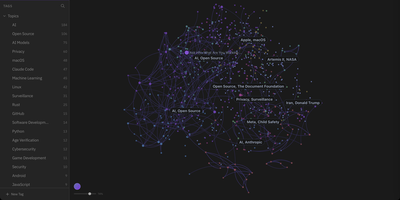
Atomic transforms collections of personal Markdown notes into an AI-augmented knowledge graph by breaking documents down into semantically linked conceptual units. Users capture thoughts, research excerpts, and web clippings as modular notes that the system automatically chunks, embeds, and categorizes with hierarchical tags. An interactive force-directed canvas maps out the entire knowledge base, positioning related ideas closer together based on embedding cosine similarity rather than manual folder hierarchies. Built-in vector search queries across text embeddings directly within SQLite, retrieving precise contextual snippets in response to natural language prompts. The automated wiki engine synthesizes disparate notes into comprehensive reference articles equipped with verifiable inline citations back to original source materials. Integrated conversational agents leverage retrieved knowledge context to answer research questions, surface contradictions across past entries, and draft structured daily briefings. External AI tools can read, search, and update stored knowledge through an embedded Model Context Protocol server endpoint. Running on a dedicated VPS on RepoCloud with guaranteed CPU, RAM, and SSD, full root SSH access, and a browser serial console. MIT licensed.
Hindsight
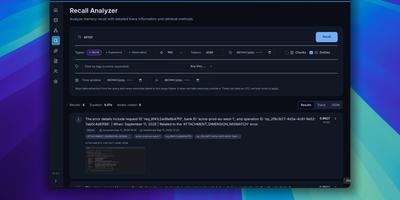
Memory that survives the session: Hindsight extracts facts, entities, and timestamps from everything an AI agent retains, then lets the agent search or reason over it later. Adding it to an existing LLM client takes a two-line wrapper, and more than 60 integrations cover Claude Code, Cursor, LangGraph, CrewAI, and n8n. Every bank also exposes its own MCP endpoint. Retain sends text, images, or files through an LLM that extracts facts, timestamps, entities, and relationships. Recall runs semantic, keyword, graph, and temporal searches in parallel, merges them with reciprocal rank fusion, reranks with a cross-encoder, and trims to a token budget. Reflect reasons across memories for questions that need synthesis, shaped by per-bank skepticism, literalism, and empathy traits. In the background, related facts consolidate into observations that keep exact quotes and proof counts and are refined, never silently overwritten. Mental models and wiki-style knowledge pages hold standing answers that rewrite themselves as the bank learns. Each user, agent, or project gets an isolated bank with no cross-bank leakage, and Memory Defense redacts or blocks secrets and PII against 45 patterns. The Control Plane adds a Recall Analyzer with traces, a memory constellation graph, and a knowledge page editor. Extraction and reasoning can run on 25+ LLM providers, including local Ollama and llama.cpp. Running on a dedicated VPS on RepoCloud with guaranteed CPU, RAM, and SSD, full root SSH access, and a browser serial console. MIT licensed.
Paperless-AI
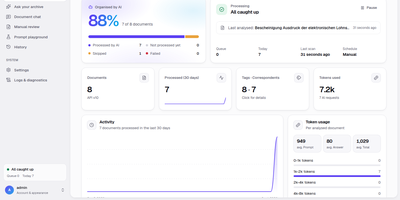
Paperless-AI reads every new scan that lands in your Paperless-ngx archive and fills in the title, tags, correspondent, document type, date, and custom fields so you stop doing it by hand. A dashboard tracks the processing queue, coverage, activity, and token usage. Ask your archive questions like "when did I sign my rental agreement" and get streamed answers with numbered citations that link back to the documents. Hybrid keyword and semantic search finds passages across thousands of pages, and follow-up questions keep their context. Manual Review shows the AI's suggestions beside the current values so you decide what to save. A prompt playground tests wording on real documents, and a history page with undo restores the original values in Paperless. Choose OpenAI, Claude, Ollama, Azure, or any OpenAI-compatible endpoint, and a workflow webhook processes documents the moment they arrive. A command menu jumps between pages, and light and dark themes come with five accent colours. Running on a dedicated VPS on RepoCloud with guaranteed CPU, RAM, and SSD, full root SSH access, and a browser serial console. MIT licensed.
Khoj
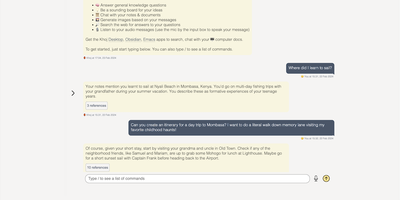
A self-hosted "second brain": Khoj indexes your own files and answers questions from them, parsing Markdown (whole Obsidian vaults included), org-mode, PDF, Word, plain text, Notion pages, GitHub repositories, and images described by a vision model, then embedding everything with sentence-transformers into a vector index for semantic search and RAG with cited sources. Any LLM backend works: local models like Llama, Qwen, or Mistral via Ollama, or cloud models like GPT, Claude, and Gemini. You can build custom agents, each with its own persona, scoped knowledge base, chat model, and tools such as web search and code execution. Scheduled automations run recurring research and deliver newsletters or notifications to your inbox, and research mode performs multi-hop web searches with inline citations. Access it from a browser, the Obsidian plugin, Emacs, desktop, or WhatsApp - all clients connect to the same self-hosted instance, making Khoj one of the few AI assistants Emacs users can point at decades of org files. Semantic search means recall works without exact keywords: "that paper about forecasting with transformers" surfaces the right PDF even when you cannot remember its title. Switching LLM backends never requires re-indexing your documents, and with a local model via Ollama, even inference stays on hardware you control - journals, research, and private notes are never sent anywhere. Python/FastAPI stack, AGPL-licensed, with PostgreSQL storage.
Arkon
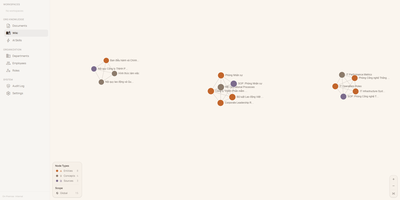
With 1,200+ GitHub stars since its April 2026 launch, Arkon provides an enterprise-grade knowledge management layer that turns scattered organizational documentation into AI-accessible structured context. The platform runs as a centralized MCP server, compiling your SOPs, policies, technical docs, and institutional knowledge into a versioned wiki with draft-approval workflows, then serving that wiki to Claude Desktop, Claude.ai, Cursor, and any MCP-compatible client through a single permission-scoped endpoint. OAuth 2.1 with PKCE authentication eliminates manual token management — employees authenticate through a browser login while the system discovers endpoints automatically via RFC 8414. The RBAC v2 system supports custom roles with granular permissions, department-scoped AI Skills, workspace isolation, and comprehensive audit logging so every query and access event is traceable. RAG retrieval powered by pgvector embeddings enables AI clients to search across all organizational documents with source attribution, while the AI Skills system lets teams define reusable instruction sets scoped to specific departments or roles. The architecture runs seven Docker containers coordinated by Compose: PostgreSQL with pgvector for embeddings and metadata, Redis for caching, MinIO for document storage, a FastAPI backend, two ARQ async workers for embedding generation and document processing, and a Next.js frontend portal accessible on port 3119. API keys are encrypted at rest with Fernet, and no telemetry leaves the deployment. Running on a dedicated VPS on RepoCloud with guaranteed CPU, RAM, and SSD, full root SSH access, and a browser serial console. PolyForm Internal Use licensed.
DB-GPT
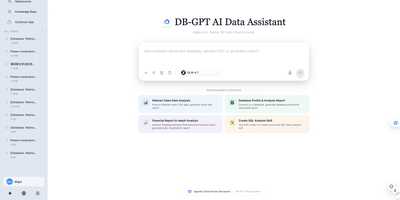
DB-GPT lets a team talk to its data: ask a business question in plain English, and an AI agent plans the work, writes the SQL, runs it, and hands back charts and a written report. Connect MySQL, PostgreSQL, SQL Server, ClickHouse, DuckDB, Doris, StarRocks, or MaxCompute, or drop in CSV and Excel files, including several at once. Every step appears in a live task view with its query, result table, code, and console output, and the agent pauses to ask clarifying questions, with answer options, when the data cannot settle the matter. Reusable skills package proven procedures, including CSV analysis, SQL analysis, and financial report analysis, and a skill creator helps write new ones. Code executes in a sandbox, parallel sub-agents split larger jobs, and an agentic knowledge-base search answers questions over uploaded documents. Scheduled tasks run saved conversations on a cron timetable with on/off switches and execution history, while MCP connectors link tools like Notion, Linear, Tavily, and GitHub. Pick OpenAI, DeepSeek, Qwen, SiliconFlow, Ollama, or vLLM for the model, then use the application and AWEL workflow tools to build data apps of your own. Running on a dedicated VPS on RepoCloud with guaranteed CPU, RAM, and SSD, full root SSH access, and a browser serial console. MIT licensed.
Kotaemon
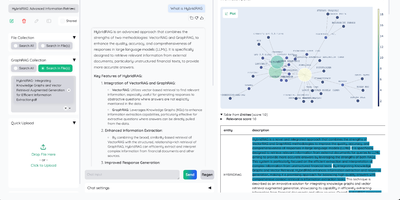
Kotaemon is a document QA platform that combines advanced RAG techniques with a clean Gradio-based web interface for chatting with your documents. Built by Cinnamon, the Python backend supports any LLM provider including OpenAI, Azure OpenAI, Cohere, Groq, and local models via Ollama and llama-cpp-python, with a model management panel for configuring LLM and embedding providers from the UI. The default hybrid RAG pipeline combines full-text keyword retrieval with vector similarity search and applies re-ranking to ensure optimal result quality, while multi-modal document parsing extracts content from tables and figures alongside text. Advanced citations link every answer to specific source passages with relevance scores, viewable directly in the built-in PDF viewer with highlighted text spans. GraphRAG indexing via NanoGraphRAG, LightRAG, or Microsoft GraphRAG builds knowledge graphs from document collections for relationship-aware retrieval. Agent-based reasoning supports question decomposition for multi-hop queries using ReAct and ReWOO strategies. Multi-user authentication organizes documents into private and public collections with sharing and collaboration features. The platform supports Docker deployment in lite, full, and Ollama-bundled variants, runs on port 7860, and stores application data in a persistent volume. MCP tool integration enables external system connections for extended retrieval capabilities. On RepoCloud, deploy Kotaemon on a dedicated VPS with Docker, root SSH access, and complete control over your document AI infrastructure, all under the Apache 2.0 license.
FalkorDB
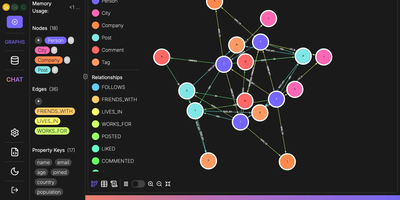
FalkorDB is the first queryable property graph database to leverage sparse adjacency matrices and linear algebra for graph traversal, replacing traditional pointer-chasing with GraphBLAS-accelerated computation. Originally the RedisGraph engine, it was relaunched as FalkorDB in 2023 and rewritten from C to Rust in 2026 for improved memory safety and performance. The database supports the OpenCypher query language with proprietary extensions, translating queries into linear algebra expressions that exploit AVX hardware acceleration. Indexing options include full-text search, vector similarity for embedding-based retrieval, and range indexing, while connectivity supports both the RESP protocol for Redis clients and the Bolt protocol for Neo4j-compatible tooling. The GraphRAG SDK enables ingestion of documents in text, PDF, and Markdown formats into knowledge graphs, with schema-guided entity extraction, hybrid retrieval combining vector and graph traversal, relationship expansion, and cited answers for LLM applications. Official client libraries cover Python, Node.js, Java, Rust, Go, PHP, and C#. Multi-tenant support handles over 10,000 concurrent graphs with zero overhead and full isolation. Docker deployment runs the falkordb/falkordb image on ports 6379 for the database server and 3000 for the built-in browser UI, with persistent volume storage and optional authentication. A production falkordb-server image excludes the browser for lighter deployments. On RepoCloud, deploy FalkorDB on a dedicated VPS with root SSH access, persistent storage for your graph data, and complete control over authentication, thread count, and memory configuration, all under the SSPLv1 license.
LLMVault
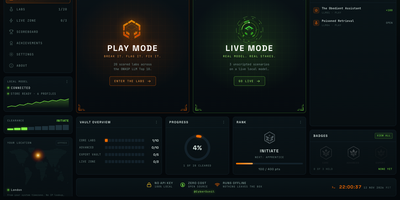
A hacking gym for AI apps: every lab is a chatbot or agent with a planted weakness, and your job is to exploit it and capture the flag. The dashboard tracks score, rank, badges, and a live activity feed across three tiers. Ten core labs map to the OWASP Top 10 for LLM Applications, ten advanced labs need multi-turn tactics like persona escalation, stored injection, and tool chaining, and an encrypted expert tier unlocks last. Each lab opens with a short reference panel on the weakness, offers hints, and ends with the defense that would have stopped you. Play mode uses scripted assistants so flags reproduce every time and the whole range runs offline without API keys. Live mode points attacks at a real local model through Ollama, mints a fresh secret per session, streams replies token by token, and checks the output instead of a flag box. Scenarios cover direct prompt injection, a hidden payload in an uploaded image, and unsafe rendering of model output. A RAG lab accepts text and markdown uploads, so poisoning a knowledge base is hands-on. Two themes, Neon and Phosphor green-CRT, change the look. Security teams run workshops with it, red teamers sharpen prompt injection skills, and developers see why their guardrails fail. Running on a dedicated VPS on RepoCloud with guaranteed CPU, RAM, and SSD, full root SSH access, and a browser serial console. MIT licensed.
KaaS
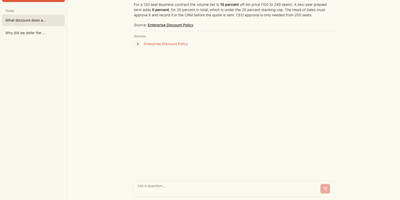
Turn scattered meeting notes, policies, postmortems, and documents into a readable wiki that your team can question in plain language. Paste text, upload a file, or point KaaS at a web page, and an AI pipeline pulls out the concepts, decisions, and people, then writes them up as Markdown articles sorted into decision, reference, guide, and concept folders. Ask a question in chat and the answer cites the exact articles it came from, so anyone can open the source and check it. Each article shows tags, a source count, and a table of contents, and every page is stored as a plain Markdown file you can read, edit by hand, or commit to version control. Adding one new document only recompiles that document, which keeps model costs predictable as the library grows. A Builds page lists every submission with its status and attempts, and a failed worker's job is picked up again instead of lost. Derive a topic knowledge base to carve a focused collection out of the wiki for one subject, and let coding agents query the same wiki through an MCP ask tool. Team handbooks, customer onboarding, incident history, and pricing rules are the knowledge that ends up scattered across a dozen files, and this is where it comes back together. Running on a dedicated VPS on RepoCloud with guaranteed CPU, RAM, and SSD, full root SSH access, and a browser serial console. MIT licensed.
Engraphis
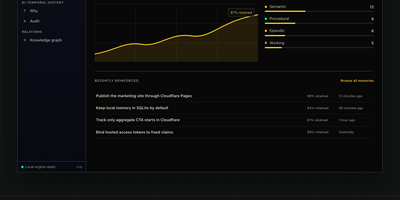
Engraphis is a durable memory layer for coding agents that answers questions like what did we decide about the auth layer three weeks ago, and why, with inspectable project memory that survives across sessions and repositories instead of evaporating when a chat ends. Store a decision once and recall it later in a new session, scoped by workspace, repository, and session so one project's facts never leak into another's context. Recall blends vector, lexical, graph, and code-aware retrieval, then packs the strongest evidence into a hard context budget your agent can actually use. Every returned fact keeps its provenance attached, and the engine cites its support or abstains when the evidence is too weak to trust. Facts are never silently overwritten: bi-temporal history preserves earlier versions, and a timeline view surfaces superseded knowledge when you need to know what used to be true. Index a repository into a code-symbol graph and ask what calls a function before you change it. Conflicting or quarantined memories wait in a review queue for a human decision. Running on a dedicated VPS on RepoCloud with guaranteed CPU, RAM, and SSD, full root SSH access, and a browser serial console. Apache 2.0 licensed.