Apache Airflow
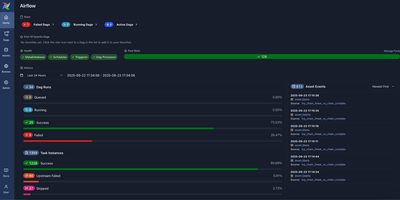
With over 46,000 GitHub stars and one of the largest communities in data engineering, Apache Airflow is the workflow orchestration platform that lets teams define, schedule, and monitor complex data pipelines as Python code through directed acyclic graphs. Airflow 3.x introduced a modernized architecture with a task execution API, the Language Task SDK for writing task implementations in Java and Go alongside Python, asset-based partitioning with FanOutMapper and FixedKeyMapper for data-driven scheduling, a first-class state store for tasks and assets, pluggable retry policies, and a redesigned React-based web UI built on FastAPI. The provider ecosystem ships 80+ packages covering AWS, Google Cloud, Azure, Snowflake, Databricks, Apache Spark, Apache Kafka, PostgreSQL, MySQL, MongoDB, Slack, HTTP, SSH, Docker, Kubernetes, and dozens more, enabling a single deployment to orchestrate jobs across multi-cloud and on-premises infrastructure. The scheduler supports cron expressions, timetable plugins, data-aware scheduling triggered by asset events, and dynamic task generation through Python loops and conditionals. Built-in operators include BashOperator, PythonOperator, DockerOperator, KubernetesPodOperator, and sensor operators that poll external systems. The web UI provides DAG visualization with Gantt charts, grid views, and graph views, task instance logs, SLA monitoring, connection and variable management, and role-based access control. Deployment options include standalone mode, Docker Compose with CeleryExecutor or KubernetesExecutor, Helm charts for Kubernetes, and managed cloud services. Running on a dedicated VPS on RepoCloud with guaranteed CPU, RAM, and SSD, full root SSH access, and a browser serial console. Apache License 2.0 licensed.
Wagtail
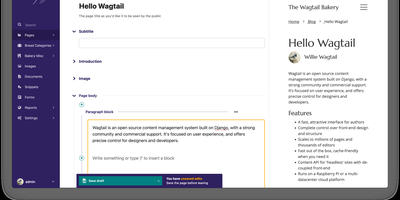
Backed by over 20,000 GitHub stars, 800 contributors, and organizations like Google, NASA, and the NHS, Wagtail is the Django-powered content management system that gives editors creative freedom through StreamField while keeping developers in full control of data structure and front-end rendering. StreamField lets editors compose pages from a custom library of content blocks — rich text, images, embedded videos, tables, code snippets, and developer-defined custom types — without compromising the underlying data model or breaking responsive layouts. The built-in JSON API supports headless deployments with versioned endpoints for pages, images, and documents, enabling decoupled front-ends in Next.js, Nuxt.js, or any framework that consumes REST. Editorial workflows provide configurable approval chains where content moves through draft, review, and publish states with commenting, task assignment, and email notifications built into the admin interface. Integrated search connects to Elasticsearch for full-text indexing with faceted filtering, or falls back to PostgreSQL and SQLite backends with fuzzy matching support added in v7.4. Multi-site management serves multiple domains from a single Wagtail installation with independent page trees, while the internationalization framework handles content translation with locale-aware URL routing. Image management includes focal point detection, responsive renditions, and automatic format conversion. The platform supports Django 5.2 and 6.0 with Python 3.10 through 3.14 and PostgreSQL, MySQL, MariaDB, or SQLite databases. Running on a dedicated VPS on RepoCloud with guaranteed CPU, RAM, and SSD, full root SSH access, and a browser serial console. BSD-3-Clause licensed.
Browser Use WebUI
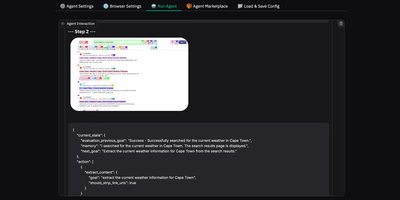
Browser Use Web UI lets you describe a web task in plain English and watch as an AI agent autonomously navigates pages, clicks buttons, fills forms, and extracts information without writing any automation code. Backed by over 16,000 GitHub stars, the Gradio-based interface supports 14+ LLM providers through a unified abstraction layer: OpenAI GPT, Anthropic Claude, Google Gemini, Azure OpenAI, DeepSeek, and local Ollama models are all configurable via dropdown menus without touching code or environment files. The BrowserUseAgent handles interactive single-task automation with step-by-step LLM decision-making and vision-based page understanding, while the DeepResearchAgent orchestrates multi-step research workflows using Langgraph state machines that spawn parallel browser instances with asyncio concurrency control. Custom browser support connects your existing Chrome profile to preserve logins, cookies, and sessions across agent runs, eliminating re-authentication overhead. Persistent browser sessions maintain complete interaction history between tasks for debugging and demonstration. The Docker deployment bundles Chrome, Playwright, and a VNC server in a single container, exposing the Gradio interface on port 7788 and a noVNC viewer on port 6080 for real-time observation of agent behavior. MCP integration via MultiServerMCPClient enables external tool access. Screen recording captures agent workflows as video for review and documentation. Running on a dedicated VPS on RepoCloud with guaranteed CPU, RAM, and SSD, full root SSH access, and a browser serial console. MIT licensed.
Marimo
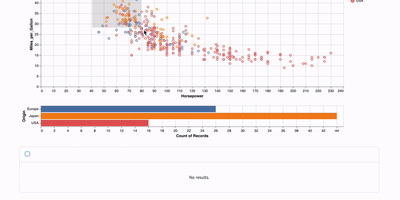
Marimo is a reactive Python notebook that treats cells like spreadsheet formulas: change one cell or interact with a UI widget and every dependent cell automatically re-executes, eliminating the hidden state bugs that make traditional notebooks unreliable. Backed by over 22,000 GitHub stars, notebooks are stored as pure Python files with PEP 723 inline metadata, making them Git-diffable, importable as modules, executable as CLI scripts with parameterized arguments, and testable with PyTest. Built-in SQL cells query Polars, Pandas, PyArrow, DuckDB, SQLite, PostgreSQL, and MySQL databases, with results automatically flowing into the reactive dependency graph. The AI-native editor provides GitHub Copilot autocomplete, context-aware assistants that access live runtime variables, inline code edits powered by configurable models from OpenAI, Anthropic, or local Ollama instances, and a pair mode that lets external AI agents connect over WebSocket. Notebooks become read-only interactive web applications with marimo run, collaborative authoring environments with marimo edit, or embedded flows inside existing FastAPI applications through ASGI middleware. Gallery mode serves multiple notebooks from a single instance with an auto-generated index page. The Docker image ships with SQL support, token-based authentication, health check endpoints at /health and /api/status, and configurable WebSocket or SSE kernel transport for proxy compatibility. Running on a dedicated VPS on RepoCloud with guaranteed CPU, RAM, and SSD, full root SSH access, and a browser serial console. Apache 2.0 licensed.
Forge
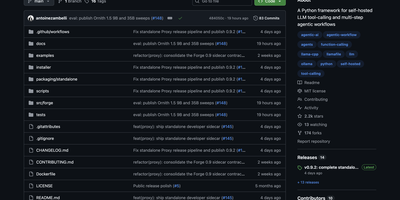
Forge intercepts failing LLM tool calls and fixes them before they derail your agent workflow, applying rescue parsing, retry nudges, response validation, and step enforcement between your AI clients and local model backends. The proxy server mode drops in as a transparent intermediary speaking both the OpenAI chat-completions API and the Anthropic Messages API, so tools like Aider, Claude Code, Continue, and opencode connect through it without configuration changes. Under the hood, the WorkflowRunner provides a complete agentic loop manager with system prompt injection, tool execution, context compaction with configurable thresholds, and VRAM budgeting for consumer GPUs with 12-32 GB. SlotWorker enables priority-queued access to shared inference slots with automatic preemption for multi-agent architectures. The guardrails middleware exposes a two-method check-and-record API that wraps into any existing orchestration loop, providing malformed tool-call rescue parsing, retry nudge generation, required step enforcement, and prerequisite ordering without taking over execution control. Backend adapters support generic OpenAI-compatible endpoints, Ollama, llama-server, Llamafile, vLLM, and Anthropic with automatic model discovery and health checking. Architecture Decision Records document every design choice. Launched February 2026, already at 2,200+ GitHub stars. MIT licensed.
Nanobot
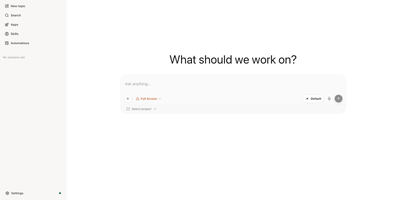
With over 46,000 GitHub stars, nanobot is the ultra-lightweight personal AI agent framework that delivers full agentic capabilities — tools, persistent memory, multi-agent workflows, scheduled automation, and 10+ chat channel integrations — in approximately 4,000 lines of readable Python core code. The agent loop receives messages from any connected channel, builds context from session history and long-term memory files, calls the configured LLM provider, executes requested tools, and publishes replies back to the originating channel. Supported LLM providers include OpenAI, Anthropic, Google Gemini, DeepSeek, Qwen via DashScope, Moonshot/Kimi, Ollama, vLLM for local models, and any OpenAI-compatible API through OpenRouter or LiteLLM. Chat channels connect the agent to Telegram, Discord, Slack, WhatsApp, Feishu/Lark, DingTalk, Email via IMAP/SMTP, QQ, Matrix with end-to-end encryption, Mattermost, and the built-in browser WebUI served from the published Python wheel with no separate frontend build. Built-in tools include filesystem read/write/edit, shell execution with configurable sandboxing via bubblewrap, web search and fetch with SSRF protection, MCP server integration, cron scheduling, image generation, and subagent spawning for parallel task delegation. The Dream memory system consolidates session history into persistent markdown files for long-term context retention across conversations. Deployment runs as a CLI agent, a persistent gateway server, a Docker container with Docker Compose, or an OpenAI-compatible API server. Running on a dedicated VPS on RepoCloud with guaranteed CPU, RAM, and SSD, full root SSH access, and a browser serial console. MIT licensed.
Frappe
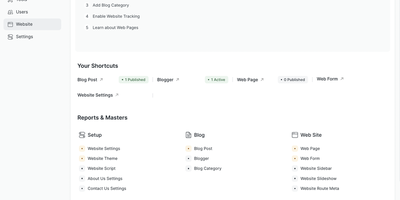
Define a DocType in Frappe and the framework automatically generates database tables, Python ORM classes, REST API endpoints, form views, list views, and role-based permission rules from that single schema definition. The meta-driven architecture stores schemas as database records, letting administrators add fields, reorder layouts, and modify validation rules through the browser-based Form Builder without redeployment. Server-side Python controllers handle business logic through hook-based lifecycle events while client-side JavaScript manages interactive form behavior, with WebSocket connections providing real-time updates across sessions. The built-in workflow engine defines document state machines with role-gated transitions, email notifications, and conditional action visibility. Pre-configured Desk views include list, form, report, tree, kanban, calendar, and dashboard layouts with drag-and-drop workspace customization. The report builder generates grid reports with configurable columns, filters, grouping, and chart visualizations from DocType data or custom SQL and Python scripts. Background job processing uses Redis queues for email delivery, data imports, and periodic tasks. Virtual DocTypes connect external databases to the framework's UI without data migration. Docker deployment via frappe_docker provides production-ready Compose configurations with MariaDB, Redis, Nginx, and worker containers. The foundation powering ERPNext, HRMS, CRM, and Helpdesk in production. Over 10,500 GitHub stars. MIT licensed.
OpenBB
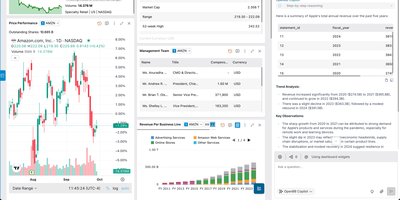
OpenBB stands as the world's most popular open-source finance repository — an Open Data Platform that evolved from a pandemic-era Reddit post into a full-blown infrastructure layer challenging Bloomberg's $25 billion empire. The "connect once, consume everywhere" architecture consolidates proprietary, licensed, and public financial data sources into multiple consumption surfaces simultaneously: Python environments for quants building models, OpenBB Workspace and Excel for analysts creating dashboards, MCP servers for AI agents performing automated research, and REST APIs for custom applications. The modular extension system supports dozens of data providers including Yahoo Finance, Alpha Vantage, FRED, Intrinio, Polygon, and Tradier with standardized schemas that normalize responses across vendors. The CLI offers a terminal-style interactive interface with autocomplete, parameter hints, and chart rendering for rapid data exploration. Provider routing handles authentication, rate limiting, and response normalization transparently so switching between free and premium data sources requires changing a single parameter. The platform covers equities, options, fixed income, crypto, forex, ETFs, mutual funds, economics, technical analysis, quantitative analysis, and alternative data across global markets. AI agent integration exposes every data endpoint as tool-callable functions with schema discovery enabling LLMs to query financial data programmatically. Install via pip with Python 3.9+ and deploy the REST API server for team access. Running on a dedicated VPS on RepoCloud with guaranteed CPU, RAM, and SSD, full root SSH access, and a browser serial console. AGPL-3.0 licensed.
Kokoro FastAPI
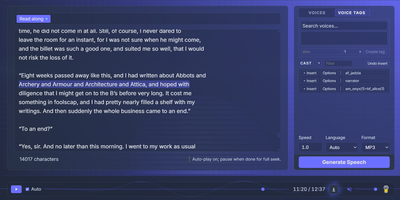
Kokoro-FastAPI turns text into natural-sounding speech across eight languages by serving the 82-million-parameter Kokoro-82M model through an OpenAI-compatible REST API, so any existing OpenAI SDK client can generate audio by just changing the base URL. With over 5,300 GitHub stars since December 2024, the fully Dockerized FastAPI server covers American English, British English, Spanish, French, Hindi, Italian, Japanese, Brazilian Portuguese, and Mandarin Chinese with language-specific phoneme processing. Inline voice mixing blends multiple profiles using weighted ratios like af_bella(2)+af_heart(1), automatically normalizing weights and caching combined voicepacks as PyTorch tensor files for reuse. Audio streams in real time over HTTP with configurable chunk sizes, or generates complete files in MP3, WAV, OPUS, FLAC, AAC, or PCM formats with speed control from 0.25x to 4.0x. Per-word timestamped captions with speaker-tagged voice labels enable subtitle generation for podcasts, audiobooks, and accessibility workflows. Pre-built Docker images support NVIDIA GPU acceleration via CUDA, experimental AMD GPU inference via ROCm, and CPU-only deployment on linux/amd64 and linux/arm64 architectures, with Apple Silicon MPS support available through direct UV execution. The integrated web interface at port 8880 provides browser-based speech generation, while the Swagger UI at /docs exposes the full API reference. Debug endpoints report system statistics for monitoring inference load. Running on a dedicated VPS on RepoCloud with guaranteed CPU, RAM, and SSD, full root SSH access, and a browser serial console. Apache 2.0 licensed.
Prefect
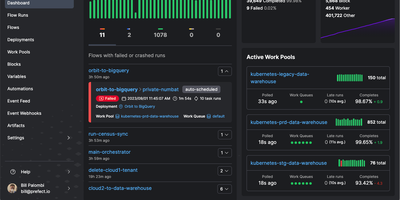
With 23,600 GitHub stars, 13 million monthly PyPI downloads, and 425+ contributors automating over 200 million data tasks monthly for Fortune 50 companies like Progressive Insurance and disruptors like Cash App, Prefect is the most widely deployed open-source workflow orchestration framework for Python — turning any script into a resilient production pipeline with a single @flow decorator while eliminating rigid DAG structures entirely. The durable execution engine persists task results and automatically resumes from failures without replaying expensive upstream work, guaranteeing exactly-once execution for any Python function. Event-driven automation triggers workflows from webhooks, cloud events, or state changes through a real-time event bus that detects what happens or fails to happen across your entire data platform. Work pools decouple workflow code from infrastructure, enabling seamless switching between Docker, Kubernetes, AWS ECS, Azure Container Instances, GCP Cloud Run, and serverless environments without modifying pipeline logic. Native Ray and Dask task runners extend execution across clusters for compute-intensive workloads. The self-hosted server provides a monitoring dashboard with flow run timelines, task state visualization, scheduling, and automation configuration. The third-generation engine reduces overhead by over 90 percent compared to Prefect 2, supporting batch, event-driven, interactive, and background task workflows. Deploy via Docker Compose with PostgreSQL, Redis, server, background services, and worker containers, or use official Helm charts for production Kubernetes. Running on a dedicated VPS on RepoCloud with guaranteed CPU, RAM, and SSD, full root SSH access, and a browser serial console. Apache-2.0 licensed.

Flagsmith
With over 6,400 GitHub stars, 130 contributors, and 512 releases, Flagsmith is the open-source feature flag and remote configuration platform that gives development teams granular control over feature releases, remote configuration values, user segmentation, and A/B testing from a single self-hosted dashboard. Feature flags support boolean toggles and remote config values simultaneously — every flag carries both an enabled state and a configurable value, letting teams deploy functional and visual changes without code modifications or app store approvals. User segments target audiences by attributes, percentage rollouts, and custom rules, enabling beta testing, canary releases, and gradual feature rollouts with real-time toggle control. Multivariate flags split traffic across multiple variations with configurable percentage weights for A/B and multivariate testing with analytics integration. The flag evaluation engine runs server-side with local evaluation mode in SDKs for sub-millisecond performance without network calls, supporting 15+ languages including TypeScript, Python, Java, C#/.NET, Go, Ruby, PHP, Swift, Kotlin, Flutter, React, and Next.js. The REST API and webhooks enable integration with CI/CD pipelines, and pre-built connectors exist for Datadog, New Relic, Amplitude, Mixpanel, Segment, Heap, Rudderstack, and Slack. Built on Django with a React frontend, self-hosting deploys via Docker Compose with PostgreSQL, or via Helm charts and the OpenShift Operator for Kubernetes environments. Change history provides a complete audit trail of flag modifications. Running on a dedicated VPS on RepoCloud with guaranteed CPU, RAM, and SSD, full root SSH access, and a browser serial console. BSD-3-Clause licensed.
Frappe Helpdesk
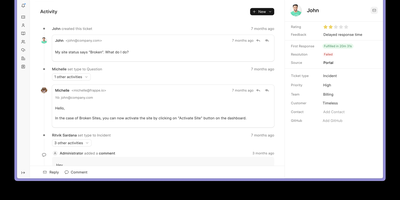
With over 3,200 GitHub stars, 900 forks, and backing from the team behind ERPNext, Frappe Helpdesk delivers a modern, streamlined alternative to Zendesk and Freshdesk with unlimited agents, no per-seat pricing, and full source code access under the AGPL-3.0 license. Built on the Frappe Framework with a Python backend and Vue 3 frontend using Frappe UI, the application collects customer inquiries from email, web forms, and the customer portal into a centralized ticketing queue with complete conversation history and threaded replies. Customizable SLA rules define response and resolution timelines by ticket type or team, triggering automatic alerts and escalations when deadlines approach or are missed. Assignment rules route incoming tickets to the appropriate agents based on priority, issue type, or workload balancing, while manual reassignment and transfer between teams remains available at any time. The customer self-service portal lets users submit tickets, track status, and search a knowledge base of published help articles that reduce repetitive support requests. Agents access saved reply templates for consistent, rapid responses to common queries. Custom fields, configurable workflows, and saved views adapt the interface to match each organization's support process. Real-time updates via WebSocket push ticket changes instantly to all connected agents. The PWA-compatible interface provides mobile access without a native app. Frappe Framework compatibility spans versions 15 and 16. Running on a dedicated VPS on RepoCloud with guaranteed CPU, RAM, and SSD, full root SSH access, and a browser serial console. AGPL-3.0 licensed.