RuoYi-Vue-Pro
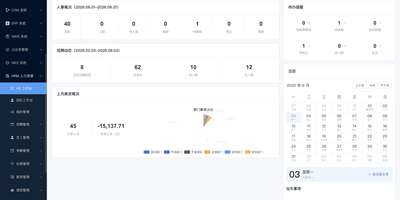
One admin platform can cover the back office of a whole company, from approvals and inventory to customers, projects, and devices. RuoYi-Vue-Pro, also called Yudao, wraps a long list of business modules around a shared system core, so teams switch on only the pieces they need. The core handles tenants, tenant packages, menus, roles, departments, SMS and email channels, audit logs, and OAuth2 single sign-on for connected apps. A workflow module offers a BPMN designer and a simplified DingTalk and Feishu style designer for approval flows. Business modules add ERP, WMS inbound and outbound documents, CRM, MES production dashboards, an HR workbench, finance vouchers, project work items, and an OA workspace with attendance, notices, and notes. More modules cover a shop and member center, payments, WeChat official accounts, AI model chat, IoT product and device management, and instant messaging with groups, shared cards, and voice calls. A code generator turns database tables into CRUD pages and back-end code, and file storage can point to local disk or S3-compatible services. Public demo sites allow a full click-through before installing anything. Running on a dedicated VPS on RepoCloud with guaranteed CPU, RAM, and SSD, full root SSH access, and a browser serial console. MIT licensed.
Orchard Core
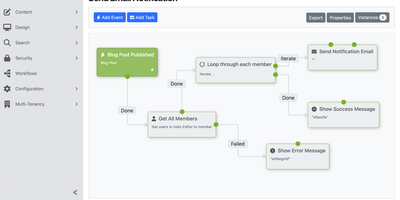
Content types, media libraries, workflows, roles, search, and a GraphQL API all ship in the box with Orchard Core, a free CMS and application framework that hosts many separate websites from one install. Editors build content types in the admin by combining parts and fields, with no migrations to write, and preview an item live before publishing it. Designers adjust page HTML safely with Liquid templates, and developers add their own modules. Multi-tenancy runs many isolated sites from one deployment, each with its own content, users, settings, and theme, and a setup screen lets you pick a recipe and database for each site. Media uploads can be resized on the fly and stored on remote providers, and a visual workflow editor automates content approvals, webhooks, and form submissions. A typed GraphQL API feeds headless sites and single-page applications, and custom SQL or Lucene queries can be exposed as endpoints. Roles and fine-grained permissions decide who can do what, OpenID Connect handles external sign-in, and two-factor authentication protects accounts. Content and the admin interface can be localized, and deployment plans move content and configuration from staging to production. SQLite works out of the box, SQL Server, MySQL, MariaDB, or PostgreSQL can be chosen at setup, and the official Docker image starts a site with one command. Running on a dedicated VPS on RepoCloud with guaranteed CPU, RAM, and SSD, full root SSH access, and a browser serial console. BSD-3-Clause licensed.
CliRelay
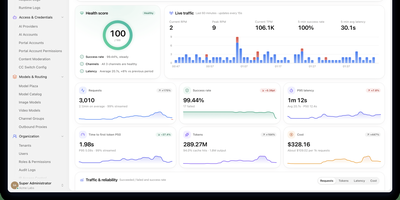
Anyone who pays for Claude Code, Codex, and Gemini CLI separately ends up juggling three endpoints, three sets of keys, and three kinds of rate-limit surprise, and CliRelay collapses all of that into one self-hosted gateway with a control panel. Clients speak the OpenAI Chat or Responses, Anthropic Messages, or Gemini protocol, and CliRelay translates each request for whichever upstream account is healthy. Channel groups limit where each key may send traffic, round-robin, fill-first, and session-sticky scheduling spread it, and cooldowns with automatic failover move requests off accounts that have run out of quota. Add upstreams from the /manage console through browser sign-in, device codes, or bulk credential import, covering Claude, Codex, Gemini, Antigravity, Vertex AI, AWS Bedrock, Grok, Qwen, Kimi, and any OpenAI-compatible service. Portal accounts own client keys with daily, period, and lifetime quotas, RPM and TPM limits, and per-model pricing. A monitor center scores health and charts live traffic, P50 to P99 latency, and time to first token, while every request lands in a searchable log with tokens, latency, and cost. Tenants, roles with resource.action permissions, content moderation profiles, an outbound proxy pool, and an audit trail make shared deployments workable, and the console speaks English, Simplified Chinese, and Russian. Running on a dedicated VPS on RepoCloud with guaranteed CPU, RAM, and SSD, full root SSH access, and a browser serial console. MIT licensed.
Yuxi
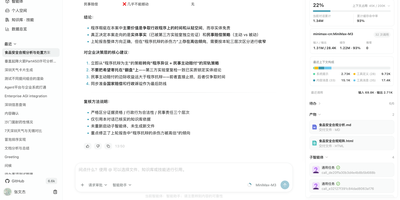
Navigating organizational knowledge, visualizing concept graphs, and orchestrating cooperative AI agents converge inside Yuxi, an open-source multi-tenant workspace built for enterprise research and deep archive exploration. Users can upload diverse business documents including scanned PDFs, spreadsheets, and slide presentations to automatically extract structured text blocks, tables, and entity relationships for semantic querying. Knowledge teams can inspect interactive topological graph views to explore connections between company entities, cross-referencing subgraphs against original file sources. Practitioners can configure autonomous agents with specialized subagents, assigning dedicated roles for concurrent research, deep data synthesis, and code execution. Human reviewers can inspect agent thought chains in real time and evaluate interactive confirmation cards before agents execute irreversible external actions or modify shared workspace files. Operators can execute sandboxed tasks that produce downloadable reports, interactive data charts, and rendered HTML pages stored within isolated workspace file systems. Administrators can govern model endpoints, set granular permission boundaries across departments, and monitor token consumption through live system analytics. Running on a dedicated VPS on RepoCloud with guaranteed CPU, RAM, and SSD, full root SSH access, and a browser serial console. MIT licensed.
Platypus
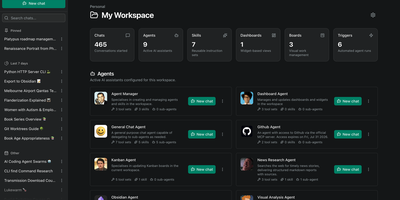
Platypus gives a whole team always-on AI agents that reason, call tools, and keep working on your own servers while everyone is offline. Build an agent once by choosing a provider and model, writing its instructions, and capping its tool-calling loop, then reuse that preset across chats and scheduled runs. Agents load reusable Skills on demand and delegate specialist work to sub-agents that appear to the parent as tools. Connect local and remote data through Model Context Protocol servers, or expose an agent to outside agents and chat platforms through A2A endpoints with a token per client. Triggers run agents on a cron schedule, as one-off jobs, or when workspace events such as a card moving on a board occur, and every run records its result. Kanban boards give agents work they can move and update themselves, while notifications and HMAC-signed webhooks push board and workspace events into your own systems with filtering and retries. Facts and preferences are extracted from conversations in the background and injected into future chats, so returning users are remembered. Sandbox backends give agents shell and filesystem access inside an isolated per-workspace environment instead of the host. Organizations and workspaces keep each team's agents and data separate, and blueprints package shared agents, skills, MCP servers, and providers so a new workspace starts pre-equipped. Running on a dedicated VPS on RepoCloud with guaranteed CPU, RAM, and SSD, full root SSH access, and a browser serial console. MIT licensed.
Magistrala
Thousands of devices speaking four different protocols is where IoT projects usually dissolve into glue code; Magistrala replaces that tangle with one platform where MQTT, HTTP, WebSocket, and CoAP clients share a single identity, provisioning, and messaging model. You organise work into domains, register clients for devices and applications, and connect them to channels that control who publishes and who subscribes, with fine-grained policies deciding which client may touch which channel. Protocol adapters bridge the transports, so a sensor publishing over MQTT and a dashboard reading over WebSocket meet in the same channel without translators in between. Telemetry lands in TimescaleDB through dedicated writer services and comes back out through reader APIs, while the bundled three-node FluxMQ cluster carries the messaging load with mutual TLS on device connections. The rules engine reacts to incoming messages with conditions and actions, alarms flag the readings that breach them, and reports package fleet data for the people who never open a terminal. A Community web UI covers domains, clients, channels, messages, and rules for day-to-day operation, and everything deploys as one Docker Compose stack with Prometheus metrics and Jaeger tracing already wired in. Running on a dedicated VPS on RepoCloud with guaranteed CPU, RAM, and SSD, full root SSH access, and a browser serial console. Apache-2.0 licensed.